How much does a conveyor sortation system cost? I get asked this question almost every month.
Last month an e-commerce owner called me: "Da, give me a straight number — how much does a conveyor sortation system cost?"
"That's like asking how much a car costs," I said. "Two grand gets you wheels. Two million gets you wheels too. I can't give you one number, but I can tell you exactly which tier you belong in."
"We do 12,000 orders a day."
"Then close that cross-belt quote right now," I told him. "At 12,000 a day you haven't even reached the threshold for basic automated sortation. Talking fully automated is a pseudo-need."
Bottom line up front: how much does a conveyor sortation system cost? Between $150K and $10M — a 60x spread. And which tier you should buy has nothing to do with your budget. It's all about volume. This article lays out five price tiers, the selection dividing lines, and the maintenance traps, all in one place.
First, the principle: a sorter does exactly one thing
Don't let "intelligent sortation" and "flexible sortation" fool you. Tear any conveyor sortation system apart and you get three stages: induction, identification, execution.
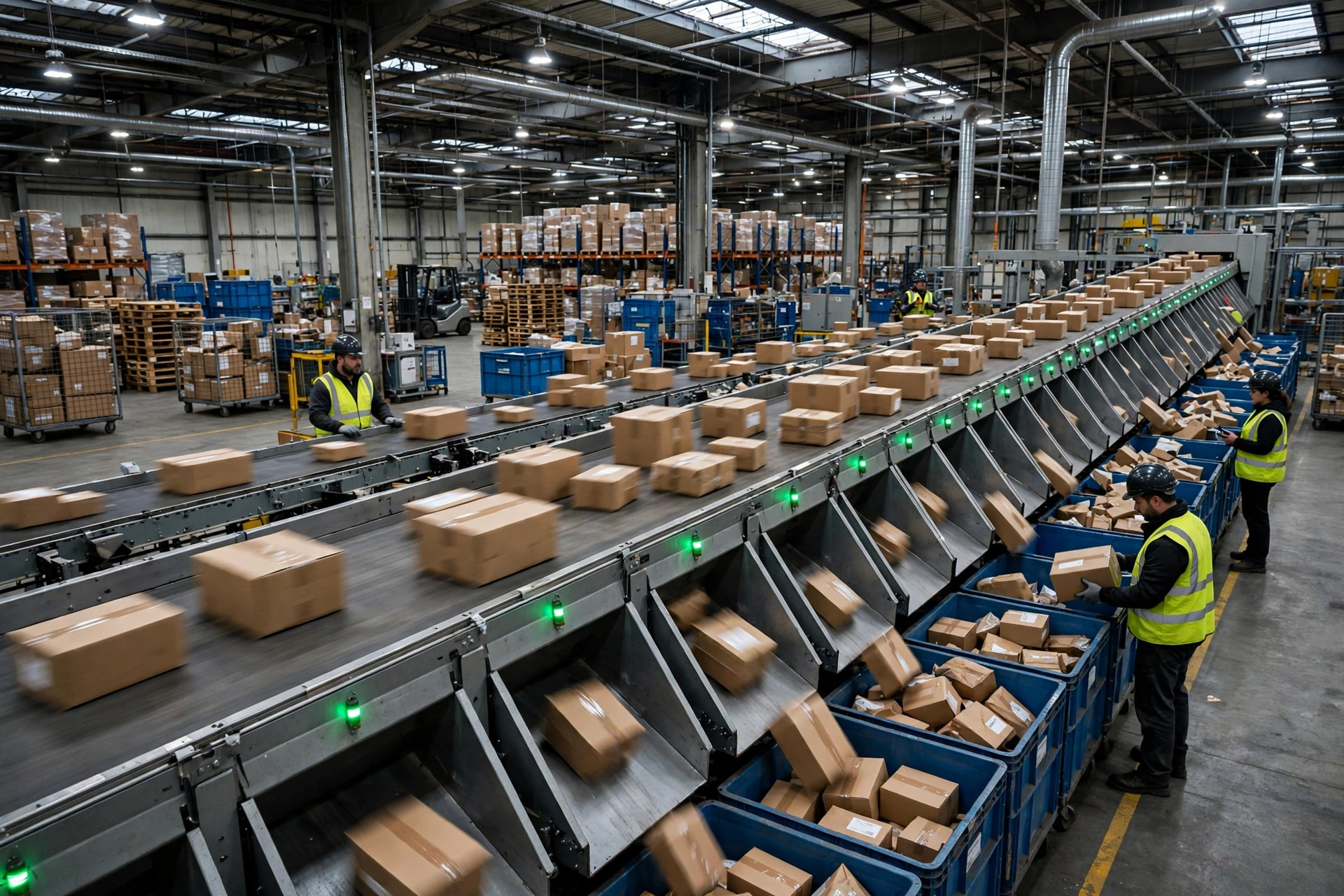
Think of it as a highway: the induction station is the toll booth, metering parcels onto the main line one by one; the scan tunnel is the license-plate camera, reading the label, weighing and cubing in a fraction of a second; the chutes are the off-ramps — the system decides "this parcel takes exit 3" and kicks it off at exactly the right spot.
It's like the pass in a restaurant kitchen — the cooks (induction) load dishes onto the belt, the runners (the divert mechanisms) only care about table numbers (the chutes). Right table, no spills, as fast as possible. All the engineering in a sorter compresses into six words: read it right, divert it fast.
A few numbers so you can feel it. A typical cross-belt line runs 2–2.5 meters per second. For reference, that's about a quarter of a world-class sprinter's average speed — except the sorter never gets tired. Integrators love writing "99.5% uptime" in proposals. Translated: 43 hours of downtime a year. Run two shifts, 16 hours a day in peak season, and that's nearly three working days — three days of parcels going nowhere while carrier cutoff times don't wait. Most buyers never do this math before signing.
Where the money goes: five tiers of conveyor sortation system cost
Straight to the table. These are order-of-magnitude figures from public industry sources — integrators vary wildly, so treat them as ranges and get a current quote:
| Tier | What it looks like | Price range | Who it's for |
|---|---|---|---|
| Budget loop | Batch picking + simple loop line + manual sort-to-light | $250K–$350K | A few thousand orders/day, the most down-to-earth semi-auto |
| Entry modular | Small wheel/slider sorter, modular build | $150K–$300K | Small DCs tasting automation |
| Basic automated | Cross-belt or narrow-belt slider, ~20K pieces/shift | $750K–$1.5M | The watershed above ~15K orders/day |
| Mid-range | ~40K pieces/shift, multiple inductions | $2M–$4M | Regional parcel hubs |
| High-end | ~60K pieces/shift, auto-induction + vision | $6M–$10M | Courier hub territory |
See the twist? The "budget" option costs more than the entry modular tier — because it's really "cheap hardware plus labor" stitched together: loop line, scanning, chutes, people. Not a single step of integration work is spared.
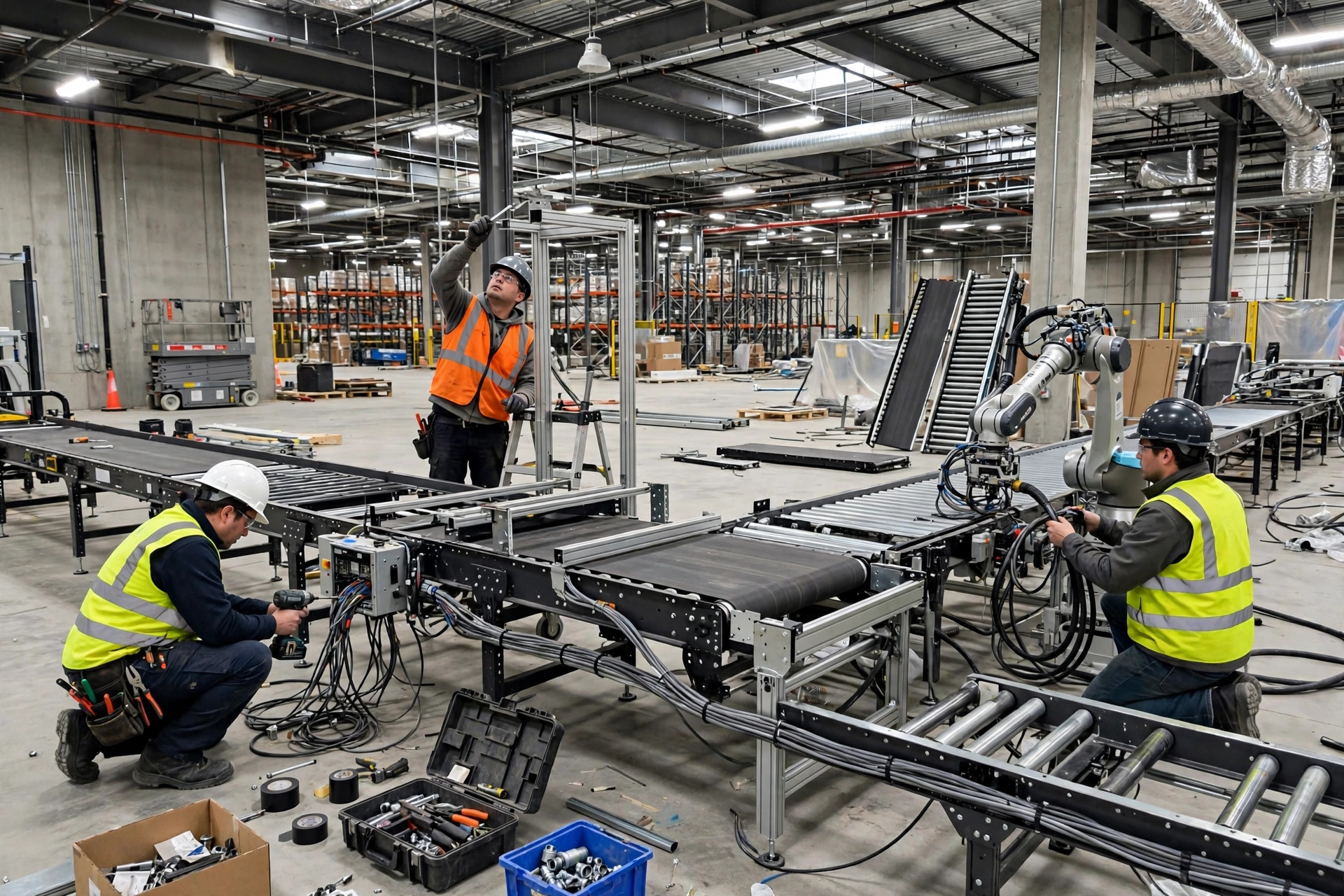
And where does the money go? From my integrator years: hardware is typically sixty to seventy percent. The rest is integration, software interfacing, and civil works. Retrofitting a sorter into an old building — floor loading, sprinkler relocation, power upgrades — routinely eats another ten to twenty percent of the budget. Remember: the equipment quote is the down payment; civil works and integration are the balance.
Payback? Public industry figures: roughly 3–4 years for enterprise-grade projects, 4–6 years for mid-range. Anything promising under 3 years either has enormous volume, brutally expensive labor, or — a padded quote.
Conveyor sortation system selection: three dividing lines
This is the part I most want to talk about, and the part sales reps least want you to read.
Line one: 3,000 orders a day. Below that, stop looking at sorters. Put walls plus manual sort, and spend the money on slotting and wave strategy — it'll beat any sorter. The pseudo-need I shoot down most often: "We do 2,000 orders a day and want automated sortation for efficiency." Friend, you don't lack a sorter. You lack orders. Without volume, automation is an expensive toy.
Line two: order profile. If multi-piece orders are over half your mix, sorter efficiency gets cut in half. Think of it this way: sorters are brilliant at "one order, one piece" (apparel, beauty, general merchandise) and clumsy at "one order, ten pieces" (auto parts, industrial, home goods) — big cartons jam the chutes and nothing recirculates.
In 2023, a home-goods e-commerce DC in Fontana, California, doing 15,000 orders a day, installed a $1.5M-class modular cross-belt — top of the basic tier. The first peak season exposed it: 40% of orders were multi-piece combos, big cartons blocked the chutes while small parcels queued behind. Real throughput: 11,000 pieces per shift. When the owner asked me to review it, I said chute count should be sized to the order profile, not maximized — with that mix, a budget loop plus two manual QC stations would have saved them a million dollars.
Line three: 60% utilization. Here's the counterintuitive one — a sortation line chronically running under 60% of rated capacity loses to manual labor. In 2024, an auto-parts distributor in Dallas doing 8,000 orders a day got talked into a 20K-pieces-per-shift cross-belt, around $1.2M. It ran at 30% capacity. Three years later the math was brutal: the labor savings didn't even cover maintenance and electricity. Sales sells you "capacity." You should be buying "utilization." A big horse pulling a small cart still eats like a big horse.
After go-live: three maintenance traps
Trap one: downtime costs more than you think. 99.5% uptime sounds great until you translate it: 43 hours a year. At 16-hour double shifts in peak, that's nearly three working days of backlog while carrier cutoffs don't move. Anyone willing to write 99.9% in the contract charges accordingly — reliability is bought, not tuned.
Trap two: spares. Cross-belt carrier slats, sorter divert wheels — all wear parts. No matter how pretty the MTBF number looks, it won't survive 24/7 operation without attention. No local spares on the shelf means a two-week air-freight wait when one fails, and the line sits dead for two weeks. My client checklist always has one line item: first spares purchase, budgeted separately.
Trap three: nobody works the night shift. The best maintenance window for a sorter is 2–5 AM, but most DCs won't staff a night technician, so small issues compound into big stoppages. Equipment is finicky: skip lubrication once and you can halve the MTBF. Whatever attitude you show it, that's the uptime it gives back. Simple as that.
Whether the money is worth it comes down to one number: cost per piece sorted.
The formula: (total system price + 5 years of maintenance) ÷ total pieces over 5 years. Take a $1.5M system running 25 million pieces over 5 years — that's a bit over 6 cents a piece. You know your current manual cost per piece. If the number lands under 70% of it, buy with confidence. If it's above manual cost, don't talk automation — talk management.
Remember: a sorter never replaces "labor." It replaces inefficient labor. Draw the three dividing lines — volume, order profile, utilization — and the numbers in the price table start to mean something.
By Da Liu, Automation Engineer