Conclusion first: when a high-volume warehouse sorting wall can't keep up, the problem is usually not too few compartments. It's a wave that's too big. Split a 2,000-order wave into four 500-order waves and peak throughput goes up, not down — and a stockout only blocks a small slice instead of the whole wall. I've seen this exact failure three times. Three times, same cause of death: the wave kept getting bigger, the wall kept getting slower, and the whole shift ended up waiting on a handful of short orders.
Why Big Waves Slow a High-Volume Warehouse Sorting Wall Down
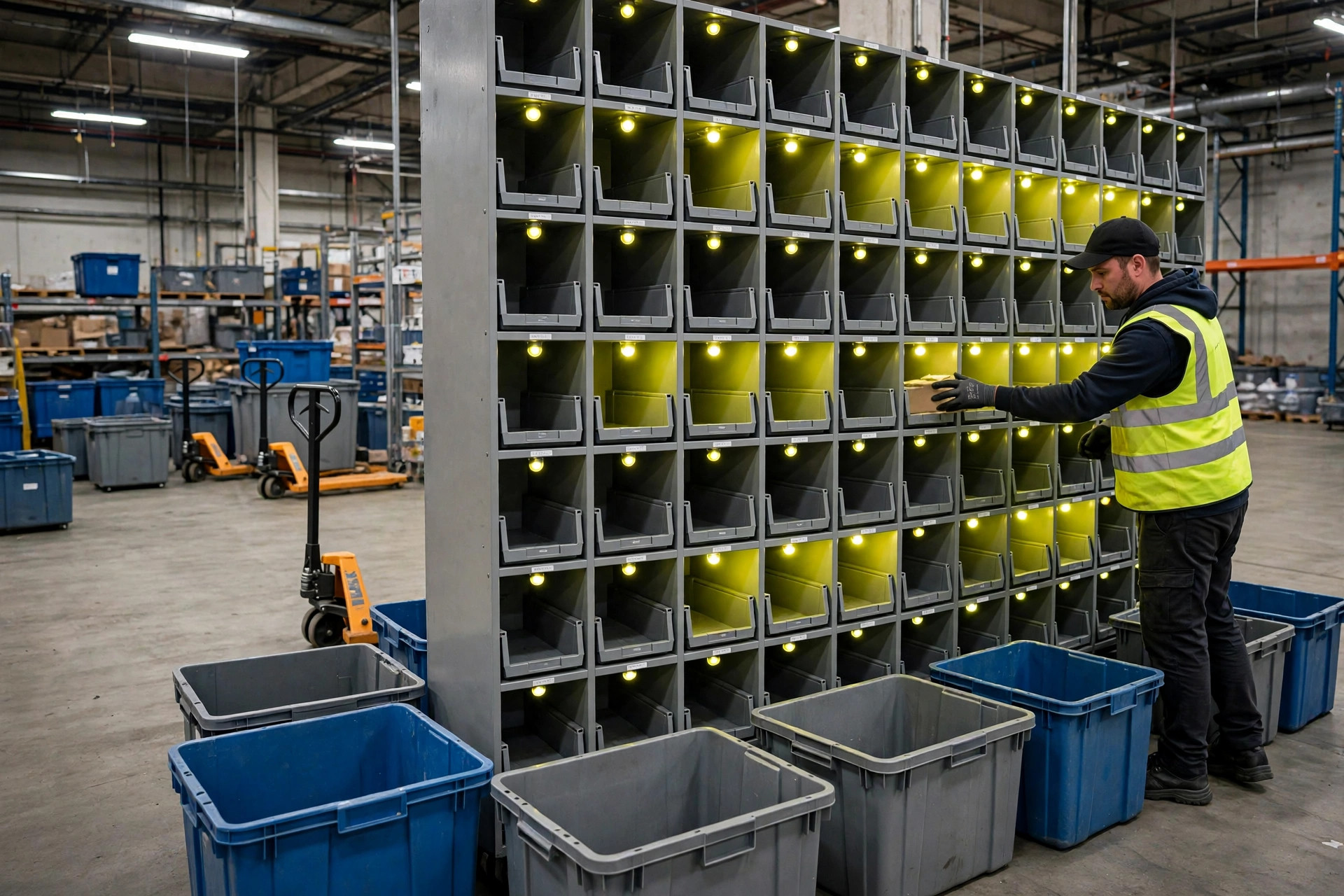
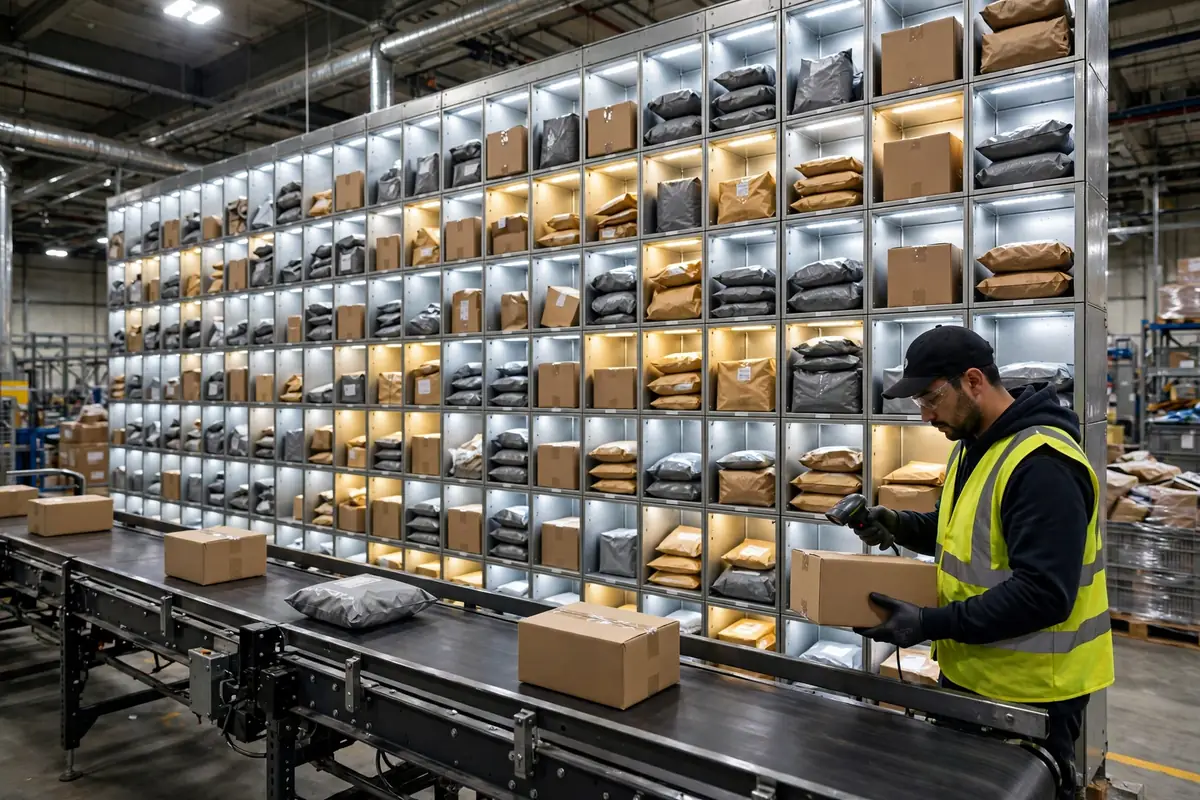
The mechanics are simple. A wave on a sorting wall is a batch of orders loaded onto the wall at the same time; pickers throw items into the matching compartments. If a few orders in the wave are short, the wave can't clear — the compartments stay occupied, the next wave can't start, and everyone waits while someone hunts for those missing items in the warehouse. There is a well-known rule of thumb in the industry: in a conventional wave of 2,000 items, missing just five items can stall the entire wave. That's not an exaggeration. It's a structural flaw of the wave model: the bigger the wave, the longer the tail, and the longer the tail, the lower the wall's utilization.
Big waves carry a second cost: changeover. The bigger the wave, the more orders a picker has to hold in their head, and the higher the mis-sort rate. Clearing the wall means waiting for the last order, so people who finished early stand around idle. On paper, big waves mean fewer changeovers. In practice, every changeover gets more expensive and more chaotic. Peak season multiplies all of this: orders flood in, waves get bigger, the wall jams harder, and throughput falls instead of rising.
Here's the counterintuitive part: the peak bottleneck on a sorting wall is rarely the number of compartments. It's the wave size. Adding compartments is adding hardware. Splitting waves is changing the rhythm — and with the right rhythm, the same wall can push 20% to 30% more orders (illustrative figure, depending on short rate and order profile). Plenty of warehouses keep adding compartments and headcount and refuse to touch the wave size. That's like swapping in a fatter pipe when the real problem is a clog.
Put the trade-off side by side and it's clearer (illustrative figures):
| | Big wave (2,000 orders) | Small wave (500 orders) | | Short impact | Whole wave stalls, waiting compartments stay occupied | Only a small wave stalls; the rest keeps turning | | Clearing | Wait for the last order; everyone idle | Release the next wave at 80% clear | | Changeover | Fewer, but each one costly and chaotic | More frequent, but each one light | | Best for | Steady volume, low short rate | Peak days, high short rate |
I saw this in a Black Friday case in 2023: an e-commerce warehouse in New Jersey raised its wave size from 800 to 2,000 orders ahead of peak, figuring a bigger wave meant more output per wave. On Black Friday, once the short rate climbed, more than 300 compartments sat permanently occupied by orders waiting on stock, pickers routed around them, and two waves were still uncleared at shift end (illustrative scenario). The next year they did the opposite — waves split down to 500 orders — and a short only blocked a small wave while the wall kept turning.
Splitting the High-Volume Warehouse Sorting Wall Wave in Four Steps
Splitting a wave isn't just typing a smaller number into the WMS. Follow these four steps; each one is executable.
Step one: measure compartment occupancy. Pull last week's occupancy per wave and look at how many compartments were held by "waiting on stock" orders during peak. If waiting compartments run above 15% for sustained periods, the wave is already too big. Fix that before anything else. The number comes straight out of the WMS — no guessing.
Step two: cut waves by cutoff time, not by order count. Set a fixed cutoff — say, every hour — and whatever orders arrive by the cutoff form one small wave. Cutoff times stay fixed while wave size breathes with volume: many small waves at peak, fewer bigger ones when it's quiet. The rhythm regulates itself.
Step three: isolate shorts immediately. The moment an order in a wave goes short, pull it out of the wave and send it to an exception area for separate handling. Don't let it sit in a compartment waiting. Compartments are the most expensive resource on a sorting wall, and a waiting order has no right to occupy one. This needs WMS support for removing orders from a live wave — confirm it works before peak, not during it.
Step four: release the next wave at 80% clear. Don't wait for 100%. Start loading the next wave when the current one is 80% cleared, so loading and clearing overlap and the wall never sits idle waiting on the last order. This step leans hardest on floor supervision — have someone watch it for the first two weeks, then let it run.
Three Ways Wave-Splitting Fails
First failure: splitting too fine. Below roughly 100 orders per wave, changeovers explode and pickers relearn the compartment layout every wave. The gain evaporates. My working range is 300 to 800 orders per wave; below 300, watch for changeover cost eating the benefit.
Second failure: splitting the wave but not the pick. The wave gets smaller while picking tasks still go out in big-wave batches. Pickers haul a full cart for one big pick while the wall waits on stock — both ends suffer. Wave, pick, and clear have to be split together. Miss one link and the whole thing is wasted.
Third failure: first trying it on peak day. I've seen this three times: someone changes the wave parameter the night before go-live, and peak day collapses. Splitting waves is a process change, not a parameter tweak. Run it at least two weeks early, validate the rhythm against a week of real volume, then go into peak.
In September 2024, a 3PL warehouse in Riverside, California, split its waves from 1,200 orders to 400 the night before a big promotion — and discovered the next morning that picking tasks were still going out in 1,200-order batches. Pickers queued at the wall with full carts while the wall waited on stock until noon (illustrative scenario). The wave split wasn't wrong. The pick wasn't split with it. Wave, pick, and clear have to move together.
Go-Live Night Checklist: 7 Items Before You Split Waves
- Wave parameters changed in the WMS, with cutoffs set hourly
- Short-removal tested — and you know exactly which exception area the pulled orders go to
- Compartment occupancy visible in real time, with someone watching when waiting compartments pass 15%
- Pick tasks split to match the wave — no big picks feeding small waves
- Floor supervisors briefed on the 80%-clear release rule
- A peak-day wave-size cap set, so the system can't auto-merge small waves back into big ones
- A rollback plan: if the rhythm breaks, can you switch back to the old wave size within 10 minutes?
One more thing: a put-to-wall station is only one shape of secondary sortation, and wave-splitting plays out differently across wall types. The guide on secondary sortation with put-to-wall systems covers the main wall types and where each fits — read it against your own setup before you split, and you'll avoid a few wrong turns.
Something you can do tomorrow: split tomorrow's waves in half and run it once, then compare clear times and compartment occupancy. The numbers will tell you whether to keep splitting. Don't wait for peak to find out. Peak won't wait for you.
By Lin Xiao, WMS Implementation Consultant