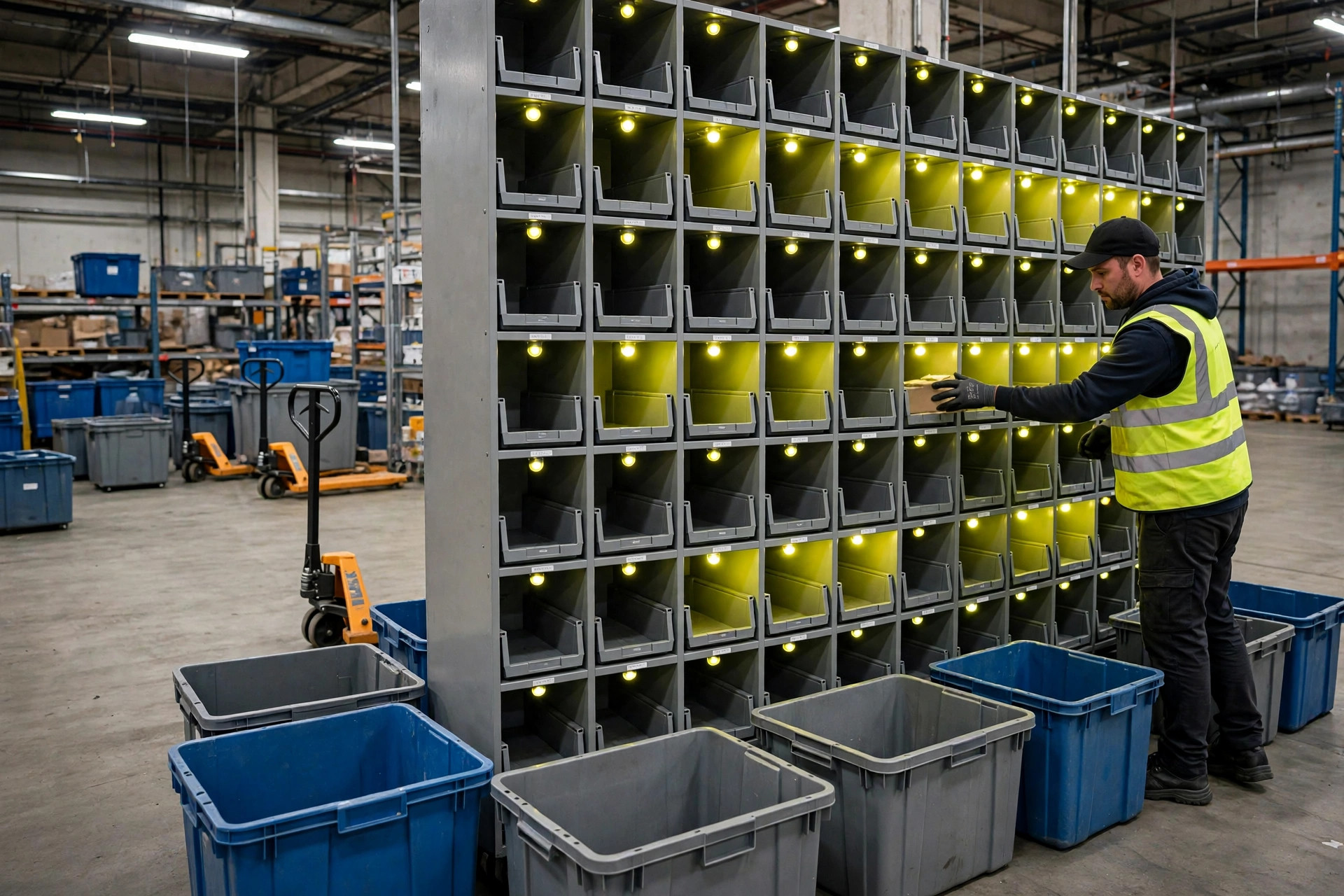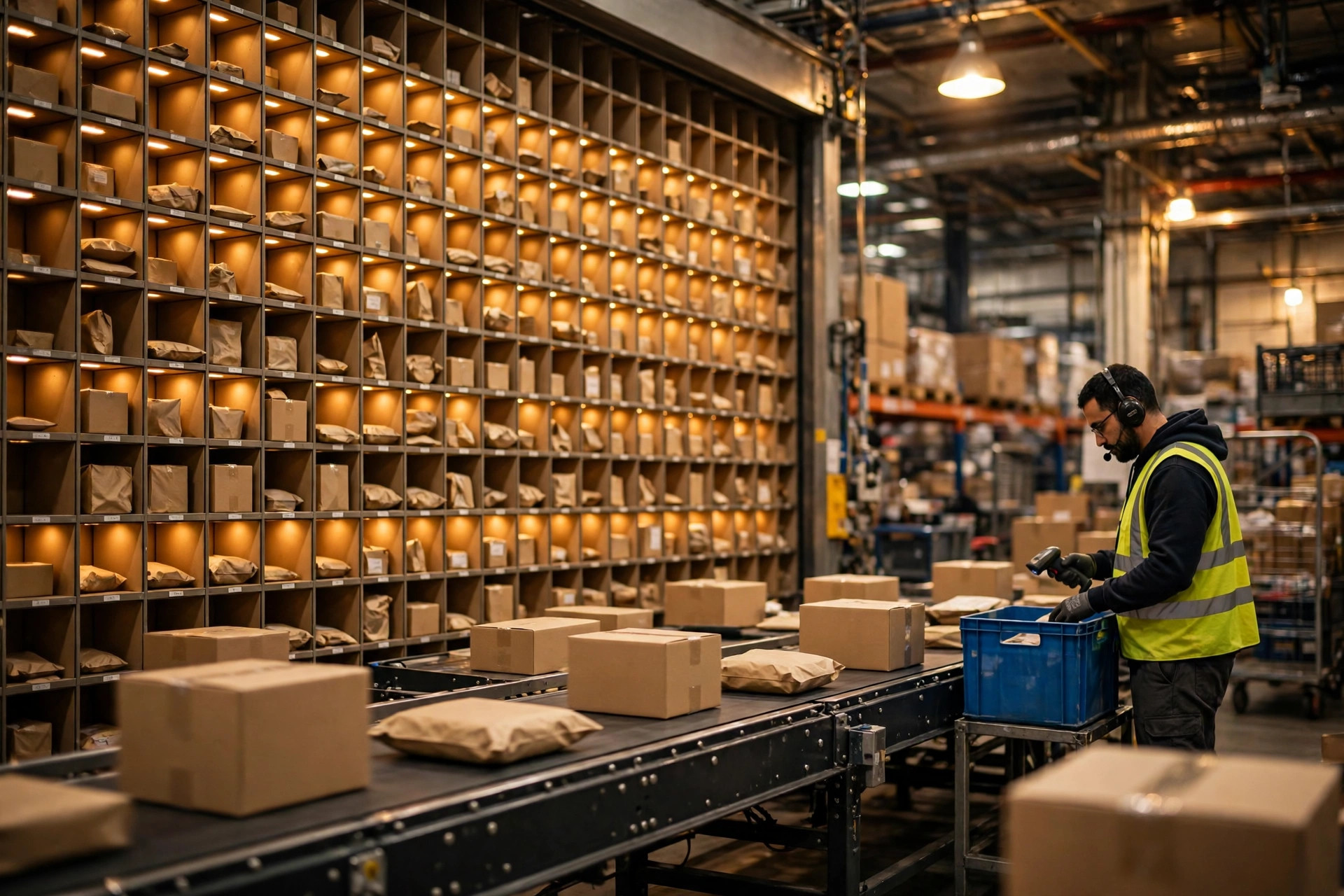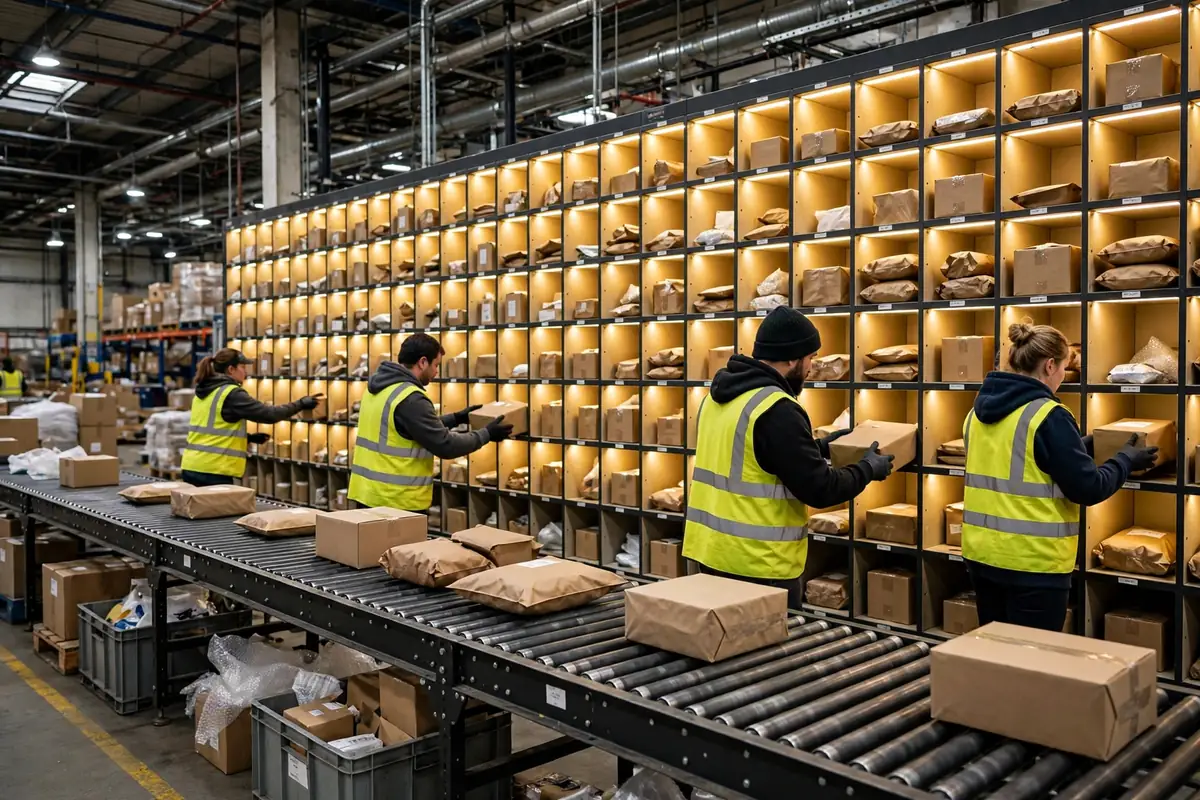
Ask a warehouse manager how many cells a sort wall needs and you will usually get the wrong question answered with confidence. Cells do not set capacity. Rhythm sets capacity. A high volume warehouse sorting wall is a tempo machine: induct, identify, sort, and clear. Whichever of those four steps is slowest decides what the whole wall can do. Think of it as a pipe. You can think of the narrowest section as the only section that matters, because widening everything upstream of it changes nothing.
In November 2024, a beauty e-commerce warehouse in eastern China came to me with a familiar complaint. Daily volume averaged 30,000 orders and peaked at 90,000. Their wall had 320 cells, light-directed put, and 12 sorters. The owner wanted 480 cells. I watched two waves and found peak cell occupancy at just 62%. The real jam was induction: two induction stations feeding 1,400 units an hour while 12 sorters could place 2,100. The wall was starving, not crowded. Adding cells would have been like fitting a bigger fuel tank to a car with no fuel in it. Same car, same problem, more money spent.
Where a High Volume Warehouse Sorting Wall Actually Bottlenecks
Capacity planning needs exactly three numbers. First, induction rate: how many units one induction station can steadily feed per hour, including scanning, exception handling, and carton changeover. Second, cell dwell: how long a cell stays occupied from its first unit to pack-out, which grows with wave size. Third, clear rate: how many cells the pack stations can empty per hour. If cells cannot clear, new units cannot enter, no matter how fast the sorters move.
Run the numbers for that warehouse: induction 1,400 units an hour, sort capacity 2,100, clear capacity 1,600. True wall capacity is 1,400, the minimum of the three. Most teams estimate from sorter productivity alone, arrive at 2,100, and then wonder why the wall collapses at peak. It collapses because induction and clearing never kept up. Put the three numbers in a table before you spend anything:
| Step | Measured rate | Verdict | | Induction and scan | 1,400 units/hour | Bottleneck, fix first | | Sort to cell | 2,100 units/hour | Headroom available | | Clear and pack | 1,600 units/hour | Secondary bottleneck | | Peak cell occupancy | 62% | Not the bottleneck |
A March 2025 case in the US Midwest ran the other way. A third-party logistics provider ran a 240-cell wall at 18,000 orders a day with waves of 800 orders each. Cells filled up, the line stopped, and sorters stood waiting for pack stations to free cells. The fix cost nothing in hardware: waves were cut from 800 orders to 300. Cells turned over faster, clearing load spread across the day, and the same wall went from 18,000 to 24,000 orders a day. Bigger waves are not more efficient. A big wave concentrates all the congestion into the same hour.
High Volume Warehouse Sorting Wall vs. Cross-Belt: The Break Line
When should you stop adding walls and move to a cross-belt sorter? There is no universal standard, but I have used one break line for a decade: if single-wall demand passes 3,000 units an hour, or if peak-to-average volume swings by more than 3x, start the cross-belt conversation seriously. Below that line, more cells, more staff, and smaller waves are cheaper. Above it, adding walls means fighting a human speed limit with headcount, and the cost curve bends sharply upward.
The logic is simple. A put wall asks people to find cells, and human walking speed and cell-recognition accuracy have a ceiling, which is exactly why a high volume warehouse sorting wall hits its limit long before its cell count suggests it should. A cross-belt asks the machine to find cells, and it does not tire, misread, or need a light to tell it where to go. The eastern China warehouse ended up adding a third induction station and one more pack station, and cutting waves from 600 orders to 350. Daily capacity reached 65,000 orders through peak season, and the owner saved the cost of a second wall. The honest follow-up: if next year averages 50,000 orders a day with peaks near 150,000, hourly demand will pass 4,000 units, and that is when cross-belt stops being a luxury. Good put wall sortation selection starts by locating yourself on that curve before choosing a side of it.
| Option | Fits daily volume | Hourly capability | Investment level | | More cells and staff | Under 30,000 orders | Under 2,000 units | Low | | Wave and induction tuning | 30,000 to 50,000 orders | 2,000 to 3,000 units | Low | | Cross-belt sorter | Over 50,000 orders | Over 3,000 units | High |
Maintenance Traps: Lights, Scans, and Full Cells
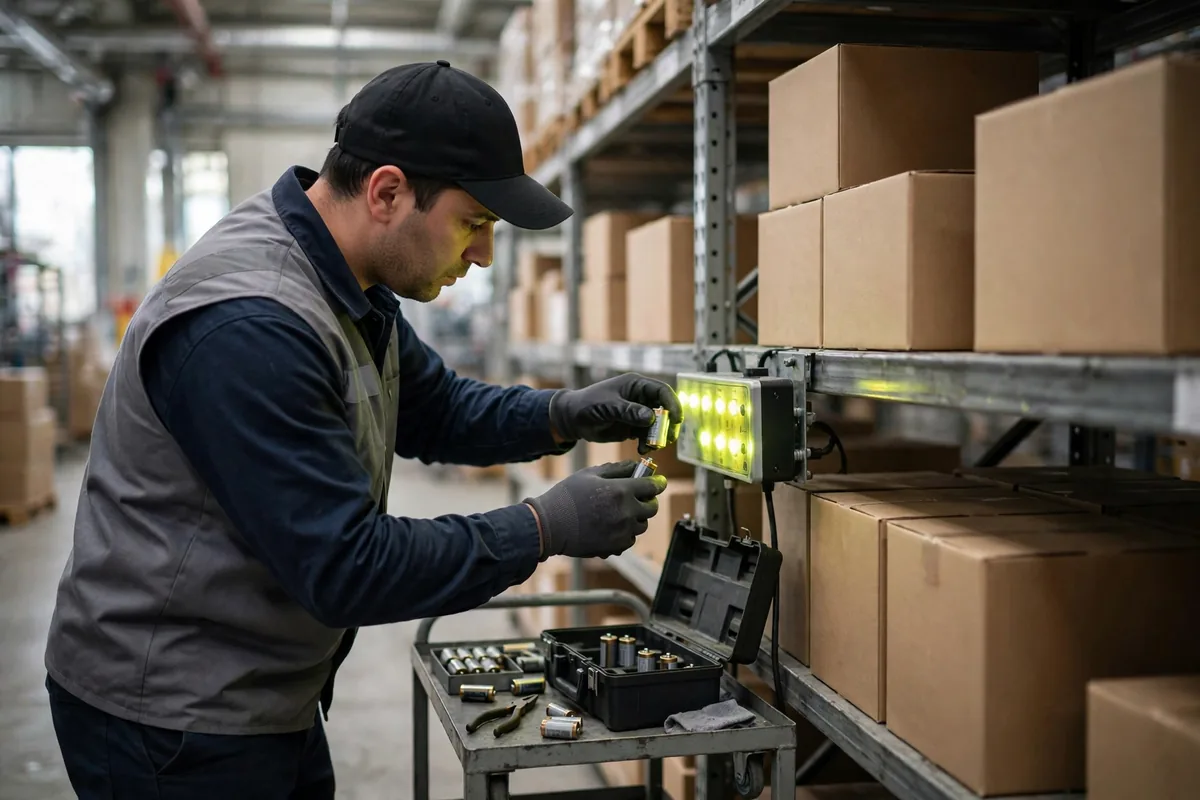
Building the wall is the easy part. The traps show up in maintenance. First, the light modules and their wiring. A dead light means a sorter works from memory, and mis-sort rates climb immediately. Inspect weekly and replace dead lights the same day, not at month end. Second, scan windows at induction. Dust and wrinkled labels drag first-scan success down, and every failed first scan costs a manual touch that eats tempo. Third, the full-cell alarm threshold. Set it too late and overflowing cells wreck wave accuracy. Set it too early and pack stations get interrupted constantly. I set the yellow warning at 80% full so clearing starts before the red light forces a stop.
One more pseudo-requirement deserves a blunt answer: automated cell clearing arms. On a wall running under 3,000 units an hour, the investment never pays back. Manual clearing is cheaper and more flexible. Automation is not better because it is more automatic. It is better only after the math says so.
So is the money worth it? Watch one number: orders per cell per day. Divide daily orders by cell count. Under 60, the wall has slack, so fix tempo first. Between 60 and 120, the wall is in a healthy band. Over 150, cells are the bottleneck, and then, only then, talk about more cells or a cross-belt. Calculate that number before you sign anything. The order matters.
By Da Liu, Automation Engineer