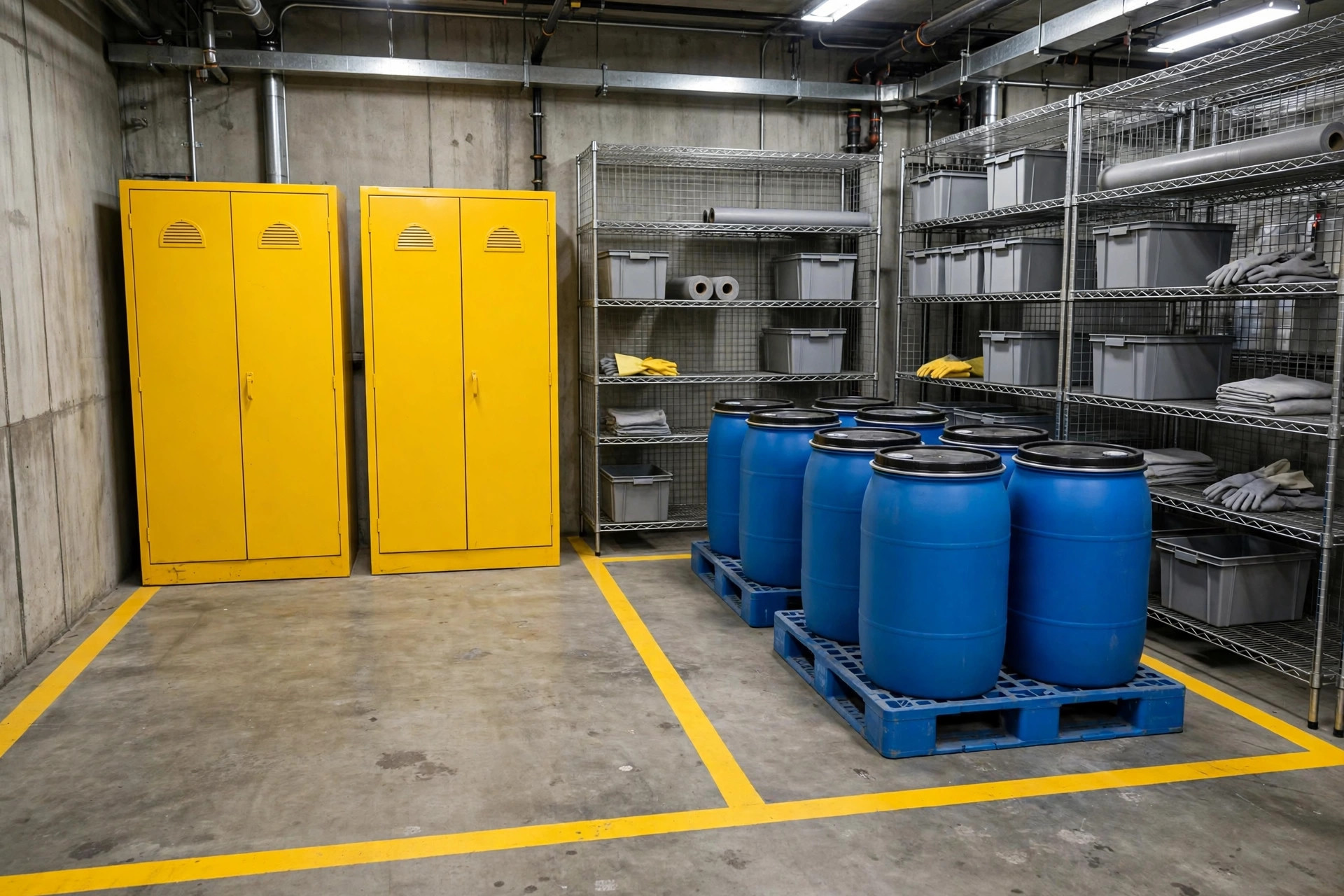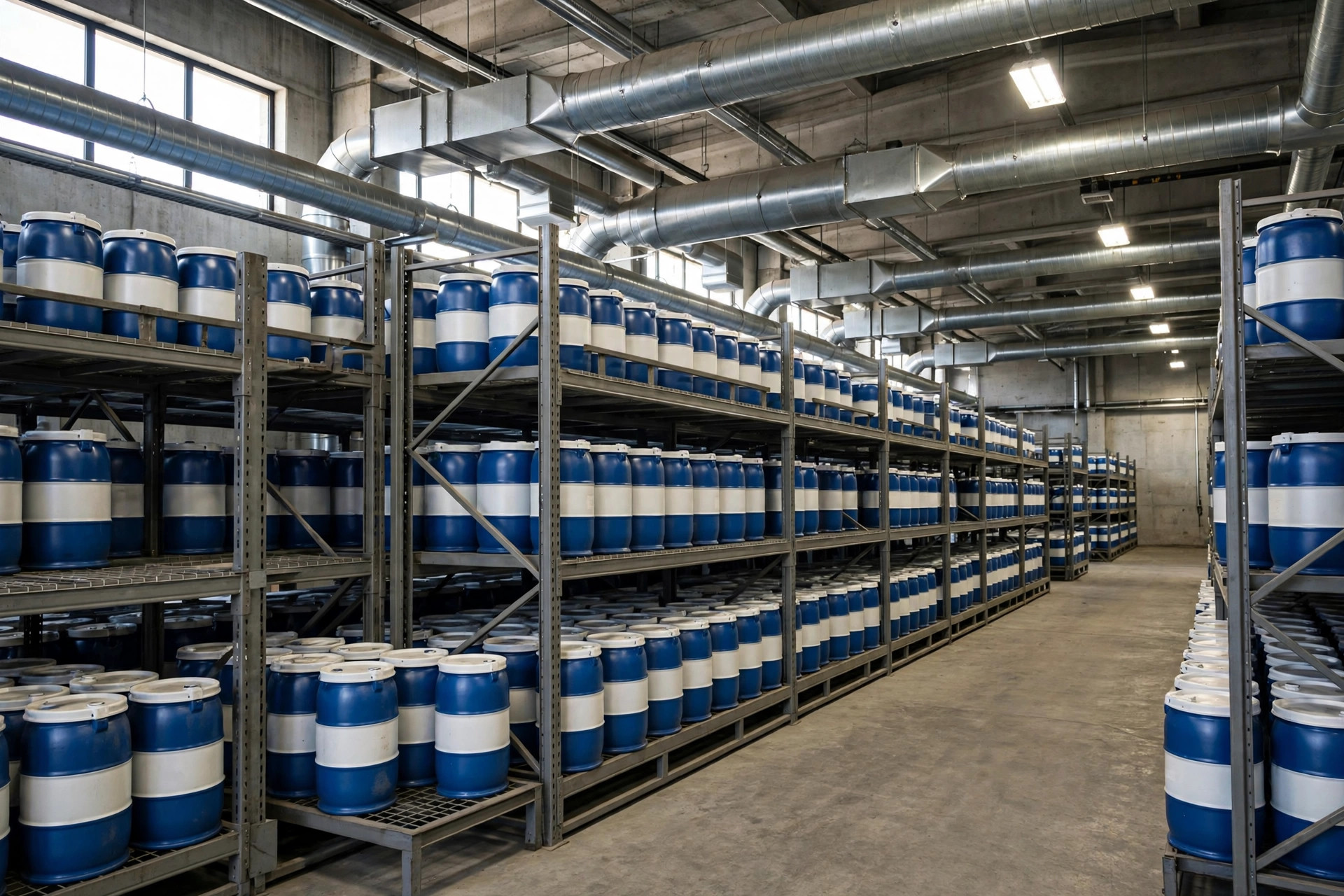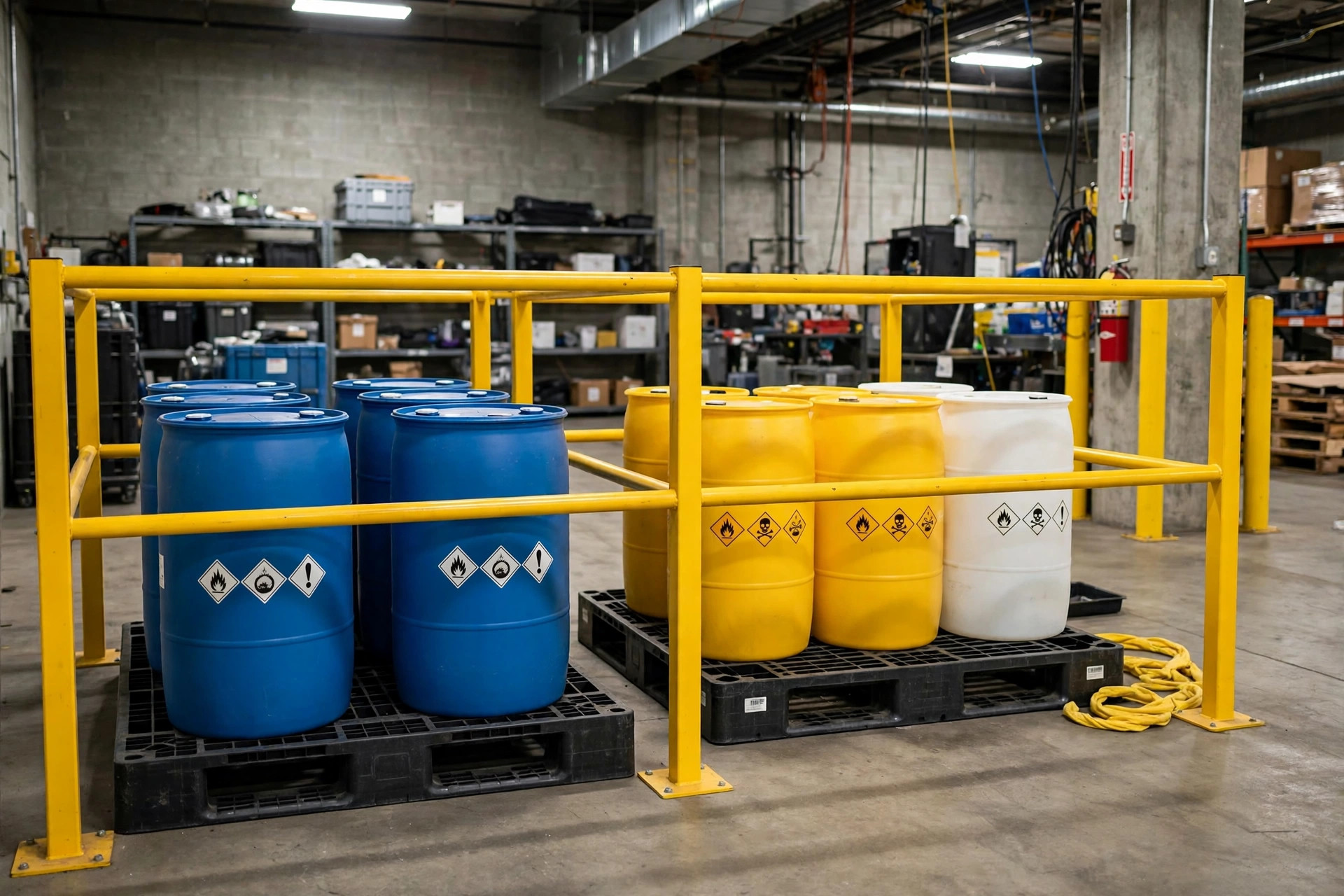
In October 2024, I toured a Pennsylvania 3PL warehouse that had just signed a chemical distributor — twenty SKUs of oxidizers, solvents, and acid-based cleaners. The manager walked me through the hazmat area and pointed at two yellow floor lines and said the zones were eight pallet positions apart. I measured: the nearest two pallets were under ten feet, edge to edge. Both zones shared one floor drain, and the slope ran toward the solvent zone. A spill on one side would flow straight into the other.
Three months later, the fire marshal walked in, and the first item on the correction notice cited IFC Section 5003.9.8: incompatible hazardous materials in storage must be separated by at least 20 feet, by a noncombustible partition, or in approved storage cabinets. Painted lines, he noted, do not count. The warehouse built a partition wall — weeks of work and a significant retrofit bill. "If we'd just built the wall on day one," the manager told me, "the rework alone would have paid for it twice over."
Separation distance is where "it looks about right" quietly replaces actual calculation — a floor line, a visual estimate of "wide enough," a label, done. But the real algorithm behind it is a full engineering logic, and distance is only its most visible parameter.
The Algorithm Has Four Authors, Not One
A fact that gets overlooked: the United States has no single hazmat separation law. The rules sit in four frameworks, each written for a different accident scenario. Read together, the logic becomes clear.
First, DOT's 49 CFR 177.848 — the segregation table for transportation. Many assume it only governs trucks, but the text covers materials that "may not be loaded, transported, or stored together" during transportation. A blank cell means no restriction; "X" means the two materials may not share a vehicle or facility at all; "O" means they may share only if separated so that leakage would not cause them to commingle. One hard rule: Class 8 corrosive liquids may never sit above or adjacent to Class 4 (flammable solid) or Class 5 (oxidizer) materials.
Second, IFC 2018, Section 5003.9.8 — the ruler the fire marshal carries. Where containers exceed 5 pounds (2 kg), half a gallon (2 L), or any quantity of compressed gas, incompatible materials must be separated by one of four options: segregate by at least 20 feet (6,096 mm); isolate with a noncombustible partition extending at least 18 inches (457 mm) above and to the sides of the stored material; store in hazardous material storage cabinets; or store compressed gases in gas cabinets or exhausted enclosures. Incompatible materials may not share a cabinet. This is the provision cited in most warehouse fire inspections.
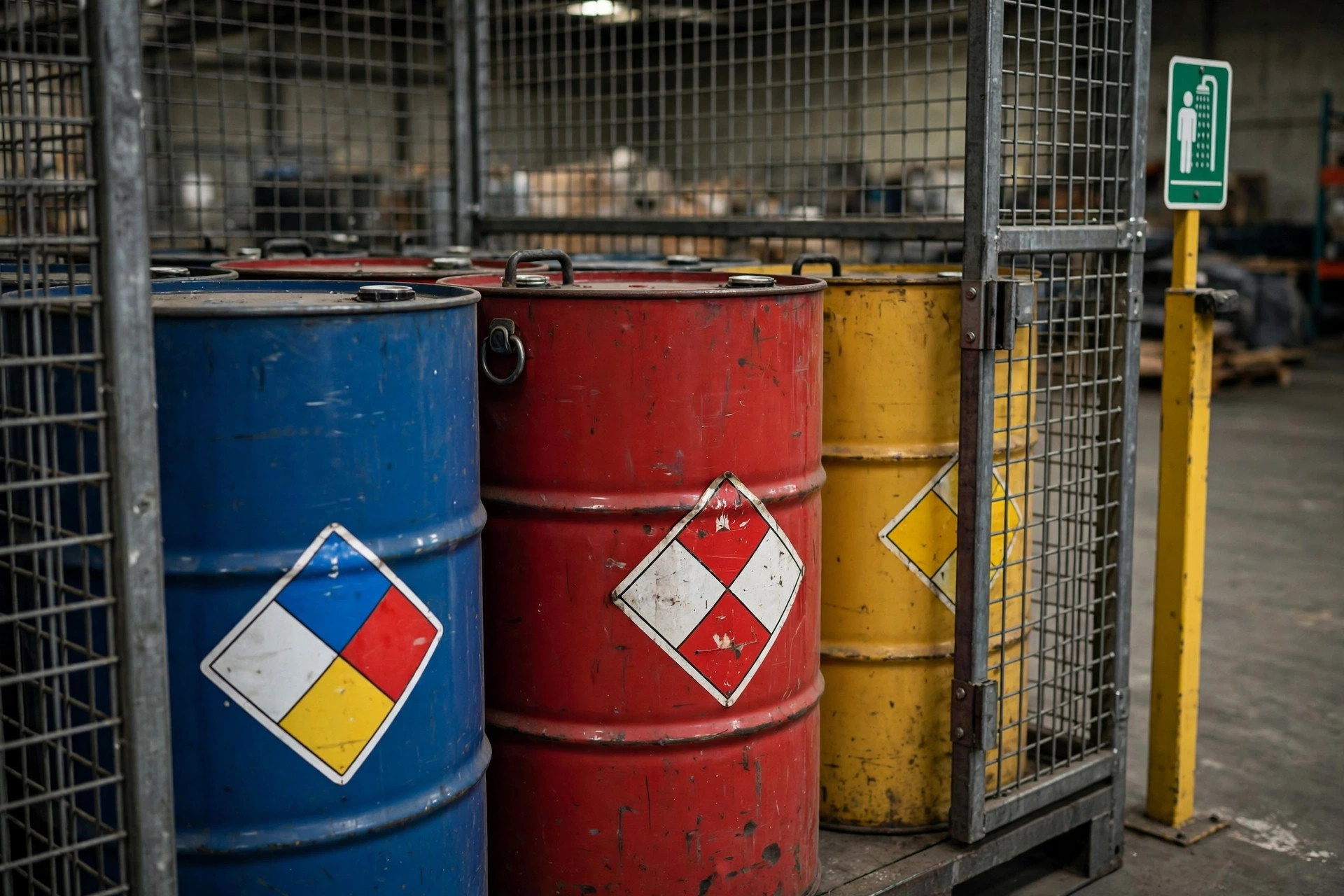
Third, NFPA 400 — the category-specific algorithm. For oxidizers stored with flammable and combustible liquids in segregated areas: at least 25 feet (7.6 m) between containers, with dikes, drains, or floor slopes keeping flammable leakage out of the buffer. In April 2013, a fertilizer storage facility in West, Texas exploded, killing fifteen people including twelve emergency responders; the Chemical Safety Board investigated. The revised NFPA 400 then doubled the minimum outdoor separation for ammonium nitrate from 15 to 30 feet — an accident rewriting the algorithm.
Fourth, EPA's RCRA, 40 CFR 265.177 — the waste-side logic. What is interesting is what the rule omits: it gives no universal distance. Section 265.177(c) only requires that a container holding incompatible hazardous waste be separated from nearby materials or protected by a dike, berm, wall, or other device — distance is negotiable, engineered protection is not. Two companion numbers: Section 265.176 requires ignitable or reactive waste containers to sit at least 50 feet (15 meters) from the property line, and Section 265.175(b)(3) requires spill containment to hold at least 10 percent of total container volume or the largest single container's volume, whichever is greater.
Side by side:
| Incompatible pair | Authority | Requirement |
|---|---|---|
| Oxidizers (Class 5.1) vs. flammable/combustible liquids | NFPA 400 | ≥ 25 ft (7.6 m), with dikes/drains/slope to prevent encroachment |
| Incompatible hazmat, general case | IFC 5003.9.8 | Four options: ≥ 20 ft; partition (18 in. above material); hazmat cabinets; gas cabinets |
| Ammonium nitrate, outdoor storage | NFPA 400 (post-accident) | Minimum 30 ft (doubled from 15 ft) |
| Explosives (Div. 1.1/1.2) vs. most other classes | DOT 177.848 | "X" — no shared vehicle or facility |
| Class 8 corrosive liquids vs. Class 4/5 | DOT 177.848 | Never above or adjacent |
| Incompatible hazardous waste containers | EPA 40 CFR 265.177(c) | Separate or protect with dike/berm/wall (no fixed distance) |
| Ignitable/reactive waste vs. property line | EPA 40 CFR 265.176 | ≥ 50 ft (15 m) |
Usage note: check DOT for the transportation leg, the IFC and NFPA for long-term storage, and layer EPA on top for hazardous waste. Verify every number against current editions and local requirements.
Why the Numbers Disagree: What Sits Behind 20, 25, and 30 Feet
The four frameworks cannot agree on one number because they are not preventing the same accident. DOT prevents two substances from mixing after a leak inside a trailer. The IFC prevents radiant heat and flame spread. NFPA 400 prevents category-specific chain reactions, and the EPA prevents waste from leaching into soil and groundwater. A separation distance is, at its core, time and space bought for spill control and emergency response.
Three things actually matter in the algorithm. First, distance must be calculated with the leak path. The Pennsylvania warehouse's problem was not "under ten feet" — it was the shared drain. Both the IFC and NFPA require the separation to be maintained with dikes, drains, or slopes; once a leak path defeats the buffer, the number is meaningless. Second, vertical separation counts. The ban on Class 8 liquids above Class 4 or 5 exists because in a racked warehouse, the vertical axis isolates as much as the horizontal one. Third, ventilation and sprinkler zoning must match. Water-reactives (Division 4.3) under sprinklers are not saved by a 20-foot buffer — placement has to start with the safety data sheet, Sections 7, 9, and 10.
The Counterintuitive Part: Longer Is Not Safer
The judgment that surprises most warehouse managers I meet: the warehouse that treats distance as the design goal is usually the least safe one.
Distance is the most honest and the most fragile isolation method — honest because a tape measure settles compliance, fragile because it offers zero physical resistance once something dynamic happens. A 20-foot buffer with a sloped floor, a connected drain, and shared ventilation may isolate less in a real incident than an 18-inch partition. The IFC lists distance, partition, and cabinet as equal options, and that equivalence is itself the signal: they are alternative engineering solutions, not a hierarchy.
Which leads to the practical trade-off: a buffer consumes the warehouse's most expensive resource — floor space. A 20-by-40-foot lane is 800 square feet. Multiply by your own rent, times twelve, and you have its annual opportunity cost; against the one-time cost of a partition wall. The practical read: small, multi-category hazmat areas should default to partitions and cabinets, with distance as the backstop — and post-West, combination solutions are becoming the new-build default.
From Algorithm to Floor: Four Steps
Four steps, in order:
First, build the incompatibility matrix. Pull the SDS for every hazmat SKU — Sections 7 and 10 matter most — and flag the classic pairs: acids/bases, oxidizers/organics, water-reactives/water, flammables/oxidizers. Without this matrix, the numbers are arithmetic without chemistry.
Second, pick one IFC option and commit — twenty feet, a partition, a cabinet, a gas enclosure. Distance requires auditing floor slope and drain routing so no drain connects the two zones inside the buffer; a partition must rise at least 18 inches above the tallest stored material and wrap the sides.
Third, verify the leak path and berms. Re-run the EPA containment math — 10 percent of total volume versus the largest container, whichever is greater. Under-pallet spill trays, berms at zone edges, and drain flow direction are what inspectors check most.
Fourth, self-inspect before the official one. Tape-measure the clearances, photograph them, and confirm everything against current NFPA and OSHA editions plus local amendments.
The Pennsylvania manager said something I have not forgotten: "Separation is not about drawing lines — it is about the reaction time we get after an incident starts." Run the algorithm to the end, and what it calculates is always time.
So the open question: is the yellow line in your warehouse calculated from a regulation, or drawn because it "looked about right"? Before the next fire marshal walks in, take a tape measure to it — and walk the drain line in the direction the water flows.
By Dr. Chen, Supply Chain Researcher