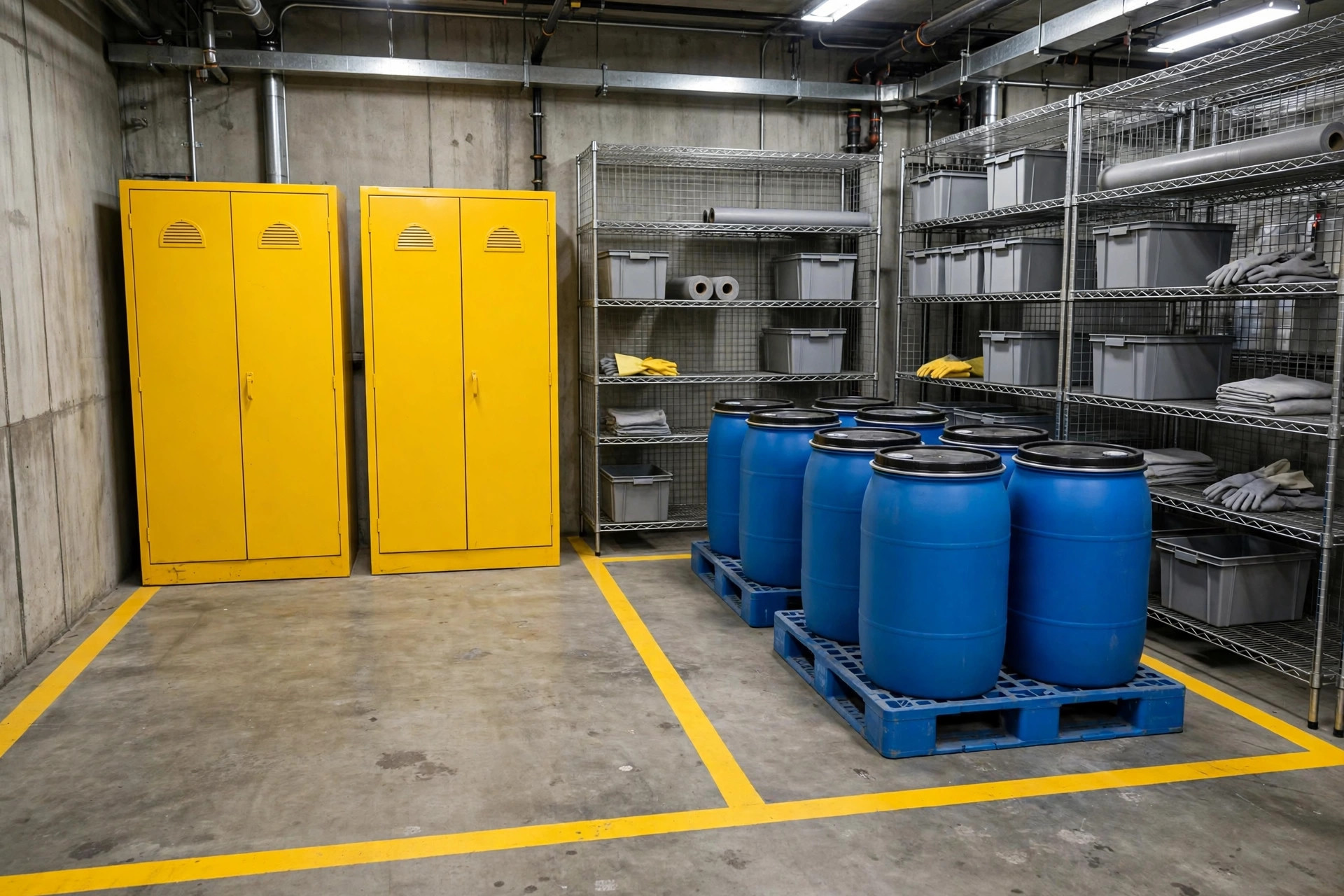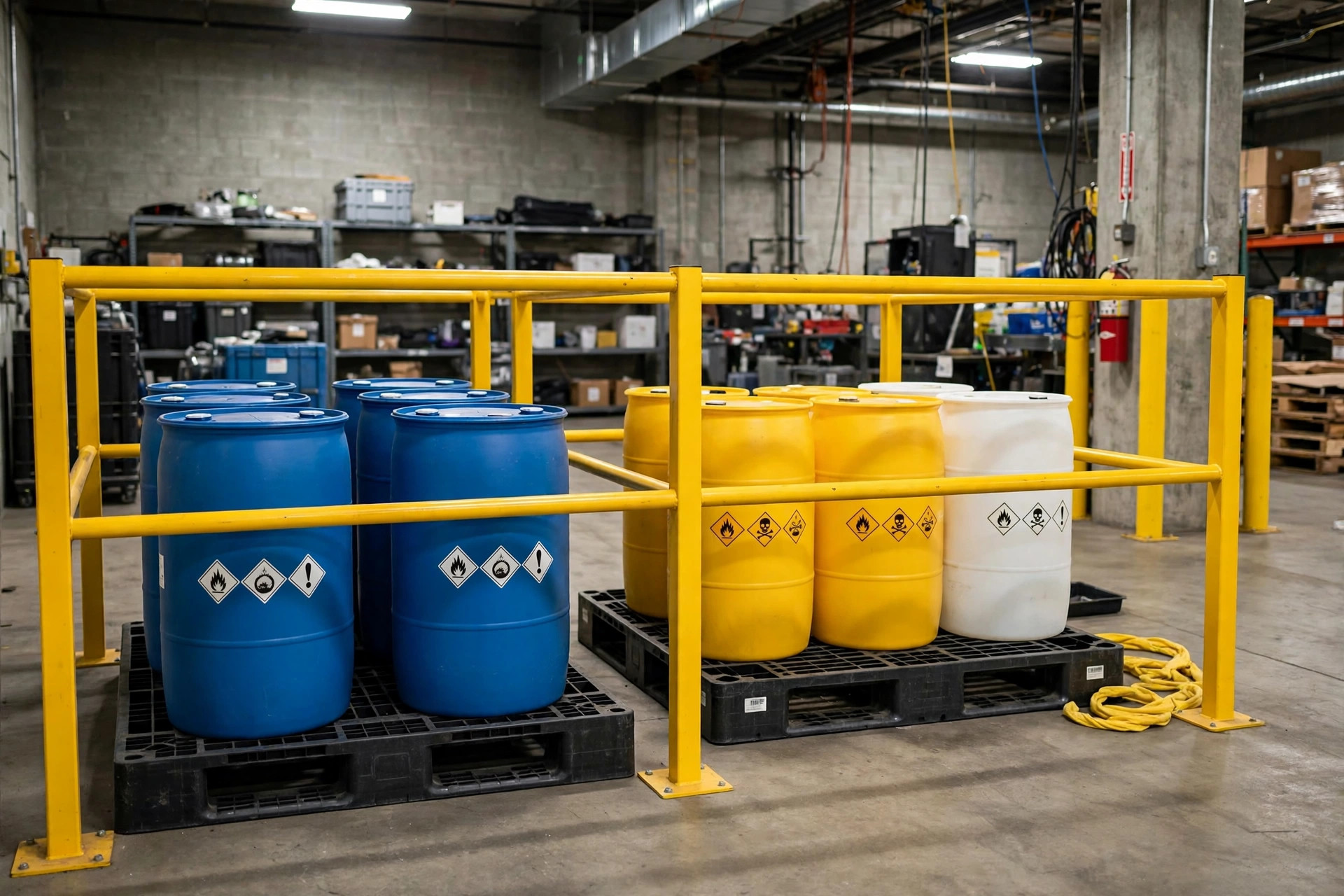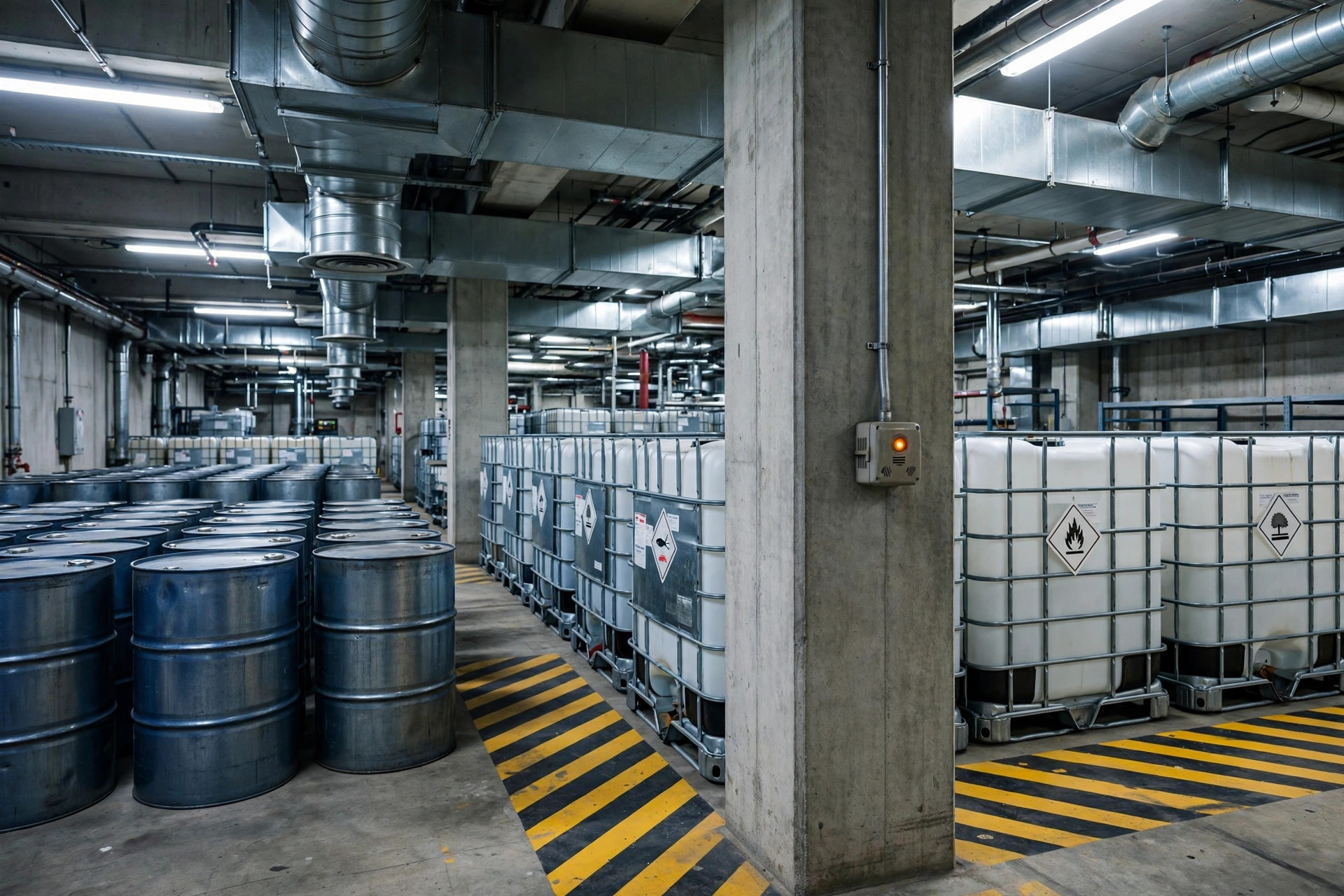
The deadliest hazard in a hazmat warehouse is invisible — and it's the reason gas detection exists. You can dodge an open flame. A colorless gas leak will have you cornered long before the gas detection panel ever lights up. In the fall of 2023, I audited a 3PL in Texas that repackages aerosols. Their LPG cylinder area had detectors installed — right under the ceiling. LPG is heavier than air. It leaks, hugs the floor, and pools at ankle height while the ceiling-mounted sensor enjoys a quiet life and the crew on the ground stands inside the danger zone.
This article covers three things: the principle (combustible and toxic gases run on two different logics), the selection dividing lines (four sensor technologies and how to choose), and the maintenance pitfalls (calibration discipline and the false-alarm balance). One disclaimer up front: alarm thresholds vary by gas. Always follow the equipment manufacturer's manual and the SDS (Safety Data Sheet). This piece is methodology, not a substitute for your setpoints.
Gas Detector Selection: Combustible vs. Toxic Is Two Different Logics
A combustible sensor doesn't measure concentration directly. It measures "how far from an explosion" — as a percentage of LEL, the lower explosive limit. Think of it as a fuel gauge running in reverse: 0% LEL is empty, 100% LEL is the bang. Alarm setpoints are usually two-stage, warning and danger, each a percentage of LEL. What percentage? Per the manufacturer's recommendation and your local AHJ (authority having jurisdiction). There is no universal number, and anyone selling you one is selling something else.
Toxic detection runs on a completely different logic: absolute concentration, in ppm (parts per million). Think of dissolving salt in a swimming pool — the absolute amount of salt decides whether the water is drinkable, regardless of pool size. Alarm thresholds follow each gas's occupational exposure limits, straight from the SDS.
So here is dividing line number one: in the same warehouse, combustible and toxic gases need two sets of sensors and two sets of alarm values. They don't convert into each other. If a vendor tells you "one unit handles everything," show them the door — that's the heaviest pseudo-requirement zone in this business.
How to pick the sensing technology:
| Technology | Measures | Strengths | Weaknesses | Fits | | Catalytic combustion | Combustible gases | Universal, cheap, good response to mixed gases | Poisoned by silicon/sulfur compounds; needs oxygen | General combustible storage | | Infrared | Hydrocarbon combustibles | Long life, poisoning-proof, low maintenance | Expensive; insensitive to hydrogen | Outdoor, harsh environments | | Electrochemical | Toxic gases (ppm level) | Sensitive, good selectivity | 2–3 year lifespan; hates wild temp/humidity swings | Toxic gas storage areas | | Semiconductor | Broad spectrum | Cheapest | Heavy drift, false-alarm prone | Consumer grade — keep out of warehouses |
Think of a catalytic bead sensor as a tiny lighter burning 24/7, inferring concentration from "how much got burned." Its Achilles' heel is poisoning: silicon-bearing vapors (some sealants, mold-release agents) are glue poured into that lighter. One exposure kills it — and it dies silently, reading zero while you believe you're safe. That's why you read the SDS ingredient list before choosing a technology, never after.
And one more shot fired: some integrators love pushing "full infrared arrays, future-proof in one step." Infrared can't see hydrogen. If your warehouse has a lithium battery staging area, that zone is effectively unmonitored. Selection starts from the gas inventory, then the technology. There is no silver bullet — anyone promising "one design fits all" is fitting your budget, not your risk.
Gas Detector Placement: High or Low Depends on Gas Density
This is the most valuable section of the article. Placement obeys exactly one law of physics: gas density.
- Lighter than air (methane, ~0.55 relative density; hydrogen, ~0.07): rises. Mount high, near the roof.
- Heavier than air (propane/LPG, ~1.5–2): sinks. Mount low, near the floor. Most manufacturer manuals suggest within 30 cm of the floor — but take that from your own equipment's installation manual, not from this article as a construction drawing.
- Close to air (carbon monoxide, ~0.97): mount at breathing-zone height, about 1.5 m off the floor, because what you care about is what people inhale.
Placement in three steps. Step one: list your gas inventory, group by density, set the mounting height per group. Get the height wrong and the detector might as well not exist — the Texas warehouse from the opening is the cautionary tale. They moved the LPG-zone sensors from the ceiling to near-floor, same system, night-and-day detection capability.
Step two: densify around leak sources. Valves, flanges, loading arms are where leaks actually happen — ring them with sensors. Coverage radius comes from the manufacturer's rated data; every vendor's effective radius differs. Ask the vendor, don't draw circles from your imagination.
Step three: fill the ventilation dead zones — behind columns, inside partitioned corners, anywhere exhaust air never reaches. Here's the counterintuitive call: more detectors does not mean safer. In a well-ventilated open bay, airflow dilutes and carries leaked gas away, so sensors must follow the airflow. The correct sequence is airflow analysis first, sensor locations second — not the other way around. I've seen too many warehouses sprinkle sensors evenly across the ceiling. It looks professional. It's actually ceiling security theater.
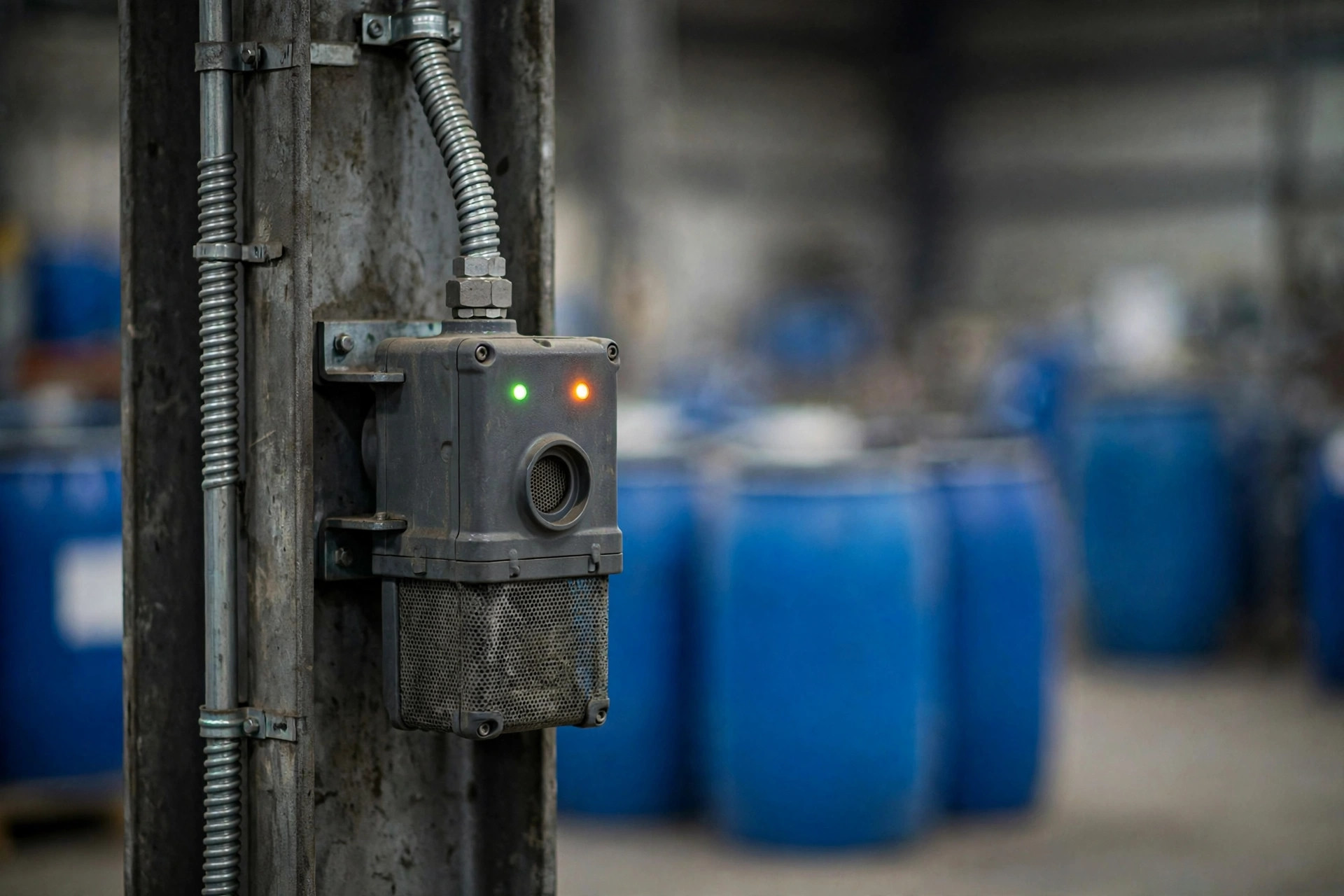
In 2021, a coatings distributor in Ohio had exactly one electrochemical sensor guarding its amine-based hardener area (toxic gas) — mounted by the door. One night shift, a valve wept at the back of the racking, squarely in a dead zone. By the time gas at the leak had accumulated to dangerous levels, the door sensor was reading barely half the threshold. Luck intervened: a patrolling employee smelled something wrong and evacuated first. The fix added three sensors under a "densify around leak sources" rule — the exact radius came from that vendor's rated data, which varies by vendor. Follow the manual, not my anecdote.
Alarm Integration and Maintenance: Four-Stage Response, Calibration Discipline
An alarm that just "makes noise" is half a system. Build four stages, each harder than the last: audible/visual alarm so people on the floor know first and evacuate; ventilation interlock to drive the concentration down and buy time; automatic gas-source shutoff valves to choke the leak at its origin — automatic, never "someone runs over and closes it"; and a signal to the control room so the shift supervisor and EHS lead know simultaneously.
Think of it as the body's pain reflex — the hand jerks back from heat (alarm plus ventilation) before the brain even weighs in (control room assessment). One essential piece of interlock logic: alarm delay plus two-out-of-two voting — two sensors must agree before the shutoff valves trip. Otherwise one false alarm slams every valve in the building, production stops, and after a few rounds the crew starts hating the system. The step after hating a safety system is bypassing it.
Two maintenance pitfalls. First, calibration. Electrochemical cells are consumables with a 2–3 year life; catalytic beads drift too. Calibrate on the manufacturer's schedule — in a hazmat warehouse you're allowed to calibrate more often than the manual says, never less. Keep the calibration records. When OSHA shows up, that's your evidence of due diligence, and it beats any argument.
Second, the boy who cried wolf. Forklift exhaust, welding fumes, even a hot humid summer day can trip sensors. A disciplined gas detection maintenance routine is the only thing standing between a trusted system and a taped-over horn. The countermeasure kit has three pieces: calibrate on time, alarm delay plus voting logic, and crew training (alarm sounds, evacuate first, investigate after — never "silence it and see"). The worst I've seen: a warehouse with so many false alarms that the night shift taped over the horn on the audible alarm. That's more dangerous than having no detection at all — with nothing installed, at least you know you're exposed. With a taped horn, management still believes the system is protecting them.
Is It Worth the Money? One Number Decides
Such a detection-and-interlock package runs from tens of thousands to low six figures USD depending on point count and interlock complexity — get a real quote from an integrator. Whether it's worth it comes down to one number: how many times in the past year has your warehouse stopped production over gas-related causes — leaks, false-alarm evacuations, fire-marshal findings — and for how many hours each time. Two hours of one false evacuation, in direct labor and delayed orders, buys several detectors. And one real leak that goes undetected? OSHA's maximum penalty for a serious violation is $16,550 per violation (per osha.gov, 2026 schedule) — before civil liability and shutdown orders even enter the picture.
So the question isn't "should we install it." It's "did we install it right." Wrong mounting height and the hardware is decoration. No interlock and you have half a system.
By Da Liu, Automation Engineer