Here's the thing about hazmat warehouses that keeps me up at night: the most dangerous thing in the building is almost never one chemical. It's two perfectly ordinary chemicals sitting where they shouldn't.
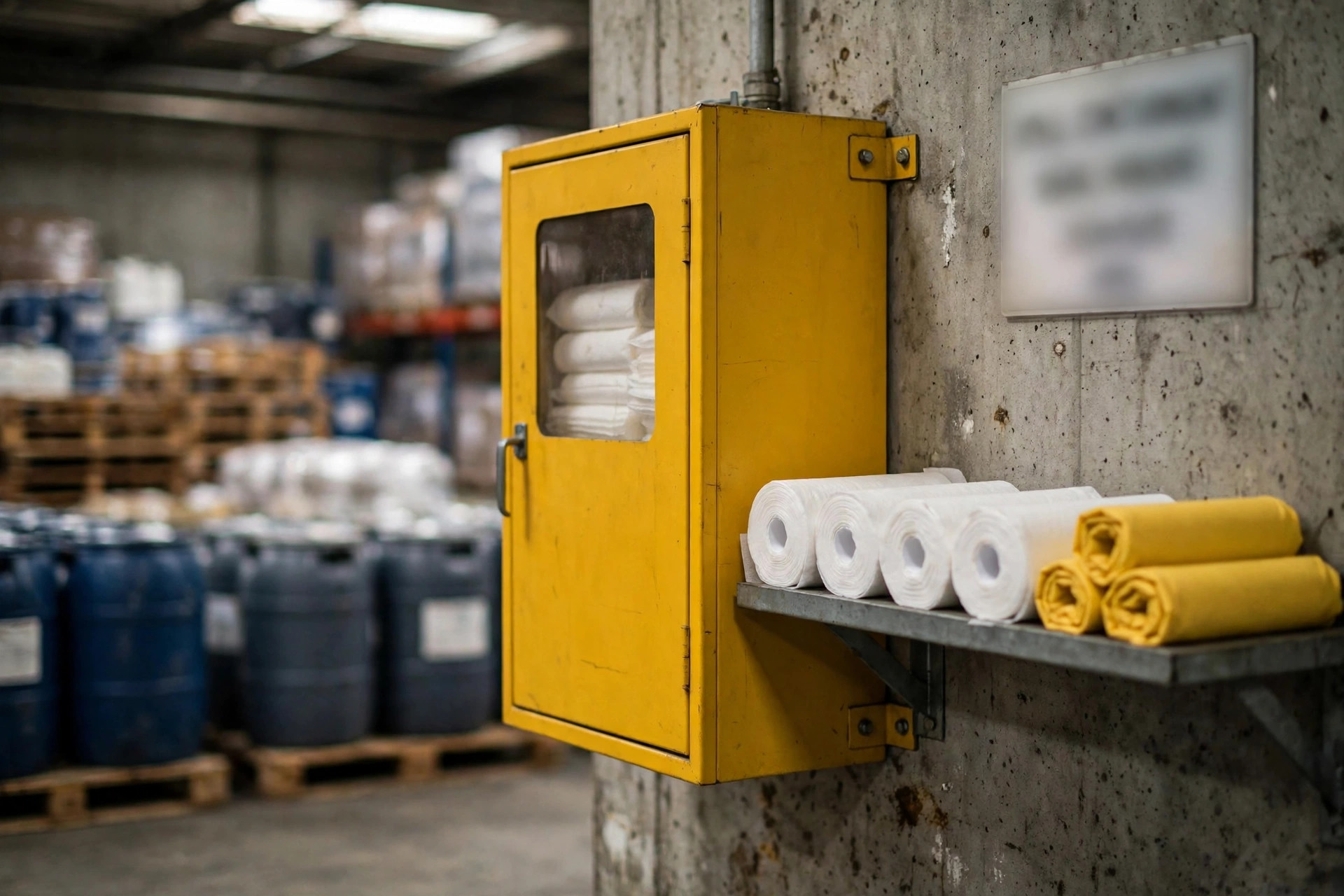
Last winter, my phone rang a little after 2 a.m. A 3PL in the Inland Empire that handles chemical distribution — the night-shift supervisor's voice was shaking. Under a rack in Zone B, two spilled powders had mixed on the floor. Faint smoke. Acrid smell. He did exactly the right thing: shut down that row, kicked on the ventilation, pulled the two pallets apart, and called me and their safety manager. By the time we got there, the mixed pile had been scooped up with a non-sparking shovel and sealed in a salvage drum. Nobody hurt. No headlines. But the debrief was sobering: with worse ventilation that night, or a little more material mixed in, that whole rack row might not have survived.
Each powder, on its own, was fine. One was pool chlorine tablets — an oxidizer. The other was an ordinary organic powder. Both SDS sheets said everything they needed to say. But nobody had turned "what happens if these two meet" into a chart on the wall.
What the chart is actually checking
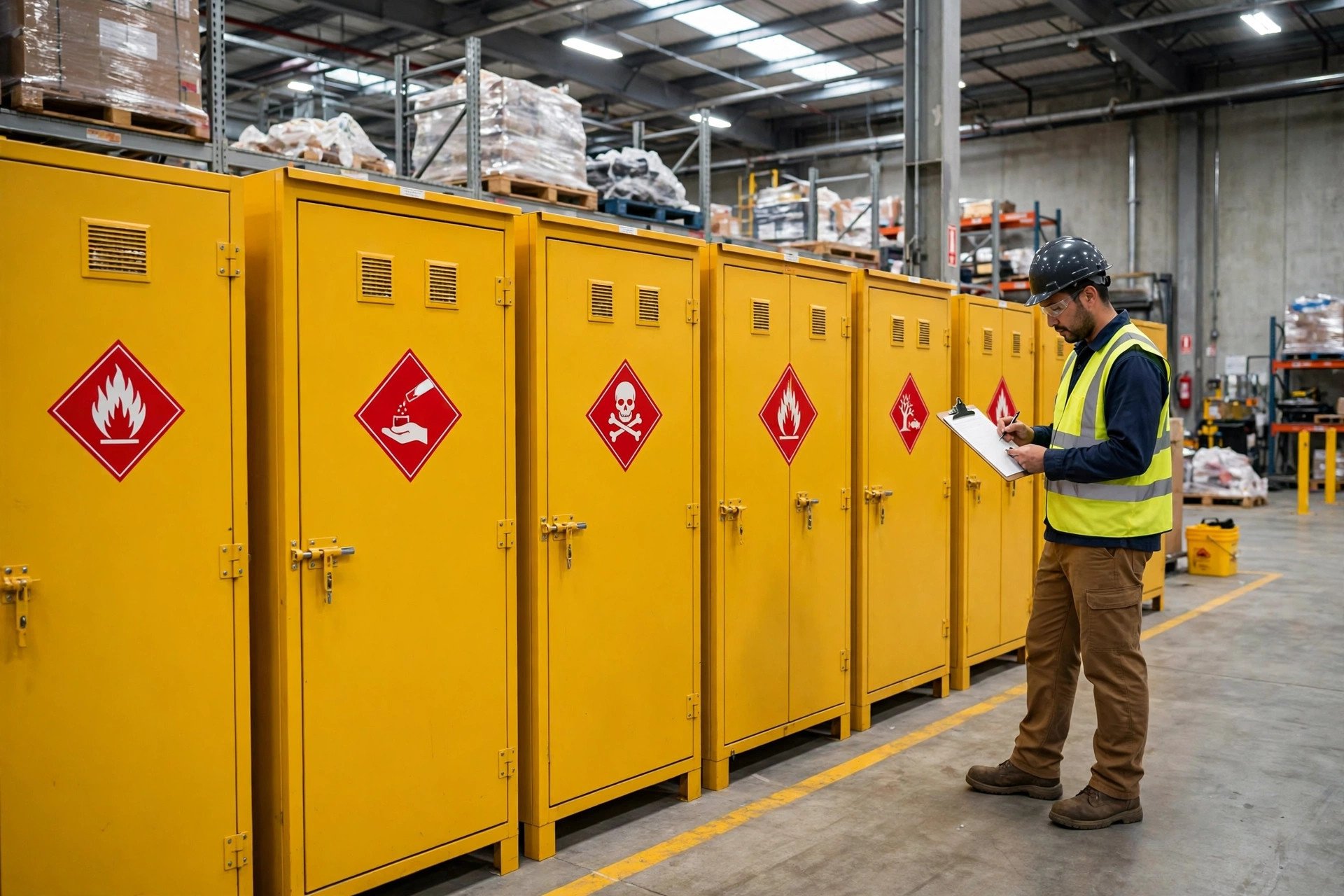
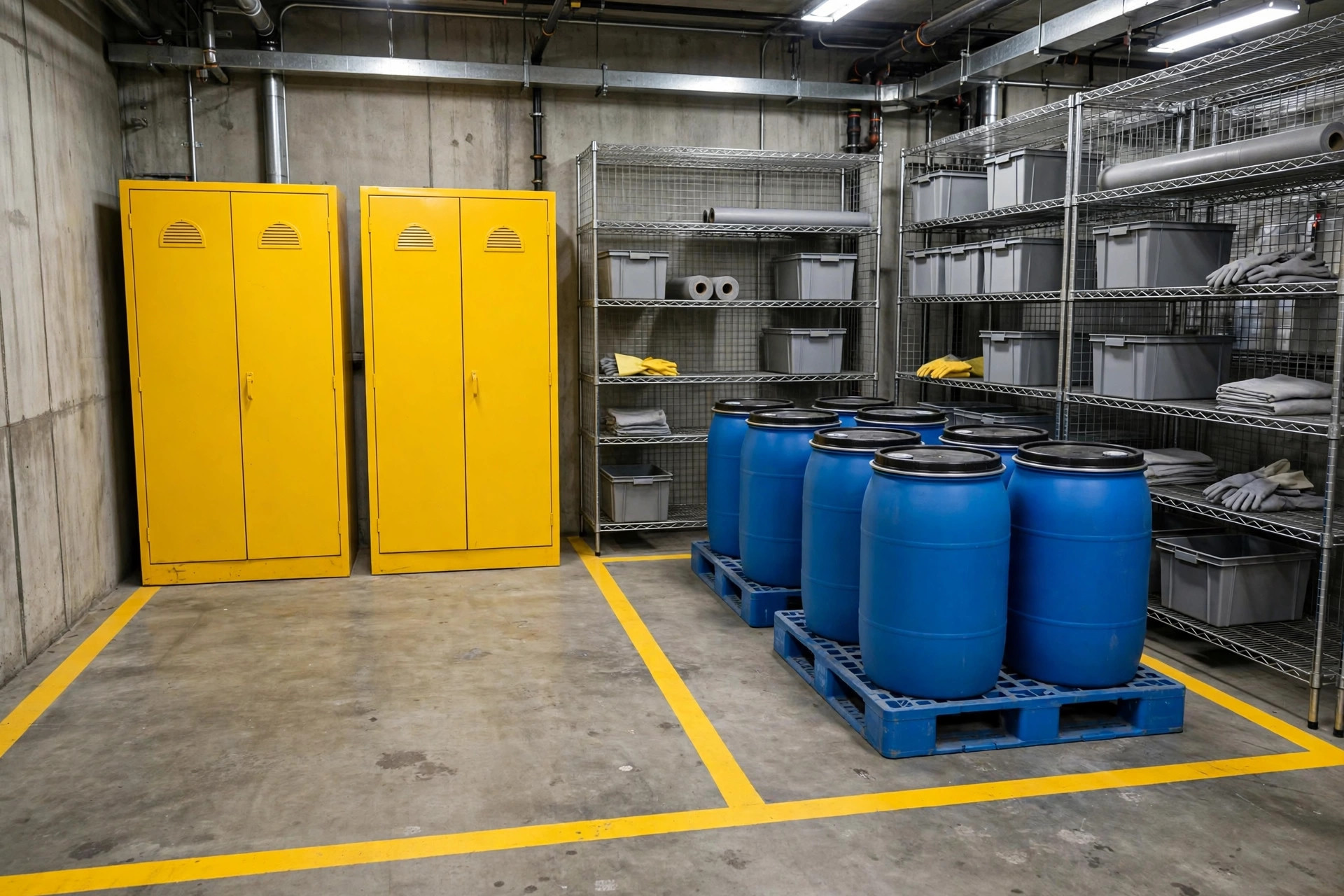
Plenty of warehouses have a hazmat zone: yellow lines on the floor, spill pallets in place, looks professional. But in my experience, eight out of ten are missing one thing — a posted chart that says who can't sit next to whom.
The industry name is a compatibility matrix, and building one is simpler than it sounds. Step one: group everything you actually store by hazard class, using each product's SDS — oxidizers, flammable liquids, acids, bases, toxics, lithium batteries. Big buckets first. Step two: draw a grid with those classes on both axes and mark the forbidden combinations with a red X. Step three: post it at the hazmat zone entrance and in receiving, where forklift drivers and receivers can see it without looking for it.
The test is one sentence: if these two leak, spill, or mix, will they react — heat, smoke, fire, toxic gas? If yes, separate them. If you're not sure, treat it as yes. The SDS usually lists "incompatible materials" — that's the manufacturer's enemies list. Copy every line of it into your chart.
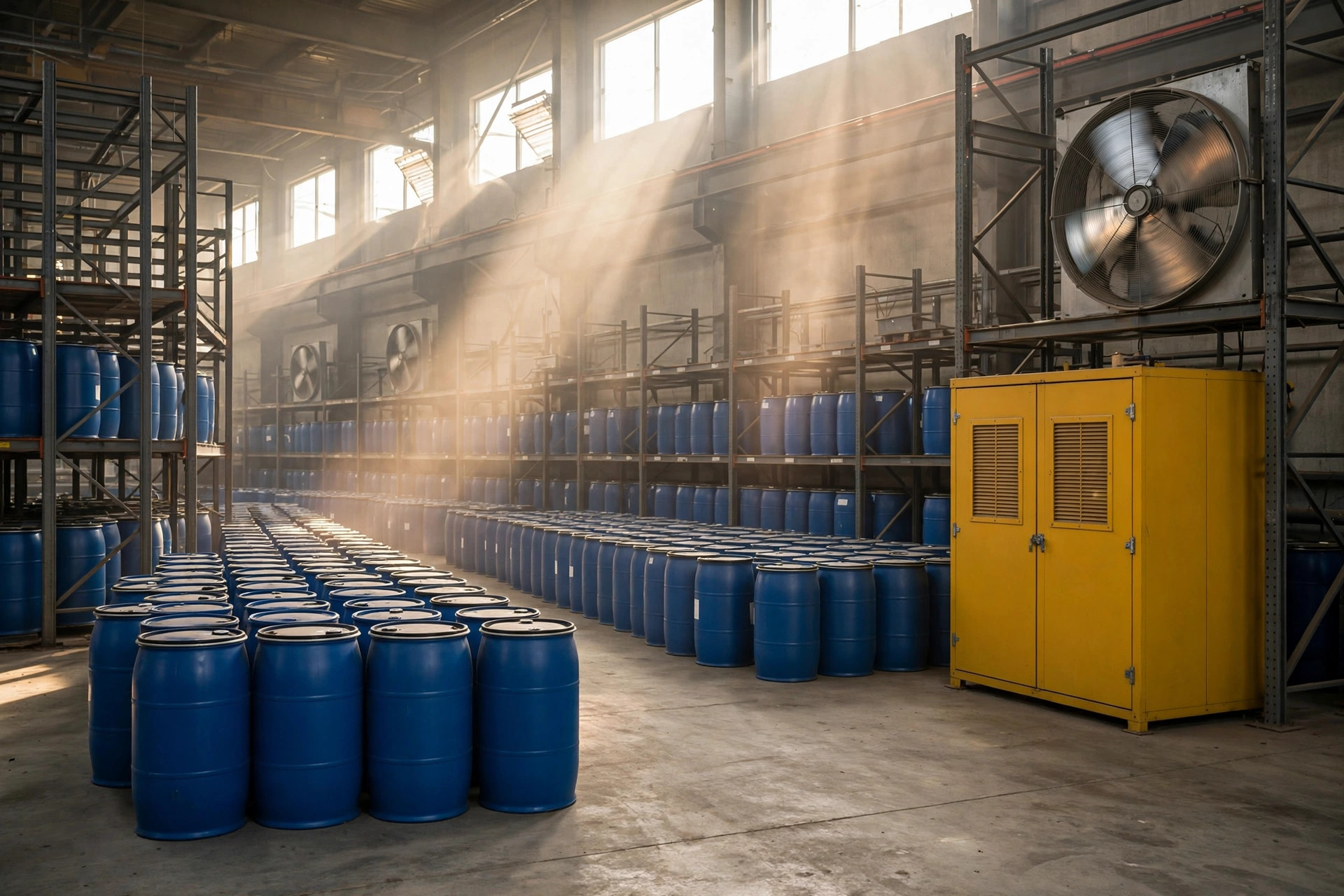
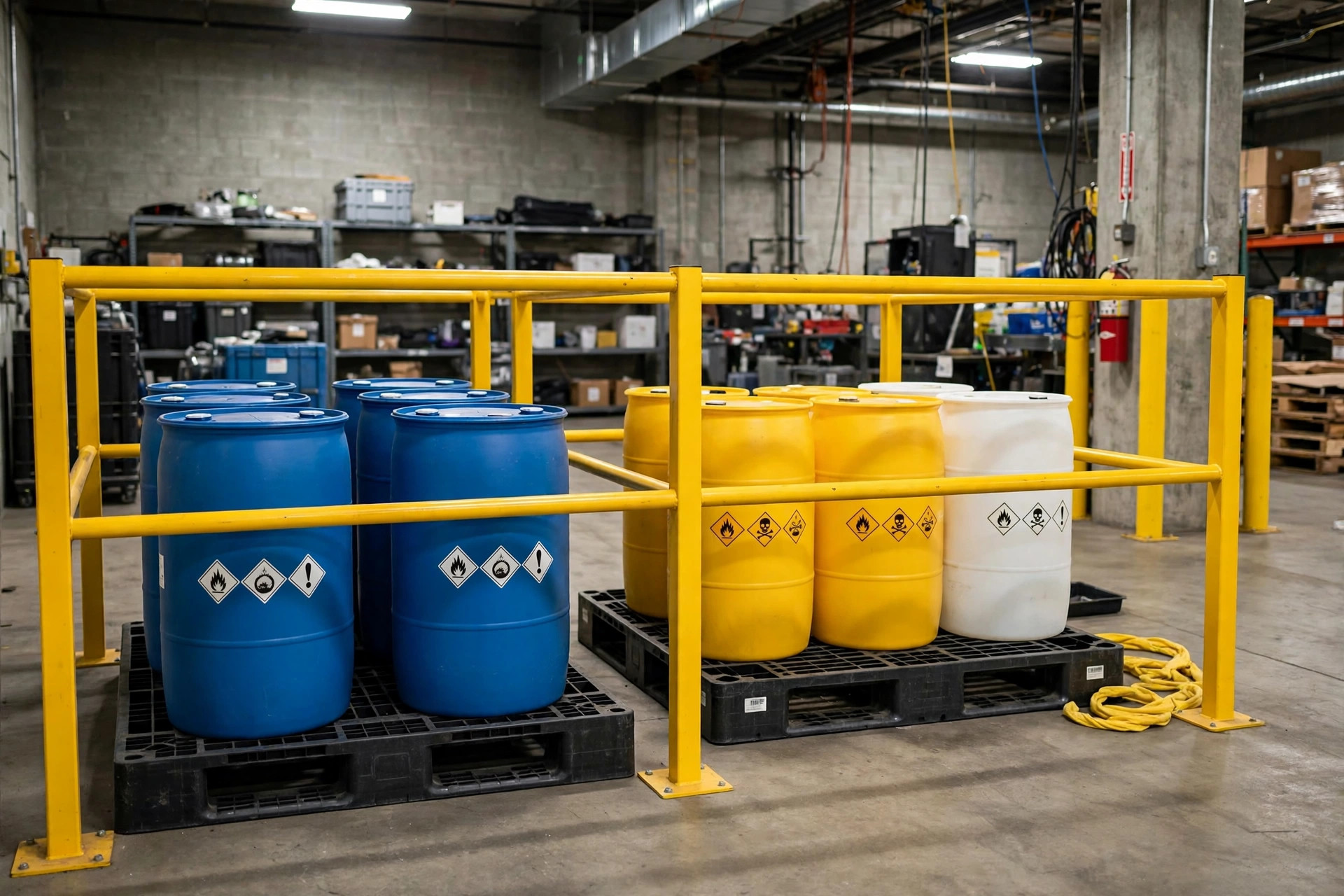
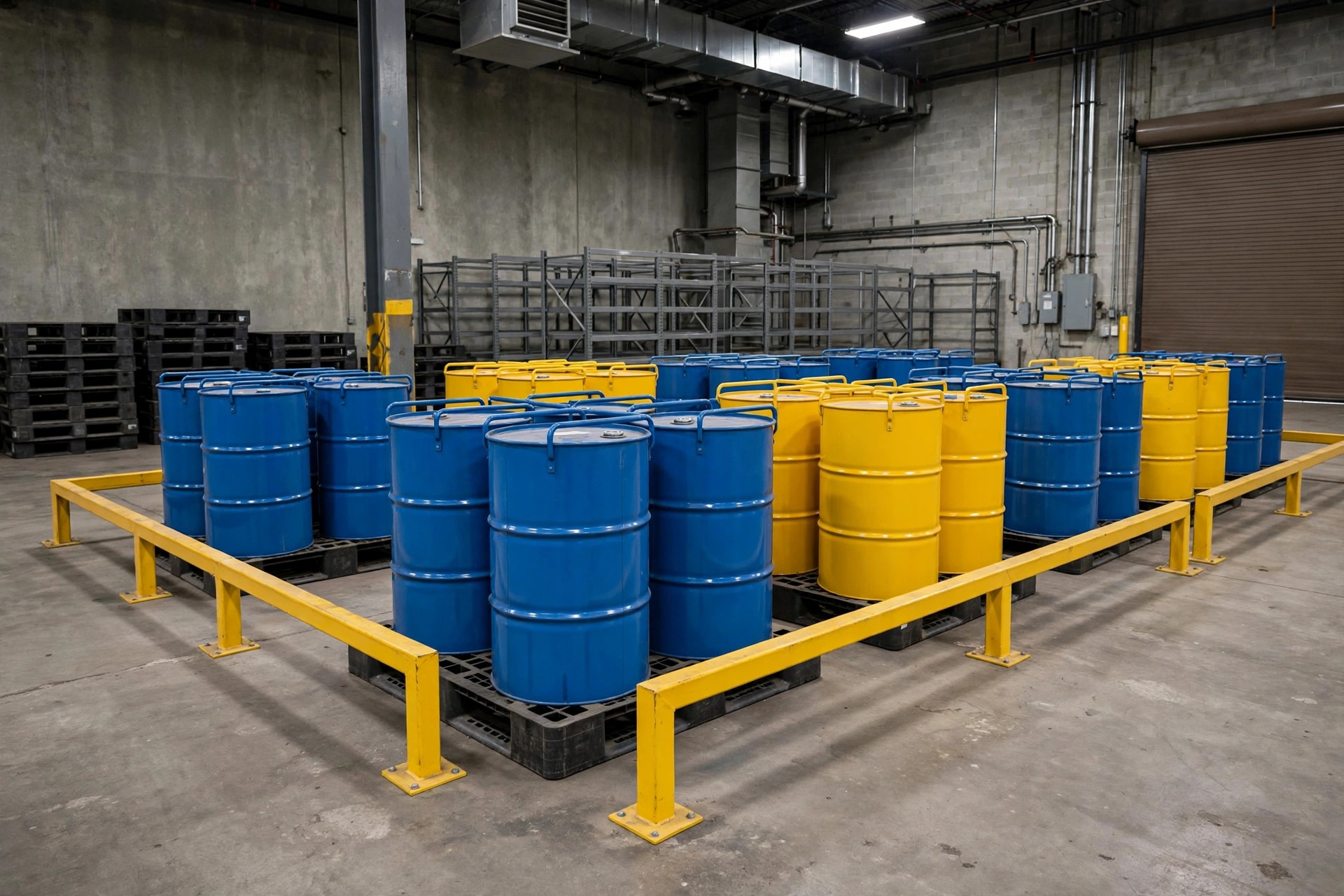
Color-coding is a helper, not a system. I've walked too many warehouses that sort by drum color — blue drums here, yellow drums there, looks tidy — and then I open the SDS and find acids and oxidizers sharing a color row. Tidy is not the same as safe.
Three places where people copy the chart wrong, and I've watched each one happen.
First, read Section 10 of the SDS — "Stability and Reactivity" — not just the pictograms on page one. The incompatibility list usually lives in Section 10. Some manufacturers write it in detail; some write one lazy line like "avoid contact with oxidizers." When it's vague, go with the strictest reading: anything the SDS flags as incompatible gets a red X. Better a false alarm than a missed one.
Second, the same product name from a different manufacturer can be a different hazard class. One maker's "cleaner" might be neutral; another's might be strongly alkaline. Build the chart from this shipment's SDS, not from the product name. New supplier, new batch, re-check the class. I learned this one the hard way at a consumer-goods warehouse: they switched cleaner suppliers, same name, formulation went from mildly alkaline to strongly alkaline, and the acid-base separation nearly became decoration.
Third, mixtures get classified by their most dangerous component. If a drum contains any oxidizer at all, the whole drum is managed as an oxidizer. This is where wishful thinking creeps in: "it's only a few percent, it's fine." Fine is not your call — chemistry's call. Classify by the worst component. Non-negotiable.
All three of these came from real chart-building sessions with clients. The chart itself isn't hard to draw. The hard part is making "check every single shipment" a habit. My low-tech fix: a card taped next to the receiving computer with three lines — "Did you read SDS Section 10? Does the class match the location label? Are the red-X pairs separated?" Receivers glance at it for every load. Beats any training deck.
Three combinations that must never sit together
First: oxidizers with organics. That's the lesson from Zone B that night, and the combination I see go wrong most often. Pool chlorine tablets, nitrate fertilizers, hydrogen peroxide — oxidizers don't burn by themselves, but they're accelerants. Put them next to organics — cardboard, wood pallets, paint, grease — and you've handed fire a ladder. Some pairs sit quietly at room temperature and start reacting once they get damp or warm. My crude-but-effective test: walk your hazmat zone and look for yellow and blue drums side by side. Color is just a clue — confirm the class in the SDS before you call it safe.
Second: acids with bases. Hydrochloric and sulfuric acids mixed with caustic soda or ammonia solutions react violently — heat, splashing liquid, choking fumes. A lot of warehouses file everything under "corrosives" as one big family. That's wrong. Acids and bases need real separation between them. I saw an auto-parts warehouse that kept acids on the left and bases on the right with a single forklift aisle between them. One sharp turn, one knocked-over drum, and half the aisle was white smoke. After that, they moved to separate rooms. Remember: one aisle is not separation. It's reassurance theater.
Third: lithium batteries with combustibles. Battery freight keeps growing — power tools, energy storage, e-scooters, every warehouse takes them now. Lithium batteries fear thermal runaway: one cell goes, dozens follow, and water won't put it out. The battery area gets its own zone, away from cartons, wood pallets, and packing materials. My rule for clients: keep a clear ring around the battery area, even if it wastes a few square meters. Empty floor in a hazmat zone isn't waste. It's insurance.
Where daily discipline breaks down
Posting the chart is the beginning. I've seen too many warehouses that made the chart, posted it, and had an incident three months later anyway. Discipline always breaks in the same two places.
One: labels that don't match the SDS. New arrival comes in, the receiver goes by memory — "looks like last month's batch, put it with those." Meanwhile the manufacturer changed the formulation, the SDS updated, the class changed, nobody noticed. My requirement: every hazmat inbound gets its SDS hazard class checked against the location label before it goes on the rack. Two extra minutes. Saves you a 2 a.m. phone call.
Two: "just temporary." Peak season, the hazmat zone overflows, a driver stages a few pallets in a regular aisle — "we'll move it tomorrow." That tomorrow routinely becomes three days, a week. Temporary staging shows up in a shocking share of mixing incidents. My rule is absolute: there is no such thing as a "temporary" hazmat location. If the zone is full, cap inbound. Never let "temporary" become permanent.
When I prioritize a cleanup, the order is: first, re-group everything by class and immediately separate any red-X pairs that are already adjacent — that's firefighting. Then post the chart and train the receiving and forklift crews — that's the system. Finally, write the "no temporary staging" line into the performance standards — that's relapse prevention. Don't reverse the order. Moving freight comes before debating procedures, not after.
One thing you can do tonight: have the night supervisor walk the hazmat zone and look at just one thing — anything sitting together that looks wrong. Instinct is right more often than people think. If it looks off, check the SDS. Ten minutes. The compatibility matrix in its final form isn't paper on a wall. It's a reflex in everyone's head. Paper fades. The reflex can't be allowed to.