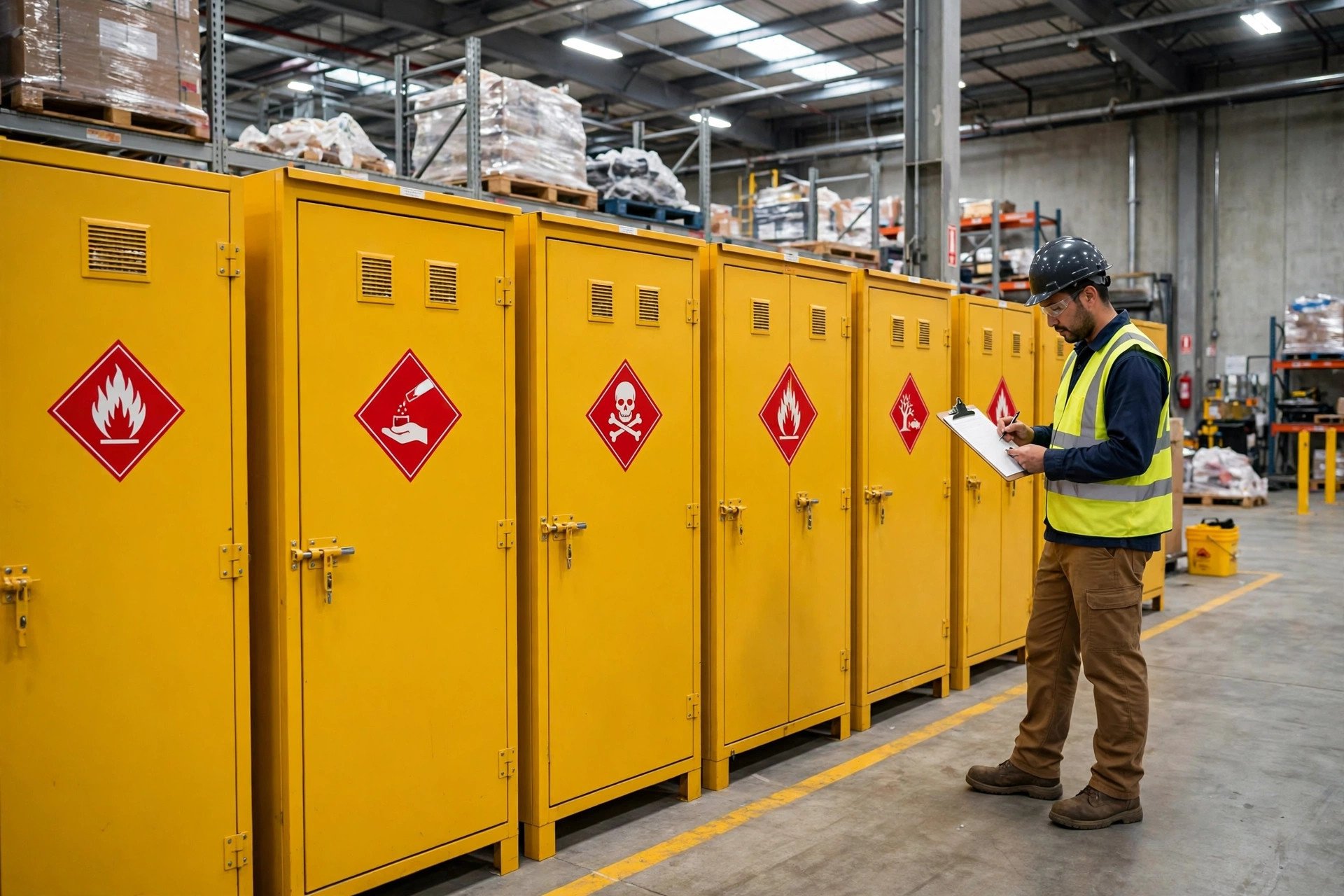
November last year. The week before Black Friday. 5:50 in the morning, shift change — and a perfect example of why people keep googling "how often is DOT hazmat training required warehouse".
I had barely walked in when Zhang — our hazmat-area forklift guy, nine years on the floor — pulled me over to a rack. "Boss, look at what the new kid stacked." Two pallets of industrial cleaner, one acid-based, one chlorine-bleach-based, side by side. I asked Xiao Li: "You know what happens if these two leak together?" He shook his head. "Nobody told me." I asked: "Did you finish your training?" "Four months in. Still waiting for a slot."
That morning scared me — not because of the kid, but because I realized I, the warehouse manager, had the DOT training timeline backwards.
If you've ever googled "how often is DOT hazmat training required warehouse", here's the short answer: new hires finish initial training within 90 days; everyone retrains at least every 3 years. But those two lines are full of traps, and we've stepped on all of them.
How Often Is Training Required? Start With the 90-Day Line
Most managers hear "90 days" and think: "Great, a 90-day grace period for new hires." Wrong. Completely wrong.
49 CFR 172.704(c)(1) says a new hazmat employee — or one who changes job functions — may do hazmat work before finishing training only if: they're under the direct supervision of a properly trained, knowledgeable hazmat employee, and the training is completed within 90 days of hire or the job change.
Those 90 days aren't a vacation. They're a countdown. On day 91, an untrained worker can't touch hazmat work. The word "grace period" does not appear anywhere in the regulation text.
Our warehouse had it backwards for years. Xiao Li went four months without a training slot while working the hazmat area daily. Zhang "supervised" him — while also driving a forklift. That's not direct supervision. New rule: new hires get general-awareness and safety in week one, function-specific on the floor with a mentor, the 90-day deadline as a hard stop. HR sends me a Friday sheet: who's at how many days, how many left. Seasonal temps too — a temp who labels hazmat drums is a hazmat employee. Same 90 days.
Because the definition is wider than most people think. Under 49 CFR 171.8, a "hazmat employee" is anyone whose work directly affects hazmat transportation safety — loading, unloading, handling, packing, labeling, preparing shipping papers, driving. Job title doesn't matter. Half the warehouses I've visited think only the two guys running the hazmat cage need training. They're missing half the building.
How Often Is Retraining Required? Every 3 Years, Full — Not a Refresher
This is the easiest thing in the whole regulation to get wrong — and the most expensive.
Section 172.704(c)(2): a hazmat employee must receive "the training required by this subpart" at least once every three years — all applicable modules from paragraph (a), run in full, not a 30-minute online refresher. We used to do a one-hour online "recap" and hand out certificates. A compliance consultant said: an inspector will treat those as if they don't exist.
Two details. Write them down.
First, the three-year clock starts on the actual date training was completed (PHMSA's official guidance) — not the hire date, not the calendar year. Trained March 10, 2023? Next one due no later than March 10, 2026. A day late is a day late.
Second, no grace period. And (c)(4): the employer is responsible "regardless of whether the training required by this subpart has been completed." Not finishing doesn't excuse you. Push retraining to "after peak season" and the inspector shows up that week — one visit wipes out years of training budgets.

Our Fixed Routine: The Training Matrix on the Wall
After enough traps, I put every hazmat-related job on one sheet and pinned it to the office wall:
| Job | Hazmat employee? | Required modules | Cycle |
|---|---|---|---|
| Hazmat-area forklift / staging | Yes (loading, handling) | All 5 modules | Initial within 90 days; full retraining every 3 years |
| Labeling / packing | Yes (labeling, packaging) | Awareness + function-specific + safety + security awareness | Initial within 90 days; full retraining every 3 years |
| Outbound paperwork / shipping clerks | Yes (preparing shipping papers) | Awareness + function-specific + safety + security awareness | Initial within 90 days; full retraining every 3 years |
| Hazmat cage keeper | Yes | All 5 modules | Initial within 90 days; full retraining every 3 years |
| Drivers (own fleet) | Yes | All 5 modules + driver training | Initial within 90 days; full retraining every 3 years |
| General warehouse staff (no hazmat contact) | No | None | — |
The five modules, decoded from the legalese:
- General awareness: the hazmat classes, what the labels look like, who to call. First week for every new hire.
- Function-specific: tied to your job. Labelers learn the 172.400 series rules; shipping clerks learn the paperwork. Mentored, on the floor.
- Safety: emergency response, PPE, the first thing you do in a leak. We run a spill drill every six months on top of formal training.
- Security awareness: theft, tampering, where to report something suspicious. Everyone.
- In-depth security: only for jobs under a security plan. With its own 90-day rule — when the plan is revised, affected employees retrain within 90 days of it taking effect, no waiting for the 3-year cycle. We revised ours in June 2024; all 17 affected people were retrained within two months.
Job Changes Reset the Clock, and Records Need Five Things
Two things people always miss. Calling them out separately.
One: a job change restarts the 90 days. Old Wang worked general merchandise five years, then transferred to the hazmat cage last September. HR said "he's a veteran." Wrong — 172.704(c)(1): a new job function means 90 days to train for the new function. Wang's old records don't count. Our transfer form now asks: "Does this change hazmat functions?" Yes means the countdown starts.
Two: records need five elements. Section 172.704(d) requires: name, most recent training completion date, training materials (description, copy, or location), trainer name and address, and certification that the employee was trained and tested. Keep records as long as the person is a hazmat employee plus 90 days after they leave or transfer out, covering the preceding three years. This is the half of "how often is DOT hazmat training required warehouse" most people miss — the cycle and the records come as a pair.
This March, a DOT inspector walked in and asked for the records of 12 hazmat-area employees. Three were past their 3-year deadline (one by two months); two records were missing the trainer's address. After that, our admin built a shared sheet — one row per person: name, job, last training date, next due date, days remaining. Under 60 days yellow, under 30 red. I check it Monday mornings. Two minutes.
One money-saver: (c)(3) lets you credit training from a previous employer with a current record from them. Our new cage keeper's general-awareness and safety records from his old 3PL were still current — we accepted them and cut his training time in half. "Current" is the key word. Expired records don't count.
The Honest Trade-off
I know what a lot of fellow managers are thinking: a 200-person warehouse, 30-plus hazmat roles, full retraining every three years — that's real money and real downtime. Worth it?
Full retraining runs a few hundred dollars per person with an outside instructor. Thirty people, every three years: low five figures — a few thousand a year amortized. Compare that to one failed inspection — remediation, downtime, fines assessed per violation per day (see the regulation text for the current schedule): at least an order of magnitude more. And that's before any incident. If Xiao Li's pallets had actually leaked, we'd have evacuated half the warehouse during peak; the delayed orders alone would cost more than a decade of training.
But don't turn it into "train everyone every year" theater. My formula: initial training strict (90-day hard deadline, safety in week one), recurrent training precise (full retraining every 3 years, warning at 60 days out), a semi-annual spill drill in between. Done right, training is a cost, not a burden.
One reminder — tonight: pull every hazmat-role employee's "most recent training completion date" and subtract it from today. Anyone past three years, anyone past 90 days without initial training: make the list, put it on tomorrow's agenda. That's how often is DOT hazmat training required warehouse — two lines plus the records rule. Inspectors don't call ahead.
By Chen Feng, Warehouse Operations Manager