Bottom line first: Greece feta cheese export warehouse storage is won or lost inside the warehouse, not at the port. If brine is not controlled, a barrel lid is not sealed tight, and cold-room temperature keeps swinging, no paperwork at the destination will save the shipment. I have seen this pitfall three times, and every time the problem surfaced on the night before loading, when fixing it cost more than storage for the whole shipment. What follows is a working method: conclusion first, reasoning second, then a step-by-step list and the failure points teams miss.
Brine and Temperature: The First Gate
Feta leaves the dairy in brine, and that brine is both its protection and the hardest thing to manage in storage. Weak brine lets texture turn soft and flavor drift. Strong brine makes the surface hard and sharp, so the buyer's first taste on opening a barrel is already disappointing. Temperature works the same way: too cold, and the cheese dries and crumbles; swinging warm and cold, and brine conditions change again and again, so texture suffers long before shelf life runs out.
My rule is to split the warehouse into three zones on arrival: quarantine, qualified, and exception. Every barrel gets two labels, one for batch and arrival date, one for brine result and next review date. That review date is not decoration: when it arrives, someone must inspect the barrel, even on a busy loading day. Too many teams write the date into a spreadsheet and never act on it. The pre-shipment checklist should start with four questions: who reviews tomorrow, which barrels, where the result goes, and who decides when something looks wrong?
In September 2024, I watched this at a mid-sized dairy warehouse near Thessaloniki. An export order of 12 tonnes was packed into 240 barrels for sea freight. The team checked barrel count on arrival but never checked brine. On the night before loading, a spot check found 38 barrels with aging lid seals and brine about two finger-widths below normal. Vibration and temperature change in transit would almost certainly have caused leakage and flavor transfer. The team worked through the night replacing seals, topping up brine, and rechecking all 240 barrels. Loading slipped by a day and a half, and overtime, a changed sailing, and repeat inspection together cost more than two months of cold-room rent. The lesson entered the plant's checklist: seals are replaced by batch schedule, never by gut feeling.
From Receiving to Loading: A List With No Skipped Steps
This is the list I use most often for Greece feta cheese export warehouse storage. Follow it, and most big failures stay out of reach.
First, check three things on receipt: barrel count, batch number, and barrel condition. Dented barrels, salt crust around the lid, or unreadable labels go to quarantine, not the qualified zone. If the count does not match, stop and find the reason before booking anything in.
Second, store by batch: one batch per row, with an inspection aisle between batches. Mixing batches to save space feels efficient until loading day, when the team spends hours hunting for the right barrel. Pick one wrong barrel and batch traceability breaks.
Third, use two people for brine and temperature checks: one measures, one records, both sign. Temperature records must show the full daily range, not just the highest reading. When the range is wide, check door-opening frequency and the refrigeration unit first, not just the setpoint.
Fourth, pick by batch at loading, first in, first out, with one deliberate exception. If a barrel fails review, hold it back even if it arrived first. Shipping a doubtful barrel just to protect first-in, first-out order turns a small problem into a rejected shipment.
Fifth, do one more open-barrel spot check before loading, at a rate fixed in advance, not decided on the day. Mark barrels already opened, so the team neither repeats checks nor misses barrels.
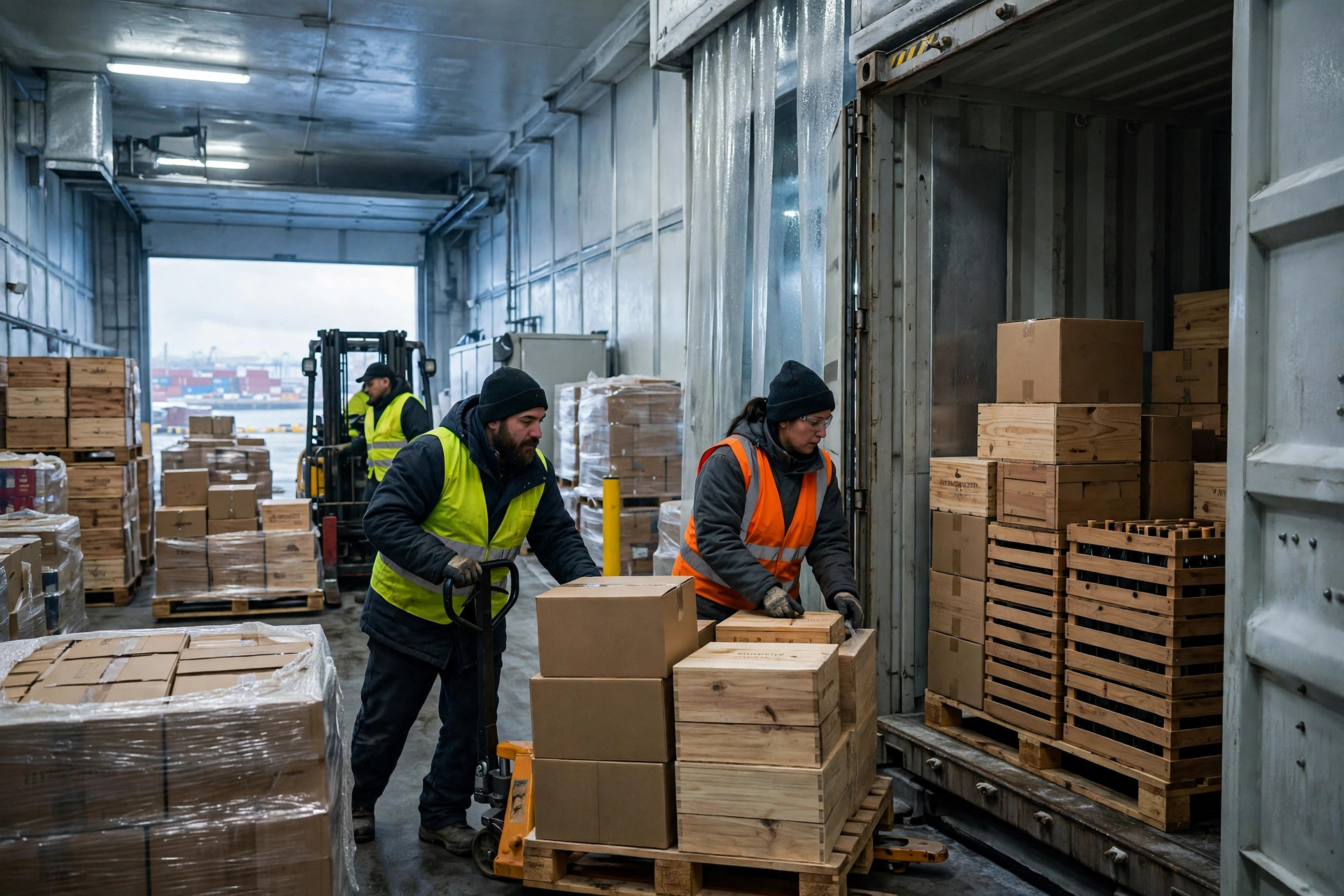
In March 2025, a third-party cold store near the port of Piraeus, outside Athens, took in a 6-tonne shipment in 120 barrels for a long-distance market. To meet a sailing deadline, picking and loading were set for the same morning. During loading, the team found 11 barrels whose label batch did not match the system batch: the night shift had swapped two pallets from neighboring batches. Because the pre-loading spot check existed, the error was caught inside the warehouse, not at the port. Without it, the buyer would have had good reason to hold the whole shipment. Afterward the cold store changed two rules: neighboring batches are separated by one empty row, and picking-sheet batch numbers are printed large, with the picker reading the number aloud before moving a pallet.
The Three Failures I See Most Often
The first failure is treating the cold room as a safe. Once goods are inside, the team assumes the job is done and stops watching brine, seals, and batch positions. A cold room only slows change; it does not manage change for you. My requirement is a fixed weekly walk checking only four items: brine, seals, temperature range, batch positions. A longer list does not get filled in; a shorter one does not control risk.
The second failure is releasing on quantity alone. The count matches, so the shipment goes, even though the batch is wrong. Export buyers care most about traceability: when they ask which batch a barrel came from and the answer does not add up, responsibility cannot be assigned. The fix is concrete: picking sheet, pallet label, and system record must carry the same batch number, and the loading check must compare all three. Any mismatch stops the load.
The third failure is having no one authorized to stop a shipment. A worker spots a doubtful barrel but will not hold it for fear of missing the sailing. A manager off site cannot judge the problem over the phone. So the doubtful barrel travels with the good ones. I have seen this pitfall three times, and the fix is always the same: name the exception decision-maker in advance, post the name on the wall and checklist, and put the phone number at the quarantine zone door. When in doubt, hold the barrel first and ask second. Never reverse that order.
Here is the counterintuitive judgment: colder is not safer, and saltier is not safer. Extra cold dries and crumbles the cheese; extra salt hardens the surface and sharpens the taste until the buyer's first bite turns against the whole shipment. Real safety comes from stability, not extremes: stable brine, temperature, and batch control beat any single extreme reading. Many warehouses react by turning temperature down and adding salt, which looks like action but covers one problem with another.
Do the Math: Build Your Own Cold Room or Rent Third-Party Space
There is no universal answer. The right choice depends on whether volume is steady, how many batches you run, and whether you need to control exception handling yourself. Use the table below as a decision framework, and fill in your own quoted figures.
| Factor | Own cold room | Rented third-party cold room |
|---|---|---|
| Upfront cost | Large one-time equipment investment | Almost none; pay for what you use |
| Seasonal flexibility | Fixed costs continue in slow months | Scale up at peak, down when quiet |
| Control over batches | Full control; fast exception decisions | Depends on provider process and roster |
| Staff and inspection | You hire, roster, and take responsibility | Provider supplies staff; standards must be in the contract |
| Best for | Steady volume, many batches, long-term export | Volatile volume, early stage, market testing |
When you run the numbers, do not count rent and power alone. Add three hidden costs: rework the night before loading; a shipment held for batch questions, in delay as well as money; and labor for weekly inspection and brine review. Once included, many options that look cheap stop looking cheap. My rule of thumb: if monthly volume swings widely, with two or three near-empty months a year, rent first. If volume has been steady for six months and batch control is demanding, consider building. Reverse that order, and slow-season fixed costs will eat the margin.
One last note for the night before loading. Do not only ask whether the goods are ready. Ask four questions: has the brine review been done, and where is it recorded? Has the temperature range been reviewed, including any abnormal period? Do the picking sheet, pallet label, and system record agree on batch, with doubtful barrels held back? Has the exception decision-maker been contacted, and who is on site tomorrow? When all four are confirmed, sign the release. That signature is not paperwork; it is the last responsibility you carry for that shipment. When Greece feta cheese export warehouse storage is done solidly, the second half of the export journey has a real chance to go well.
By Lin Xiao, WMS Implementation Consultant