Conclusion first: Cote d'Ivoire cocoa export warehouse storage is not won on floor space. It is won on three details done properly — drying, grading, and shipment handover. If any step is handled loosely, the result is rework, arguments, or worse: a whole batch questioned at the destination port.
Why start with Cote d'Ivoire? It is the world's largest cocoa producer, and its export trade runs mainly through two ports, Abidjan and San Pedro. Huge volumes, a concentrated main season, and two main exit ports shape the warehousing logic. In the main season, beans arrive like a tide, straining port, trucks, and warehouse at once. I implement warehouse systems, so I check first whether the paperwork closes the loop, then whether the floor follows it. Once a bag loses its identity, finding it again means opening bags by hand.
Here are two scenes I have actually seen.
The first was near Abidjan. One main-season morning, dozens of pallets arrived at once, trucks queued at the gate, and the crew was only the usual size. To keep up, the supervisor moved a few pallets that had not fully dried into the ready-to-ship area, noting only the batch number, with no drying recheck recorded. Days later, a pre-loading spot check found damp bag mouths and sticky beans. The pallet was opened and rechecked, loading slipped a day, and rework stock briefly sat beside good stock — only the batch paperwork kept them out of the same container. I have seen this pitfall three times, and the cause is always the same: one skipped drying recheck, paid for later with three times the labour.
The second scene was toward San Pedro. Port congestion pushed vessel schedules back, export stock piled up at the gate, and space suddenly ran short. Without waiting for a clear vessel date, he moved graded, fully documented stock to the dockside, pushed ungraded stock to the back rows, and isolated failed stock. When the schedule recovered, dockside stock loaded at once. The lesson is direct: in a congested season, locations should be planned by whether stock can ship right now, not only by first-in, first-out.
Cote d'Ivoire Cocoa Export Warehouse Storage Starts with Drying
After fermentation, cocoa beans must be dried. Beans stored before they are properly dry carry the mould risk in with them. So the first receiving check is not counting, but dryness. Five steps, each leaving a trace on the batch paperwork:
- Check the bag first. Torn, damp, or muddy bags go aside on their own, and the bag mouth must be tied tight. Damaged bags are the first to go wrong.
- Sample bags for dryness. Open a share of bags from each batch, and look at, squeeze, and smell a handful of beans. Sticky, soft, or mould-smelling beans go straight back for rework. A warehouse is not a drying yard.
- Record the recheck: who, when, which bags, and the result. A batch with no recheck record does not enter the ready-to-ship area.
- Zone the stock. Dried stock goes to the grading area. Failed stock goes to a separate rework isolation area, with a real physical gap between the two. The isolation area gets a board showing the batch and the reason for rework.
- Patrol the isolation area daily for more damp, smells, or mistaken moves.
Here is a counter-intuitive judgement: the most dangerous time is not a rainy week, but a sunny spell when everyone relaxes. In the rain, people stay careful. In fine weather, they assume the beans must be dry, and the recheck becomes a formality. That is exactly when under-dried stock slips through.
Cocoa Export Warehouse Grading: Bags, Labels, and Batches
Once drying passes, grading begins. For the warehouse, grading comes down to three things that must match one-to-one: bags, labels, and batches.
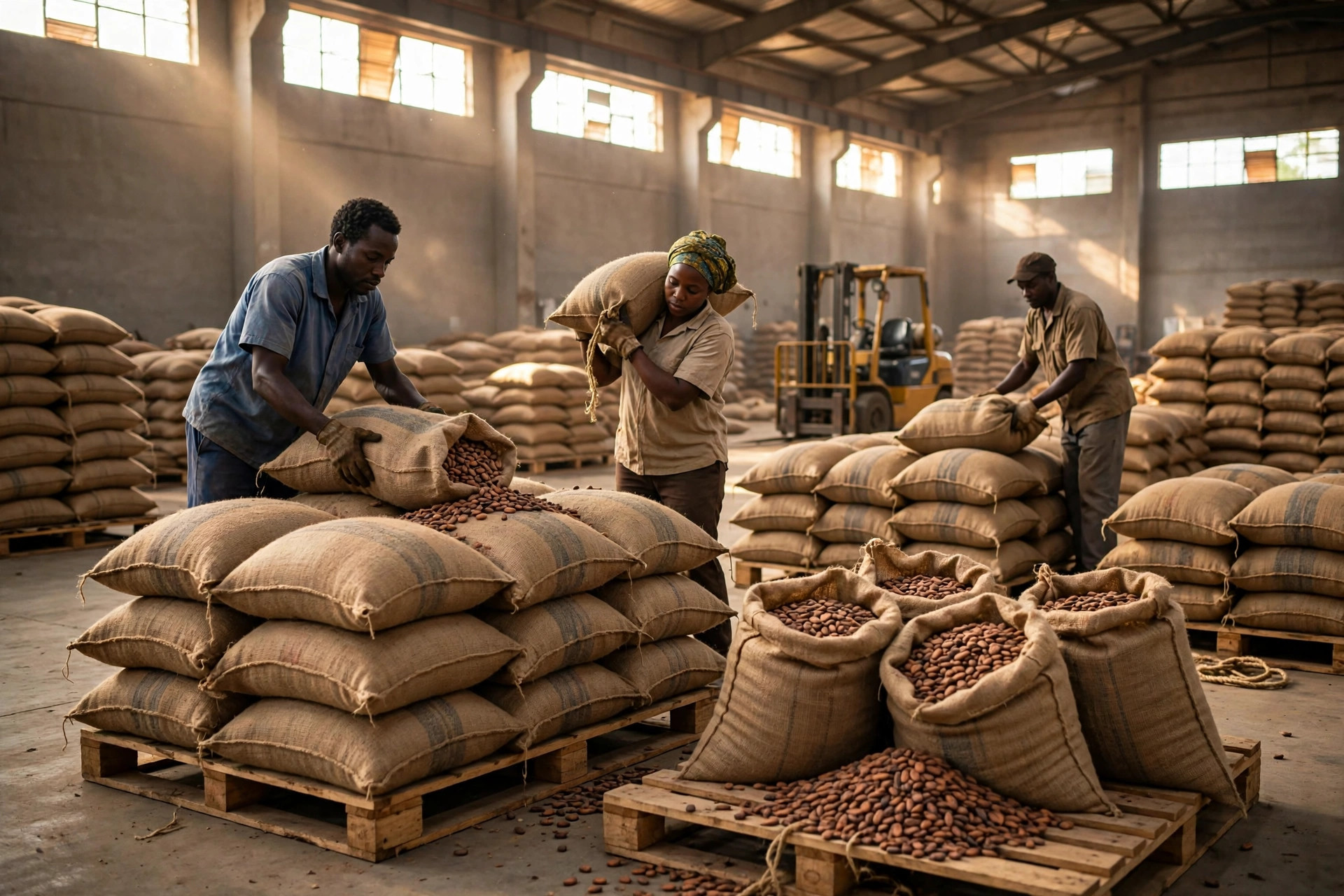
Cocoa beans are normally packed in jute sacks, and the sack itself must be clean, dry, and free of strange smells. A smelly sack taints its beans, and one tainted sack can spoil a pallet. Dirty, damp, or torn sacks get replaced, and the replacement is recorded on the batch paperwork.
Labels come next. My rule is one label per pallet, placed where it can be seen from outside, showing at least the batch number, the grading result, the drying recheck result, and the receiving date. A label hidden in the gap between two pallets is the same as no label, because nobody will move a whole pallet just to read one.
Batches are the third item, and the easiest to get wrong. When one batch arrives in several deliveries, or one pallet holds two batches, the paperwork must say so, separately. Mixed batches are not the problem. Unrecorded mixing is. If a container is declared as one batch and a destination check finds otherwise, the whole container is dragged into the dispute. Batch numbers only move forward; changing one needs approval and a change record.
Moisture and Mould: Three Lines of Defence in the Warehouse
Cocoa beans hate damp, so moisture defence needs three lines, and none of them can be skipped.
The first line is the floor. Stock always sits on pallets. Sacks never sit directly on the ground. Floor damp is the most common cause of wet stock, especially in the rainy season, when the floor can look dry while damp creeps up under the pallet. The pallet itself must be dry too. A wet pallet is like a wet towel under the beans.
The second line is the roof and walls. Before the rainy season, walk the roof for leaks, check the walls for seepage, and check door and window seals. Leaks stay invisible until one heavy storm exposes them. Record what was fixed, and when.
The third line is daily ventilation and patrols. Set ventilation windows by the weather: doors closed in the rain, opened on a schedule in dry weather. Patrol daily, watching pallets near walls, doors, and known leak spots first. A damp bag mouth or mould spot gets isolated and recorded at once.
One trap: dry-season temperature swings can also condense moisture on bag surfaces, so patrols follow the same sheet all year.
Shipment Handover and Main-Season Space: Abidjan and San Pedro
The last link is shipment handover. Abidjan and San Pedro are both main export ports, and which port a shipment uses depends on where the stock comes from, the vessel schedule, and how congested each port is at the time. There is no single permanent answer. The warehouse must keep stock ready to load at any time, not start sorting only when a vessel date is confirmed. Good Cote d'Ivoire cocoa export warehouse storage means the paperwork, the labels, and the location all agree before the truck is even booked.
When port congestion eats into space in the main season, three common space tactics apply:
| Space tactic | When it fits | Cost | Risk |
|---|---|---|---|
| Hold in place and wait for the vessel | Short delay, space covers it | Storage time stretches, dock occupied | A longer delay blocks everything |
| Move graded stock to the dock, ungraded stock back | Space tight but not full | One shift moving stock | Batches can get mixed |
| Ship in parts, send what can go first | Two ports available, some dates confirmed | More truck trips, split paperwork | Split paperwork is easy to mismatch |
Choose by two questions: days of space left, and the share of stock graded, documented, and ready to load. If space holds and ready stock is high, waiting is fine. If space is tight and ready stock is low, move stock early. As for port fees and export charges, these change over time, so check the official source for current fees and taxes rather than relying on old experience for a fixed figure.
The night before loading, tick this pre-shipment checklist: batch paperwork complete, drying recheck recorded, grading labels attached, isolation stock out of the ready area, pallets dry, sacks undamaged. All six must pass before loading is released. Loading the wrong container costs far more than loading half a day late.
Three failure points, briefly. First, sampling only surface bags: sample by batch and position, surface and depth alike. Second, a label on the wrong pallet, system right but floor wrong: recheck labels on the floor before loading, not only in the system. Third, temporary workers who do not know the isolation area: use big, clear signs and a first-day zone briefing before anyone moves stock alone.
To close: a cocoa export warehouse earns its value not by how much it stacks, but by whether paperwork, batches, drying, and grading all line up when the goods leave port.
By Lin Xiao, WMS Implementation Consultant