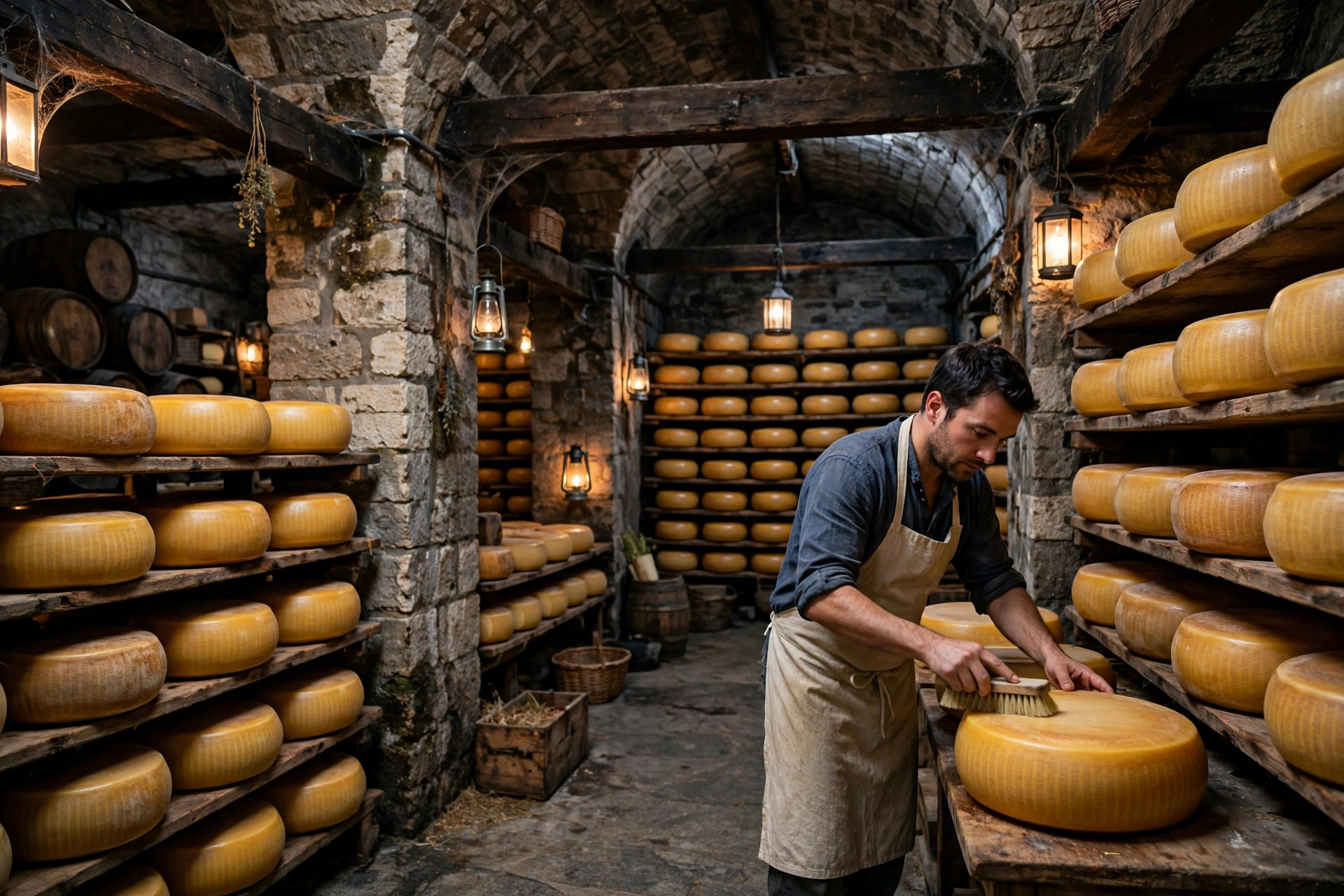
In a stone aging cellar outside Parma, wheels of golden cheese rest on wooden shelves, and a worker moves down the row turning each wheel and brushing its rind. The smell is a mix of mould and milk fat, and the work looks unhurried. Yet Italy cheese export warehouse storage already starts here, long before any ship is involved: every extra month in the cellar is simultaneously a charge for capital, for space, and for risk. That sequence matters more than the ocean freight rate, because once a batch leaves the cellar at the wrong moment, no cold chain further down the line can restore what was lost.
The basic facts frame the decision. Hard cheeses of the Parmigiano Reggiano type are commonly aged from 12 months upward, reaching 24 months and beyond, while another common hard cheese type starts from a shorter minimum. A single wheel weighs close to 40 kilograms, and turning, brushing, and moving it are all manual work. Every row of shelving in the cellar therefore carries real rent and real labour. Before accepting an order, an exporter has to answer one question first: is this batch to be released at 12 months, or is it worth betting on the deeper flavour and higher price of 24 months? The answer changes the whole warehousing account.
The Aging Room Ledger: Why Cheese Cannot Be Rushed
Consider a typical small cooperative near Parma that ages batches of 100 wheels at a time. Releasing at 12 months rather than 24 months changes the account in three places. First, capital is tied up for twice as long, so the same outlay on milk and labour sits in the cellar for an additional year. Second, the cellar space is occupied for that extra year, which pushes back the next batch and reduces how many batches the cooperative can turn over in a given period. Third, handling and loss accumulate with time, because each additional month adds more turning and brushing, and more wear on the rind. The deeper flavour and the higher price on the other side of the ledger are real, but they are bought with slower turnover and a longer exposure to risk. There is no free side to this bargain.
A second scene shows the daily side of aging management. The 100 wheels in one batch do not age in lockstep. Wheels near the door dry a little faster, wheels deeper inside change more slowly, and the worker turning them has to judge from touch and from records which row needs extra attention. If a batch is released purely by the calendar, without regard for how each row has actually developed, the result can be uneven flavour within a single shipment. When the overseas buyer complains, the complaint usually lands on warehousing rather than on production. Seen from a research perspective, the aging cellar is less like a passive store and more like a workshop that is still shaping the product, which means warehousing decisions here directly shape quality.
| Option | Aging period | Capital tied up | Cellar turnover | Main risk |
|---|---|---|---|---|
| Early release | Around 12 months | Shorter | Faster | Shallower flavour, limited price premium |
| Late release | Around 24 months | Roughly doubled | Slower | Accumulated loss, longer capital and market exposure |
The table is not a recommendation to always choose one option. It is a decision framework: work out capital and cellar capacity first, then weigh flavour and price, and finally test whether the buyer is genuinely willing to pay for a longer aging period. If a buyer orders at an ordinary hard cheese price but demands long-aged stock, the account is loss-making from the start, and no warehousing technique can make the time cost disappear.
Italy Cheese Export Warehouse Storage and the Cold Chain Ledger
Once cheese leaves the cellar, temperature control changes character. Inside the cellar the task is stable, cool conditions; after dispatch the task is an unbroken chilled chain, and the handover points between the two are where problems cluster. A common handover looks like this: cheese moves from the cellar to a regional cold store, and the truck temperature, the waiting time during loading, and the queue for cold store intake all have to join up. Any stretch spent at ambient temperature takes value off months of careful aging. The damage is often invisible at the time, because the wheel can look intact while its flavour and texture have already shifted, which is also why responsibility is so hard to assign afterwards.
Here is a counterintuitive finding: for exported cheese, the most expensive part of cold chain management is often not the refrigeration equipment itself, but the waiting and the information gaps at handover points. Equipment can bring the temperature down, but if the dispatch note, the temperature record, and the truck arrival time do not line up, the goods simply wait on the dock, and no equipment is responsible for the temperature during that wait. Experienced exporters align three things before the batch leaves the cellar: the truck arrival window is kept close to the cellar dispatch time, the temperature record runs continuously from the moment of dispatch, and the receiving cold store reserves intake capacity in advance rather than finding space after the truck arrives. None of these steps requires new equipment, yet together they prevent most temperature disputes.
The broader trend points in the same direction. Export warehousing is moving from managing temperature to managing evidence. Buyers no longer ask only whether the goods were chilled; they ask whether the temperature record can be traced segment by segment, and whether a fault can be located to a specific stage when something goes wrong. For smaller exporters this is both a burden and an opening. The burden is that records and procedures have to be brought up to standard. The opening is that whoever completes the evidence chain first gains leverage in negotiation. The cold chain ledger is becoming, in substance, a ledger of trust, and trust is accumulated one documented handover at a time.
Italy Cheese Export Warehouse Storage in the Final Days Before Genoa Port
A final scene takes place near the port of Genoa. A batch has completed aging and chilled transfer, and now waits in a port-side warehouse for container loading. In principle only one step remains, but these last days carry their own management load. The warehouse has to work backwards from the sailing schedule to set intake and loading times, so that goods neither arrive so early that they consume cold store capacity nor so late that they miss the vessel. It has to sort shipments by buyer and destination before loading, so that different batches are not mixed at the container door. And it has to leave time for re-checking and document verification, so that a paperwork problem is not discovered on the day of loading. Failure on any of these points puts the earlier investment in aging and temperature control at risk.
A further trade-off deserves attention: the balance between lead time and flexibility. Sending goods to the port warehouse well in advance gives a buffer if the sailing schedule changes, but it adds cold storage cost and capital tied up in stock. Sending goods close to the sailing date costs less, but a single schedule change can disrupt the whole plan. The exporter's choice usually depends on the buyer's payment terms and on how stable the sailing schedule is, rather than on the warehouse rate alone. In other words, the warehousing decision in these final days is essentially a question of risk pricing: how much is it worth paying for room to respond to change?
Taken together, the three ledgers reveal a wider pattern. The export strength of Italian cheese rests not only on origin and craft, but on whether the aging cellar, the chilled transfer, and the port warehouse connect into a single chain without breaks. If any segment optimises only for itself, the whole chain can end up paying for it. The division to watch is between exporters who manage time, temperature, and documents as one account, and those who still treat warehousing as a temporary step before loading. Whether that chain converges toward larger centralised cold chain systems, or continues as a division of labour between origin cooperatives and regional cold stores, remains an open question, and the clues will be found in the next batch's cellar records and temperature logs.
By Dr. Chen, Supply Chain Researcher