Here is the conclusion up front: warehouse order batching should be sized backward from the pack station, not forward from picking. A batch that comes back from the aisles should feed the pack benches for about 30 to 60 minutes, no more and no less. Pick faster than the benches can pack and the totes simply pile up in the aisle waiting for hands. Every metre saved on walking gets paid back in waiting.
I have seen this pitfall three times. The worst case was a small-appliance third-party warehouse in Guangdong in autumn 2023. The picking lead was strong and grouped 80 orders into one batch. Pickers finished the run in about two hours, pushing carts back to a pack area staffed by only four people. Checking, boxing, and labelling could not keep up. Totes stacked two rows deep around the pack benches, and more than 20 orders were still unpacked at shift handover. On-time dispatch that day was worse than before batching started. Picking was not the problem. The person who built the batch had counted walking distance and never counted pack capacity.
Warehouse Order Batching Starts at the Pack Station
The backward calculation fits on one sheet of paper. Measure real pack throughput first, not the standard rate written in the system. Watch a normal shift and count how many orders one packer completes in an hour, with checking, boxing, and labelling all included. That number is the capacity you plan against.
- Measured orders packed per person per hour
- Number of packers on the shift
- Target feed time of 30 to 60 minutes
- Batch cap = per-person throughput × packers × target feed time
Take a plain example. One packer completes 25 orders an hour, and six packers are on shift, so the team packs 150 orders an hour. At a 45-minute feed time, the batch cap lands near 110 orders. That cap is a ceiling, not a target to beat. Add packers in peak season and the cap rises with them. Lose a packer to absence and the cap drops the same day. The rule has to be written in plain terms: when pack headcount changes, the batch cap changes that day. Carrying yesterday's number into today is how queues form.
Here is the counterintuitive part: a smaller batch can move more orders across a whole day. An 80-order batch sounds efficient until the pack benches jam. Pickers then cannot start the next batch, and the whole line stalls in sequence. A 40-order batch that the benches finish cleanly lets pickers roll straight into the next run. Judge the idea by full-day throughput and on-time dispatch, not by the walking distance of a single trip. A batch that looks slow on paper can be the faster operation in practice, because it never creates a queue.
Warehouse Order Batching Needs an SKU-Overlap Test First
Once the cap is set, a batch still is not ready to release. Check whether these orders genuinely belong together. Grouping only saves walking when the orders visit the same zones and pull the same goods. Forty orders spread across eight unrelated zones still send a picker across the whole building. Grouping them saves one start-up and almost no walking.
My check before release is specific, and I keep it short enough that a lead will actually use it:
- Are the core SKUs concentrated in two or three zones?
- Is the average line count high enough for grouping to matter?
- Has every order that needs separate handling been pulled out already?
- Do all orders in the batch share the same cut-off time?
A cosmetics warehouse in Zhejiang in early 2024 put this check on my go-live list for good. Its orders looked alike, all small items, but the SKUs sat across three floors. Grouped batches sent pickers up an extra floor for a handful of lines. We changed the rule to split waves by floor first, grouping only orders on the same floor, and travel per trip dropped at once. Since then I have held one line firm: orders with weak overlap should stay ungrouped. Small single-order waves beat a forced group that drags a picker through zones it never needed to visit.
| Check before grouping | Pass standard | If it fails |
|---|---|---|
| Pack feed time | 30 to 60 minutes | Halve the batch or add packers |
| SKU zone concentration | Two to three zones | Split the wave by zone, do not force it |
| Cut-off time | Same cut-off for the whole batch | Rush orders go to the fast lane |
| Special handling | Nothing needs separate handling | Pull it out and run it separately |
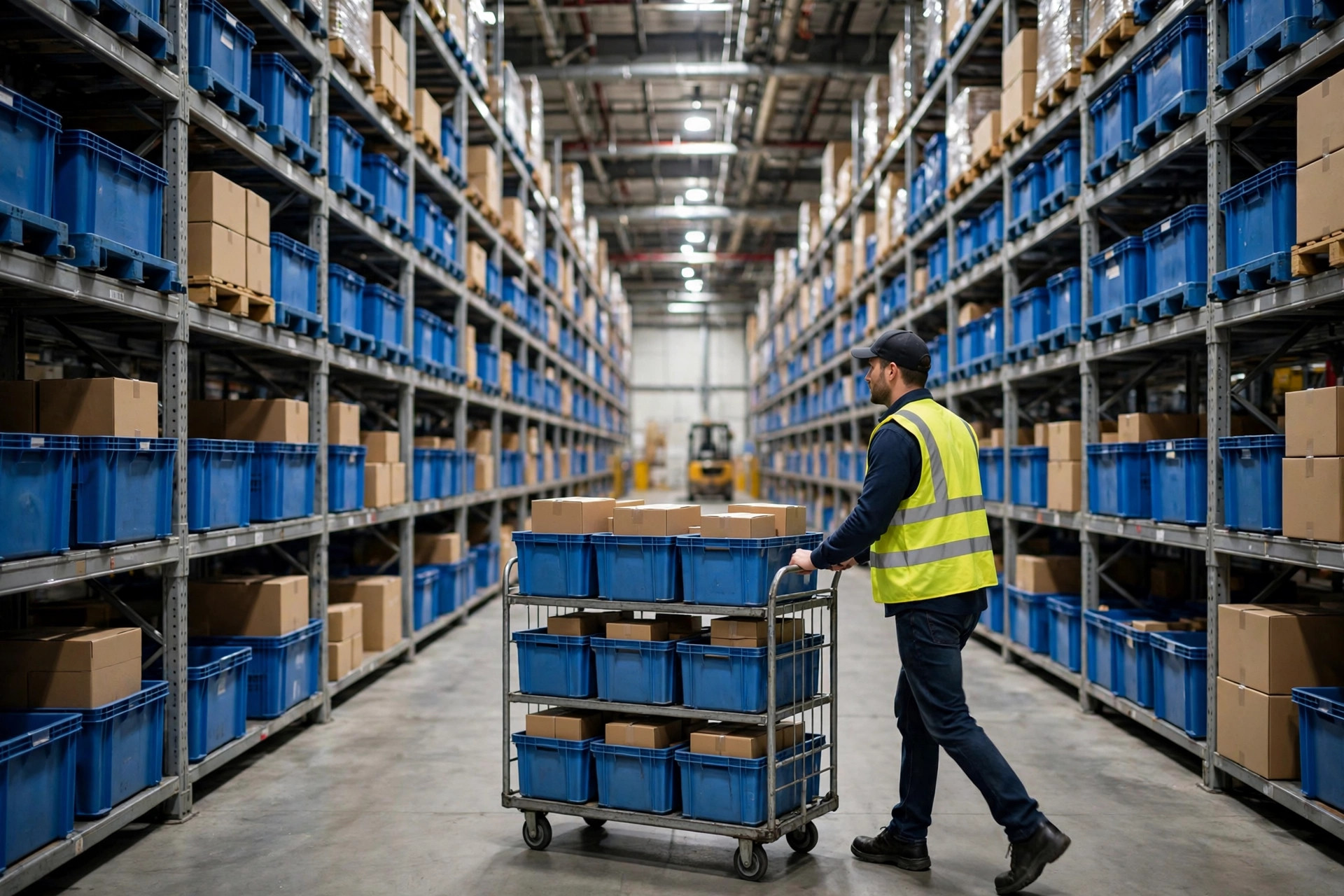
Cart slots deserve the same attention as headcount. A 60-order batch on a cart with 20 slots forces the picker back to the pack area mid-run to unload and start again. Walking saved in the aisle gets spent on unloading trips. When slots run short, cut the batch again or add a cart. Equipment, people, and batch size have to be sized together. Sizing one in isolation guarantees a bottleneck somewhere else, and in peak season that bottleneck will sit at the pack benches.
Orders That Must Never Enter Warehouse Order Batching
Some orders should never enter a grouped batch at all. Forcing them in drags the whole batch down, and the list needs to live both in the system as a hard block and on the wall at the grouping station. People forget lists when the shift gets busy, and I have watched that happen in three separate go-lives.
- First-expired-first-out or lot-controlled orders: these must be picked by designated lot, and a grouped run makes the wrong lot easy to grab and hard to catch at check.
- Oversized or overweight orders: one unit can fill a tote on its own and breaks the loading and packing rhythm for everything behind it.
- Hazardous goods: these must be stored, picked, and packed apart from general goods. Mixing them into a general batch is a safety problem, not an efficiency choice.
- Orders needing extra verification: high-value goods that require a second count will hold the entire batch at dispatch if they ride along with ordinary orders.
Rush orders get their own fast lane and stay out of ordinary batches. A rush order inside a batch bends the rhythm of the whole group around one deadline, while a rush order on its own lane goes straight to the location and to a pack bench that handles it first. Left inside ordinary batches, rush and ordinary orders delay each other, and both miss.
Pulled-out orders still need an owner. In that Guangdong warehouse, the early habit was to set special orders aside until ordinary batches finished, so special orders piled up and were cleared only near the end of the shift. Customer complaints came almost entirely from those delayed orders. We changed the rule so a pulled-out order immediately became its own task with its own picker and pack window, running in parallel with the ordinary batch. An exception is not permission to postpone. It needs its own lane and a named owner, and the grouping lead should check the exception backlog before close of shift. Anything beyond that day's capacity needs extra hands the next morning, not a quiet night in the system.
After go-live, watch three numbers rather than walking distance alone: travel per order, queue time at the pack benches, and on-time dispatch. In the first week of many go-lives, walking looks good while pack queues grow, which means the cap was never adjusted for actual pack headcount. Review the numbers daily, adjust the cap daily, and run a new rule at a small batch size for two weeks before scaling it up.
A workable grouping rule comes down to three usable pieces: a pack-derived cap table, a short overlap checklist, and an exclusion list with its own handling lane. Write them into the system where possible, and keep a printed copy at the grouping station where the system cannot block. Grouping is not about packing as many orders as possible into one run. It is about grouping the right orders, at the right size, so the whole line keeps moving.
By Lin Xiao, WMS Implementation Consultant