When Germany's Supply Chain Act, the LkSG, took effect on January 1, 2023, most warehouse managers I spoke with filed it under "legal's problem." That filing was wrong then, and it is more wrong now. The law started with companies employing more than 3,000 people in Germany; on January 1, 2024, the threshold dropped to 1,000, pulling in warehouses that had never been briefed on a due diligence regime. For many Chinese exporters, the first encounter with the LkSG was not a regulator's letter but an email from a German customer asking for a human rights and environmental due diligence statement, with the quiet implication that next quarter's orders would be reassessed without one.
The law is enforced by BAFA, the Federal Office for Economic Affairs and Export Control, and it rests on nine due diligence measures: a risk management system, a designated human rights officer, regular risk analyses, a policy statement from management, preventive measures, remedial measures, a complaints procedure, due diligence on indirect suppliers, and an annual report to BAFA. None of the nine names the warehouse as its subject. Nearly all of them depend on evidence that only the warehouse can produce. Risk analysis draws on receiving records and supplier files. Preventive measures live or die in the receiving and putaway process. Remedial measures need a paper trail of what went wrong and what was fixed. A complaints procedure is only as good as its ability to hear the people on the floor. The real test of the LkSG is not how well a legal department writes a policy statement. It is whether a warehouse's daily record-keeping is solid enough to stand up when someone asks to see it.
What the Germany Supply Chain Act LkSG Actually Asks of Warehouses
The penalty structure is the right place to start, because it frames everything else. Companies that breach their due diligence obligations face fines of up to 8 million euros, or up to 2% of annual turnover. The turnover-based fine applies only to companies with annual turnover above 400 million euros. Eight million euros is already a serious number, but for a large company, the 2% figure is the one that matters. A company found in breach can also be excluded from public procurement, which can hurt suppliers dependent on German public-sector contracts more than the fine itself.
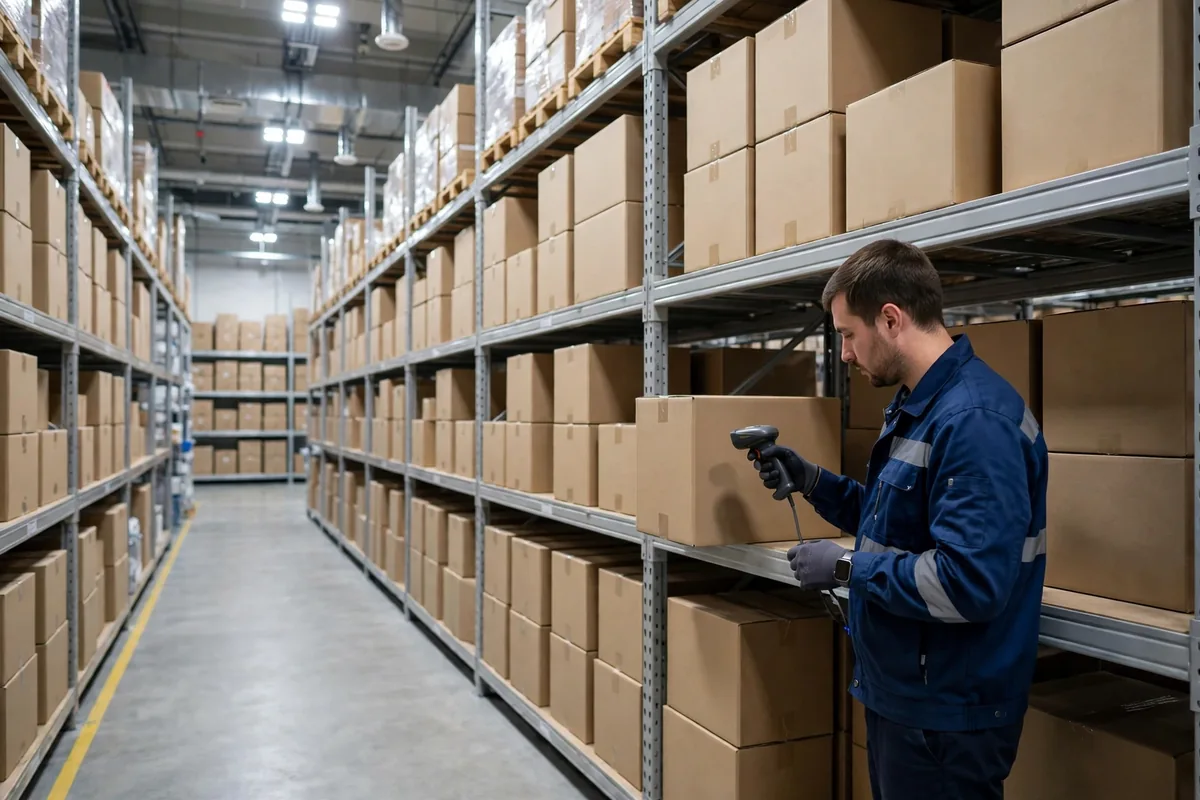
The warehouse's role in this regime can be stated plainly: the warehouse is where the evidence is made. Receiving records prove where goods came from, who delivered them, and when they arrived. Supplier files prove that compliance commitments upstream were put in writing. Temperature, humidity, and working-hours records prove that storage conditions and labor conditions stayed within reasonable bounds. Cycle counts and discrepancy handling prove that anomalies were found, addressed, and logged. On an ordinary day, these records look like paperwork. The moment BAFA asks a company to substantiate its annual report, or a major customer asks for due diligence support, a warehouse that cannot produce them breaks the whole evidence chain. And the chain breaks exactly where the records stop.
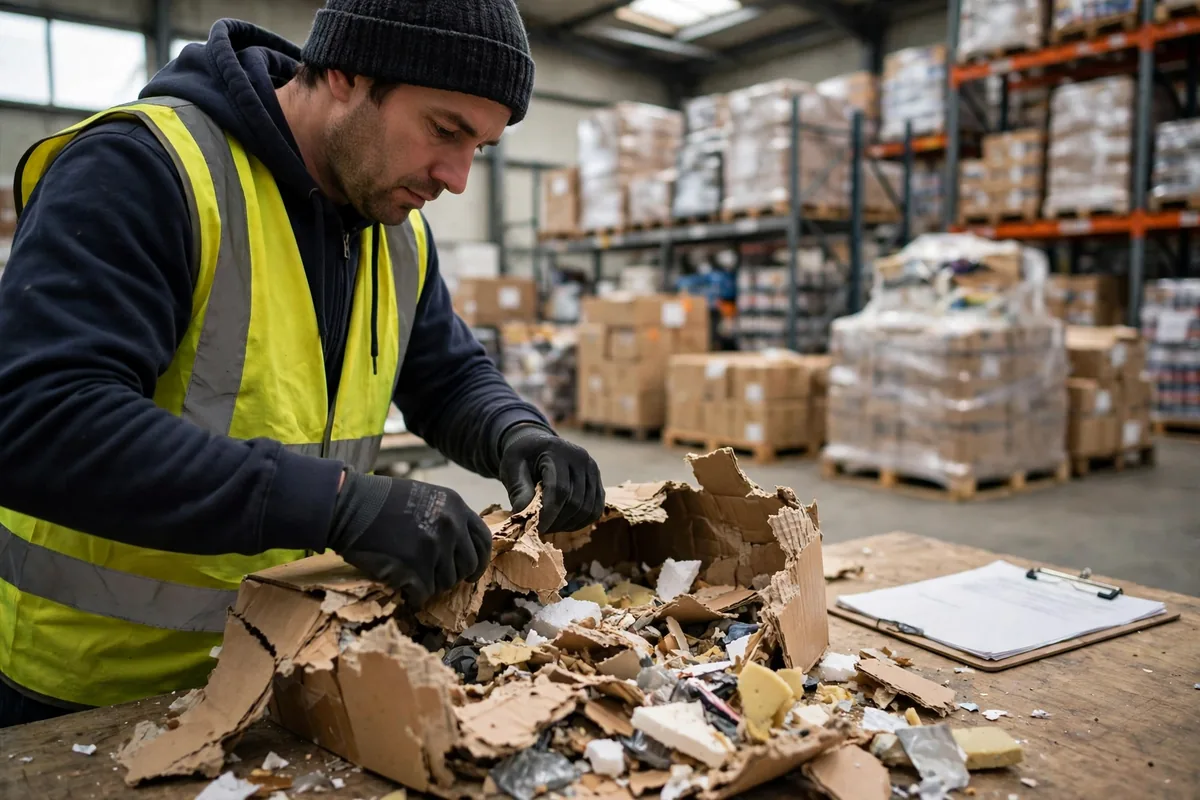
Consider a hypothetical scenario (hypothetical scenario): a German auto parts supplier with roughly 1,200 employees in Germany falls into the LkSG's scope in 2024. Its warehouse handles parts from more than a dozen countries. Some receiving documents live in the WMS; others still sit in paper folders. An internal audit asks the warehouse for a year's receiving records and the matching supplier compliance files. It takes three weeks to assemble an incomplete set. Three shipments have supplier files that do not match the receiving batches. Two shipments are missing several consecutive days of temperature and humidity logs. The audit report does not use the word "violation." It says "gaps in the evidence chain." For the company, that sentence means something concrete: when BAFA asks the same questions, the answers will cost more the second time around.
Where the Supply Chain Act Evidence Chain Breaks, the LkSG Fines Follow
Mapped against warehouse operations, the nine measures produce a self-assessment framework. It is not a restatement of the statute; it is a checklist a company can score itself against, line by line.
| Due diligence element | Evidence the warehouse must hold | The usual breaking point |
|---|---|---|
| Risk management system | Risk grading of suppliers and product lines | Suppliers graded, batches not graded |
| Regular risk analysis | Working papers linking receiving exceptions and complaints | Analysis done once, never updated |
| Preventive measures | Records of receiving inspection and putaway checks | Actions taken, nothing recorded |
| Remedial measures | Records of exception handling and closed-loop fixes | Exception handled, fix never followed up |
| Complaints procedure | Records of frontline feedback received and resolved | An email address exists, no handling trail |
| Indirect supplier due diligence | Source documentation for second-tier suppliers | First tier checked, second tier taken on trust |
| Annual report | Year-round aggregation and archiving of evidence | Assembled at year-end, no archiving habit |
The most underestimated row in that table is the complaints procedure. Many companies treat it as satisfied once an inbox exists. From an evidence-chain perspective, its value is that it catches the earliest signals on the floor: a supplier whose shipments keep arriving damaged, an outsourced shift whose hours keep running past reasonable limits, a storage zone where temperature alarms keep getting silenced. If those signals stay verbal, risk analysis never sees them. Turned around, a working complaints procedure is the cheapest data source risk analysis has.
Now the arithmetic, using only the penalty figures the law itself sets out (hypothetical calculation): take a company with annual turnover of 500 million euros, above the 400 million euro threshold, so the 2% penalty corresponds to 10 million euros. That order of magnitude sits in a different league from the cost of building an evidence-retention system, which is process redesign, system fields, and staff training, spread across quarters as a running cost. A fine is one-off, public, and usually accompanied by lost orders. Many companies misprice this comparison because they treat compliance spending as pure cost and fines as a low-probability event. That math is wrong on its own terms: the probability of a fine may be modest, but once it lands, the loss multiplies, while the cost of an evidence system thins out year by year. The counterintuitive point is this: the most expensive part of compliance is often not the fine at all. It is losing a major customer. A German carmaker does not need to wait for a BAFA penalty to drop a supplier from its list; one unanswered due diligence questionnaire is enough.
What Changes When the CSDDD Takes Over from the LkSG in 2027
The EU's Corporate Sustainability Due Diligence Directive, the CSDDD, was adopted in 2024 and applies in phases from 2027. Its coverage is broader than the LkSG and its obligations heavier. For companies already working through LkSG compliance, the message is unambiguous: the German law is not the destination. It is a rehearsal. The ability to maintain an evidence chain, the granularity of risk analysis, the depth of indirect-supplier visibility — every capability built under the LkSG will be asked for in finer detail under the CSDDD, not relaxed.
For warehouse managers, that carries two implications. First, the earlier the record-keeping habit is rebuilt, the cheaper the rebuild; waiting until the CSDDD timetable presses means paying more for the same change. Second, warehouse evidence standards are becoming the common language of supply chain admission. Today it is a German customer asking; tomorrow it may be a French or Dutch customer, with different wording on the questionnaire and the same underlying questions: where did this shipment come from, whose hands did it pass through, were conditions compliant, and how were exceptions handled.
There is one more trend worth watching: due diligence obligations are shifting from "do you have a system" to "is the system actually running." A polished policy the warehouse's own records contradict becomes evidence against the company. BAFA's enforcement logic points the same way: it looks for the evidence behind the annual report, not the quality of the report's prose. The more complete the warehouse records, the cheaper self-substantiation becomes; the more scattered they are, the pricier every external question gets.
So here is an open question to close with. If your warehouse were asked tomorrow to produce an unbroken evidence chain for the past year — receiving documents, supplier files, temperature and humidity logs, complaint handling — could you deliver it within a week? If the answer is no, you probably already know where the gaps are. Compliance with the Act was never a legal department's job alone. It is the sum of what a warehouse does every day.
By Dr. Chen, Supply Chain Researcher