Start with the bill. Warehouse temporary staffing agency compliance is the question that decides whether temps are actually cheap — and the answer starts with arithmetic, not with the hourly rate. The numbers below are a labelled worked scenario, not measured data from any real warehouse. Suppose a warehouse brings in 40 temporary workers for a peak season, each working 8 hours a day for 30 days — 9,600 hours in total. The staffing agency bills by the hour, the warehouse pays that one invoice, and recruiting, paperwork and turnover are the agency's problem. On that page of the ledger, temps look far cheaper than permanent hires. But that page is only half the account. The other half sits in training, injuries and liability, and it all surfaces the moment something goes wrong in peak season. Anyone who has done cost analysis for a while fears exactly this kind of half-finished arithmetic: the missing half does not disappear, it comes back later under a different name.
The US Occupational Safety and Health Administration worked this out years ago. On 29 April 2013, OSHA launched its Temporary Worker Initiative, built on one idea: the staffing agency and the host employer are joint employers, sharing responsibility for a temp worker's safety and health. A temp is not "someone else's worker" once they are inside your building, moving between your racks. If they get hurt, it is both parties' problem. Plenty of warehouse managers still believe that signing a staffing contract moves the safety duty off their books. That belief is itself the most expensive mistake in the building. A contract can move recruiting paperwork. It cannot move site safety, and OSHA's position has not changed since 2013.
Who Trains, Who Records: Warehouse Temporary Staffing Agency Compliance
The division of duties is clearer than most people think. Site-specific training and personal protective equipment sit mainly with the host employer, because only the host knows how the racks are laid out, which aisles the forklifts use, and which goods throw up dust. The agency's duty sits on the other side: it must understand the conditions at the worksite and verify that the host has delivered the training. It cannot collect a per-head fee and send people in blind. Injury records are the host employer's job to keep, under 29 CFR 1904.31(a). The split, in one table:
| Item | Host employer | Staffing agency |
|---|---|---|
| Site-specific training | Primary duty — knows the site best | Must verify the host delivered it |
| Personal protective equipment | Primary duty — issued for site risks | Must understand conditions, verify |
| Injury recordkeeping | Keeps the records, 29 CFR 1904.31(a) | Supplies assignment information |
| Understanding the worksite before placement | Provides truthful site information | Must actively learn and verify conditions |
The counterintuitive part is that the party paying less does not carry less responsibility. The host pays for hours and carries the primary duty for site safety; the agency collects a service fee and carries the duty of vetting the placement. The most dangerous moment for a temp worker is when each side assumes the other has it covered. A new worker's first day, with nobody explaining aisle speed limits or forklift blind spots, is when accidents tend to happen. Training done on day two instead of day one costs only a few hours more. The risk it carries can be a whole injury.
Where Temp Staffing Savings Actually Live
Temporary staffing genuinely saves money in only three places, and you should name them before you use it. The first is recruiting cost: filling 40 peak-season slots yourself takes weeks, while an agency can place people in days — the saving is time. The second is a buffer against turnover: when orders fall back, you scale the headcount down instead of carrying idle staff. The third is administration: onboarding, timekeeping and payroll chores move to the agency. Those three are visible savings, and they reconcile neatly against the quote.
The invisible money sits on the other side. Undertrained newcomers damage goods, clip racking and misuse equipment, and a single incident can eat months of staffing savings. When an injury happens, compensation, downtime, investigation and higher insurance premiums arrive as a chain, and the bill multiplies. One item is easy to overlook: a forklift operator's evaluation must be carried out on the actual truck type and under the actual working conditions, under 29 CFR 1910.178(l). A worker who has driven a forklift before is not automatically qualified to drive yours. Different truck, different aisle width, different load centre — an evaluation not done on the real truck in the real aisle is barely an evaluation at all. The labour saved by skipping it is a rounding error next to one accident.
The end of peak season brings one more calculation, again a labelled scenario. Suppose 40 temps must be cut back to 12 when orders fall, and the other 28 leave the same day. Under the staffing model, cutting headcount is a phone call to the agency. Cutting permanent staff takes far longer. That flexibility is the real value of the model, and it is worth paying for. But flexibility has a condition: the safety handover on the last day cannot be skipped. Departing workers return protective equipment and access badges, and the remaining crew's roles are re-confirmed. One missed item on the handover list plants a problem for the next peak season.
Four Clauses the Contract Must Contain
When I negotiate a staffing contract, I read the liability clauses before the price. However good the quote looks, vague liability terms make the whole calculation hollow. Four clauses belong in the contract. First, who delivers site training, to what standard, and by when — whether a newcomer is trained on day one or day two must be written down, not assumed. Second, who issues protective equipment, to what standard, and who replaces a missing item. Third, who records an injury, who reports it, who cooperates with the investigation, with recordkeeping resting on the host employer under 29 CFR 1904.31(a). Fourth, what the agency owes before placement — understanding the worksite conditions — and who can send back an unsuitable worker and how fast a replacement arrives. With those four written, the numbers on the quote start to mean something.
The first clause is the one most often negotiated away. At the table, the agency says its people are already trained, the host says it will show them around, and both sides happily write training down as a single vague sentence. The price of that vagueness only appears during an injury investigation, when the first question is what training this worker received before starting, who delivered it, and whether there is a record. No answer, and the balance of responsibility tips immediately. Training records are not paperwork. They are the only evidence you can produce when it matters.
The Forklift Check Cannot Be Skipped
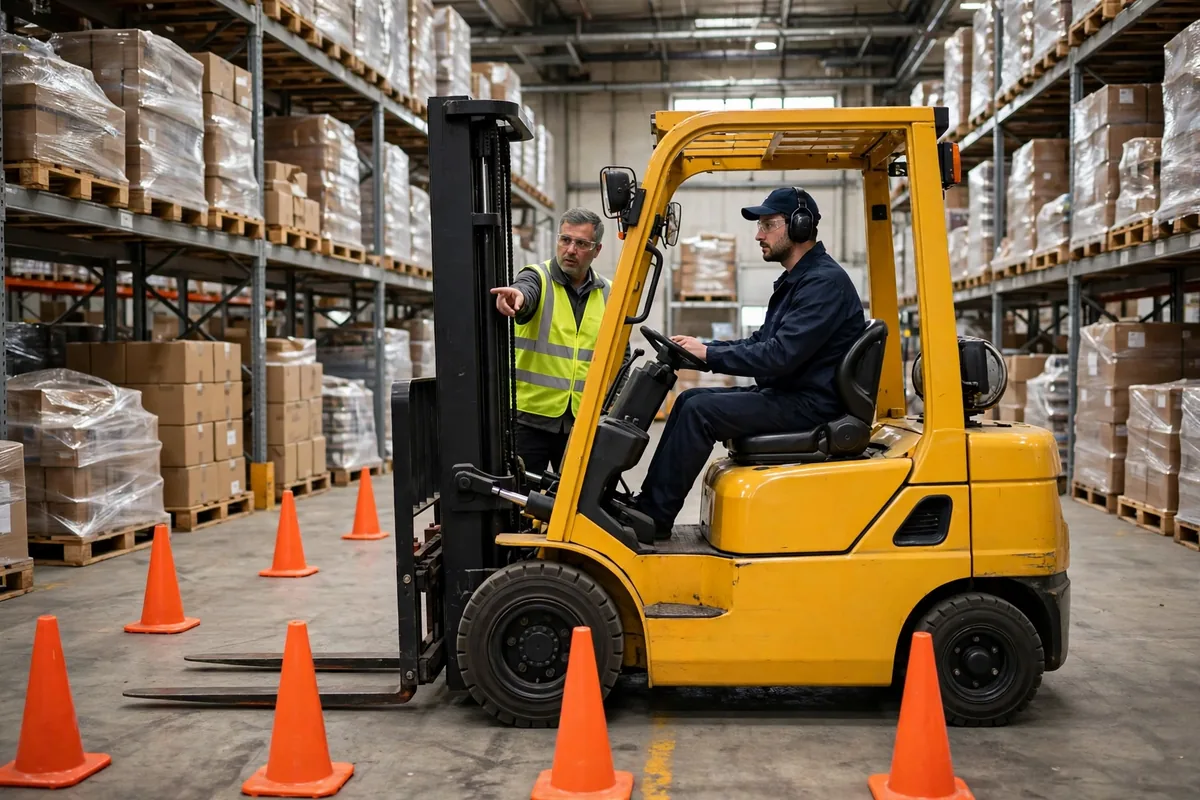
I have watched warehouses treat temp forklift evaluations as a formality: a glance at a certificate, a question about years of experience, and the worker is on the truck. A certificate proves someone was trained once. An evaluation proves they can operate safely on your truck, in your aisles, with your loads. The gap between the two is a live site check, which is exactly what 29 CFR 1910.178(l) is aimed at. The evaluation costs half a day. The accident it prevents costs weeks of shutdown and remediation. The arithmetic is not close. The evaluation must also be documented: who assessed, which truck, which aisle, what load, written down, signed and filed. An undocumented evaluation is the same as no evaluation at all.
Here is a conclusion you can calculate. Warehouse temporary staffing agency compliance comes down to three numbers you write before anyone clocks in. Before using temporary staffing, write three figures into the budget: the agency's hourly bill, the cost of site training and protective equipment, and a reserve for injuries and incidents. Add the three together, then compare the total with the full cost of permanent hires, and only then decide how many temps to use and in which roles. Temporary staffing is not a synonym for cheap. It is a trade that converts fixed cost into variable cost, and the trade only works when the division of duties is written into the contract, the training happens on site, and the evaluation happens on the real truck. Get those three right, and the temp worker is genuinely cheap.
By Lao Zhou, Logistics Cost Analyst