On February 2, 2026, the FDA's Quality Management System Regulation (QMSR) took effect, rewriting 21 CFR Part 820 and incorporating ISO 13485:2016 by reference. For many device distributors and third-party warehouses, that date was an exam, not a headline. Medical device warehouse storage is now judged on whether a warehouse can prove, with records, that every product was stored correctly from arrival to departure. The business is shifting from finding a clean place to put things toward maintaining an evidence chain that shows they were always put in the right place.
The shift has a clear driver. Device distribution has fragmented: the same batch can pass through a hospital operating room, a distributor's warehouse, and a consumer's living room. As channels multiplied, the boundaries of storage responsibility blurred. Hospitals have their own sterile storage rules, home users have almost none, and the warehouse in the middle has become the only link that can systematically cover the gap. Regulators have followed the same logic, moving attention from factory production records to storage evidence in the distribution chain.
Medical Device Warehouse Storage Is Not Ordinary Storage: Three Device Classes, Three Logics
The most common mistake is treating every device as the same kind of freight. A warehouse that applies one temperature and humidity standard to its entire inventory will eventually fail on some product category. By storage requirements, devices fall roughly into three groups, each with its own logic.
The first group is surgical instruments and sterile-packaged products. What matters here is packaging integrity and a clean environment. Under CDC and AAMI ST79 requirements, sterile storage areas should be kept at 20–23°C with relative humidity of 30%–60%, continuously monitored and documented. Clearances from the floor, walls, and ceiling exist for a reason: cleaning water, wall condensation, and sprinkler discharge must never reach a sterile pack. Cartons never sit directly on the floor or lean against walls, and heavy boxes never press down on sterile packaging to save space.
The second group is implants and high-value consumables: joint prostheses, pacemakers, orthopedic fixation systems. Their temperature demands are comparatively forgiving, and most are stored at controlled room temperature. The United States Pharmacopeia defines controlled room temperature as 20–25°C, with short excursions permitted between 15°C and 30°C provided the mean kinetic temperature does not exceed 25°C. The real storage challenge for implants is not temperature but traceability: a single implant may change hands three or four times before it reaches a patient, and any break in the lot record makes it unfindable in a recall.
The third group is home monitoring devices: blood pressure monitors, glucose meters, home pulse oximeters. These go directly to consumers, and their storage conditions are printed on the label, usually room temperature, protected from moisture and crushing. The problem is volume. Home devices are cheap, numerous, and carry scattered expiry dates, so warehouses tend to manage them like ordinary consumer goods, and short-dated stock quietly flows to the slowest sales channel.
| Category | Storage priorities | Verified reference range | Main risk |
|---|---|---|---|
| Surgical instruments, sterile packs | Cleanliness, packaging integrity, continuous monitoring | 20–23°C, 30%–60% relative humidity | Damaged packaging, moisture, crushing |
| Implants, high-value consumables | Room temperature, lot-level traceability | Controlled room temperature 20–25°C | Broken lot chain, commingled stock |
| Home monitoring devices | Room temperature, moisture and crush protection | As stated on the product label | Mixed expiry dates, short-dated stock shipped out |
The numbers in this table have public sources: the sterile-storage figures come from CDC and AAMI ST79 requirements, and the controlled room temperature range comes from USP General Chapter 659. Where a product label states different conditions, the label wins.
The Traceability Ledger in Medical Device Warehouse Storage: UDI, Lot Numbers, and FEFO
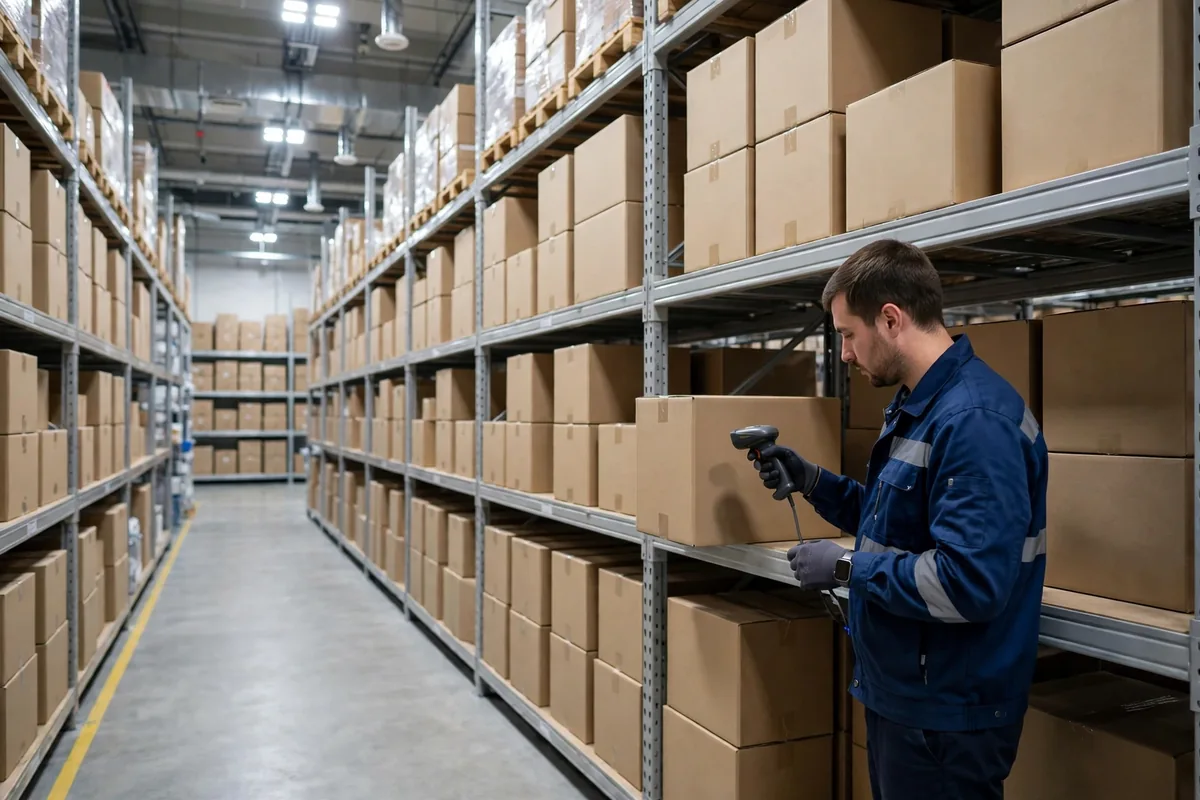
Traceability is the ledger most worth auditing in this business. Under the FDA's Unique Device Identification rule (21 CFR Part 830), a UDI has two parts: a fixed Device Identifier (DI) naming the labeler and the specific model, and a variable Production Identifier (PI) carrying the lot or batch, serial number, expiry date, or manufacture date. DI data is submitted to the Global Unique Device Identification Database (GUDID). The warehouse does not issue codes; its job is to scan them, once at receiving and once at shipping, so the link between lot, expiry, and UDI never breaks.
An orthopedic implant distributor once ran an internal drill: assume one lot of knee prostheses must be recalled, and the warehouse has two hours to locate every unit in stock and trace every unit already shipped. The first drill took most of a day. The system was not slow; part of the stock had been received by scanning only the outer carton code, never the individual UDI, so the lot-to-location mapping had to be reconstructed from paper slips by hand. After the fix, the same drill finished inside two hours. Two hours is not a time limit written in any regulation; it is the distributor's own internal target, set so the warehouse knows where the product is before the recall notice reaches hospitals. The lesson is plain: traceability speed depends less on how expensive the system is than on how completely the receiving scan was done. Seconds saved at the dock are repaid in hours during a recall.
First-expired, first-out (FEFO) is the other half of the traceability ledger. Expiry management for devices differs from food: expired food usually spoils, while an expired device may lose its sterile barrier or its material performance, and the risk is harder to see. FEFO only works when the expiry data in the system is real. In many warehouses, expiry dates are keyed in by hand, and a one-month typing error turns short-dated stock into long-dated stock. One workable control: quality staff sample the 20 earliest-expiry lots each month against physical labels, relaxing to quarterly checks after three clean months.
What QMSR Changed for Warehouse Records
The most direct effect of QMSR on warehouses sits in the records. The revised 21 CFR Part 820 incorporates ISO 13485:2016 as the core requirement while keeping FDA-specific additions, including section 820.35 on record content and section 820.45 on labeling and packaging controls. For a warehouse, that means three practical demands.
First, temperature and humidity records must be continuous and retrievable. Recording conditions by hand twice a day is hard to defend: if a cold-room compressor fails at 2 a.m., a manual log can only prove the daytime was normal and says nothing about the night. Continuous monitoring probes with automatic alarms cost far less than a single deviation investigation.
Second, deviations need handling records. A temperature excursion is not necessarily an incident. What inspectors look for is what happened after it: whether the affected lots were quarantined, the product impact assessed, and corrective action taken. A record that reads "temperature exceeded limits for two hours; lots quarantined, impact assessed, no effect found" is more convincing than one that is perfect forever.
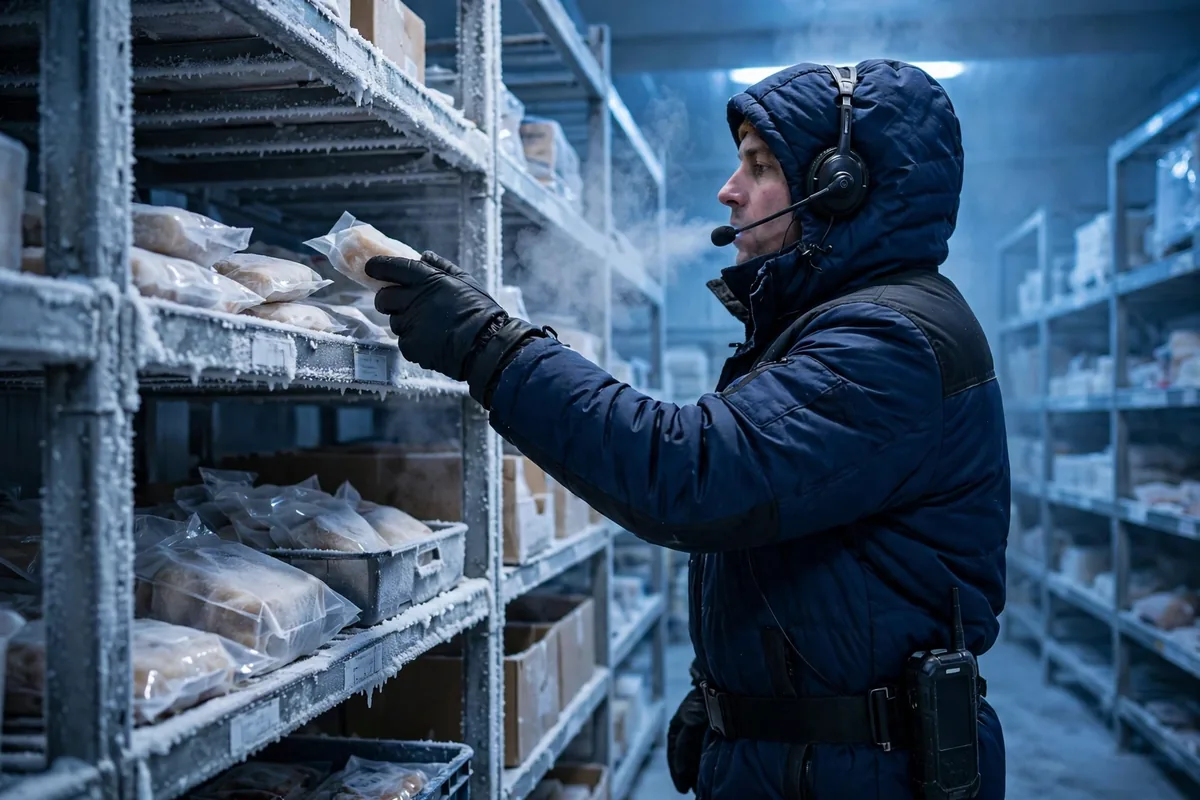
Third, the boundary between cold chain and room temperature must be written down. Products that need refrigeration are stored at 2–8°C; room-temperature products are stored at controlled room temperature, 20–25°C. Warehouses with a fuzzy boundary fail at the handover point: refrigerated goods left too long in the ambient zone, or room-temperature goods mistakenly pushed into the cold room. The costs are asymmetric. Refrigerated goods that lose temperature may have to be scrapped in full; room-temperature goods in a cold room are usually a false alarm. Zone signage, hard validation in the location system, and a second check at handover are all needed, and none of the three substitutes for the others.
There is a counterintuitive point here: the largest cost in this business is not the cold room but the records and traceability. Electricity and depreciation for a cold room are visible, fixed, and easy to budget. Failing to locate a full lot during a recall, or failing to produce continuous records during an inspection, costs several times more and cannot be budgeted in advance. Many warehouses spend freely on temperature-control equipment and then keep cutting corners on scanning and record processes. That is the ledger calculated backwards. A regional distributor's warehouse shows the alternative: three zones, ambient, sterile storage, and a 2–8°C cold room, each monitored independently, with receiving blocked until the UDI and expiry date are scanned. No expensive system; the process is complete — zoning, scanning, records, and drills.
Compliance in medical device warehouse storage has only just begun. As QMSR settles in, inspection focus is likely to move from "does the quality manual exist" toward "can the records prove this is how work is actually done every day." The question for any warehouse operator: if an inspector picks a lot at random and asks for its complete journey from receiving to shipping within a few hours, can your warehouse produce it? The answer decides whether the ticket to this business stays in your hands.
By Dr. Chen, Supply Chain Researcher