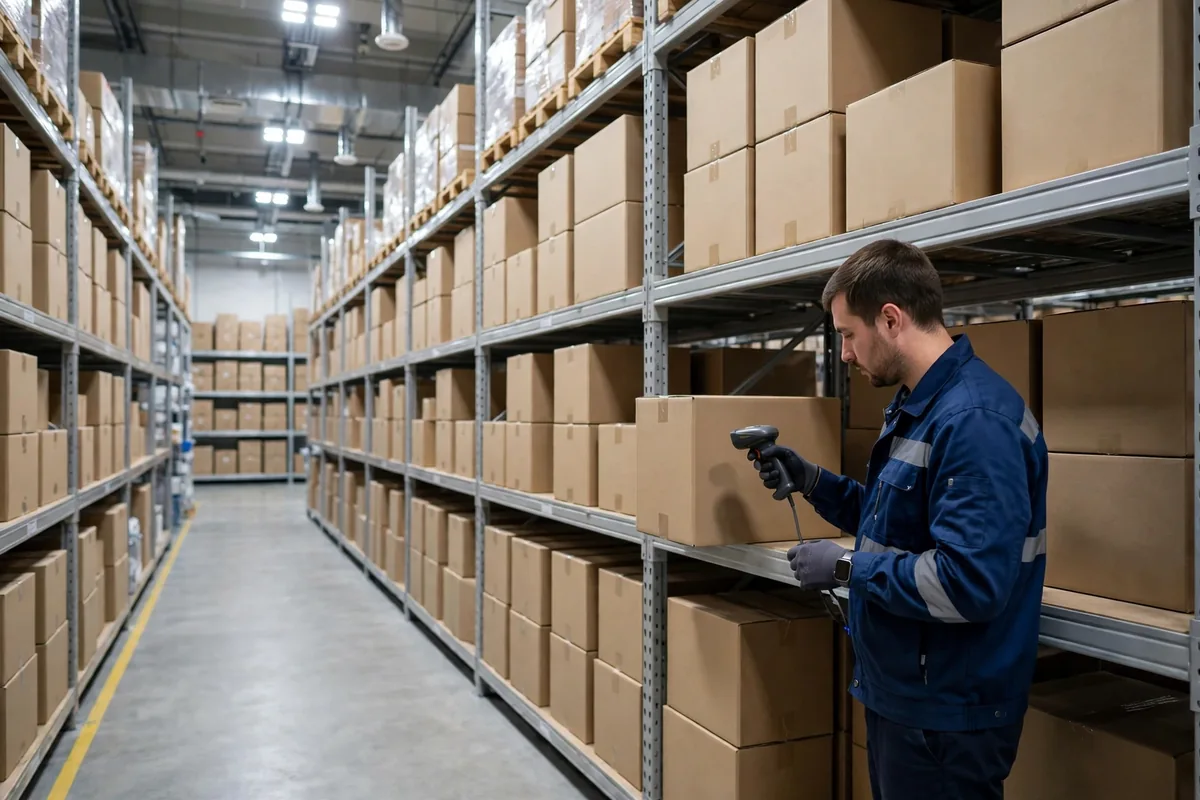
The California warehouse quota law AB701 has been in effect for almost five years, and yet I still hear warehouse managers ask the same question at industry gatherings: how high can we set the quota before it becomes illegal? The persistence of that question is itself revealing. In many warehouses, quota management remains an informal exercise — targets set from experience, communicated verbally, with no written record in the employee's hands and no compliance file in the manager's. That is precisely the state of affairs AB701 was written to end.
What the California Warehouse Quota Law AB701 Actually Regulates
According to the text of the law, AB701 was signed by the California governor on September 22, 2021, and took effect on January 1, 2022. Its scope is drawn with unusual precision: it applies to employers with 100 or more employees at a single warehouse distribution center, or 1,000 or more employees across multiple centers statewide. The covered industries are defined by NAICS codes 493110, 423, and 424, while 493130, agricultural warehousing, is expressly excluded. The law targets distribution networks of a certain scale, where quota systems are most systematized and the risk greatest.
The law's core logic is straightforward, and it does not impose a single numerical speed limit on picking. Instead, it constrains quotas from three directions. First, transparency: at the time of hire, the employer must give each non-exempt employee a written description of every quota, including the quantified number of tasks, the time period involved, and the consequences of failing to meet it. A verbal instruction does not count, and neither does a vague poster on the wall. Second, a floor of protected time: a quota must not interfere with meal and rest periods, must not interfere with the use of restrooms, including reasonable travel time to and from them, and must not interfere with compliance with occupational safety regulations. If any of these lines is crossed, the quota itself cannot stand. Third, traceability: an employee who believes a quota caused a violation may request the written quota description along with their own work-speed data for the most recent 90 days. A quota is therefore no longer a number sitting in a manager's system; it is a record that can be called up at any time.
Consider an illustrative scenario, and every warehouse manager should try it on for size. A picker at a large distribution center in the Inland Empire makes two extra restroom trips one day, and their hourly unit output slips below the quota line. The system logs a miss automatically, and the supervisor carries that miss into the performance file. If the quota formula in this scenario counts restroom travel time as idle time, then the problem is not that the employee was a few minutes slow. The problem is that the design of the quota itself crossed the line the law drew, and the employee's 90-day work-speed data is exactly the evidence needed to reconstruct what happened.
Where the Line Falls: Quota Levels Under AB701
From these rules, one conclusion follows: what the California warehouse quota law AB701 really constrains is not the height of the target but the denominator used to calculate it. Whether a quota is lawful turns first on whether the legally protected time was subtracted before the math began. A quota that counts only pure working time, leaving no room for meals, rest, or reasonable restroom travel, is difficult to defend no matter how modest the number looks, because it asks employees to fund output with time that the law reserves for them.
A second illustrative scenario makes the point more sharply. A warehouse upgrades to a new warehouse management system, the system's modeled capacity steps up, and management raises quotas across the building to match — but no updated written quota description is issued, and new hires still receive the old quota sheet. Even if the new target is entirely reasonable on capacity grounds, the procedural gap has already formed, because the law requires written notice at hire and synchronized updates when quotas change. The target moved and the notice did not, and the compliance chain broke at the link most easily overlooked.
So how should a lawful quota be calculated? The following figures are a hypothetical example, offered only to demonstrate the method, and represent no legal standard. Assume a shift of 8 hours. Subtract a 30-minute meal period and two 10-minute rest breaks, then subtract reasonable restroom travel time, and what remains is the available working time a quota may cover. The compliant quota ceiling equals that available time multiplied by a per-hour output rate verified against real operating data — and that rate should come from the statistical distribution of actual performance, not from a system's theoretical maximum or a peak-season spike. Writing this calculation down, keeping it on file, and giving it to employees is itself part of compliance. The quota stops being a black box and becomes a document that can be reviewed, challenged, and corrected.
The counterintuitive judgment sits right here: a compliant quota is not necessarily a lower one. A quota that cleanly deducts protected time, states its method in writing, and keeps 90 days of data ready for inspection can often be set higher — and defended more firmly — than a target chosen by gut feel, because it survives being traced backwards. The most dangerous quota was never the highest one. It is the one with no written basis, no documented calculation, and no way to explain where it came from when something goes wrong. Many warehouses do not lose efficiency cases. They lose record-keeping cases.
The 90-Day Data Right in the Employee's Hands
Under the law's design, the employee's right to request the written quota description and their personal work-speed data for the most recent 90 days is the provision warehouse managers most often underestimate. It converts a quota dispute from a war of impressions — the manager says the employee is slow, the employee says the target is too high — into a confrontation that can be settled with data. What was the quota, when was it written down, how did the employee's actual speed move across 90 days, and do those movements track with scheduling, freight volume, or equipment downtime? Once these questions enter a written process, neither side can answer from memory alone.
From a management perspective, the practical meaning is that work-speed data now has a dual identity: an input for operational analysis and potential compliance evidence. Whether the data definitions are consistent, how missing values are handled, and whether historical data survives a system upgrade intact can now surface as compliance questions. A pragmatic step is to treat the ability to export 90 days of work-speed data as a standing feature to maintain, with periodic spot checks on completeness, rather than discovering only when a formal request arrives that the system retains just 30 days.
The broader trend deserves attention as well. The legislative approach behind AB701 is being watched by other states, and its two main threads — quota transparency and traceability of work-speed data — are likely to spread from the California experience into more general regulatory expectations. For networks operating across multiple states, standardizing on the California standard now costs far less than patching it state by state later.
A Compliance Checklist for Warehouse Managers
Return to the opening question: how high can the quota go? The answer does not live in a single number. It lives in whether each item below can be checked off. Has every non-exempt employee received a written quota description, including the task count, the time period, and the consequences of missing it? Does the quota calculation deduct meal periods, rest breaks, and reasonable restroom travel time before doing its math? Is the written description updated in step whenever quotas change? Can the most recent 90 days of personal work-speed data be exported completely at any time? Does the quota in the system match the written version given to employees? And when supervisors cite performance in a review conversation, are they citing the written quota rather than a verbally inflated version?
If all six can be checked, a warehouse manager can set the target as high as capacity allows, because the confidence comes from the process, not from keeping the number low. If any one cannot be checked, the priority is not the number on the target but the written record that lets the number stand up.
One question remains open, and it is worth carrying forward. When algorithms begin adjusting each person's quota in real time, will a static written description issued at hire still keep pace with the speed of change? The law demands writing and transparency, while the technology moves toward the dynamic and the real-time. The tension between the two may well be where the next round of quota compliance debate begins.
By Dr. Chen, Supply Chain Researcher