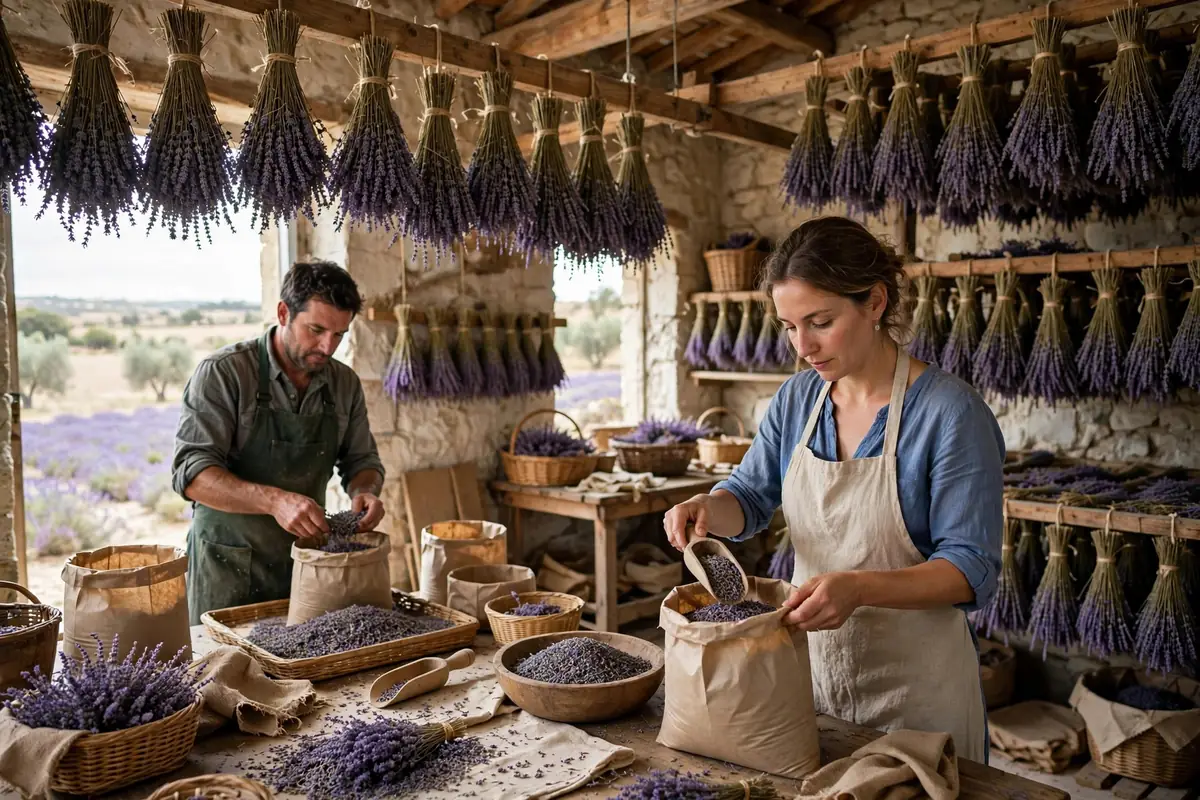
Start with the bill. One tonne of freshly cut lavender flowers yields about 5 kilograms of essential oil. True lavender runs about 0.5% oil by weight; lavandin, the hybrid, runs 1.0% to 1.8%. That is the whole cruelty of France lavender export warehouse storage: your warehouse holds tonne after tonne of flowers, and what you sell is measured in kilograms of oil. The flowers take up space, hate moisture, hate light, and hate being crushed. The oil is valuable, hates oxidation, and hates picking up other smells. Get the storage bill wrong and you do not lose rent money — you lose the value of the goods themselves.
Now the big picture. France produces roughly 1,000 tonnes of lavandin oil and about 50 tonnes of true lavender oil a year, and roughly 80% to 90% of it is exported. Statistics from 2014 put French lavender and lavandin plantings at nearly 19,800 hectares. The flowering season runs from late June to mid-July — the Valensole plateau blooms first, often at its best in early July, while the high ground around Sault, above 800 metres, runs later, into mid-July and August. The harvest window is only a few weeks, and the distilleries run flat out from around 10 to 30 July. So the whole year's stock comes in and gets distilled in three weeks, then sells slowly over twelve months. Storage is not a supporting actor here. It is the one link in the chain that turns a timing gap into money — or into a loss.
Where the Money Goes in France Lavender Export Warehouse Storage
Most people think warehouse cost is rent plus labour. Wrong. The lavender storage bill splits into five parts. The table below is an illustrative example, estimated for one batch of 10 tonnes of dried flowers plus 200 kg of oil:
| Cost item | Share | Why it costs what it costs |
|---|---|---|
| Rent and climate control | ~35% | A conditioned warehouse costs more than a plain one, but this is survival money |
| Grading and quality inspection | ~20% | Mix true lavender with lavandin and the whole batch is priced at the lower grade |
| Packaging and light-proofing | ~15% | A light-permeable pack is just giving the fragrance away |
| Spoilage and oxidation | ~20% | Stock stored badly loses value directly, no negotiation |
| Insurance and export paperwork | ~10% | One missing certificate of origin and the shipment stops at customs |
See it? Rent is barely more than a third. The real money burns on grading mistakes and bad storage, which is the part of France lavender export warehouse storage that most newcomers never budget for. My view is blunt: the lever for saving money on lavender storage is not rent, it is grading and climate control. Whatever you save on a cheap warehouse, one damp batch takes it all back — with interest.
Here is the counterintuitive part: colder is not better. French producers state the ideal storage for lavender products as a stable 15–20°C, dark and dry. Refrigeration actually risks condensation when the goods are taken out — a touch of dew and the dried flowers go mouldy while the oil oxidises. I have seen more than one warehouse pay for cold storage and then store the goods badly. That money was wasted, wasted on mistaking "cold" for "preserved". What lavender wants is stability, not cold.
Dried Flowers and Oil Need Different France Lavender Export Warehouse Storage
Dried flowers and essential oil are two completely different tenants, and forcing them into one room punishes both. Dried flowers fear moisture: above 60% relative humidity, mould activates; too dry is also bad — below 40%, the stems turn brittle, snap at a touch, and release their fragrance early. The working range used across the trade is 40–60% humidity, 15–20°C, and complete darkness. Flower bundles need to hang upside down in a shaded, ventilated space for one to two weeks, and only count as dry when a stem snaps cleanly. Bag them before they are fully dry and you are farming mould inside the bag.
Oil is fussier still. It goes in dark glass or metal containers, sealed, away from light and heat. One French lavender producer puts it plainly: true lavender oil kept properly lasts 3 to 5 years, and if the smell turns sharp or the colour changes, it has already oxidised. Oil has three enemies, in order: light first — UV breaks down the aromatic compounds directly; heat second — warmth accelerates evaporation; oxygen third — it slowly oxidises the esters. So my rule is to separate everything: separate zones, separate temperature and humidity logs, separate packaging, separate inbound and outbound flows. Dried flowers get a ventilated, light-proof zone in breathable but moisture-resistant packs; oil gets a cool, sealed zone in dark bottles inside outer cartons, handled gently. Whatever rent you save by mixing them will not cover one claim for tainted stock. One more rule: never share a warehouse with strong-smelling goods. Spices, cleaning products, mothballs — one trace of them and the lavender is ruined.
The Grading Bill: One Field, Three Prices
The most valuable skill in lavender is not storage, it is grading. Flowers from the same field can be worth several times more or less depending on how they are graded. True lavender grows above 800 metres, yields little, and carries about 0.5% oil — it goes to perfumery and high-end cosmetics. Lavandin grows on the lower Valensole plateau, yields far more at 1.0–1.8% oil, and mostly goes into soap, detergent, and mass-market cosmetics. A 2021 industry report put French lavandin oil production at roughly 2,000 tonnes. The two must be harvested separately, distilled separately, and stored separately from the field onward. Distil them together and the oil is too expensive for the lavandin buyer and too cheap for the true-lavender buyer. Both ends lose.
Do the grading arithmetic as an illustrative example. One tonne of fresh flowers yields 5 kg of true lavender oil, or 10–18 kg of lavandin oil. True lavender oil sells at a higher price per kilo, but one tonne of flowers only gives you 5 kg of it; lavandin sells cheaper per kilo, but yields two to three times as much oil. The warehouse's job is to protect that price gap. A wrong grading label, a mixed batch, a quality report attached to the wrong lot — any one of these means the whole batch sells at the lower price. One grading mistake can cost you an entire season's storage fees.
Then there is the origin paperwork. True lavender carries a protected designation of origin — Haute-Provence lavender from the Sault area is a protected product. At export customs, the origin documents, quality reports, and batch records must all be present; one missing paper and the shipment stops. Paperwork is not an add-on to warehousing, it is part of warehousing. My practice is to open a file for every batch on arrival: plot, variety, harvest date, distillation date, oil content, inspection result. Six items, all present, before the batch goes on the shelf. A batch with an incomplete file waits in quarantine.
One cost people forget: insurance. A batch of essential oil can be worth more than a whole warehouse of dried flowers, so the cover must be written on the oil's actual value, not the flowers' weight. The product name, batch, and storage conditions on the policy have to match the warehouse file, or a claim will not pay out.
Is Cold Storage Worth It? One Number Decides
Here is the calculable conclusion. Whether lavender storage spending is worth it comes down to one number: storage cost per kilogram of oil shipped. The formula is simple — total annual storage spend divided by total kilograms of oil shipped that year. As an illustrative example: a warehouse spending 120,000 yuan a year and shipping 2,000 kg of oil carries 60 yuan per kilogram. If that oil sells at 800 yuan per kilogram, storage is 7.5% of the price — money well spent. If it sells at 200 yuan per kilogram, storage is 30%, and you either need a cheaper warehouse or better grading to lift the price.
The same formula settles whether to upgrade climate control. An upgrade costing 30,000 yuan a year that cuts spoilage from 8% to 3% saves, on 2,000 kg at 800 yuan per kilogram, 80,000 yuan a year. Spend 30,000 to save 80,000 — no thinking required. But if the upgrade only cuts spoilage from 3% to 2.5%, it saves just 8,000 yuan a year, and the 30,000 yuan is not worth spending. There is no "best" lavender warehouse. There is only the one whose numbers add up. The fragrance in the field is a gift from the weather; the profit in the warehouse is calculated.
By Lao Zhou, Logistics Cost Analyst