How much does one 3-ton forklift cost you in tires per year? I have asked a dozen warehouse managers that question. Fewer than half could answer on the spot. Here is the range: a 20-truck fleet runs $8,000–$15,000 a year on tires, and the spread comes down to two decisions — which tire you spec, and when you replace it. Forklift tires are the most overlooked line item in a warehouse budget. The unit price is small, but the tire is wired directly into downtime, safety, and rim damage. Let us run the numbers properly, from the top.
The annual bill: what three forklift tire types really cost
Start with unit prices and service life, in ranges (common 3-ton specs; treat as magnitudes and confirm with your dealer):
| Pneumatic | Solid | Polyurethane wheels | |
|---|---|---|---|
| Unit price range | $125–$300/tire | $250–$400/tire | $60–$130/wheel |
| Life range | 2,000–3,000 hours | 4,000–6,000 hours | No fixed life — replace on chunking |
| Biggest strength | Cushioned ride, strong grip, cheap | No flats, long life, zero inflation checks | Wear-resistant, non-marking, quiet |
| Biggest weakness | One nail = one flat; needs air | Hard ride, pricey, rough on floors | Brittle, chips on impact |
| Typical fit | Outdoor yards, rough surfaces | Indoor, debris-heavy floors | Drive and load wheels on electric pallet jacks and stackers |
On 2,000 hours a year, the annualized math per set of four: pneumatics at $800–$1,200 a set last roughly 1–1.5 years, so $550–$1,000 a year; solid pneumatics at $1,000–$1,600 a set last 2–3 years, so $400–$800 a year.
Notice what just happened. The tire that costs nearly twice as much per unit lands at roughly the same annual purchase cost — sometimes lower. The real gap is not in the tire. It is in the downtime. Anyone who specs tires on unit price alone has done the math wrong from step one.
One more number, the breakeven: a solid set runs about $600–$1,000 more than a pneumatic set. A single blowout costs roughly $225–$300 in idle labor and delayed work at a $150/hour downtime rate. Three to five blowouts erase the price gap. In a yard with debris, five blowouts a year is unremarkable — which means the right tire pays for itself in year one.
Forklift tires: when worn is too worn — the 50% rule
The industry standard is the 50% rule: when the tread wears down to half its original height, the tire comes off. Not "should." Comes off.
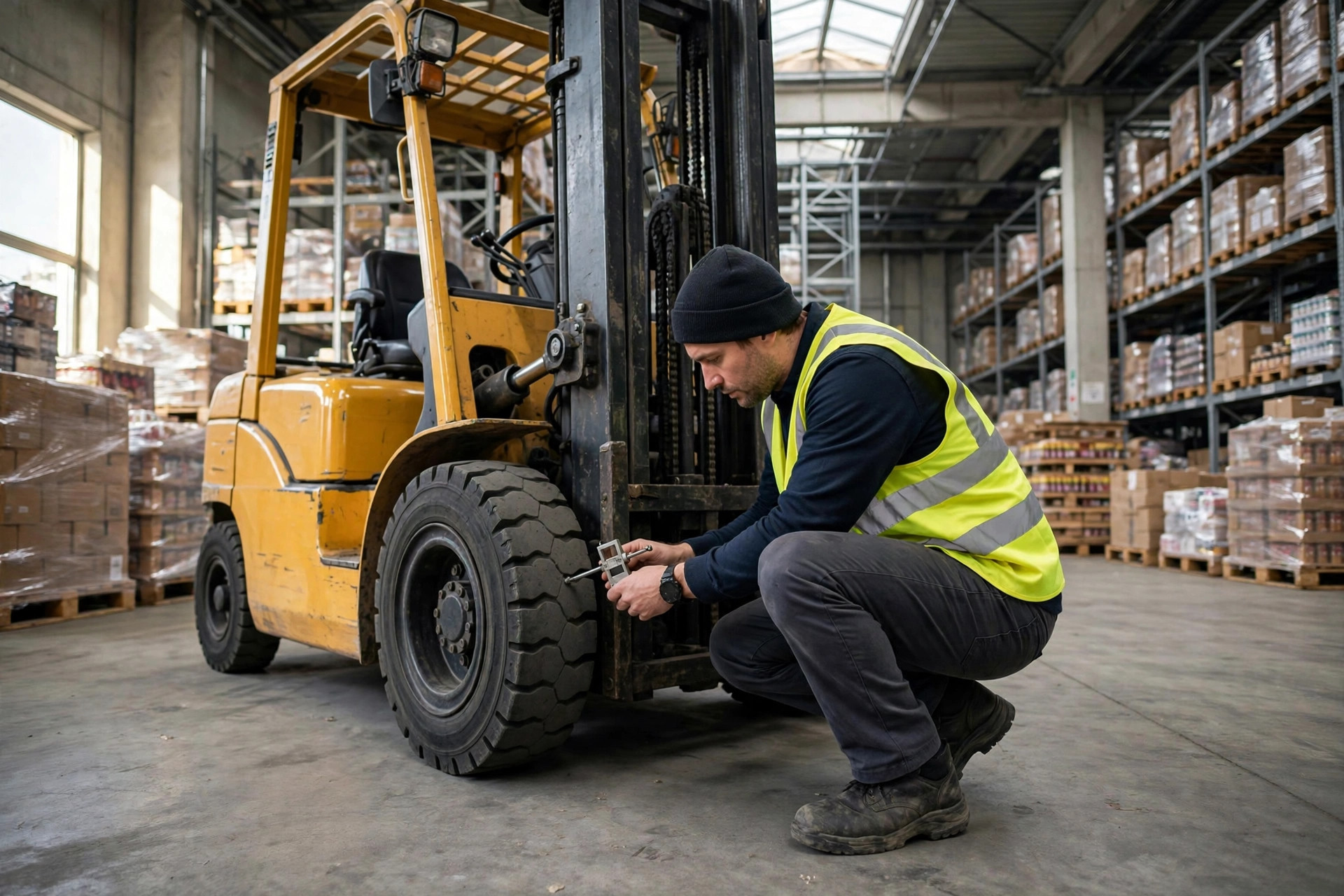
- Solid tires: measure from the tread surface to the metal band. Remaining rubber at or below half the original height means replacement. Most solid tires carry a wear indicator line on the sidewall — once the tread wears to the line, there is nothing to debate.
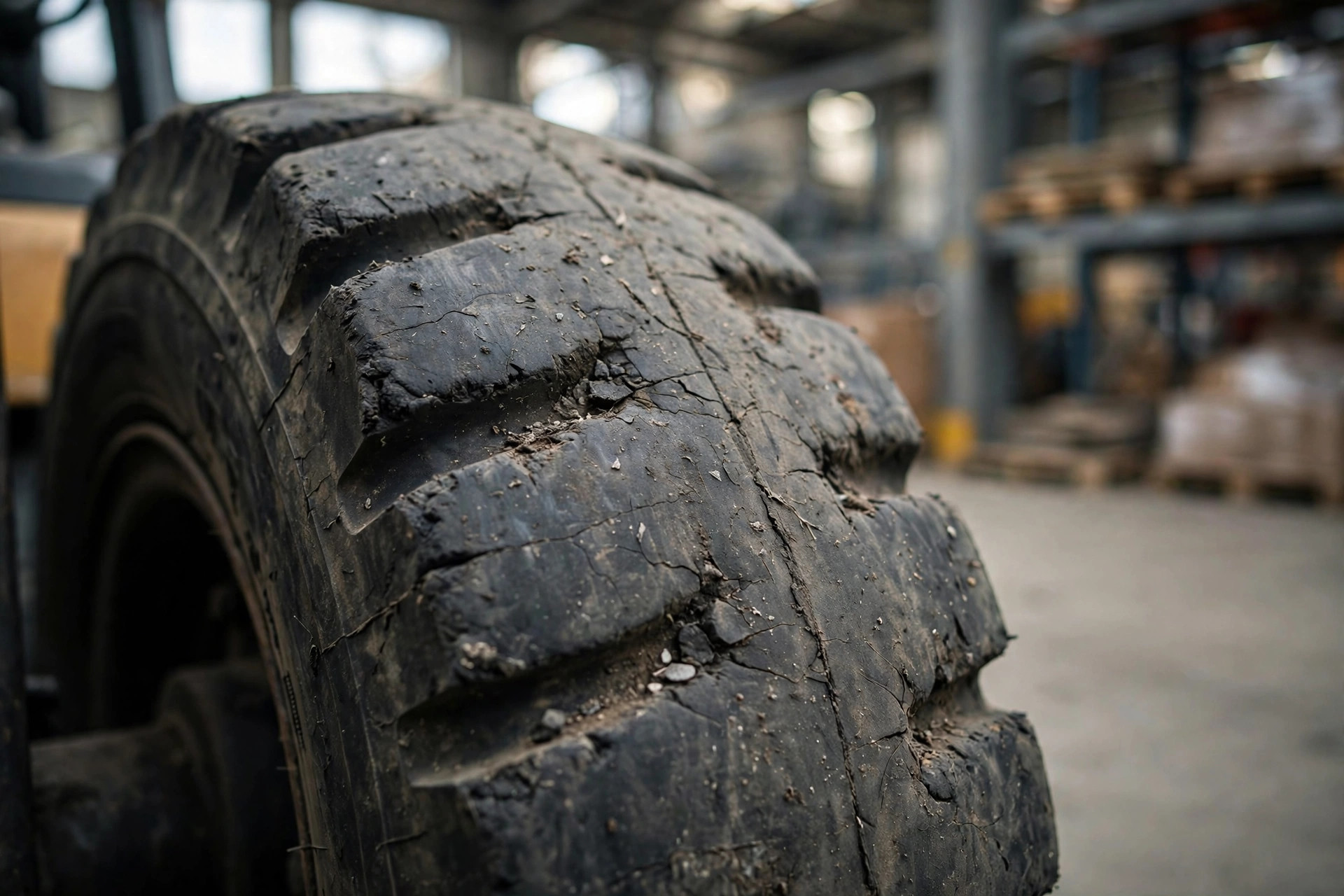
- Pneumatic tires: read the tread. Bald tread, feathered shoulders, or sidewall bulges and cracks mean replacement. Check pressure weekly — wrong pressure doubles the wear rate.
- Polyurethane wheels: look for chunking and cracks. Polyurethane does not wear down gracefully; it fails by breaking apart. A chunked load wheel, a cracked drive wheel, or 10%+ diameter loss causing slip means replacement.
Wear patterns are diagnostic readouts: fast center wear means over-inflation, fast edge wear means under-inflation or overloading, one-sided wear means alignment is off, flat spots mean operators are power-sliding through corners. Every tire inspection doubles as an operator-behavior audit — the tire is the cheapest driver monitor you own.
Two cases where late replacement got expensive
Case one: 2024, a 3PL site in Ohio. Twelve trucks on pneumatic tires, working a yard full of banding scraps and nails. Five blowouts in one peak month, each costing 1.5–2 hours of downtime while drivers stood idle and the dock waited. Finance ran it: about $250 per incident all-in, over $1,200 that month, on pace for roughly $12,000 a year — enough to convert all twelve trucks to solid tires with change left over. Money spent stupidly, and the stupidity was in the spec, not the maintenance.
Case two: a published port-operations cost model. Under high-intensity port duty, pneumatic sets last about 8 months against 24 months for solid sets. At $150/hour downtime cost, the three-year total for pneumatics comes to $9,450 — and the tire itself is the smallest line in that total. Your numbers will differ by duty cycle; the structure will not: downtime is always the biggest line in the tire budget.
Replace early and you waste rubber; replace late and you waste rims
Replace too early and you throw away remaining tread life. Replace too late and you throw away rims, bearings, and safety margin. Run a solid tire past its limit and the metal band grinds on the floor — a set of rims costs an order of magnitude more than the tire you were trying to squeeze. Saving $300 on rubber to destroy $3,000 in rims is arithmetic only an optimist could love.
My practice: a tire card per truck. Mount date, original tread height, one measurement a month. The wear rate predicts the replacement month, so you order ahead and never pay emergency pricing (emergency orders run 15–20% over list, as a magnitude). The monthly checklist is four items:
| Check | Method | Replace at |
|---|---|---|
| Remaining height | Caliper, tread to metal band | At or below 50% of original |
| Wear indicator line | Visual, solid tire sidewall | Tread reaches the line |
| Pneumatic pressure | Gauge, weekly | 10%+ below spec — reinflate |
| Polyurethane condition | Visual for chunking/cracks | Any chunking or cracking |
The counterintuitive takeaway: the most expensive part of a tire budget is never the tire. People haggle over $100 a set and ignore $250 a blowout. That is penny math with dollar consequences.
Two numbers to remember: 50% and the wear line. Order at 50%, replace at the line, check pneumatic pressure weekly. And one formula you can apply tomorrow:
Annual tire cost per truck ≈ set price ÷ service years + expected annual downtime loss
Worked: a solid set at $1,300 over 2.5 years ≈ $520/year with near-zero downtime; a pneumatic set at $1,000 over 1.2 years ≈ $830/year plus two or three blowouts. For a 3-ton truck, $600–$1,000 a year all-in is the reasonable band. Above that, check the spec first, the replacement timing second, and operator behavior third. Once the math is this explicit, tires can never quietly eat your budget again.
By Lao Zhou, Logistics Cost Analyst