A forklift attachment is best understood as a "bolt-on hand" for the truck: the forks are the palm, and the attachment is the specialized tool mounted on it — a clamp, a shift table, a fork spreader. Whether it's worth the money comes down to whether your product mix and your cycle rhythm actually match it. Get the match right and one truck does the work of one and a half. Get it wrong and you've just paid thousands of dollars to make your forklift heavier.
The physics first: an attachment doesn't change the forks, it changes the load moment
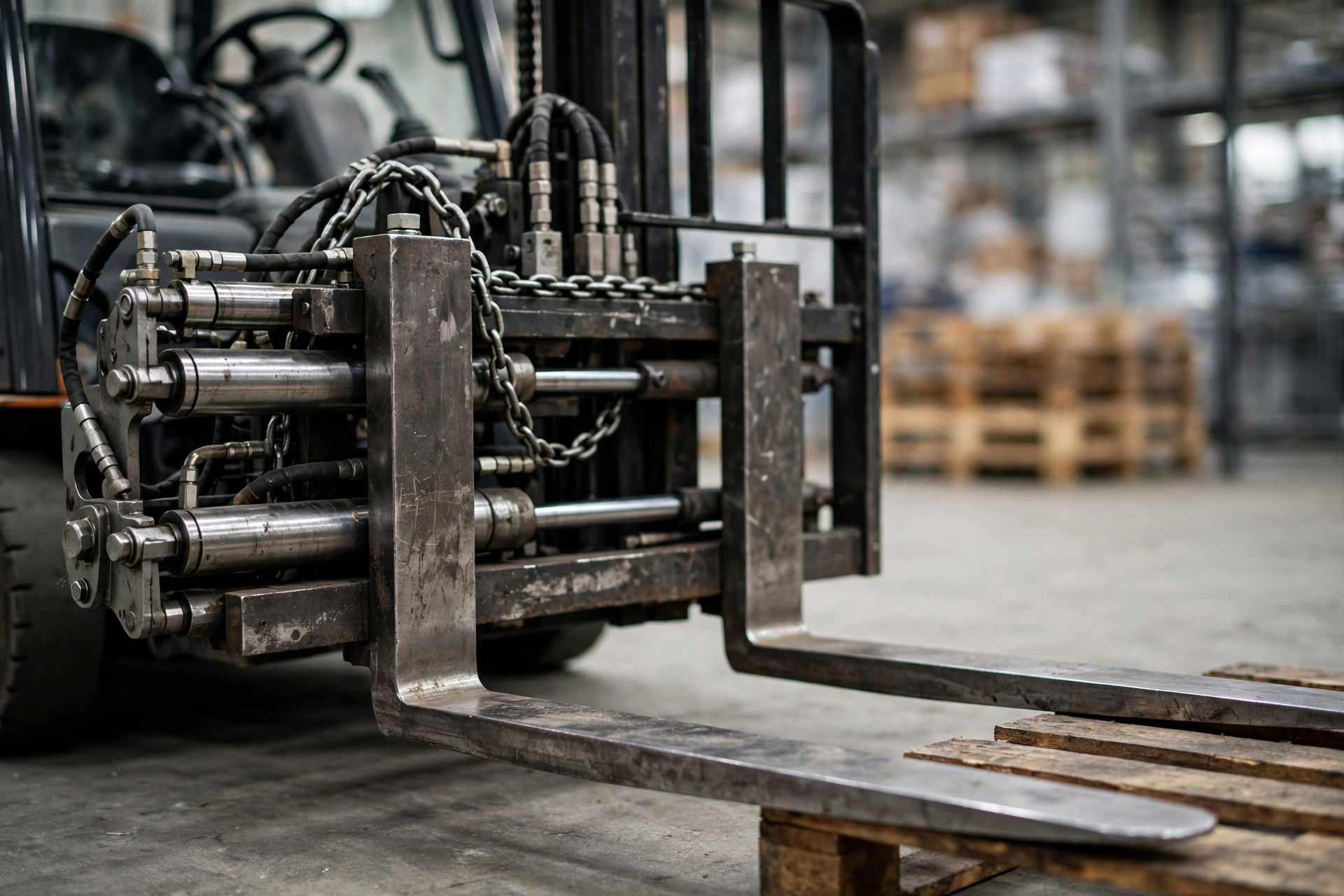
Most people think an attachment just "adds a function." Wrong. It hangs in front of the fork carriage, weighs a few hundred kilos by itself, and pushes the load's center of gravity 100–150mm further forward. Think of carrying a bucket of water with your arms fully extended versus tucked against your chest — same bucket, different weight. A forklift feels exactly the same difference.
So rule number one: install an attachment and the truck's rated capacity must be recalculated. A 2.5-ton counterbalance truck rated at a 500mm load center will typically only lift 2.1–2.2 tons once a sideshifter is on it. A 10–20% derate is normal, not a defect. The attachment maker gives you a derated capacity data plate, and that plate is not decoration — under OSHA 1910.178 in the US, any attachment that changes load characteristics requires the truck manufacturer's written approval and an updated plate.
Rule number two: attachments eat hydraulics. Sideshifters, fork positioners, and roll clamps are all hydraulic, so your truck needs an auxiliary valve (usually the 4th function) plus a hose reel assembly. Running an older truck without one? Add a valve retrofit to the quote — sales sheets routinely "forget" that line item. Ask before you sign.
The selection table: three attachments, when each one pays off
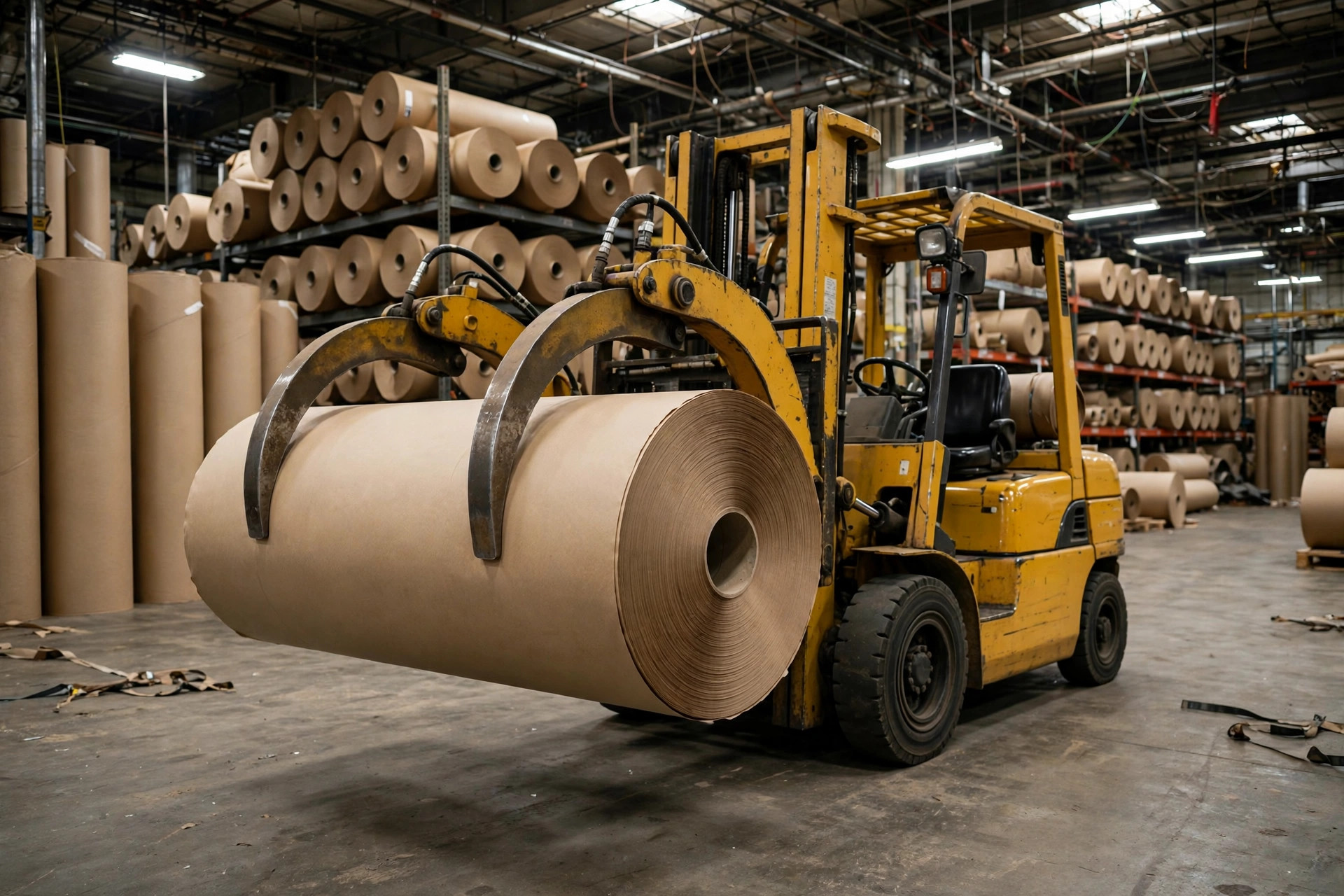
Paper roll clamp: a big hand built for cylindrical loads
Paper rolls, film rolls, fabric rolls, cable reels — forks give you a small contact patch on a tall, round load, and one hard brake sends it rolling. A roll clamp grabs the roll between two curved arms, and the rotating versions can stand a horizontal roll upright for container loading.
The line where it pays off: cylindrical goods make up more than 30% of your throughput, or single rolls exceed about 1.5 tons. Paper mills, printers, and corrugated plants (where kraft liner rolls routinely hit 2–3 tons) are no-brainer territory. Don't bother when: you move a handful of rolls a month and the "forks plus a strap" routine still works — buy a wider strap instead and take the savings to dinner.
Check three numbers when selecting: the clamping diameter range (does it cover your biggest and smallest rolls?), whether you need rotation (pretty much mandatory for container stuffing), and the pressure regulation valve — a 2.8-ton kraft roll versus an 800-kilo film roll needs roughly double the pressure.
Sideshifter: the fastest-payback fine-tuning table in the attachment world
Dead simple principle: the whole fork carriage slides left and right, typically ±100mm. You can think of it as giving the forklift a mouse's fine-adjust — where the driver used to shuffle the entire truck back and forth to line up with pallet openings, now a flick of the wrist slides the forks over.
The line where it pays off: high-bay racking (alignment errors get magnified when the forks are 4+ meters up), container loading (inches of lateral room inside the box), narrow aisles — with 300+ pallets a day. In those settings a sideshifter saves roughly 8–15 seconds per pallet. Don't bother when: bulk floor stacking or an outdoor yard, where pallets get dropped wherever and being 5cm off-center bothers nobody. Bolting one on there is like buying a chronograph watch to time boiled eggs — pure vanity spend.
Fork positioner: the cure for the "mixed pallet zoo"
Hydraulically spreads or narrows the fork gap on the fly. The classic 3PL headache: 48×40-inch GMA pallets, 1200×800 Euro pallets, and 42×42 chemical pallets all in one building. Every size change means the driver climbs down, pulls the locking pins, drags the forks, climbs back up — 1–2 minutes a pop, a dozen times a day.
The line where it pays off: three or more pallet sizes in regular rotation with frequent changeovers. Don't bother when: the whole warehouse runs one pallet size — a positioner that moves twice a year is furniture.
| Attachment | Install with confidence when | Save your money when | Payback comes from | Check this number first |
|---|---|---|---|---|
| Paper roll clamp | Cylindrical goods >30% of throughput, or rolls >1.5 tons | A few rolls a month, strap-and-forks still works | Less roll damage + one operator does it all | Clamp diameter range, rotation or not, pressure valve |
| Sideshifter | High-bay / containers / narrow aisles, 300+ pallets/day | Floor stacking, outdoor yards, nobody cares about alignment | 8–15 seconds of alignment saved per pallet | ±100mm travel enough? Capacity left after derate? |
| Fork positioner | 3+ pallet sizes in the mix, frequent changeovers | One pallet size site-wide | Killing the 1–2 minute "climb down and adjust" ritual | Spread adjustment range, independent sideshift included? |
Two real cases: one done right, one done wrong
Done right: a corrugated plant in Dongguan, China, 2023. They moved 40+ kraft liner rolls a day at 2.5–2.8 tons each. With forks and straps, even good drivers dropped two or three rolls a year — a roll falling from a meter up ruins the outer 50 meters of paper, costing well over a thousand dollars per incident. Mid-2023 they fitted two trucks with rotating roll clamps: one operator, one truck, rolls flipped from horizontal to vertical and loaded solo. Two-plus years on, roll-drop incidents stand at zero. The math is easy: saving three or four ruined rolls a year paid for the attachments in year one.
Done wrong: a 3PL in Ontario, California, 2024. The owner heard sideshifters were great and bolted them onto all 12 trucks at once. Problem: four of those trucks live in the bulk floor-stack area, where pallets get dropped on the ground and being off-center by 5cm bothers absolutely nobody. The sideshifters there get touched a few times a year. Worse, the attachments derated those four trucks by about 15% — a 2.3-ton load that used to go in one trip now takes two. So four attachments' worth of money was wasted and capacity went backward.
Here's the counterintuitive bit: the attachment bolts onto the forklift, but the payback lands in the labor budget. A sideshifter doesn't save fuel, it saves the driver those 10 seconds per pallet. A fork positioner doesn't save electricity, it saves the half hour a day of climbing in and out of the cab.
The maintenance traps: three places attachments love to break
Principle, then selection, then maintenance — in that order, always. An attachment's MTBF rarely loses to the attachment itself. It loses to how people use and maintain it.
Trap one: the hydraulic hoses. Attachment oil lines run from the mast all the way to the carriage, flexing with every lift. Without protective sleeving or a hose chain, three months to a chafed-through leak is normal — the fastest one I ever saw died in 47 days. Check the hose routing at acceptance, not just the attachment.
Trap two: sideshifter wear pads and seals. Plenty of drivers "nudge" pallets sideways with the sideshifter to straighten them — a sideshifter is a fine-adjustment table, not a bulldozer. Do that and the wear pads go oval in six months, and the seals start weeping right after. Correct use: alignment into pallet openings only. Straightening pallets is the whole truck's job.
Trap three: the roll clamp's pressure valve. Same clamp grabs a 2.8-ton kraft roll in the morning and an 800-kilo film roll in the afternoon — the pressure valve must be reset for each. Half a megapascal too high and the core crushes, the whole roll gets rejected; too low and a heavy roll slips and drops. Skipping the reset on a paper change is the number-one cause of roll clamp damage. Nothing else comes close.
One more that's easy to miss: re-certify the whole truck after the install. Updated derate plate, hydraulic pressure test, stability check on combined tilt-and-lift moves — sign off only after all three.
Worth it or not? One number decides
Ignore the sales pitch about "30% efficiency gains" and run one formula yourself:
Payback days = total attachment cost ÷ (seconds saved per pallet × pallets per day ÷ 3600 × fully-loaded driver hourly rate)
Example: a $2,800 sideshifter, 10 seconds saved per pallet, 500 pallets a day, driver at $25/hour loaded — that's $34.70 saved per day, about 81 working days to payback. Under a year of payback with years of savings after? Worth it. If the math says three years, fix your process first.
Attachments were never a buy-or-don't-buy question. They're a fit question. When the product mix, the cycle rhythm, and the derate cost all line up, an attachment is the best-value investment in the building. When they don't, it's the most expensive decoration on the truck.
By Da Liu, Automation Engineer