The most annoying thing about selling shoes is not low traffic. It is footwear warehouse storage going wrong: stock on hand while the size the customer wants is gone. I have run that math too many times, and it always ends the same way: if you do not get the size curve right, you are gambling. Lose the bet and you either sit on dead stock or run out of the sizes that actually sell.
My first year selling running shoes, I made the classic mistake: I stocked more of whatever size seemed hot that week. Big sizes piled up while small sizes sold out every other day. Shoes do not sell by the pair, they sell by the size. Lose your core size and the whole listing slows down while ad spend keeps burning.
That is the real problem with footwear warehouse storage. It looks like a space problem, but it is really a ratio problem. Get the ratio wrong and every other fix is just damage control.
Footwear Storage Size Curves: Build the Ratio Before You Buy
In September 2024, I stocked 1,200 pairs of a men's running shoe at a partner warehouse near Ontario, California. I built the size curve from the previous 90 days of orders, not from a gut feeling. It looked like this:
| US men's size | 7 | 8 | 9 | 10 | 11 | 12 | 13 |
|---|---|---|---|---|---|---|---|
| Share of sales | 5% | 12% | 20% | 24% | 18% | 12% | 9% |
| Units stocked | 60 | 144 | 240 | 288 | 216 | 144 | 108 |
Sizes 10 and 11 together made up 42% of sales, so I kept 60 days of cover on those two sizes and only 35 days on the sizes at the edges. That split matters. Running out of a core size for one day costs you the margin on real orders. Overstocking an edge size for 30 extra days only ties up cash on a few dozen pairs. Those are two different kinds of loss, and you should not treat them the same.
One detail most sellers miss: the curve changes by color. For that same shoe, black sold fastest in size 10, while white moved fastest in size 9. A curve built per style but not per color is only half a curve. I now build one table per color, order by color-plus-size, and have the warehouse receive and count by that same combination.
My reorder rules are fixed: ocean replenishment 75 days ahead, air 20 days ahead, safety stock 14 days of sales for core sizes and 7 days for edge sizes. Through the fourth quarter of 2024 my core sizes never stocked out once; the only stockouts were edge sizes I had deliberately decided not to chase.
When a Size Runs Out, Do Not Fake Full Availability
In March 2025, size 7 of a women's casual shoe sold out, and the factory needed 40 days to restock. I had two obvious choices: pull the listing until stock returned, or keep selling and hope customers would pick another size. I took a third path. The listing stayed live, the sold-out size was marked out of stock, and I pushed sizes 6.5 and 7.5 to the front, with a clear foot-length chart on the page.
The result was straightforward. Daily orders on that listing fell from 38 to 27 during those 40 days, but there were zero cancellations from customers ordering a size we did not have, and zero returns caused by shipping the wrong size as a substitute. When size 7 came back, the listing recovered to more than 35 orders a day within two weeks. Faking full availability and then cancelling orders is what actually hurts a listing, because a rising cancellation rate gets you downranked fast.
My stockout routine is now fixed. The day a size runs out, its inventory is zeroed and marked out of stock. Customer service gets a prepared script with the restock date and the closest alternative sizes. The warehouse flips the bin tag for that size so pickers do not walk to an empty slot from memory. The worst case is phantom inventory: the system says two pairs are left, the customer orders, the warehouse cannot find them, and you cancel anyway.
Here is the counterintuitive part: not every stockout is worth fixing. One low-volume color in size 13 sold only 6 pairs in 90 days, and the freight to restock it cost more per pair than the margin on the shoe. I cut that size entirely and removed it from the page. One fewer size means one fewer headache, and the freed-up cash goes straight into core sizes.
Crushed Boxes and Mispicks in Footwear Storage: Small Leaks That Eat Your Margin
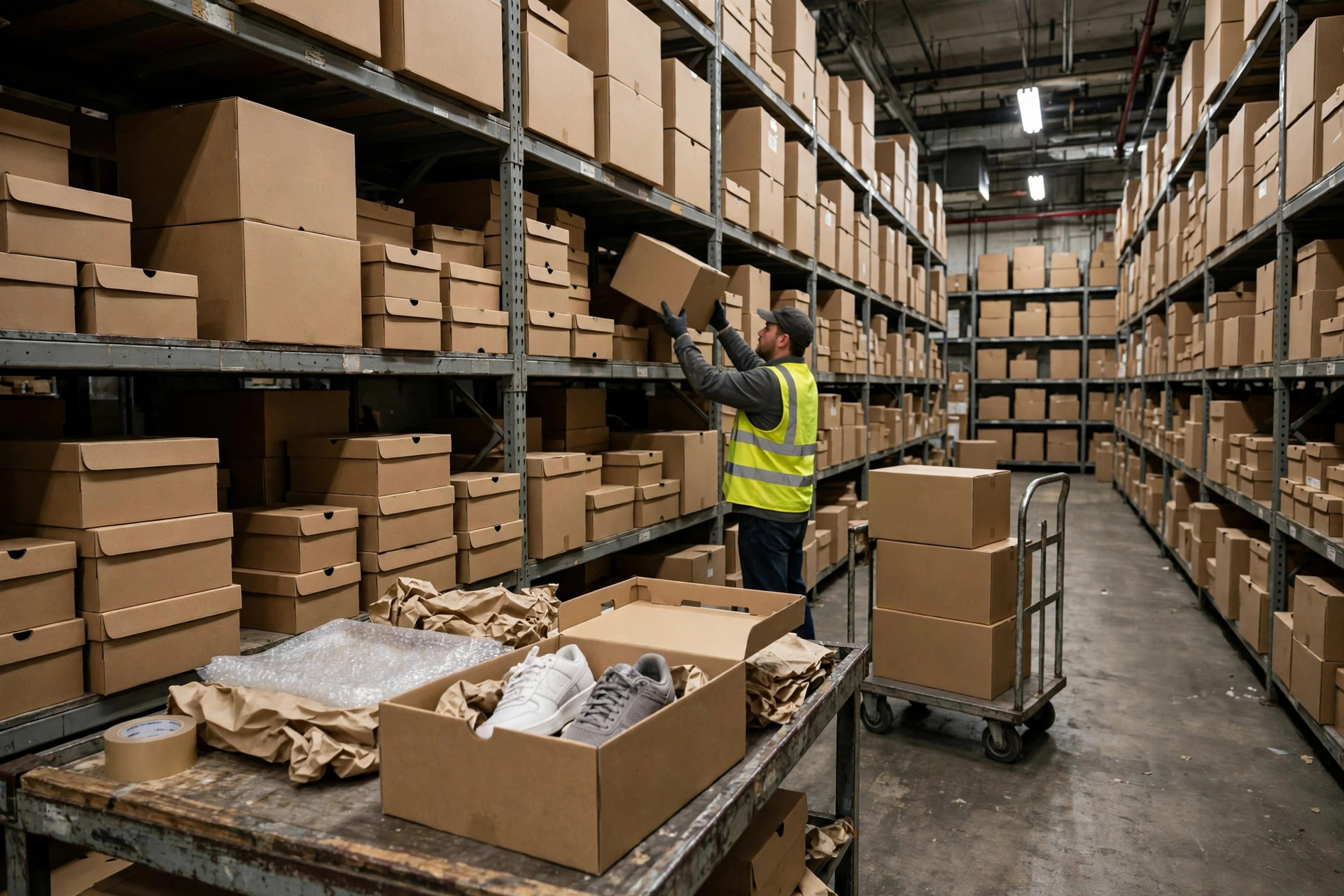
A crushed shoe box is invisible from your desk and obvious the moment a customer opens the parcel. In November 2024, I got 12 complaints in one batch about crushed box corners, and 4 of them turned into negative reviews. The warehouse had stacked shoe boxes six high, the bottom layer could not take the weight, and the outer cartons had no fill, so the boxes rattled around in transit.
The fix is not complicated, but it has to be written into the warehouse instructions. Shoe boxes stack no more than four high, heavy boxes at the bottom and light ones on top. Every gap between the shoe box and the outer carton gets filled so the box cannot shift in transit. Large-size boxes are taller, so they get their own layer instead of being mixed in with small sizes. Three months after that change, the same complaint fell from 12 cases to 2, and packaging-damage returns dropped with it.
Mispicks are the other leak. Shoes go wrong in three ways: left and right feet mixed up, the wrong color picked, or two neighboring sizes swapped. My warehouse once shipped 9 mispicks in a single week, a mispick rate close to 1.5%. Return freight plus the replacement shipment averaged 18 dollars per order, so that week burned more than 160 dollars before counting the reviews.
My rules now are simple. Pickers must scan the barcode on the shoe box to confirm size and color, not just read the shelf label. Left and right feet are stored in separate rows with an empty slot between them. Neighboring sizes never sit next to each other: size 9 and size 10 get separated by at least one other style's bay. It sounds fussy, but once the mispick rate fell below 0.4%, that fuss paid for itself many times over.
That is why I keep coming back to footwear warehouse storage as a profit lever, not a back-office chore. Every dollar saved on return freight is margin you do not have to earn twice.
Size Exchanges: Short Process, Repeat Customers
Shoes get exchanged more than apparel, because fit is something you only learn by trying them on. In the first half of 2025, exchanges made up 11% of orders on one of my shoes, and 70% of those were just half a size up or down, not quality problems. If an exchange takes a week, the customer has already bought elsewhere. If the new size ships within 3 days, many of them come back and buy again.
My exchange flow has four steps. The customer picks the new size first, and the system reserves it. The customer ships the old pair back, and the warehouse inspects it before it goes back into sellable stock. If the condition is fine, the new size ships the same day. Returned shoes with damaged boxes go to a separate clearance zone, never mixed back into full-price stock.
There is a trade-off here: should you ship the replacement before the return arrives? Shipping first feels great, but you lose a pair whenever someone never sends the old one back. Waiting is safer but slower. My compromise: repeat customers get the new size shipped first, first-time buyers send the old pair back first.
One more trap: returned shoes must never go straight back on the shelf. Check the soles for wear, the box for damage, and that left and right are actually a matching pair. I have seen returns come back with two different sizes in one box. Returned stock gets its own zone, gets inspected, and only then goes back to full price, clearance, or disposal.
So the whole game in footwear warehouse storage comes down to three lines: build the curve before you buy, never fake availability when a size is gone, and watch crushed boxes, mispicks, and exchanges like they are line items on your profit statement. They are. Every one of them is small money on its own, and together they decide whether a shoe makes money or not. This one I have tested myself, and it works.
By Ah K, E-commerce Seller (5 yrs)