
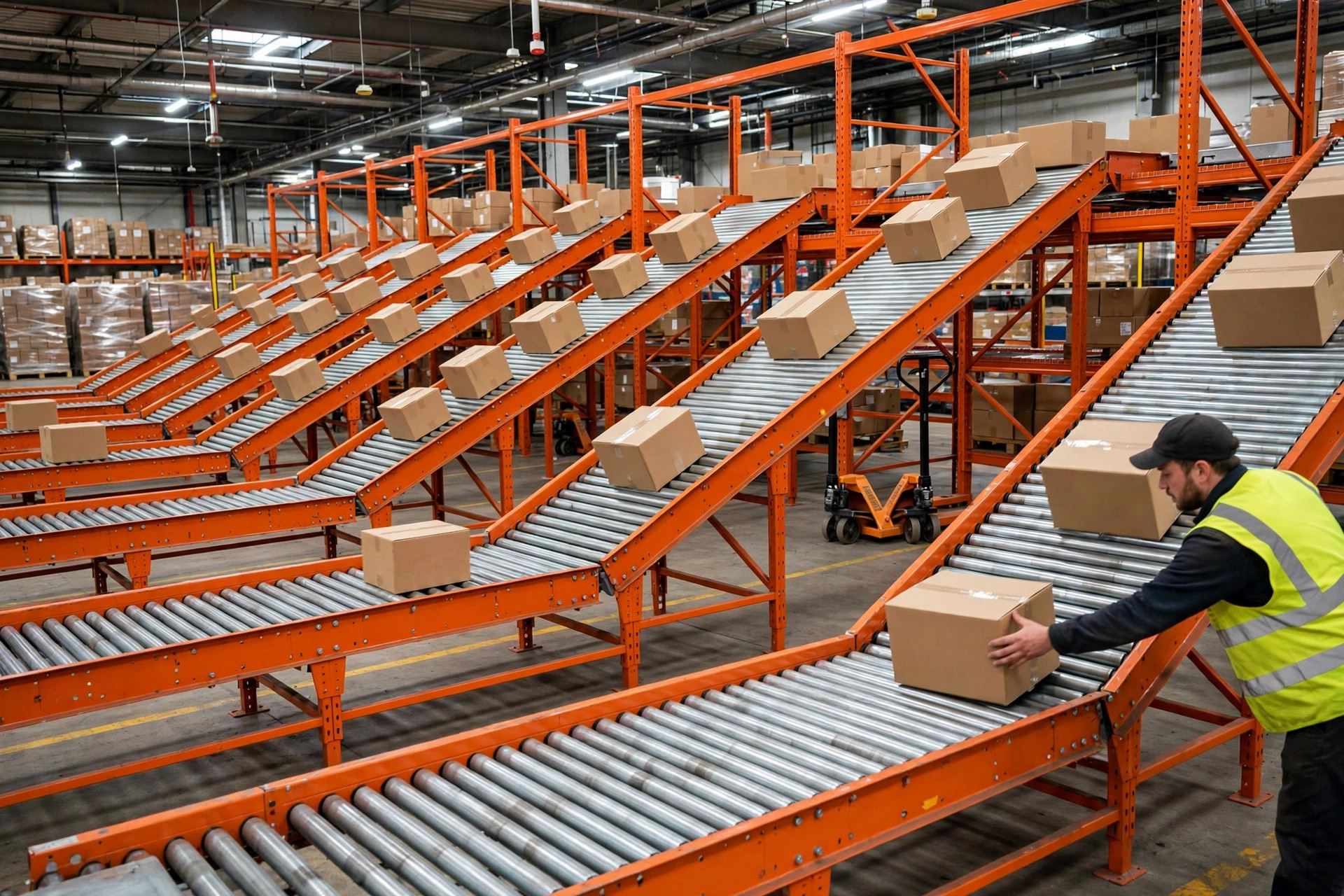
Here's a counterintuitive one: on a carton flow rack, first-in-first-out isn't enforced by software. It isn't enforced by people. It's enforced by gravity.
Think of it as a vending machine stood on its side: cartons load from the back, ride down inclined roller lanes under their own weight, and present themselves at the pick face. The first carton in is always the first one the picker grabs. FIFO is physically mandatory — unlike static shelving, where FIFO depends on pickers remembering dates and supervisors spot-checking with a flashlight, and compliance depends on everyone's mood that day.
But I've watched too many warehouses buy flow rack and use it as expensive static shelving: restocking from the front, mixing carton sizes in one lane, parking slow movers in lanes for three months collecting dust. The money got spent; FIFO never happened; pick rates never improved. Let's walk through the whole thing, from physics to slotting.
Which SKUs Earn a Lane: Three Hard Rules
Flow rack isn't universal shelving. It only serves SKUs that clear three hard rules.
Rule one: velocity. A SKU needs enough daily pick lines to justify a lane — think dozens of lines a day as a working threshold. Fast-turning lanes stay full and fluid. A slow mover on flow rack is a SKU renting a private room it barely sleeps in — and you're paying by the foot.
Rule two: uniform carton specs. Carton dimensions and weights need to be consistent, because lane width, roller spacing, and pitch are all engineered around the box. One oversized carton in a lane tilts, jams, and shuts the whole lane down. SKUs with chaotic carton sizes belong on static shelving.
Rule three: FIFO or lot control actually matters. Food, pharma, cosmetics, consumer chemicals — anything with a shelf life or lot-traceability requirement is where physical FIFO earns its keep. Hardware fittings and packing materials with no expiration pressure? Putting them on flow rack is using a sledgehammer on a thumbtack.
Miss any one of the three, and the SKU doesn't go on flow rack. That's a dividing line, not a suggestion.
The Numbers: Rules of Thumb, Then the Manufacturer's Spec Sheet
I'm an engineer — I don't blink at parameters. But full disclosure first: everything below is industry rule-of-thumb magnitude. Final sign-off always comes from the equipment manufacturer's load and pitch calculations for your actual cartons. Get it on their spec sheet.
Lane depth commonly runs 4 to 12 feet. Don't pick it by feel — size it from "how many days of stock should one lane hold": 20 cartons a day with 3 days of safety stock means the lane must swallow 60 cartons, then work backward from your carton depth. Too shallow and your replenisher runs laps all day; too deep and front cartons pile pressure on the back ones, and a marginal pitch can't push them.
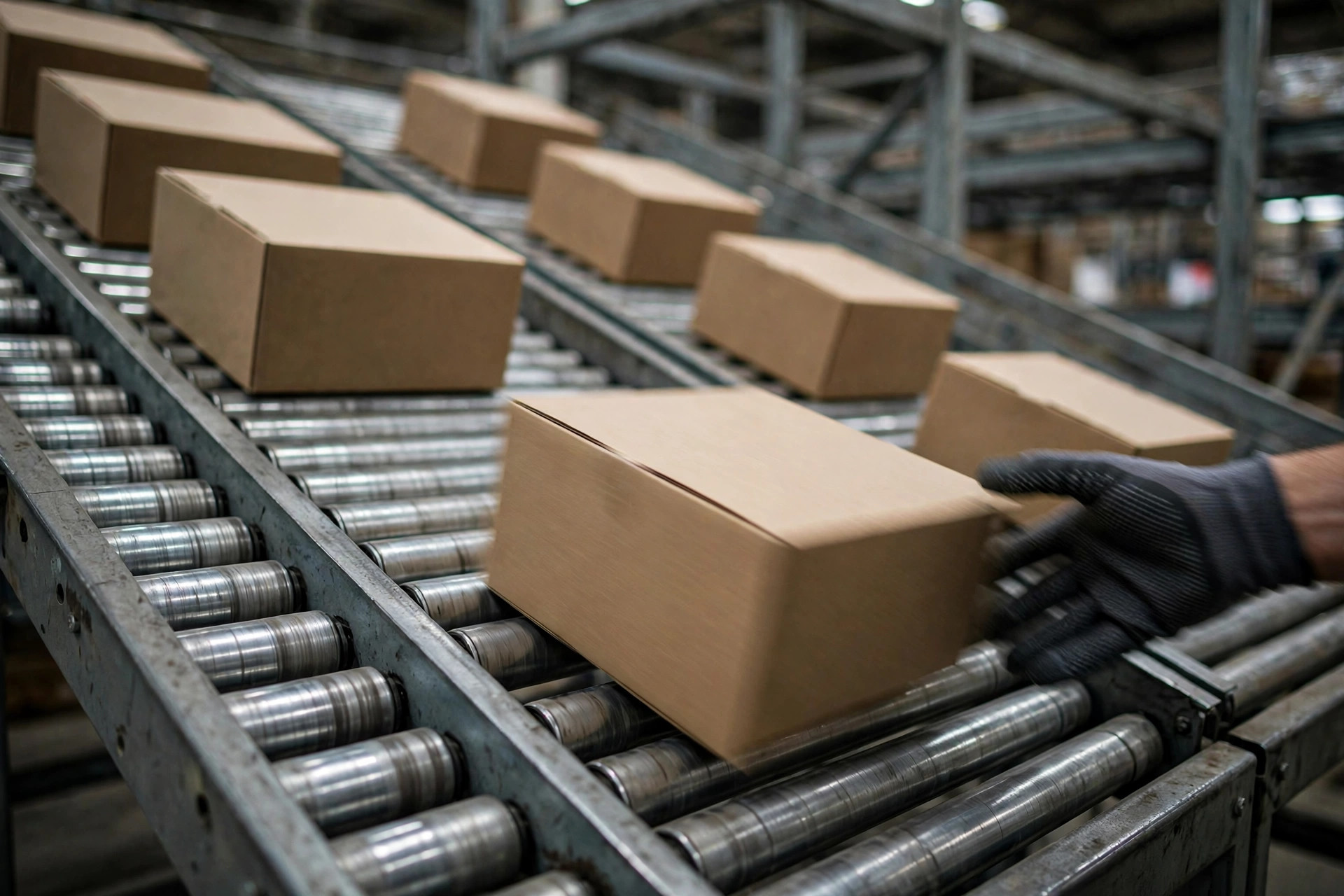
Pitch — the working experience value is roughly 1/2 to 5/8 inch of drop per foot, about 3 degrees. Too steep and cartons slam into the stops, damaging product and end retainers; too flat and they stall mid-lane, forcing pickers to reach in — at which point you've built expensive static shelving. Lighter cartons and soft-bottomed boxes want the steeper end of the range and tighter roller spacing. That's roller-selection basics.
Per-lane load capacity depends on the roller or skate-wheel spec — commonly on the order of tens to a couple hundred kilos. Don't guess; make the manufacturer run the calc against your heaviest carton. An overloaded lane deforms rollers sooner or later, deformed rollers change the pitch, changed pitch stalls cartons. Chain reaction.
And one iron rule: replenishment face and pick face must stay separated. Load from the back, pick from the front, so the aisles never fight each other and FIFO never breaks. Restocking from the front voids FIFO on the spot — I'll rant about this again in the demolition section.
Flow Rack vs. Static Shelving vs. Pallet Positions: Where the Line Is
Too many warehouses assign storage types by gut feel. Here's the dividing line, in table form:
| Dimension | Flow rack | Static shelving | Pallet position |
|---|---|---|---|
| Daily pick lines per SKU | High (dozens+) | Low to medium | Low, or full-pallet moves |
| Carton specs | Uniform | Anything goes | Anything goes |
| FIFO / lot requirement | Strong, physically enforced | Enforced by humans | Enforced by humans or full-pallet rotation |
| Replenishment | Full-case from the rear | Toss in from the front | Forklift, full pallet |
| Relative cost | High, about 3–5× shelving | Low | Medium |
See it? Flow rack costs 3–5× because you're buying two things: gravity enforcing FIFO for you, and a pick face that's always stocked. If all you want is "neat rows of boxes," static shelving does the job and every extra dollar is tuition.
Four Pseudo-Requirements That Burn Money
I don't do polite when it comes to fake requirements. Here are four; I argue with every one I meet.
"All our SKUs need FIFO." Wake up. SKUs with no shelf life don't need FIFO. A slow mover sitting in a lane for three months achieves perfect FIFO of absolutely nothing. In 2024 I walked an e-commerce warehouse in the Inland Empire that had put 3,000 long-tail SKUs on flow rack — average lane utilization under 30%. My recommendation: rip out half the lanes, put static shelving back, and spend the savings on two pickers for a year. FIFO is a means, not a religion.
"Restocking from the front is more convenient." Convenient, my foot. The entire soul of flow rack is back-load, front-pick. Shove new cartons in from the front and the oldest carton gets pushed to the back — FIFO dies instantly. If walking around to the rear feels like a hassle, your aisle layout is broken, not the rack.
"Mix carton sizes in one lane to save lanes." You'll save your way into an incident. Half an inch of size difference and the carton rides crooked; double the weight and the light one gets pinned. One jam stops the lane, pickers queue up, and everything you "saved" evaporates.
"Once it's installed, replenishment takes care of itself." An empty lane with nobody restocking it is just a picker standing at the pick face waiting. Flow rack converts "searching for stock" into "waiting for stock" — replenishment triggers and priorities don't disappear. None of the homework goes away.
The Maintenance Traps: Pitch, Rollers, and Jams
One last section — the stuff integrators don't dwell on when they're selling you the rack.
Rollers hate dust and dry bearings. Cardboard dust settles in, rollers seize, cartons stall mid-lane. Lane dividers get clipped by forklifts as a matter of routine — a bent divider scrapes cartons, scraped cartons grow burrs, burrs snag the next carton. Deformed pitch from impacts is sneakier: invisible to the eye, but cartons start moving in fits and starts. That's your signal.
My standing advice: audit 10% of lanes monthly — pitch with a level, spin every roller by hand. Ten minutes of work that can prevent a line stop.
In 2023, an imported-snacks distributor in Ontario came to me: 6–9-month shelf-life goods, static shelving plus humans remembering dates, 200+ cartons a month hitting expiration. Flow rack with physical FIFO cut expired write-offs to single digits within three months. What they bought wasn't racking — it was "never relying on human memory for dates again."
So is the money worth it? Watch one number: cost per pick line. Flow rack commonly compresses per-line pick time from 40-plus seconds to under 20. At 2,000 lines a day, that's a full picker's labor saved. Payback period = equipment investment ÷ monthly labor saved. Past 18 months, go back and check whether you slotted the wrong SKUs. Numbers don't lie; "I feel like we need automation" does.
By Da Liu, Automation Engineer





