I have been driving trucks for fifteen years, and in fishing gear warehouse storage, the most precious and most fragile cargo I have ever seen in a warehouse is not electronics, and it is not glassware. It is fishing rods. One summer a couple of years back, I was delivering to a tackle warehouse, and I watched a young worker drag a carton of long rods off the truck. One end of the carton hit the ground first, and there was a faint snap from inside. When we opened it, three rod tips were broken. The value of that one carton was about a month of that kid's wages, and the driver, the warehouse, and the cargo owner argued about it for half a month. I still remember the look on his face.
Since then, every time I walk into a tackle warehouse, I take an extra look around. Fishing gear warehouse storage is tricky because every type of goods has a different temper: long rods snap, fishing line hates sunlight, and small tackle parts turn into chaos. Get it right, and picking runs smooth. Get it wrong, and you pay in money, in time, and in customer trust.
Fishing Gear Warehouse Storage Starts with Long Rods: Store Them Standing, Never Stacked Flat
Long rods are the bulkiest and most easily hurt goods in a tackle warehouse. Plenty of warehouses lay rods flat on shelves to save space, then pile more cartons on top. It saves space for a while, but over time the rods at the bottom bend, the tips deform, and any customer who picks one up knows immediately that something is off. Worse, pulling one rod out of a flat stack disturbs the whole row, so picking a single rod means shifting everything, which wastes time and risks bumping the neighbors.
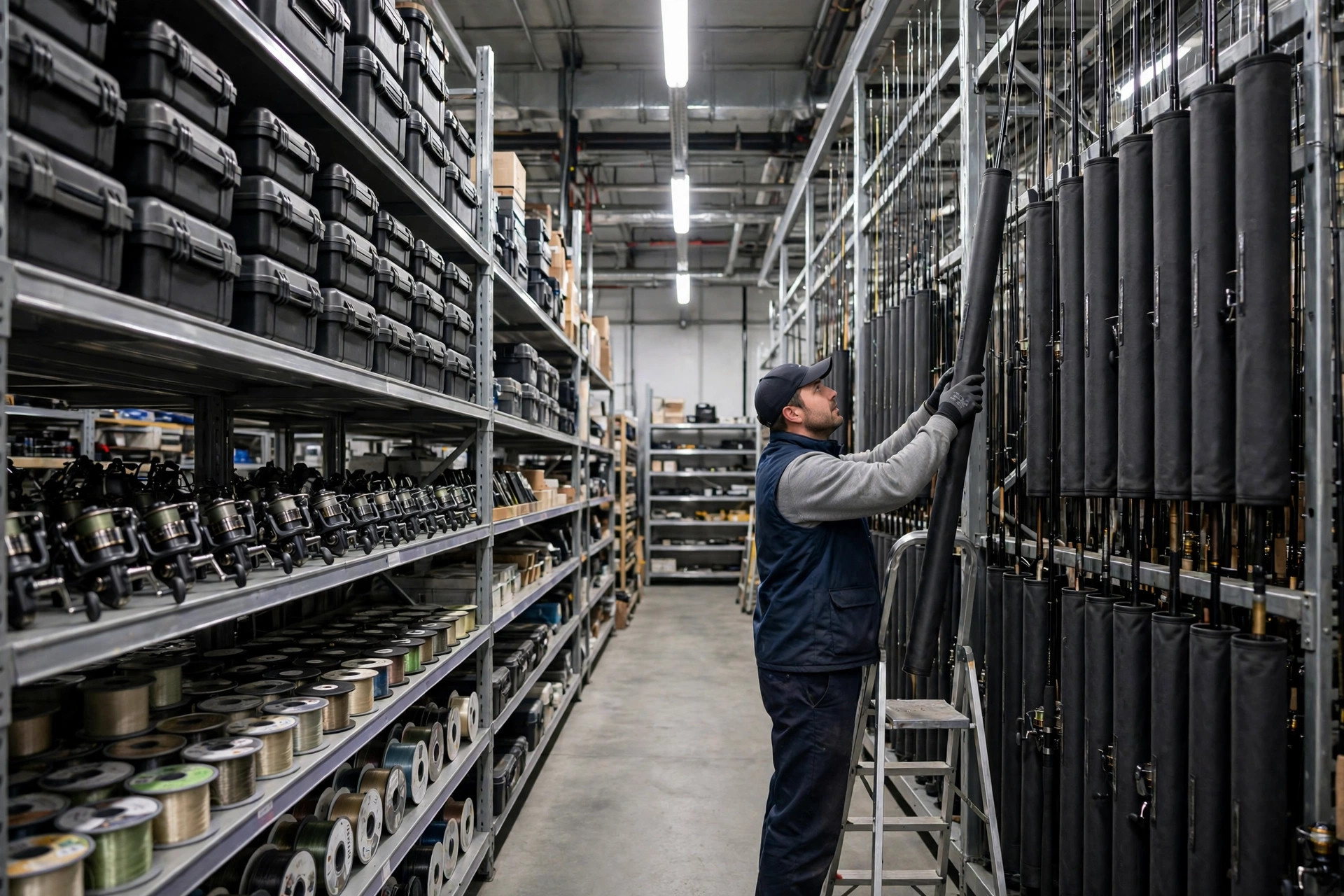
Every well-run warehouse I have seen does roughly the same thing: rods stand upright, tips up, in a long-goods rack with dividers, one slot per rod, so they never squeeze each other. Rods go into protective sleeves before they go on the rack — a bare rod never goes up. The high slots get a small step ladder, because nobody should be climbing on cartons to reach a rod. That is how you break goods and hurt people at the same time. Standing storage looks like it takes more room, but picking is far faster: you pull one rod, and only one rod moves.
Here is another story from the road. One summer delivery, the cargo owner left a truckload of rods parked in an open lot under the sun for most of the day, and by the afternoon the rod tubes were too hot to hold. That batch later drew a string of complaints about brittle rod blanks. What does that tell you? Rods do not only fear breaking. They fear heat and sunlight too. Inside the warehouse it is the same rule: keep long rods away from sun-facing windows and heaters. A cool, ventilated spot is where they belong.
Fishing Gear Warehouse Storage and Fishing Line: Keep It Out of Sun, Heat, and Tangles
Fishing line looks unremarkable, but it will wear you down if you store it badly. Line hates direct sunlight and high temperatures, and it hates being mixed with sharp objects. Line that has baked in the sun turns brittle, and when a fish strikes, it snaps under load. The customer loses a big fish, and what they curse is not just the line — it is the whole shop's reputation.
The safe approach I have seen is this: line gets its own rack, away from windows and heat sources, sorted by diameter and material, with spools standing upright instead of stacked in piles. At receiving, check every spool for damage and every package for openings, and keep damaged ones apart from good stock. One more small trick: do not put loose hooks next to the line section. A spool that rolls into a pile of hooks tangles into a mess that takes forever to undo, and your hands end up full of line ends.
Let me put it plainly: one spool of line costs very little, while a complaint about snapped line costs a lot of time and goodwill. There is no comparison. Giving line a proper spot costs a few rack slots. It saves a pile of trouble later.
Fishing Gear Warehouse Storage Gets Messiest with Small Tackle Parts
Hooks, floats, sinkers, connectors, lures — these small tackle parts are the most grinding part of fishing gear warehouse storage. They are tiny, they come in endless varieties, and they look alike. Pickers spend ages hunting for them, and stock counts take ages too. In all my years dealing with warehouses, I have seen plenty of places that manage their big goods beautifully while their small parts are a tangled mess, with a picker opening three boxes just to find one pack of hooks.
There is only one rule for small parts: divided slots, color coding, and big labels. Before small parts go on a shelf, sort them into divided bins, and put a large-print label on each bin mouth, big enough to read from the aisle. Fast-moving small parts go at waist height, the golden zone, so nobody spends the day bending and crouching to find things. Keep fast movers and slow movers apart, with the slow ones up high, so they stop blocking the everyday goods.
| How each type of fishing gear gets its spot | The method |
|---|---|
| Long rods | Standing long-goods rack, sleeved, tips up |
| Fishing line | Shaded rack, spools upright, sorted by diameter |
| Reels | Separate shelf, protected from bumps and stacking |
| Small tackle parts | Divided, color-coded bins with big labels, fast movers at waist height |
That table is the consensus I picked up from talking with several warehouse keepers. Stick it at the entrance of the tackle zone, and a new hire understands it at a glance.
Here is a counterintuitive judgment: in fishing gear warehouse storage, the goods most deserving of the best locations are not the most expensive rods, but the cheapest small parts. The reason is simple. Rods go out a few times a week, while small parts go out dozens of times a day. Three extra minutes picking one small-parts order adds up to hours of labor a day. Flip it around: small parts in a handy spot mean faster picking, fewer mispicks, and a smoother rhythm for the whole warehouse. Expensive goods need protection from breakage; cheap goods need efficiency against chaos. Those are two different calculations, and you have to run them separately.
There is also a trade-off to face honestly. Standing rods upright does take room, and a small warehouse short on space hates giving it up. But the space saved by laying rods flat always comes back as breakage claims and picking time. When space is tight, build the rod zone taller and use the upper air, rather than pressing rods flat under other goods. Space can be found by going higher. A snapped rod cannot be unfixed.
There is an old saying: to do good work, first sharpen your tools. For a tackle warehouse, the tool is the storage location itself. Rods standing up, line kept out of the light, small parts divided and labeled — get those three things right, and fishing gear warehouse storage is basically solid. Next time you walk into a tackle warehouse, skip the reports. Look first at whether the long rods stand upright, whether the line hides from the sun, and whether the small parts can be found at once. If all three check out, that warehouse knows what it is doing.
By Shifu Zhao, Trucking Veteran (15 yrs)