Outdoor furniture warehouse storage sounds like a dream job until the first truck backs into your dock. Rattan sofa sets, patio umbrellas, swing chairs, grills — everything smells like vacation. Then you unload it and realize your warehouse just shrank by a third. Our warehouse is small, about 3,000 square meters, and we cannot afford the big-company playbook: no high-bay automation, no climate-controlled palace. We survive on common sense, cheap fixes, and rules written in marker pen on the wall. Here is how we learned to live with the bulkiest, most weather-sensitive stock in the building.
Our Problem: The Floor Disappeared Before the Goods Sold
In May 2024, a customer sent us 120 rattan sofa sets in one go. Each set broke down into a sofa, a coffee table, and a footstool, plus 120 patio umbrellas on top. Within three days the ground-level bays were full, and the forklift driver had to move stock just to turn around. Worse, every set came with five seat and back cushions — 600 cushions with nowhere to go. They ended up in wire cages by the aisle, and finding the right one meant shouting across the warehouse.
Then came the weather. A summer downpour that July soaked more than 30 umbrellas stored near the roller door, and the customer noticed the damp packaging immediately. Rattan goes brittle in strong sun, grill cartons go soft in damp air, and swing-chair frames rust if they sit in a puddle. That was the week we finally admitted the truth: this category is afraid of rain, afraid of sun, and afraid of nothing more than running out of floor. Big warehouses solve that with money. We had to solve it with layout.
Outdoor Furniture Warehouse Storage Zones: Covers, Racks, and a Cage for Cushions
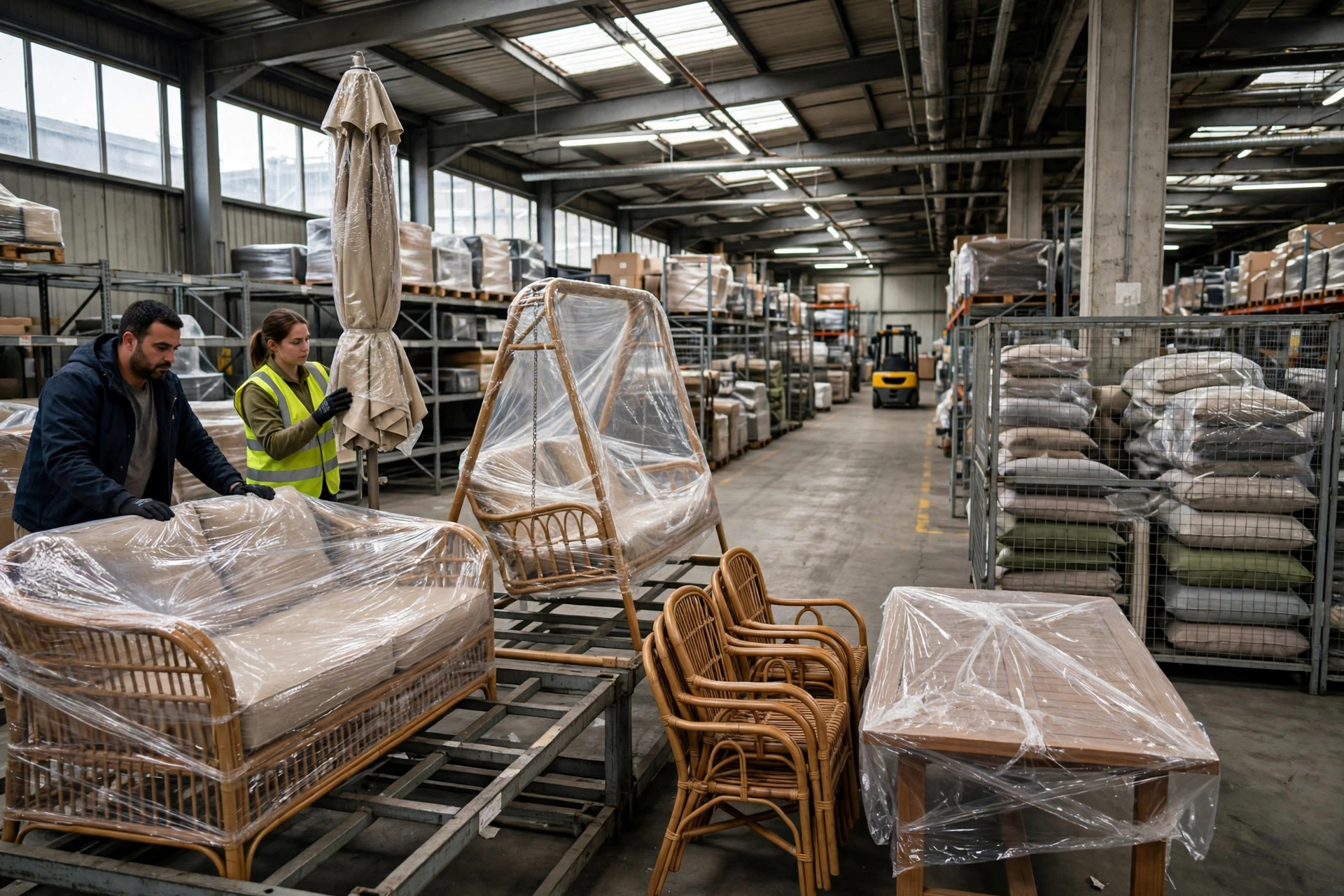
Our first fix was zoning, and we made it brutally simple. Anything near a door, a window, or a known leak point holds only hard goods like grills. Rattan sets live in the shaded interior, each under a breathable dust cover — not plastic sheeting. We learned that one the expensive way: in our first year, plastic covers trapped moisture and grew mold spots on a batch of cushions, a mistake that cost us over 4,000 yuan to make right. Breathable covers cost a little more and save a lot more.
Bulky pieces got their own storage tricks. Umbrellas never lie flat; every one stands upright in a steel frame slot, one per slot, fabric facing inward, so picking one never means digging through a pile. Dining sets stack as a unit: chairs flip upside down under the table, so a whole set takes roughly the footprint of one table. Swing chairs were the worst space hogs until we split them — the hanging basket goes on a wall hook, the frame lies flat against the wall. One swing chair went from eating about 3 square meters to just over 1. Our forklift driver jokes that the method looks scrappy, but one rack row suddenly held 20 extra sets.
Grills earned their own corner too. They look tough, but two things hurt them: damp cartons collapsing and chipped paint from stacking. Now every grill sits on a wooden pallet, ten centimeters off the floor, with a moisture mat along the wall row, and we never stack them. When 60 grills arrived in August 2024, that method kept carton damage to just 2 units for the whole peak season; back when we stacked them flat, we used to damage about 8 a month. It takes a bit more floor, but once you count refunds and rework, it is cheaper.
Cushions, though, are where we got strict. Every set's cushions go into one big transparent bag, tagged with the set number and the cushion count, and all bags live in the cushion cage. Nobody ships a set until the tag is checked against the bag. In April 2025, during peak season, that little tag stopped 7 incomplete shipments before they left the dock. Customer complaints about missing cushions fell off a cliff after that.
Outdoor Furniture Storage Through the Seasons: Sprint in Spring, Squeeze in Winter
The seasonality is brutal. March through June is a stampede — umbrellas and dining sets fly out. By November, the warehouse turns into a parking lot for unsold stock. At the end of October 2025 we counted more than 80 unsold swing chairs and sofa sets sitting on nearly 400 square meters. Kept in peak-season layout, they would have blocked every incoming winter delivery.
So we run two layouts a year. In peak season, sets stay assembled and neatly lined up for fast picking. When the slow season hits, we switch to squeeze mode: stack what stacks, split what splits, footstools tuck under sofas, umbrellas stand in their frames, and the freed floor takes other customers' goods. Squeeze mode is not neglect, either — once a month someone walks the cages, checks covers for tears and bags for damp, and signs the checklist taped to the cage door. Whoever checks, signs. No signature, no excuses.
Here is the counterintuitive part, and it is the heart of outdoor furniture warehouse storage at our scale: most advice says a warehouse like ours needs full climate control. We ran the numbers and walked away. For a small warehouse, ventilation beats air conditioning, and getting the rain and sun zones right matters far more than holding a perfect temperature. A full environmental system would have added a cost per set that our margins simply could not carry. The big-company answer is not always the right answer; sometimes it is just the expensive one.
Split Sets and Missing Parts: Slower by Half a Day, Right Every Time
Split sets are the most fiddly part of the job. A customer orders one spare chair, or a replacement footstool, and suddenly a complete set is broken. Our rule is strict: change the set's status in the system before anything is split, stick a temporary label on the loose piece showing its original set number, and hang a yellow tag on any incomplete set. Yellow-tagged sets cannot be sold as complete. It feels slow, but it cut our missing-part shipments from about 5 a month to fewer than 1 a month by summer 2025.
The results are easy to count, because they come from our own dockets, not a report. After the restack, one rack row went from holding 40 dining sets to 58. Cushion hunting dropped from an average of 20 minutes to under 5. Picking errors fell, and even overtime in peak season dropped by roughly a fifth. None of that came from new equipment. It came from writing the rules down and actually following them.
If you run a small warehouse and are thinking about taking on this category, my advice is three lines long. First, price the floor by the disassembled set, not by the carton count — cartons lie. Second, manage cushions separately, because a tag beats a memory every single time. Third, write down two layouts, one for peak and one for slow season, and switch on schedule instead of reinventing the wheel every spring.
Big warehouses have their way of doing things. We have ours, and for outdoor furniture warehouse storage that means rules over equipment, every time. No fancy gear, no wasted floor, no shipments going out short. Small warehouses have their own way to survive — and honestly, it works just fine.
By Xiao Ma, Small Warehouse Owner