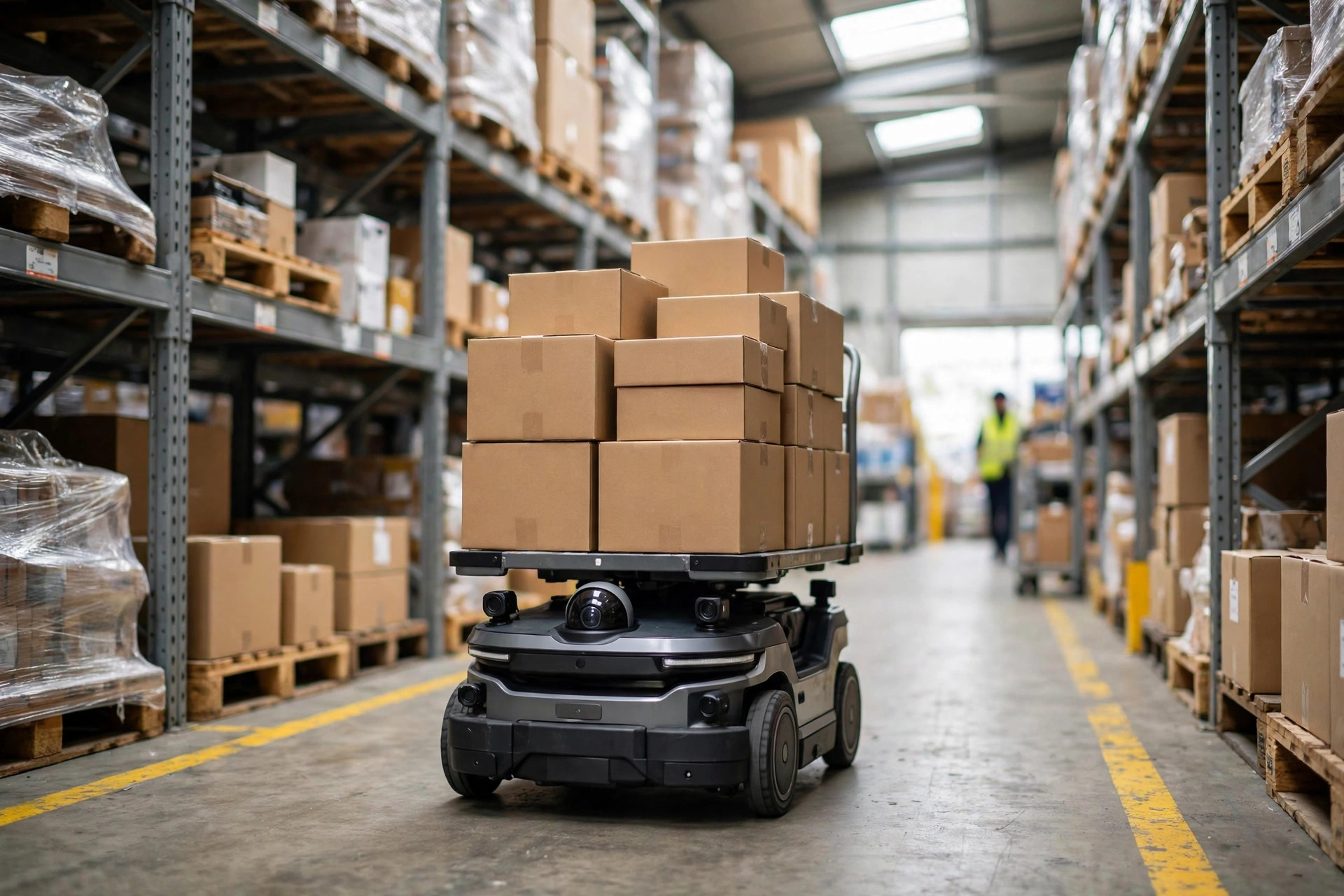
Your First AMR Deployment Pilot: Which Route to Start With in a Small Warehouse
If you're planning your first AMR deployment pilot in a small warehouse, here's the short version: don't put that first robot on your most critical line. Put it on the route you'd barely miss if it broke down — and would quietly celebrate if it worked.
Last fall at a logistics expo in Los Angeles, I watched an AMR demo and fell in love. The little robot mapped its own route, dodged obstacles, queued itself at the charger. The sales rep leaned in: "Full-fleet orchestration. You'll cut labor in half." Then I did the math. Their "full-fleet" pitch starts at a dozen robots, each priced around forty to fifty thousand dollars. I run a 3,000-square-meter 3PL warehouse. We can't burn money like that.
But the itch was real. Three months later, I bought one. Exactly one. And before it arrived, I made myself a rule: the first AMR deployment pilot would not touch our core picking line. Not even close.
Pick a Route That's Cheap to Lose and Sweet to Win
Why? Because a brand-new robot will misbehave in its first two weeks — the map isn't quite right, a pallet stop is off by two inches, there's a Wi-Fi dead zone nobody knew about. If that happens on your core outbound line, orders stop shipping and customers call your phone directly. In my case, that phone is mine.
I set four criteria for the pilot route. Miss one, and the route is out:
- Stable tempo. Roughly the same number of trips every day. A robot's schedule can't handle 50 trips today and 5 tomorrow.
- Fixed route. Two or three fixed stops, no detours. The simpler, the fewer surprises.
- Few exceptions. No forklifts constantly cutting across, no pallets randomly parked in the aisle. An AMR's worst enemy isn't distance — it's being stopped by "unexpected" obstacles every ten minutes.
- Measurable results. You must be able to measure the before and after. Otherwise you've spent the money and even you — the owner — can't tell if it was worth it.
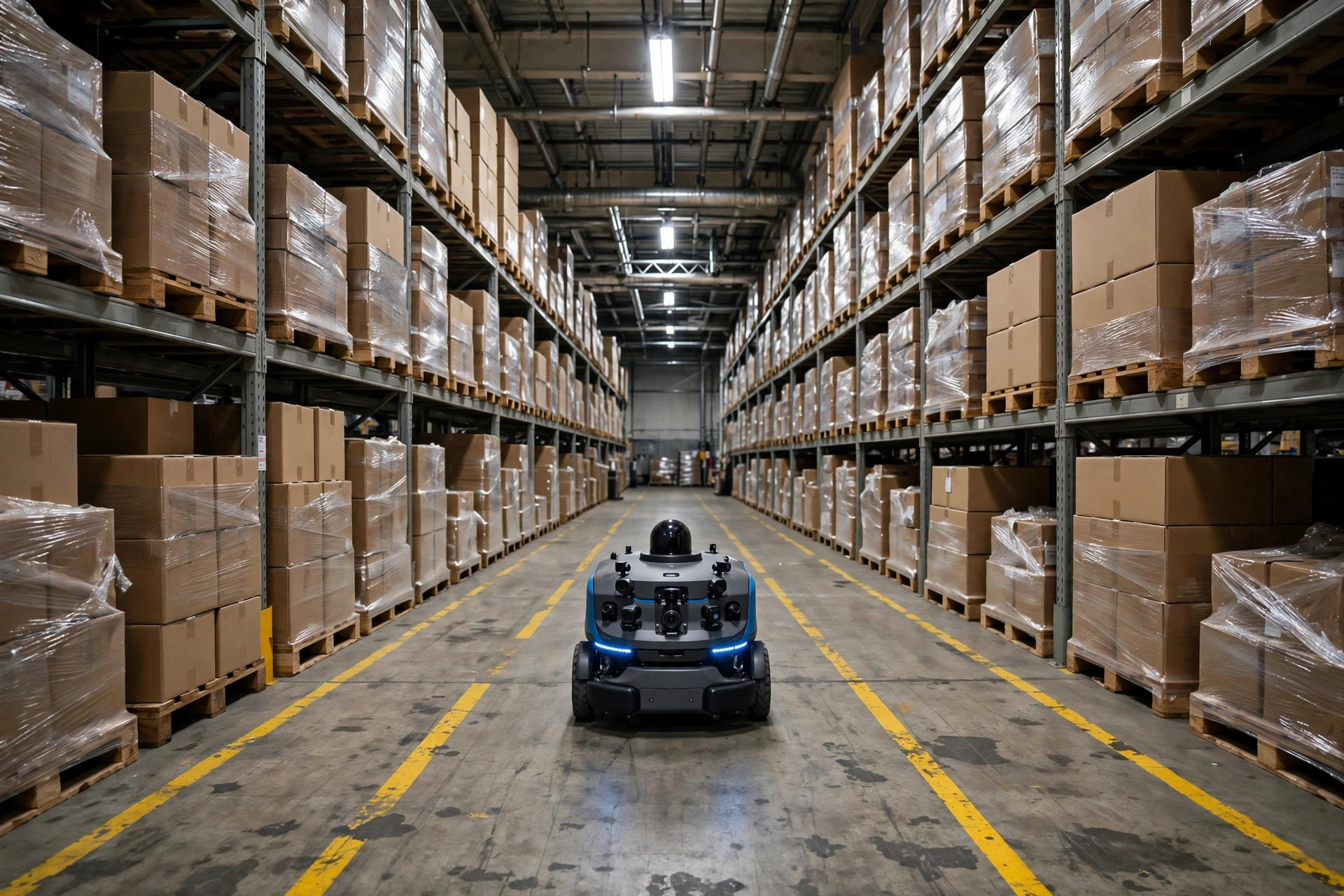
Two routes in my warehouse survived the filter: the replenishment run (bulk storage to forward pick area) and the empty-pallet recycling run. The recycling run was too embarrassing — if it worked, nobody would be impressed. Replenishment was just right: it runs like clockwork every day, it's one straight main aisle, and my pickers complained about late replenishment constantly. Done deal.
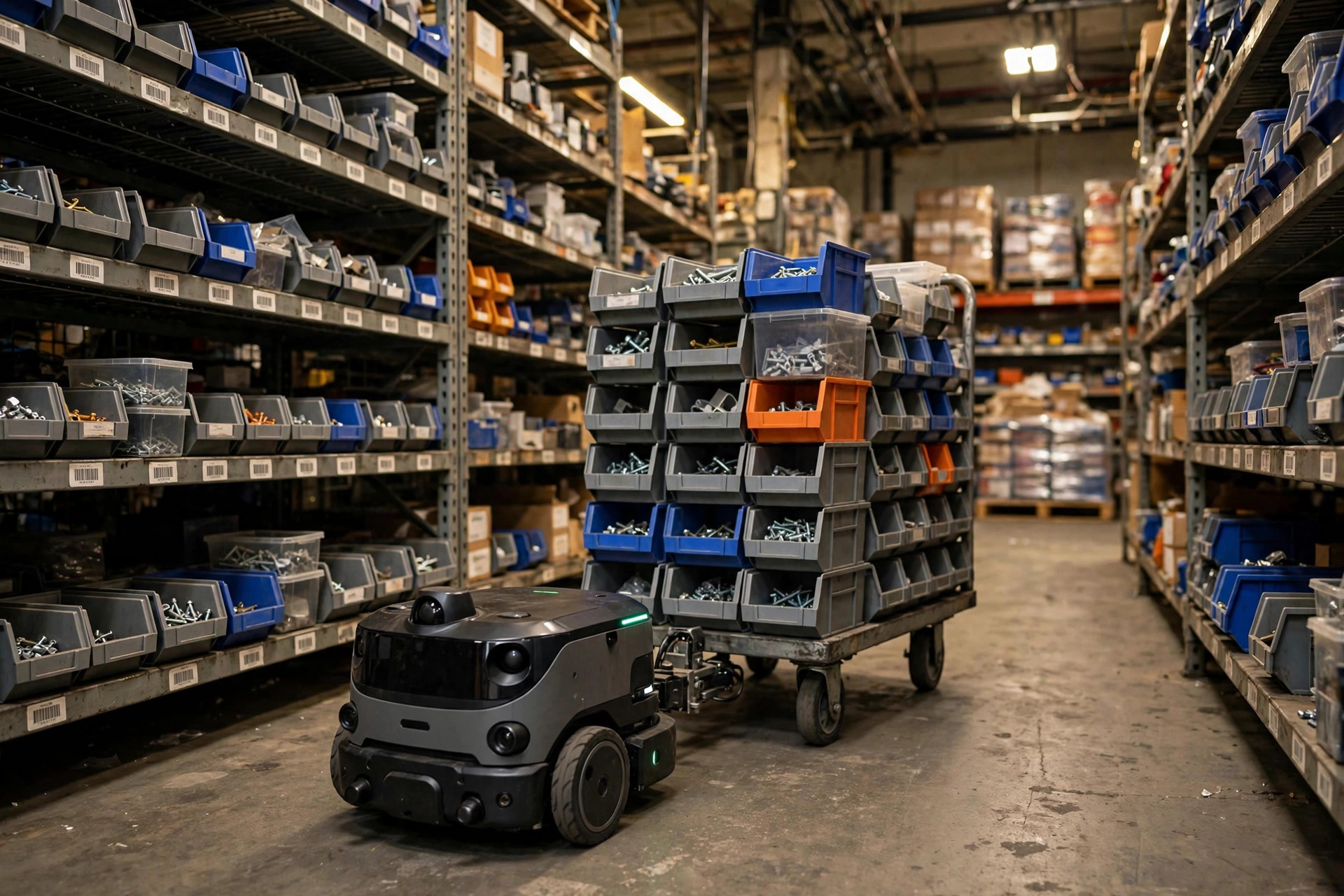
The Real Math on Our Replenishment Pilot
Here's the before picture. We handled small appliances and home goods for a handful of 3PL clients, with about 200 forward pick locations. Replenishment was one guy — Lao Chen — pushing a cart. Bulk storage sat at the far end of the building, the pick area near the dock: roughly 120 meters one way. In peak season he made 40-plus trips a day. The real pain was stockouts: a picker would scan an empty slot, file a request, and wait 10 to 15 minutes for Lao Chen to arrive.
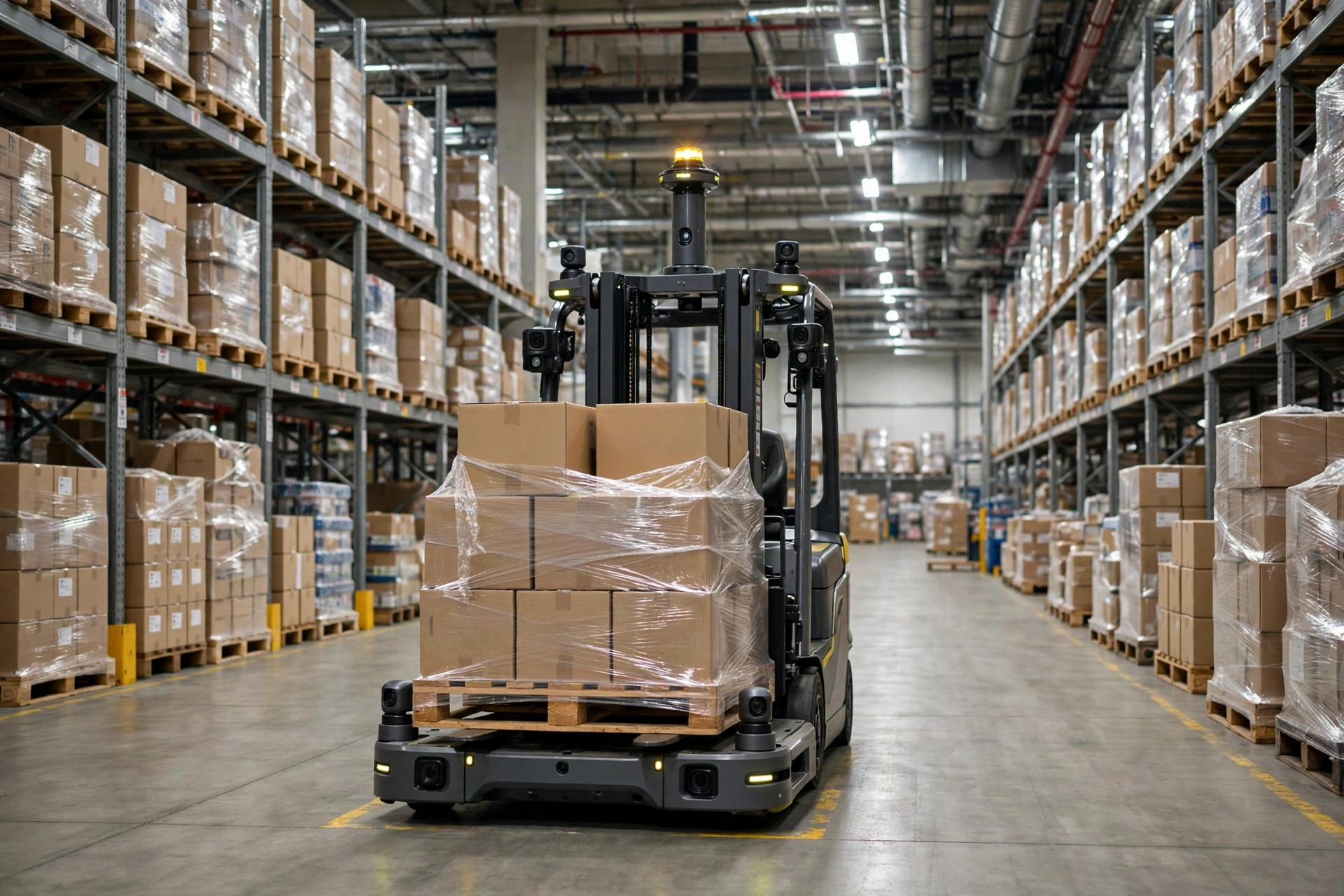
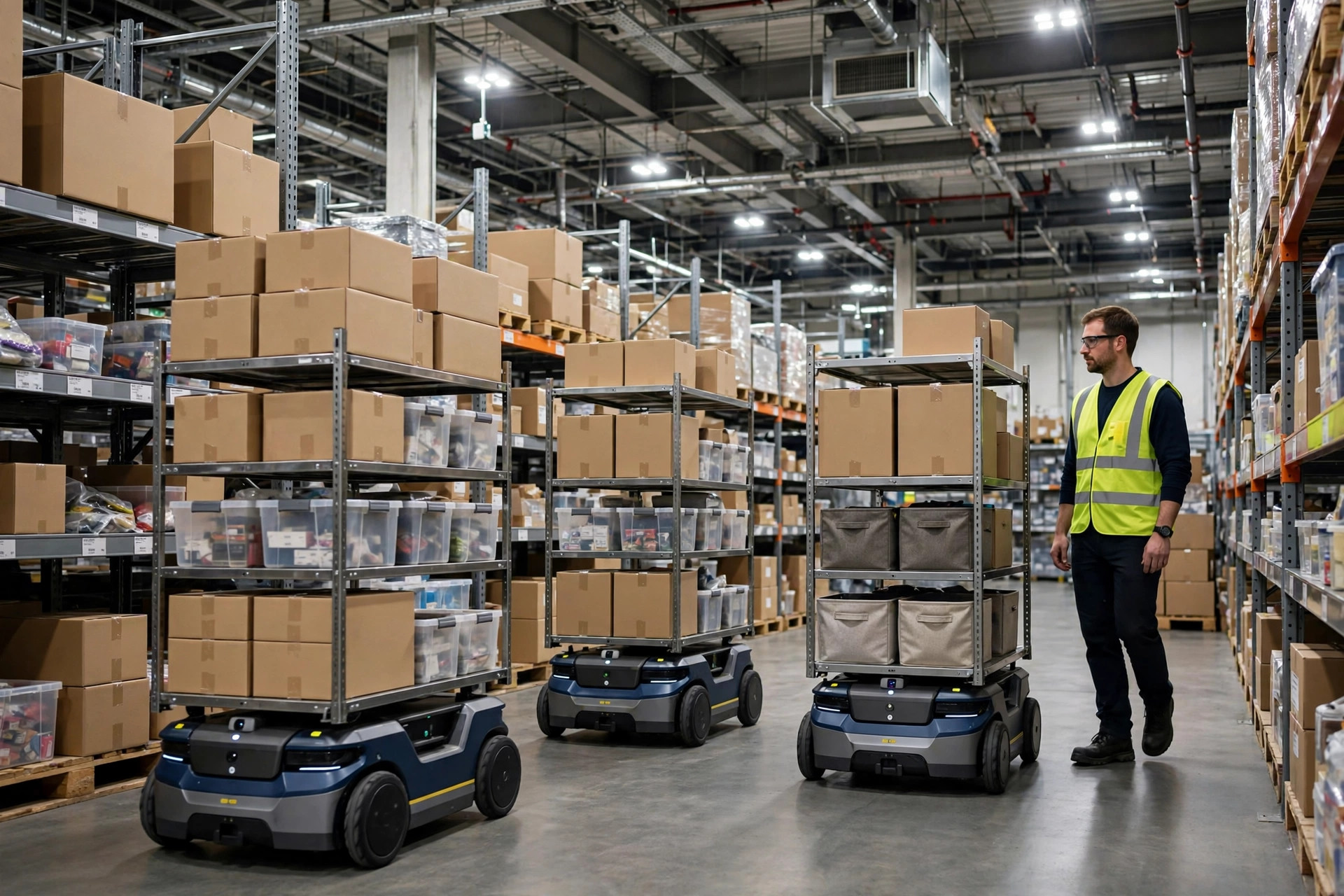
The first tow-type AMR arrived in early 2025 through a US distributor of a Chinese manufacturer. All-in — hardware plus implementation — it cost us a bit over fifty thousand dollars. We didn't do any "full-fleet orchestration." The robot did exactly one job: from 7 a.m. to 7 p.m., it shuttled between bulk storage and the pick area on a fixed beat, towing two carts carrying 8 to 12 bins per trip. When a replenishment task popped up in the system, the stock clerk loaded the bins, scanned, and the robot left on its own. At the pick area, pickers unloaded it themselves, and the empty robot drove back.
After three months, here's the ledger:
| Before (all manual) | After (1 AMR + part-time help) | |
|---|---|---|
| Replenishment staffing | 1 full-time | 0.5 (Lao Chen picked up other duties) |
| Trips per day | ~40 | 55–60 (the robot doesn't take breaks) |
| Avg. stockout wait | 10–15 min | Under 5 min |
| Pick-area stockout complaints | Several per week | Basically zero |
| Investment | $0 | ~$50k+ one-time |
I measured UPH too: replenishment throughput went from about 35–40 lines per hour (manual) to 50–55 lines per hour (AMR-assisted). But let me be honest — at least half of that UPH gain came from the process being forced into shape, not from the robot itself. Lao Chen used to replenish by gut feel; now tasks come in system order and bin staging is standardized. The robot was the excuse; process discipline was the real win.
Payback? Saving half a warehouse worker (fully loaded, that's over forty thousand dollars a year here) plus fewer stockout penalties puts payback at roughly 18 to 24 months. But that first robot was only actually "working" about 12 hours out of 24. The marginal cost of robot number two and three drops hard — the map is done, the process is proven, the crew is used to it. The first AMR deployment pilot is the expensive one; the fleet is the cheap part.
The Big-Vendor Playbook Doesn't Fit Small Warehouses
Time for my contrarian streak. AMR sales pitches are built on big-vendor case studies: "This e-commerce giant runs 200 units," "That auto plant went fully unmanned." Inspiring — and irrelevant. Those sites are 100,000 square meters and up, with dedicated automation engineers and an IT team for integrations. My IT department is me. My automation engineer is me. The person who gets up at 2 a.m. to reboot the thing is me.
Big-vendor orchestration solves a scale complexity problem: dozens of robots, dynamic task assignment, dynamic yielding, dynamic charging. Genuinely impressive. But it answers "how do we coordinate a hundred robots," not "should a small warehouse buy its first one." With one or two robots, there's nothing to orchestrate. One fixed route, scheduled departures, a human as backup — crude, stable, cheap, and I can fix it myself.
And here's the counterintuitive take I'd give any fellow small-warehouse owner: the biggest value of your first AMR isn't labor savings — it's converting replenishment from a people-management problem into a scheduling problem. Lao Chen calling in sick, having a bad day, slowing down in peak season — that's a management problem with no fix. A robot running on a beat with 95%+ on-time performance, and humans covering the other 5% — managing that is an order of magnitude easier.
One cautionary tale: my neighbor Lao Wang bought his first AMR around the same time. He went bigger — straight onto the core picking line. First week of peak season, the robot got blocked three times by manual pick carts during the rush, the system had no priority scheduling, and the whole line slowed down. He nearly returned the machine; it sat in a corner collecting dust for half a year. The robot wasn't bad. Putting your first unit on the core line leaves zero margin for error.
Three Things I Check Before Calling the Pilot a Success
After three months, I graded the pilot on three acceptance metrics. Pass all three, and robot number two gets ordered:
- On-time rate. Planned trips vs. completed trips, target above 90%. We hit 93%. Half of the misses were a Wi-Fi dead zone — one extra access point fixed it.
- Human interventions per day. Target: under 3. Month one was 7–8 a day, month two was 4, month three settled at 2.
- Picker sentiment. I just asked the pickers: "still getting starved for stock?" The best state of automation is when nobody notices it exists.
All three passed. Robot number two is already ordered — same replenishment route, filling the early and late shifts. Robot number three will try the "embarrassing" empty-pallet run. If that works, it's pure profit.
So here's my advice to fellow small-warehouse owners planning their first AMR deployment pilot: don't let the sales rep talk you onto the core line, and don't chase full-fleet orchestration. Find a route that's cheap to lose and sweet to win, run it plainly for three months, and let the map, the process, and the crew's habits settle in. If it works, you've got the data and the confidence to scale. If it doesn't, the loss is contained — and the robot can always be reassigned to odd jobs.
Big warehouses play the scale game. Small warehouses play the smart game.
By Xiao Ma, Small Warehouse Owner