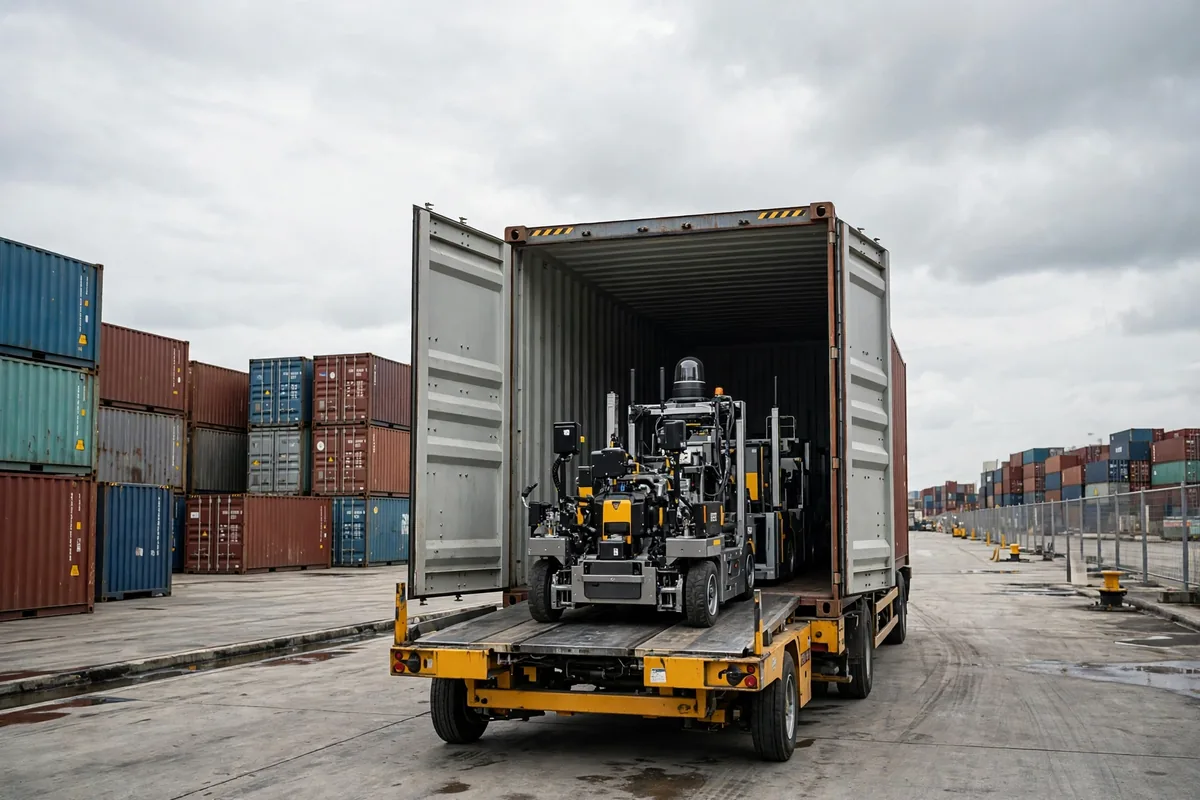
Last autumn a friend of mine who builds sorting equipment called me, and his voice had gone flat. A shipment of sorters bound for Rotterdam had its CE marking in place and its test reports in order, and customs held it anyway: no economic operator inside the EU, and the authorised representative and technical file didn't line up. The machines sat in the port for over two weeks, and the storage and rescheduling bill ended up bigger than a full year of an authorised representative's fee.
That call taught me something plain: the CE marking is only the ticket into the venue. Your authorised representative and technical file are what actually get the goods sold. Plenty of automation people spend serious money on certification and then trip over the last gate at the border. This piece is about that gate: the EU authorised representative and technical file rules for importing equipment.
An Authorised Representative Is Not a Name on Paper
Think of an authorised representative as a local caretaker you hire in Europe. Something goes wrong with a machine, a regulator asks for the file, a customer chases a liability question — the first phone call goes to this person, and they have to pick up, produce the documents, and explain who is responsible.
Regulation (EU) 2019/1020 has set the rule since July 2021: a manufacturer outside the EU who wants to place products on the EU market must have an economic operator inside the EU — an importer, a fulfilment service provider, or an authorised representative. At least one of the three. Without one, the goods can be stopped at the border.
And an authorised representative is not a friendly acquaintance lending you their address. The rules require a written mandate spelling out the scope: the representative is authorised to hand the technical file to market surveillance authorities, cooperate with checks, and handle compliance enquiries on your behalf. The file has to be ready in their hands, not something they start hunting for the day the regulator's letter arrives.
My friend's shipment failed exactly there. To save money they used a trading company they knew, and that company had never even seen a technical file. The authority sent one email, got no reply for three days, and the port ordered the shipment returned. Later they switched to a specialist firm: a fixed annual fee, and when a check came, the file was delivered within two days and the goods cleared as normal.
Here is the dividing line for the choice. If you ship only one or two consignments a year to Europe, hiring a specialist firm is the cheapest option. If you already have a subsidiary or a long-term importer in Europe, letting them take the role is smoother. Either way, remember one thing: the representative's first skill is not "having an EU address". It is "when the regulator writes, they deliver the file within the deadline".
The Technical File: Ten Years of Keeping It
A technical file is the thing nobody looks at until the day it becomes your entire defence. The Machinery Directive 2006/42/EC requires the declaration of conformity to name the person inside the EU who is responsible for compiling the technical file — and note that it says a person, not a website: a specific, reachable, responsible individual the authorities can find.
The retention period is 10 years, counted from the day the last unit of that product is placed on the market. Read that again: the last sorter you sell this year can still be the subject of a file request a decade from now. Most people never do this arithmetic. Product lines change, engineers leave, drawings sit on somebody's laptop — and ten years later, what exactly will you hand over?
One more date to mark. The Machinery Regulation (EU) 2023/1230 is scheduled to replace the current directive in January 2027, subject to the latest timetable. The new regulation is more detailed on digital instructions and software safety, so if you are building a technical file today, it pays to draft it against the new regulation's expectations and avoid reworking everything in 2027.
So what actually belongs in the file? From our experience as an integrator, a complete set covers at least: the risk assessment record, design drawings and calculations, a list of critical components, test reports, installation and commissioning instructions, user manuals in the relevant languages, and the declaration of conformity itself. Every item must match the model actually shipped. Drawings for model A with a declaration for model B means the work was wasted.
The most typical failure I have seen happened about three years ago. An older model was sampled by a customer-side check in Europe, and the authority asked for that year's risk assessment and test reports. The engineer responsible had left long before, and the files lived in his personal cloud drive; the company server held only a half-finished draft. Rebuilding the file took two months, and that model was pulled from sale in Europe for the whole period.
Here is the contrarian point: a technical file is not marketing material for your customers. The prettier you write it, the less it matters. Regulators care about three things only: can it be found, can it be produced, does it match the product. Where the file lives, who is responsible for keeping it, and who can still retrieve it in ten years — answer those three questions and the file is mostly good enough.
Before You Ship to Europe, Tick This List
Enough theory. In practice it comes down to one checklist. Before booking the vessel, go down this table item by item, and do not ship with a single box unticked:
| Item | Do it up front | Cost of finding out later |
|---|---|---|
| Authorised representative | Written mandate; confirm they can deliver files on time | Goods held or returned, rescheduling at your expense |
| Declaration of conformity | Name the EU person responsible for the technical file | Declaration invalid, whole batch re-certified |
| Risk assessment | Done for the actual model, records kept | Nothing to show at a check, product pulled from sale |
| Technical file | One named keeper, 10-year retention, handover on staff changes | Engineer leaves with the files, months to rebuild |
| Manuals and nameplates | Language versions matching each shipped model | Model mismatch makes the file worthless |
| Regulation tracking | Watch the 2023/1230 implementation timetable | Scramble at the 2027 switch, rework under pressure |
Pin this table to the wall at the project kick-off meeting. It beats any compliance training. Our rule now is: on day one of any Europe project, we fix the authorised representative and the file keeper before we talk about delivery dates and prices. People who do it the other way round end up paying tuition at the port.
And one blunt truth: this money cannot be saved. You can either spend a small sum up front on a specialist, or ten times as much later on lawyers and rescheduling. One is a cost, the other is tuition. They are not the same size, and they do not feel the same.
Is it worth it? Look at one number: compare the cost of one held shipment against a year of an authorised representative plus the file work. Whenever the first number is bigger — and it usually is — the money should be spent, and the earlier you spend it, the cheaper it gets.
By Da Liu, Automation Engineer