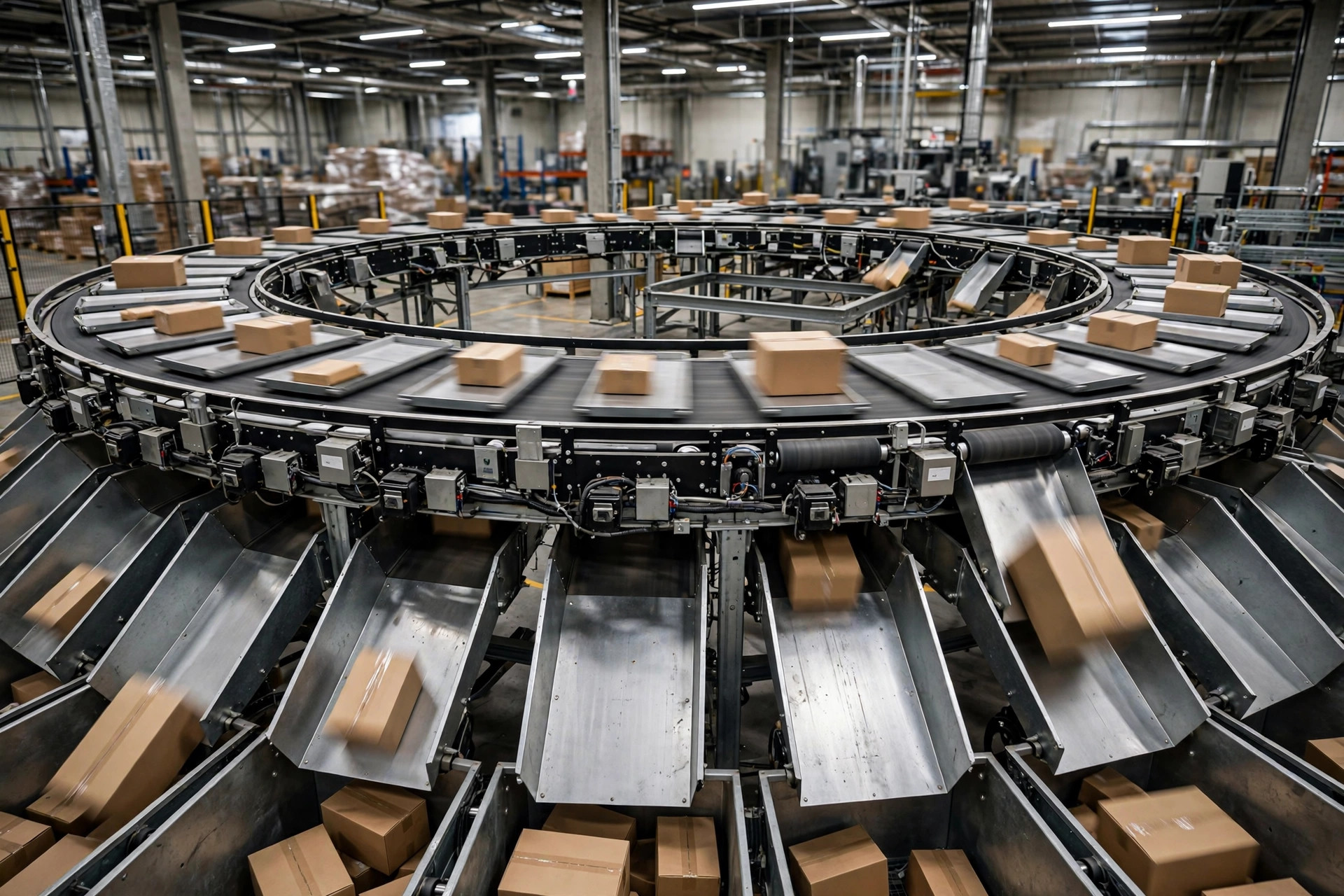
Last October I watched a sort supervisor at a 3PL returns warehouse fish 40-plus cartons out of chute 12 that belonged in chute 14. Classic mis-sort. The recheck crew worked overtime and six wrong shipments still went out — roughly two grand burned on reverse pickups and service calls.
Here's my verdict up front: a sorter's "accuracy" number is about ninety percent marketing and ten percent engineering reality. To move from 99.5% to 99.95%, you first have to understand exactly where that half percent goes wrong.
How mis-sorts happen: three root causes
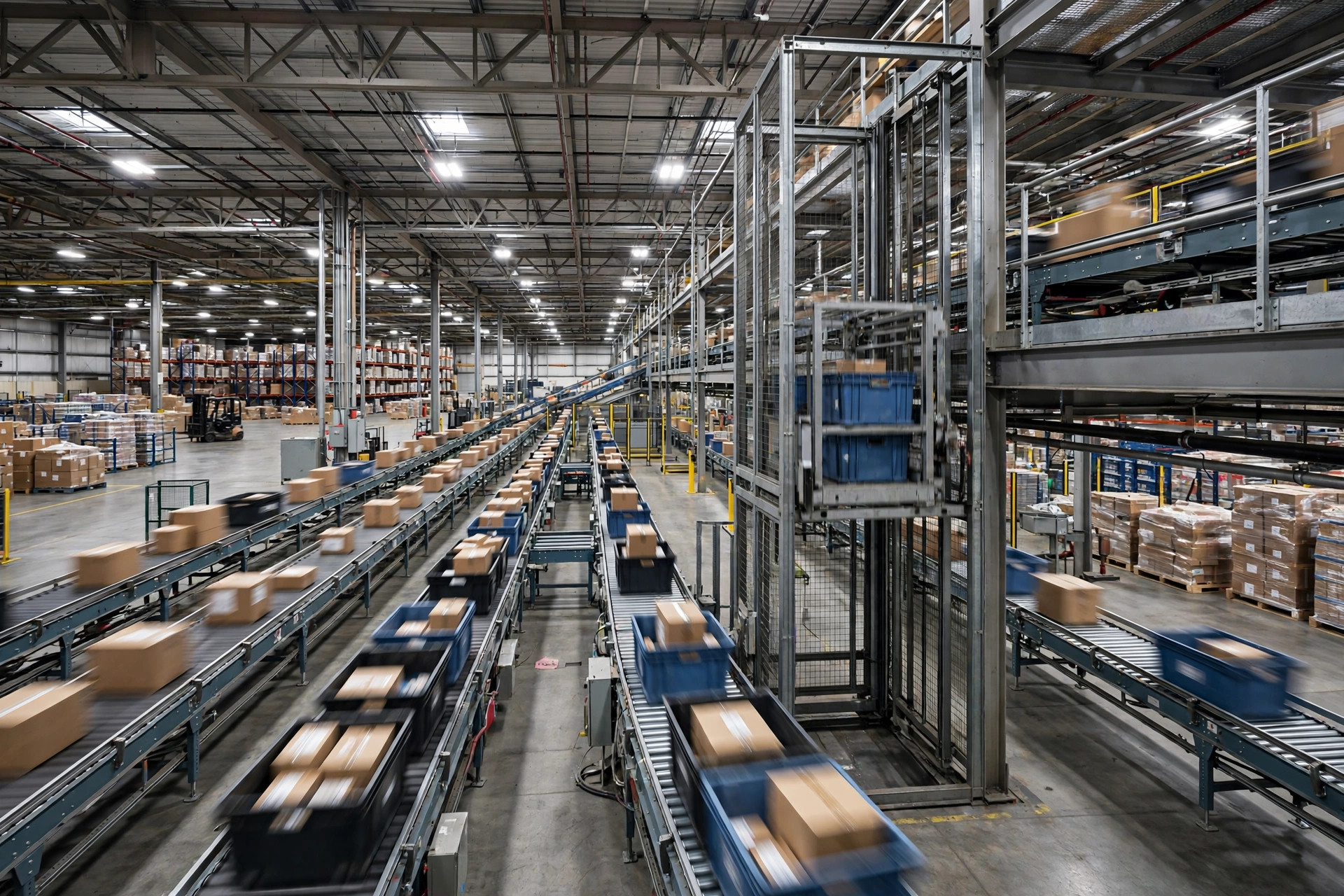
Every parcel goes through four steps — scan, chute assignment, divert, drop. Mis-sorts live in the gaps. I bucket them into three.
Cause one: misidentified — the scan. Damaged barcode, smudged label, tape over half the code, or the parcel spinning with the label face-down. Think of a toll camera trying to read a mud-covered plate — no amount of camera money fixes that. Most WCS setups divert no-reads to an exception chute — until that chute fills up uncleared and parcels slide into the neighboring chute. Often the root cause isn't the scanner — it's the induction operator tossing parcels label-down onto the belt.
Cause two: misdiverted — the physical handoff. Code read fine, chute assigned right, but the parcel's posture was wrong at the divert moment: a light polybag carried sideways by air, a heavy carton sliding off the discharge edge, or two small parcels riding nose-to-tail so the divert pushes both. It's like bowling — strike versus gutter is millimeters at release. Discharge angle, belt speed, and weight distribution stack up in ways physics doesn't negotiate. The hardest kind to prevent — it happens in milliseconds.
Cause three: nowhere to go — chute overflow. The most common and most underestimated. Chute capacity is designed around average flow; during a wave peak, a hot chute fills in 20 minutes, the full-chute photoeye alarms, and the WCS reroutes parcels to an overflow chute. If nobody clears that either, parcels ride the slide straight into the adjacent chute. Like a parking lot: entrance-level spots fill up, cars start parking in the next building's lot without leaving a note. Causes one and two are "sorted wrong"; this one is "never finished sorting." In my projects, chute overflow routinely accounts for over half of all mis-sorts.
So here's the counterintuitive call: most people assume mis-sorts are an equipment precision problem and spend big on better scanners and diverters — when over half of mis-sorts come down to nobody clearing the chutes. A labor scheduling problem, dressed up as an equipment problem. No vendor will tell you this, because "hire two more people to clear chutes" doesn't sell hardware.

Four recheck mechanisms for mis-sorts: no silver bullets, only combinations
| Mechanism | How it works | Mis-sort rate it can hold | Investment | Biggest trap |
|---|---|---|---|---|
| Chute lights | Light above each chute; WCS lights the assigned chute as the parcel lands | 99.5%–99.7% | Low — light strips plus IO modules | If nobody looks at the lights, they're decoration |
| Manual recheck | Recheck station behind the chute; operator re-scans before packing | 99.7%–99.9% | Medium — labor cost | Speed up and operators rubber-stamp; night shift is theater |
| Checkweighing | Scale at chute exit; actual weight vs. theoretical weight in WMS | 99.85%–99.95% | Medium-high — scale plus integration | SKUs with near-identical weights slip through |
| Vision re-inspection | Camera above the chute; second barcode read and visual match | 99.9%–99.95% | High — cameras plus algorithms | Label face-down or stacked parcels blind it too |
Cheapest option: the WCS lights the assigned chute as parcels land — like a parcel locker pickup code. The trap is blunt: lights are a prompt, not an interlock. Short-staffed at peak, operators grab by muscle memory and never look up. I've seen a warehouse install them and mis-sorts dropped 0.1 points — money spent, habits unchanged.
Manual recheck is most warehouses' reality: one person behind each chute, re-scanning before the gaylord. Effectiveness is the operator. By hour six of night shift, eyes and scanner are in quantum recheck: scanned, not seen. The ceiling on manual recheck is the ceiling on people.
Checkweighing is the underrated one. A dynamic scale at the chute exit weighs each parcel against the SKU's theoretical weight in the WMS; mismatches kick to a recheck chute. Like airport baggage check — one weigh tells you. Its Achilles' heel is SKUs with near-identical weights: two t-shirts 20 grams apart, caught; two phone cases 5 grams apart, the scale is guessing too. Checkweighing fits warehouses with high weight variance (apparel, shoes, mixed sizes), not ones where SKU weights cluster (3C accessories, beauty samples).
Vision re-inspection is the ceiling: a camera above the chute photographs each parcel at drop, re-reads the barcode, and alarms on mismatch with the WCS assignment. In theory, 99.95%. Note "in theory" — label face-down, stacked parcels, reflective packaging blind it too. Hidden cost: false alarms. The camera can't see, it alarms; alarms pile up, operators loosen thresholds, the system exists in name only. Iron law of automation: too many alarms equals no alarms.
In 2023, a home-goods e-commerce warehouse in Texas brought me in to go from 99.4% to 99.9%. I didn't recommend vision — their SKU weights were widely spread (50-gram hooks to 3-kilo bins), checkweighing's natural hunting ground. The fix: a checkweighing section at the chute exits (a bit over $80K) plus two shift workers dedicated to clearing chutes. Three months later: 99.88%, holding. That's the selection dividing line — not the most expensive option, the one that matches your freight. SKUs checkweighing couldn't separate got manual recheck as backup. Combination punches. No silver bullets.
After a mis-sort: tracing it in four WCS log steps
Even the best recheck lets some through. The WCS keeps an alibi for every parcel. Four steps:
- Pull the sort record by barcode: when it was read, at which scan station, which chute assigned. Confirms whether the system assigned it wrong.
- Check the divert confirmation signal: a proper sorter has a drop photoeye at every chute firing a "drop confirmed" event. Log says "assigned chute 14" but chute 14 shows no drop while chute 12 shows an extra one — the divert stage mis-sorted it.
- Pull the full-chute alarm timeline around the incident. If chute 14 alarmed full ten minutes prior, the WCS should show a reroute record. No reroute means the overflow logic was never configured, or configured but not firing — a system configuration problem.
- Pull the induction scan image: decent scan tunnels store images. Was the barcode damaged, the posture wrong? This assigns responsibility — a trashed barcode inducted anyway is induction's fault.
Those four steps locate ~90% of mis-sorts. The murky 10% are stacked failures — half-dead barcode plus nearly-full chute. Don't litigate blame; add recheck.
Maintenance traps live where those four steps point: dusty scan-tunnel lenses (wipe weekly), drop photoeyes taped over by stray labels (check at shift start), full-chute photoeye drift (recalibrate monthly), WCS overflow thresholds changed without a change log. Sorters look rugged but they're fussy — 99% uptime comes down to these five-minute chores. Size equipment per the vendor spec sheet; don't use this article as a sizing manual.
From 99.5% to 99.95%: the cost curve
Each 0.1 point of accuracy costs exponentially more, not linearly:
- 99.5% → 99.8%: mostly management and labor. Real chute-clearing schedules, a dedicated person on the exception chute, induction training on "label side up" — many warehouses get here with zero equipment spend. Cost: one or two extra headcount a month.
- 99.8% → 99.9%: now you buy hardware. Checkweighing or manual recheck, picked by your SKU structure — tens to low hundreds of thousands of dollars. Best bang for the buck lives here.
- 99.9% → 99.95%: vision re-inspection plus deep WCS tuning. Investment doubles, and you're catching a few parcels a month. Whether it pencils out depends on mis-ship cost: an apparel returns warehouse pays $15–25 per mis-ship (reverse pickup, service, reship); a high-value 3C warehouse can pay a hundred-plus. Mis-ship cost times volume — beats equipment amortization, buy it; doesn't, don't force it.
Time to call out a pseudo-requirement: warehouses doing 3,000 parcels a day wanting vision to hit 99.95%. Run the math — at 99.5%, that's 15 mis-ships a day at $10 each, $4,500 a month. Vision starts around $200K; over five years that's $3,300 a month before maintenance and false-alarm labor. Does it work? It doesn't. Accuracy is bought, and bigger isn't better — the right target is where mis-ship cost crosses prevention cost.
So is the money worth it? Watch this one number: your current mis-ship rate times your cost per mis-ship. Beats the monthly amortization of the prevention setup — buy it. Math doesn't work — start by keeping the chutes clear. That's free.
By Da Liu, Automation Engineer