
"The prototype went into the lab for the third time. Same page, same red mark."
That was the call I got in the spring of 2024 from a client in Foshan who builds charging piles for AGVs. Their chargers had been running in a U.S. customer's warehouse for over half a year without a single issue. But getting into Europe meant the CE mark, and the CE mark was stuck on EMC — radiated emissions failing by a few dB around 30 MHz. The lab's recommendation was to swap the power module: a six-figure bill in RMB and at least two months of tooling and re-verification. The client asked if there was a way to fix it without touching the mold.
I told him to hold off on any redesign. I borrowed a spectrum analyzer and spent two days at his factory. The root cause was almost embarrassing: the control board and the power board shared a single ground copper bar, and switching noise was riding the ground straight into the signal path. We added a separate ground bar inside the cabinet, split power ground from signal ground, and put a line filter on the power inlet. Total fix cost: under a thousand yuan. Retest passed on the first try.
Since then I tell everyone the same thing: when warehouse automation equipment fails EMC on the way overseas, it is rarely a design capability problem. It is almost always nobody taking it seriously early enough. UL is about safety — don't catch fire, don't electrocute anyone. EMC is about a completely different promise: the electromagnetic noise your equipment emits must not interfere with anyone else. Getting into the U.S. means FCC Part 15; getting into Europe means the EMC Directive under the CE framework, with the EN 61000 series of standards behind it. The test items look similar on both sides, but the limits and methods differ — never walk into a European lab waving an American test report and hoping for the best.
The Three Failures Labs Love to Find
After years of lab sessions with clients, the top three failure items never change: conducted emissions, radiated emissions, and electrostatic discharge.
Conducted emissions measure the noise your equipment pushes back into the power grid through its power cord. In warehouse automation, the usual suspects are VFDs and switching supplies — AGV charging piles, conveyor motors. Once the power level goes up, noise runs out along the power line. The fix is straightforward: add a line filter at the power inlet, keep power ground and signal ground separate, and keep the filter's ground lead short and thick. A long ground lead turns your filter into decoration — plenty of people learned that the hard way.
Radiated emissions measure what your equipment broadcasts into the air. When this one fails, nine times out of ten it is a cabling problem: motor cables or encoder cables without shielding, or shielding without proper 360-degree termination. The sneakier trap is the cabinet door: many prototypes have painted doors, and that coat of paint sits between door and frame like an insulator. It looks like metal, but it is not electrically continuous, so radiation leaks straight through the door gap. The fix is low-tech but effective: bonding straps at the hinges, or scraping off a patch of paint to mount a grounding lug.
Electrostatic discharge tests whether your equipment dies when someone touches it. Warehouse floors get dry in winter, an operator in synthetic work clothes reaches for the touchscreen, and a few thousand volts walk right in. Exposed parts — the AGV's lidar, the e-stop — take the hit first. Design it in from the start: bond every metal enclosure part to ground, leave spark gaps under keys on plastic housings, and put debouncing plus a watchdog reset on critical interrupts in software. ESD's infuriating trait is randomness — nine passes out of ten, one reset on the tenth, and the report still says fail.
What You Can Fix on Your Own Factory Floor
Lab time is billed by the hour, so anything you can check in your own factory first saves real money. My pre-check list has five items, each paid for in cash and embarrassment.
Check grounding first. Grab a multimeter and measure the resistance between every metal surface of the cabinet. Anything above a fraction of an ohm needs attention. Painted and anodized parts are "insulation in disguise" — they look like metal but aren't connected. The most common rookie mistake.
Then check power filtering. Add line filters at the inlet of every switching supply and VFD where you can. Don't just check the current rating — the insertion loss curve must match your noise band. Buying against the actual failed curve beats buying blind.
Then check cabling. Route power cables and signal cables separately; where they must cross, cross at ninety degrees. Single- or double-end shield grounding depends on signal frequency: low-frequency gets single-end, high-frequency gets both. Unsure? Ground both ends — it's right more often than not.
If the cable from a VFD to its motor runs longer than a dozen meters or so, add an output reactor or a dv/dt filter. It cuts radiation and protects motor insulation. Plenty of conveyor builders don't know this — insulation breaks down after two years, everyone blames motor quality, and it was the VFD's voltage spikes all along.
And during prototyping, reserve cabinet space for filters and ferrite cores. A ferrite core clamped on a cable knocks off a few dB — the lab's most common emergency kit. Don't wait until you fail to discover there is nowhere to put it. Drilling holes and rerouting wires after the fact doubles your fix timeline.
Pre-Testing: Where the Money Actually Goes
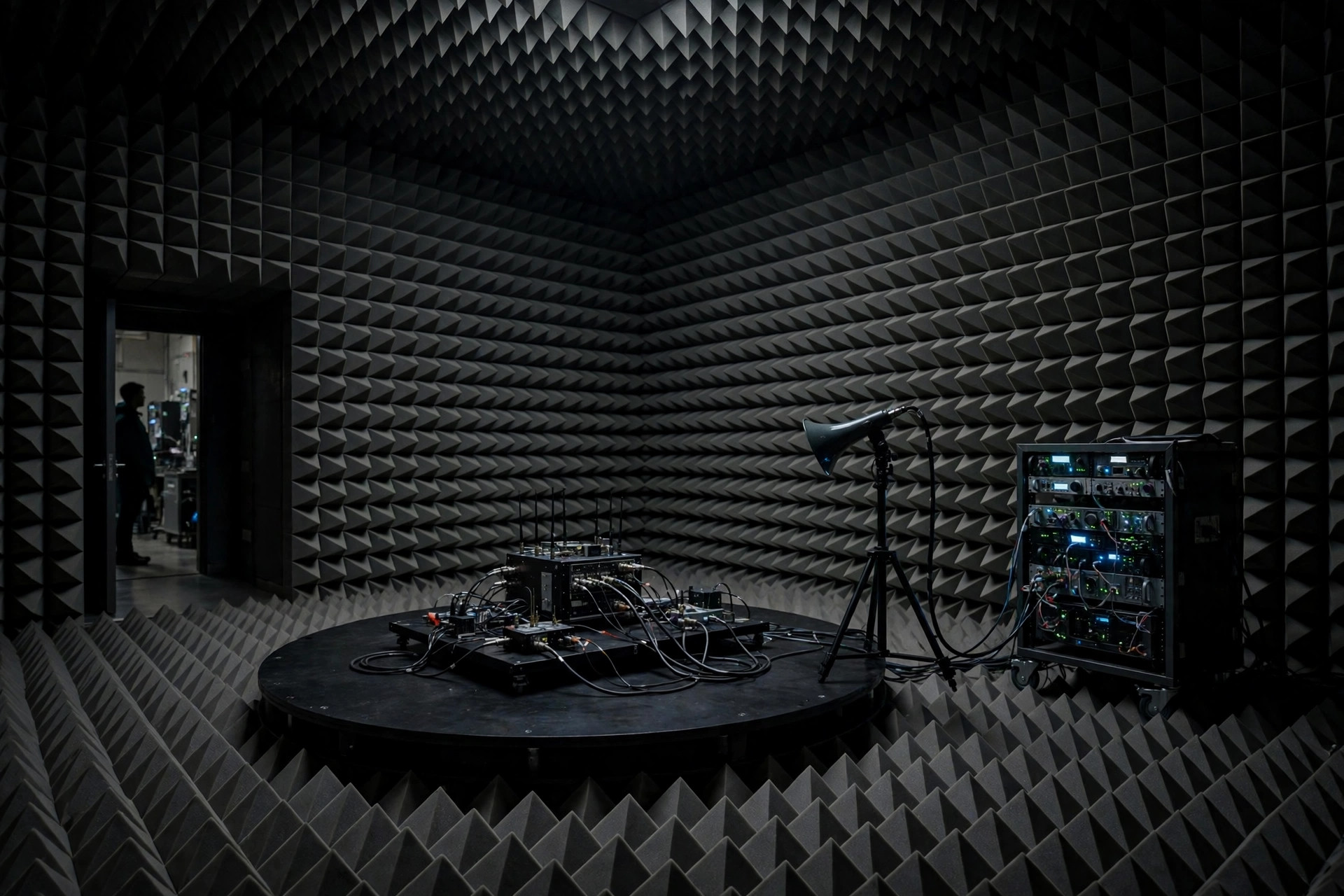
Before formal testing, I strongly recommend a pre-scan. Many labs offer pre-test services billed by the hour or the day — check the lab's latest pricing for exact numbers. It looks like extra spending, but it's the cheapest money in the project: find problems in the pre-scan, fix them in your own factory, then go in for the real test. Walk in cold, fail once, and the rework plus retest fees and delays will cost you three times the pre-scan.
Focus the pre-scan on two bands: conducted emissions from 150 kHz to 30 MHz, radiated emissions from 30 MHz to 1 GHz. Take the curves back to the factory and fix against them — clear targets, one fix per problem. One more warning: the unit you submit must be in mass-production condition. Cable lengths, routing, grounding — everything must match what ships. I've seen a "specially prepared" prototype pass, then a harness supplier switch in production, an end-customer interference complaint, and rework costing ten times the certification fee.
One practical difference between FCC and CE worth knowing: under FCC Part 15, many devices can use Supplier's Declaration of Conformity — testing at a qualified lab is enough, no designated body required. The CE EMC Directive demands a complete technical file, and Notified Body involvement depends on the product category. Paperwork differs a lot, so budget document prep time into the plan — don't just count lab days.
Pre-Shipment Checklist
There's no one-and-done with EMC — every new model or key supplier change means going through it again. Run this checklist before you ship:
- Measure ground resistance between all cabinet metal surfaces with a multimeter; scrape paint or add bonding straps wherever it is over the limit
- Line filter installed at the power inlet, ground lead short and thick, power ground separated from signal ground
- Power and signal cables routed separately, shields terminated 360 degrees, cabinet door bonded to ground
- Output reactor or dv/dt filter added on VFD-to-motor runs longer than a dozen meters
- ESD protection designed in for exposed keys, touchscreens, and e-stops; watchdog in software
- Pre-scan done, conducted and radiated curves reviewed, fixes driven by actual data
- Submitted unit matches mass production: harness, routing, and grounding all identical
- FCC SDoC or CE technical file complete, with document prep time in the project schedule
Every item costs hours; missing one costs days of lab time and scheduling. Do that math yourself if you run an export business.