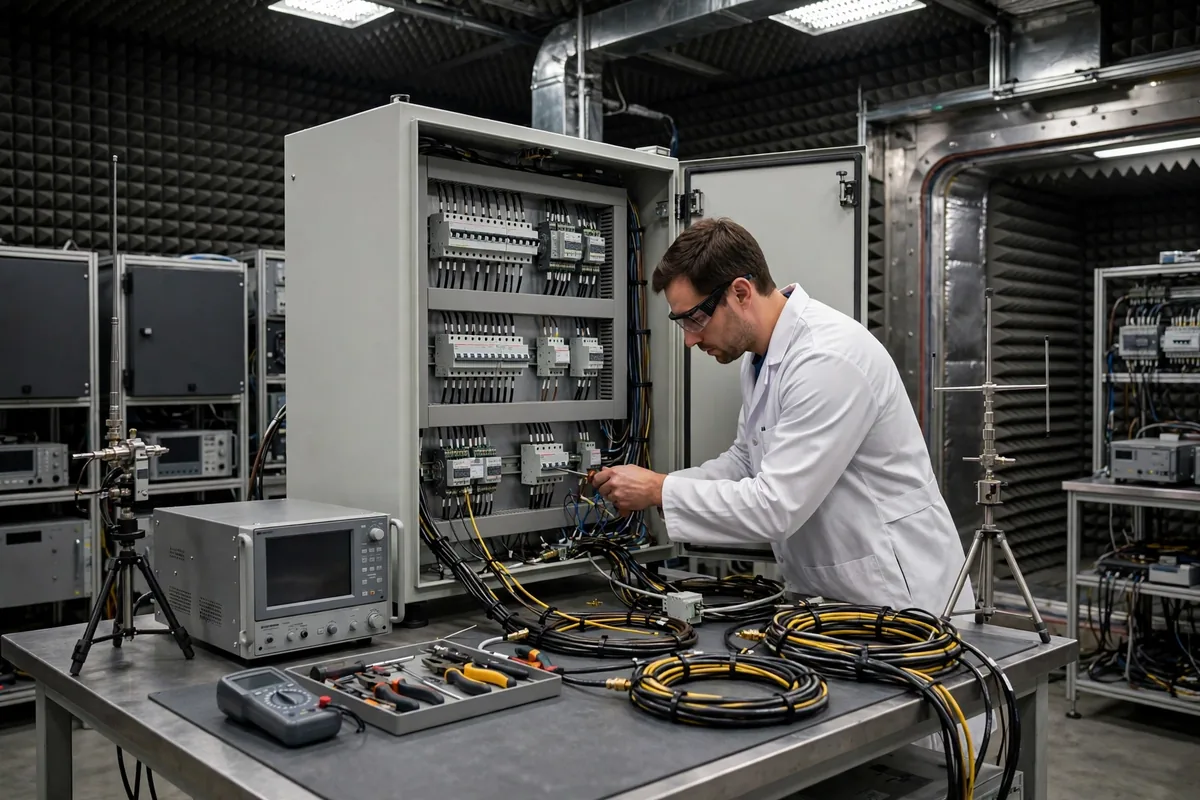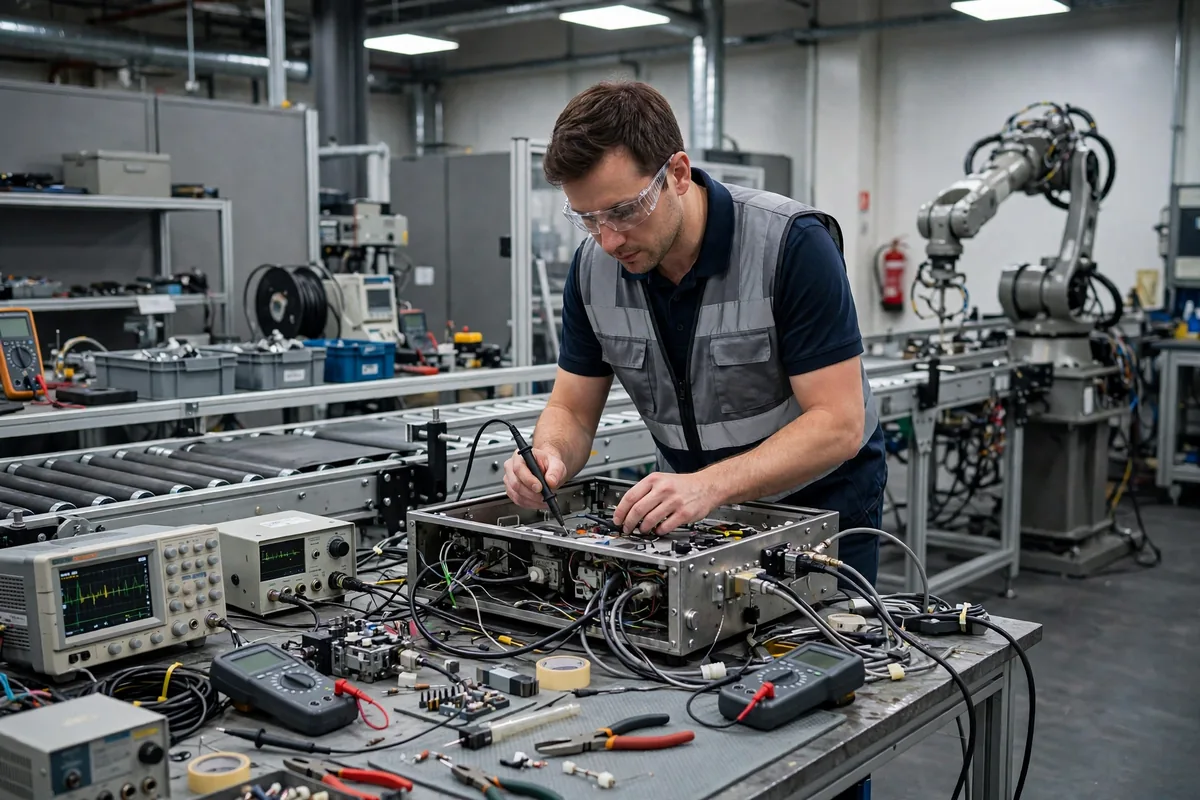
Electromagnetic compatibility, or EMC, is one of the most common reasons warehouse automation equipment gets sent back for rework before it can be sold in Europe. It is not a niche technical detail. Every powered device must meet two conditions at once: it must not emit electromagnetic interference above permitted limits, and it must keep working properly in a real electromagnetic environment. A sorter that runs flawlessly in a domestic warehouse can trigger false signals from photoelectric sensors at a European customer site, or get held up at customs pending additional testing, and these stories circulate widely among systems integrators.
What makes EMC electromagnetic compatibility so treacherous is timing. Problems rarely show up on the drawing board. They surface during system integration, whole-machine testing, or even customer acceptance on site, and by then every fix costs several times more in both money and schedule. Understanding the logic of EMC matters far more than memorizing standard numbers.
Why EMC Electromagnetic Compatibility Keeps Tripping Up Europe-Bound Equipment
Compliance for automation equipment entering Europe runs along two intertwined tracks. One is the EMC Directive, which governs electromagnetic emissions and immunity. The other is the Machinery Directive, which governs the overall safety of the machine. Both must be satisfied before a CE mark can be applied, and EMC is usually the weak link discovered last, because machinery safety can be checked item by item in a design review, while electromagnetic compatibility can only be proven by measurement.
According to published experience from certification bodies, three interference sources show up most often in automation equipment. The first is the variable-frequency drive: it regulates motor speed through high-frequency switching, and the harmonics generated at each switching instant spread outward along power lines and motor cables. The second is servo motors and drives: the price of high dynamic response is steeper current changes, and a slightly long cable starts behaving like an antenna. The third is wireless modules: Wi-Fi, Bluetooth and industrial wireless terminals common in warehouses are intentional emitters by design, and a small deviation in frequency band or power can cross a limit.
A revealing pattern is that passing the test as a single machine does not guarantee the whole system will pass on site. In 2023, a conveyor-line integrator in China had tested every machine individually, yet once the full line powered up at a German customer's warehouse, nearby barcode scanners began dropping reads intermittently. The investigation eventually traced the problem to the grounding busbar shared by more than a dozen drives: each unit was compliant on its own, but their common-mode currents added up and exceeded what the site environment could tolerate. EMC is a system-level problem, and a stack of single-machine reports cannot prove it away.
Three Usual Suspects Behind EMC Electromagnetic Compatibility Failures
Start with variable-frequency drives. Their interference travels two routes: conducted and radiated. Conducted interference follows power and motor cables; radiated interference couples through space into nearby low-voltage equipment. The first step in any rework is always to identify which route is at fault: conducted exceedances call for filters, radiated exceedances call for shielding and routing checks. Adding components blindly without that diagnosis is the most common waste of money in EMC rework.
Servo systems are subtler. If the shielding of the power cable between a servo drive and its motor is grounded incorrectly at one end, high-frequency currents leak into the control signal lines through the grounding loop. An automated high-bay warehouse commissioned in 2024 learned this the hard way: every time the stacker crane accelerated, the slot-detection sensor flickered, and it took three weeks to trace the fault to a servo cable shield grounded at only one end. Whether a shield should be grounded at one end or both has no universal answer; it depends on frequency and on-site grounding conditions, which is why experienced engineers insist on measuring on site before finalizing a scheme.
Wireless modules carry a different kind of risk. Warehouses increasingly use wireless links for equipment networking, but a module's transmit power, frequency band and duty cycle must all meet European radio equipment requirements. A certified module does not make a compliant machine: antenna placement, shielding by metal enclosures, and spacing from other emitters all change real-world performance. Installing a certified module deep inside a metal cabinet and expecting it to communicate reliably is a mistake integrators keep making.
Pre-Test Checks and the Cost of EMC Rework
The cost of EMC rework follows a predictable curve: the later it is found, the more expensive it gets. Adding a filter stage or separating power and signal routing at the design stage costs almost nothing. Reworking a finished machine, replacing cables, rearranging a cabinet layout and redoing grounding, typically costs several times more. If the equipment has already shipped to a European customer, travel, downtime and contractual penalties join the bill.
A practical pre-test checklist covers roughly four items. First, confirm that compliance documentation is complete for every powered component, with priority on drives, servo drives, power supplies and wireless modules. Second, inspect the grounding system: is the cabinet grounding bus continuous, is shield grounding executed as designed, and is there a single reference point. Third, check cable routing: are power and signal cables run separately, do crossings sit at right angles, and are parallel runs kept short. Fourth, power the machine up and run a basic screening measurement, at least looking at emission levels at the main frequency points with simple spectrum tools, so there is a rough picture before formal testing.
The other side of the cost equation is time. A slot at a formal EMC test laboratory often needs to be booked weeks ahead, and a failed first attempt means another round of rework and retesting. For export projects with tight delivery dates, the prudent approach is to reserve time for at least one screening test plus one formal test before shipment, rather than scheduling testing three days before the container leaves. The test slot is part of the project plan, not an afterthought.
Counterintuitively, the equipment with the best EMC performance is often not the one with the most added components, but the one with the most disciplined wiring. Filters and ferrite cores help, but what usually decides success or failure is mundane work: clean grounding, separated cables, continuous shielding. Teams that rely on adding components to fix EMC frequently find the bill growing while the problem stays.
Over the longer term, Europe's electromagnetic compatibility requirements for automation equipment will only tighten. Equipment density keeps rising, with more drives, servos and wireless terminals operating simultaneously in a single warehouse, while customers' tolerance for instability keeps falling: a single false trigger that stops a line costs far more than the rework itself. For automation vendors exporting to Europe, treating EMC as a design input rather than a pre-shipment checkbox is a lesson that will have to be learned sooner or later. How different vendors walk that road, and at what pace, is a question the next few years will answer.
By Dr. Chen, Supply Chain Researcher