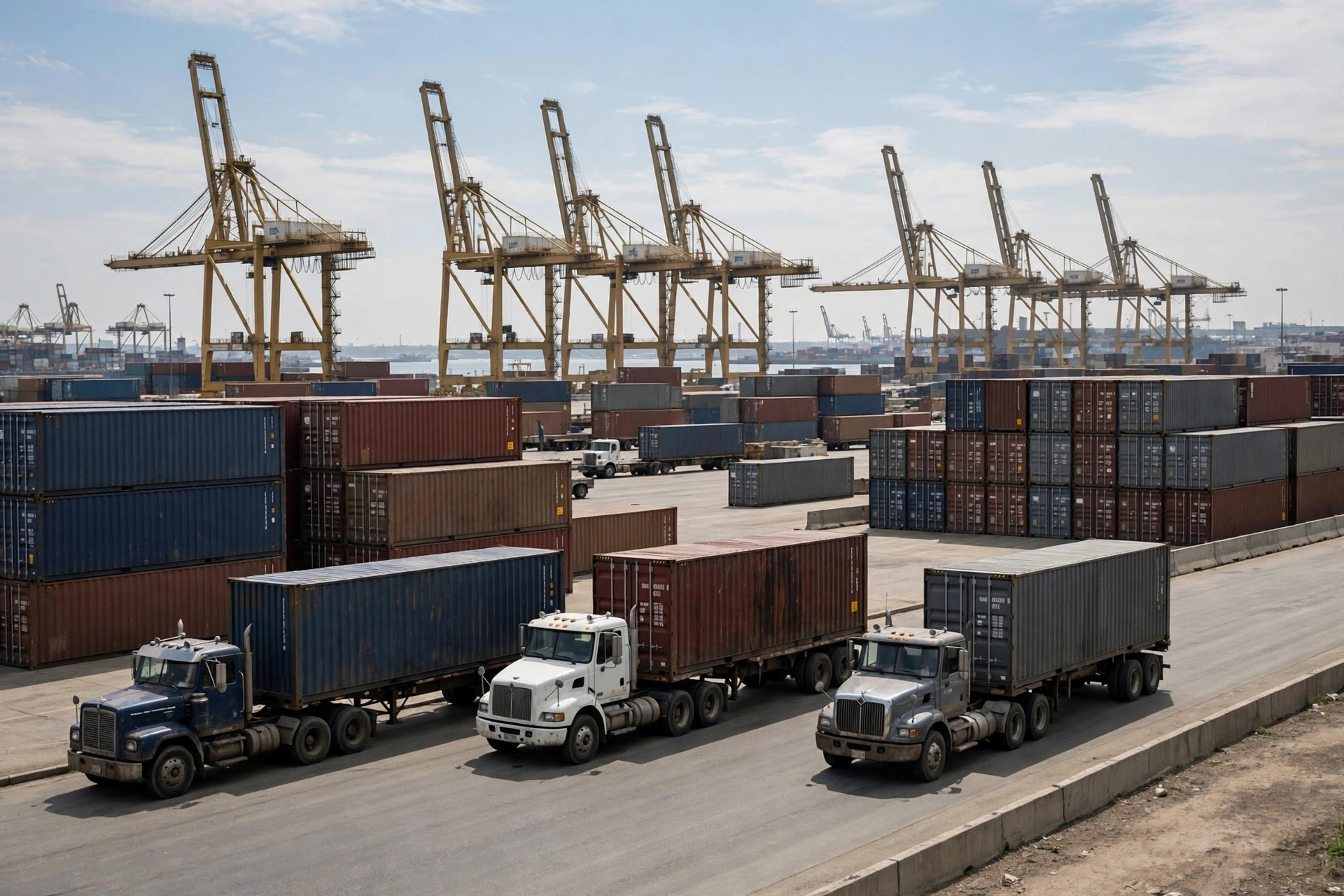
We had a client — a furniture importer in Los Angeles — who called me early in 2025, voice cracking: "Susan, settle this for me. Ten containers landed at Long Beach, customs held things up for a few days, and now I have three invoices: one from the terminal, one from the ocean carrier, one from the trucking company. Nearly twenty grand, total. Who is supposed to pay these?" I told him to slow down and lay the three invoices side by side — demurrage, detention, driver detention. Three different animals. And the question of who pays each one changed with the FMC billing rule, so pay attention to that part especially.
First, Separate the Three: Demurrage vs Detention vs Per Diem — Box Money and People Money
Charge number one: demurrage. The container is still sitting in the marine terminal's yard, free time (commonly 4–5 days — always confirm against the terminal's published schedule) has expired, and nobody has picked it up. The terminal collects. Remember its location: inside the port.
Charge number two: detention, and its inseparable companion, per diem. The container has been picked up and is sitting with you — at your warehouse, at your yard — past the empty-return free time (commonly 5–7 days, shorter for reefers; the ocean carrier's tariff governs). It has not been returned. The ocean carrier collects. Per diem is simply detention expressed as a daily rate — the "dollars per day" number on the invoice. Detention is the event (holding the box too long); per diem is the math (charging by the day). Do not let the two names fool you. Remember its location: outside the port.
Charge number three: driver detention, a.k.a. truck waiting time. This is money for the person, not the box. The driver queues at the terminal or waits at the receiver's dock past the free waiting window (commonly 1–2 hours, and it must be written into the rate confirmation), and the trucking company bills by the hour. It has nothing to do with the two box charges above.
| Charge | Where the box is | Paid to | Typical free time | What decides it |
|---|---|---|---|---|
| Demurrage | Inside the terminal yard | Marine terminal | 4–5 days | Pickup speed |
| Detention / per diem | Outside the port (in your hands) | Ocean carrier | 5–7 days | Return speed |
| Driver detention | Forget the box — it's about the person | Trucking company / driver | 1–2 free hours | Loading/unloading efficiency |
One piece of insider knowledge from the sell side before we move on: of these three, demurrage and detention are negotiable, and driver detention is the hardest to negotiate — because the first two sit on published carrier and terminal tariffs with room to talk, while the third involves a truck that already rolled and a driver who already burned the hours. By the time the invoice arrives, what leverage do you have? That is why the driver detention clause in your contract deserves the most attention, not the least.
After the FMC Billing Rule: Who Pays Demurrage and Detention Now
Some background. Following the Ocean Shipping Reform Act of 2022, the FMC issued its final rule on demurrage and detention billing practices in May 2024, effective May 28, 2024. The core change is a single sentence: invoices may only be issued to the party with a contractual relationship with the ocean carrier or terminal (the "billed party") — in practice, the shipper or consignee. A drayage carrier or trucker with no direct contract with the ocean carrier can no longer be billed directly. The rule also requires invoices within 30 days, with itemized detail (container numbers, start and end dates, applicable rates), and gives the billed party a 30-day dispute window.
What does that mean for shippers? It used to work like this: the trucker got the detention invoice from the carrier, rolled it into your drayage bill, and you never saw the underlying detail. Now the invoice comes to you directly, and for the first time you hold the "see the detail first, then decide whom to go after" card. But note carefully — "not billed to the trucker" does not mean "the money disappears." The shipper pays first, then pursues the responsible party (forwarder, trucker, warehouse) under the contract. Same money, different plumbing.
When I finished explaining this to the furniture importer, his first reaction was: "So I don't have to pay?" Oh, sweetheart. Shippers, do not celebrate too early — the rule gives you transparency and recourse, not a free pass.
A Real Case: Two "Waiting Charges" That Nearly Got Paid Twice
We had another client, a building-materials importer in Houston, in mid-2025. Their receiving warehouse unloaded slowly; one container kept a driver waiting over five hours. The trucking invoice arrived: driver detention, billed by the overtime hour. The client exploded: "I already paid detention to the ocean carrier! Now the trucker charges again? This is double billing!"
It was not double billing. The detention paid to the ocean carrier is money for the box overstaying; the driver detention paid to the trucker is money for the person waiting. One container can absolutely generate both — the box sat with you for extra days, and the driver sat at your dock for extra hours. Each is calculated on its own. When we pulled the contract, the rate confirmation's driver detention clause was vague — the free waiting window was never pinned down. A week of arguing ended in a split-the-difference settlement.
The lesson fits in one sentence: driver detention must stand alone as its own clause — how many free hours, how much per overtime hour, measured from port arrival or warehouse arrival, in black and white. A verbal "the driver will wait a bit" turns into tears the moment it hits an invoice.

Writing the Contract: Three Fees, Three Places You Cannot Leave Blank
First, the free-time clause. How many days, counted from when (the "available" date or the bill-of-lading date), and do weekends and holidays count. Miss one of those three questions and you have a hole — I have seen five "free" days that included a weekend in the count, leaving three usable days in reality.
Second, the rate table. Can the demurrage and detention tiered rates be locked? The common structure is one price for days 1–3 past free time, then a jump (always reference the carrier's and terminal's published tariffs, and write "per attached tariff; rate changes require advance written notice"). Here is a counterintuitive call: more free time is not always better. Some carriers hand out generous free time, then jack the overage tiers brutally. Compare on "your average container dwell days times the tiered rates," not on who offers the longest free time. And weigh extending free time against simply paying for expedited pickup and return — sometimes the latter is cheaper. Run the trade-off; do not go by feel.
Third, responsibility split. Whoever caused the delay pays for it; cite the FMC's billed-party rule and write that "carrier/terminal invoices are issued to the shipper, who pursues the responsible party against itemized detail"; list driver detention separately with its free window, overtime rate, and measurement point.
In negotiation, put these three questions directly to the carrier and the trucker. One: "Can we get two more free days — and is peak season held to the same standard as off-peak?" Two: "Can the tiered rate table be locked for a year — and can the jump starting day four be capped?" Three: "Can we get itemized invoices within 30 days — and if I dispute, who exactly do I call?" Do not underestimate the third question. The FMC gave you a 30-day dispute window; you need to know which door it opens.
Next time you negotiate a contract, remember to ask these three: first, who exactly is each of these three invoices made out to? Second, when does free time start ticking, do weekends count, and are the rates locked? Third, how many free waiting hours for driver detention, how much per overtime hour, and is it in the rate confirmation? Ask those three, and at minimum you will never again spend weeks arguing with three parties over who pays. Invoices can be paid late. Contracts cannot be asked about late.
By Susan, 3PL Sales Director