Peak season, 6:30 in the morning, barely light, first truck backing up to the dock, and the crew is in a hurry to unload. Be honest — nobody bends down to look at the steel plate. I have run warehouse floors for years, and the most invisible piece of metal on the dock is the one that hurts people. That is why dock plate maintenance matters, and why it keeps getting skipped.
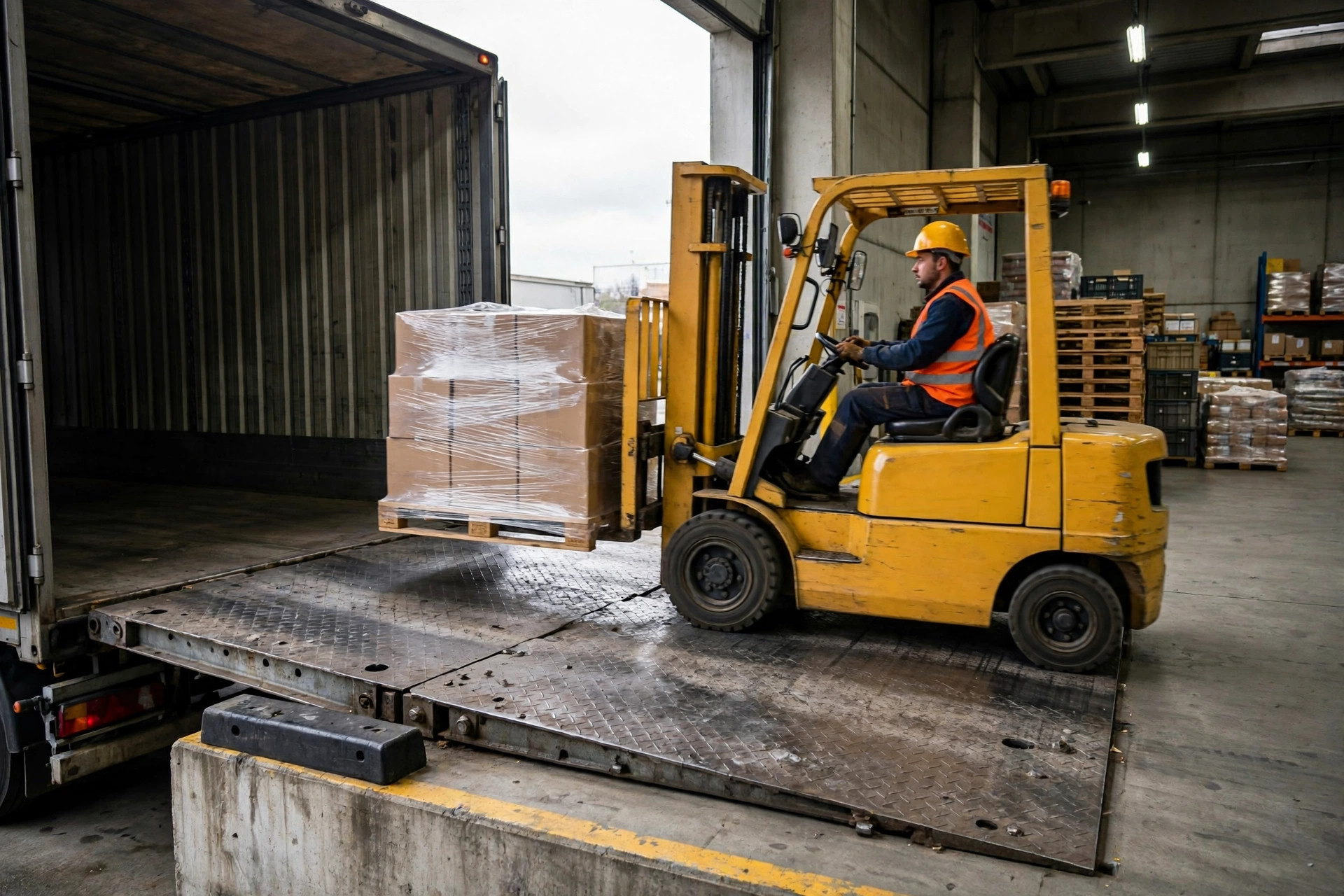
First, get the equipment straight in your head. A portable dock plate is the loose steel plate two people carry and drop between the truck bed and the dock. A dock leveler is the machine built into the pit, hydraulic or mechanical, that moves with a button or a chain. They are not the same thing and they do not fail the same way. A leveler usually fails by refusing to move, which costs you time. A plate has no mechanism protecting you at all — its safety is the flatness of the steel, the grip of its surface, and whether somebody placed it right. For the built-in machines, this breakdown of hydraulic versus mechanical dock leveler maintenance covers it well. My subject here is only the portable plate, and it needs its own routine, not a leftover line on the leveler checklist.
What our dock crew actually does every shift
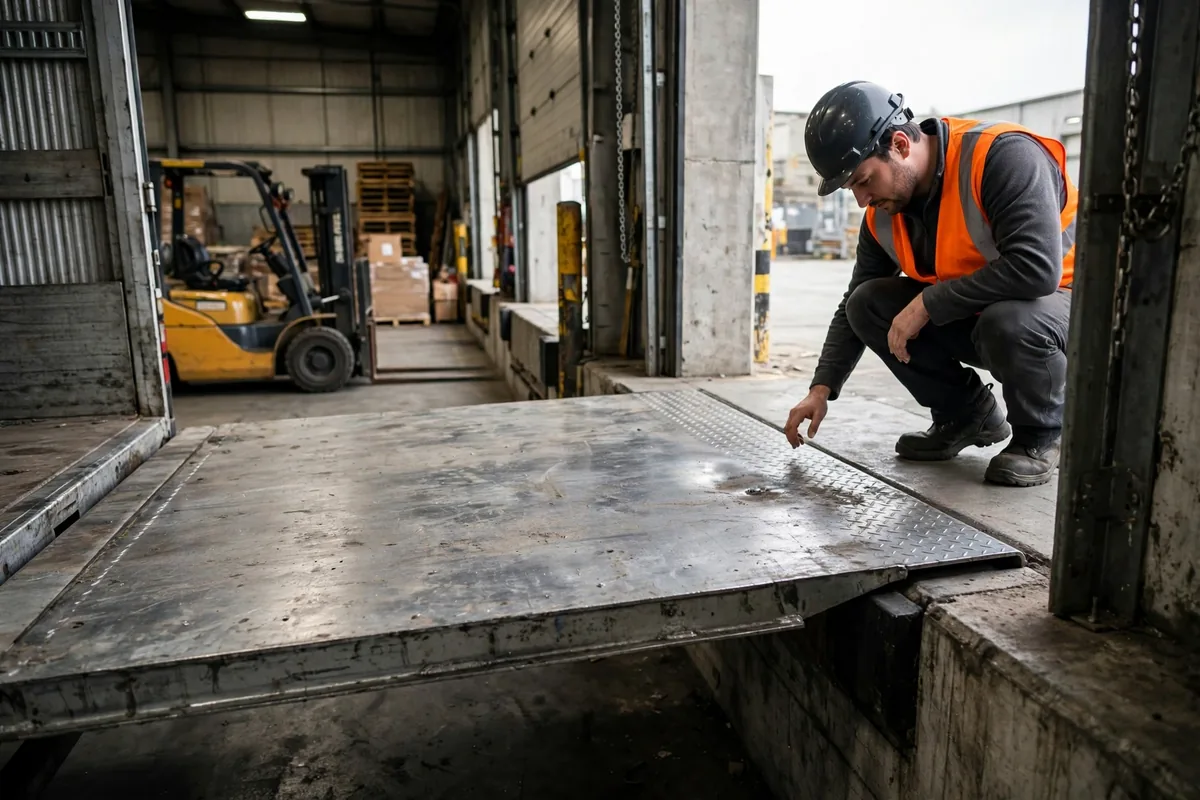
We keep it to four moves, done by whoever carries the plate out: look, step, feel, flip.
Look at the anti-slip surface. The raised tread or grip coating wears down trip by trip. Once it polishes smooth and shiny, a wet truck floor plus a worn tire is a slide waiting for a date. Shiny patches get logged that shift, not after someone goes down. Step on both ends and the middle. A plate with a hidden crack talks to you through your boots — a flex or a tick that a visual check misses. Feel the edges with your hand. Lifted lips, curled corners, and burrs all live on the edge, and the edge is exactly what a forklift wheel hits first. Flip it over. Bending shows best from the back. If the plate rocks on a flat floor instead of sitting on all four corners, it is no longer flat, and flat is the whole job.
In peak season 2022, helping on a night shift at a warehouse in South China, I watched a plate nearly cause a serious accident. A heavy load had pressed one edge up slightly during the day. Under dock lights at night, the lift was easy to miss, and the young worker set the plate the way he always did. The first pass, empty, was fine. Coming back down loaded, the front wheel caught that lifted edge, the plate kicked, and the whole load swayed hard enough to turn the driver's face white. He was moving slowly, which is the only reason I am telling this as a warning instead of something worse. We dragged every plate out that night and checked them one by one. Three were bent to some degree. Three, sitting in daily rotation.
Plate capacity is an axle number, not a total number
Every plate carries a rated capacity, and the most common dock mistake is matching it against the combined weight of forklift plus load. That comparison is wrong. Crossing a plate, the weight does not spread evenly — it concentrates on the front axle, on two wheels, near the middle of the span. The plate feels far more than the total on your paperwork suggests. Match the plate to front axle load with margin, and treat the manufacturer's plate rating and current guidance as the source of truth. I will not quote ratings from memory; on my dock, we read the nameplate. If the nameplate has worn off, that plate leaves service until it is identified. No exceptions, no "it looks heavy-duty."
The comparison below is a hypothetical example to show the matching logic only. It is not a buying guide; confirm every selection against manufacturer data.
| Situation (hypothetical example) | Common mistake | What we do |
|---|---|---|
| Manual pallet jack crossing | Grabbing any thin plate because the load feels light | Light still gets the slip, edge, and bend checks |
| Loaded electric forklift crossing | Counting only the load, forgetting truck weight and front-axle concentration | Check axle load against the nameplate; step up a plate class if needed |
| Peak season, many trucks rotating | Using whichever plate is closest, good and bad mixed | Numbered plates only; heavy doors get assigned plate numbers |
The scrap line has to be absolute, or it will be negotiated at 6:30 in the morning. Through-cracks, a bend that will not come back, anti-slip surface worn smooth across a wide area, cracked bend sections at either end — any one of those retires the plate. There is no bend-it-back-and-run-it on my dock. Steel that has yielded once is damaged inside, and it will fail again at the same spot, under a load, at the worst moment. Our rule: a deformed plate is tagged and moved out of the dock area on the same shift. Never lean it against the wall "for later." If it is within arm's reach during a rush, somebody will grab it. The heart of dock plate maintenance is not the inspection form. It is making the bad plate physically unavailable.
Dock plate storage and numbering sound boring until the first incident review
Most docks I visit store plates leaned against a wall by the door, in a messy row. Leaning storage lets a plate slowly take a curve under its own weight. Flat on the floor, it gets driven over. We moved to a simple rack — off the floor, dry, out of the travel path — and the plates stopped picking up new damage between uses.
Numbering costs one afternoon and a can of spray paint, and it changes everything. Each plate gets a number, and the inspection record follows the number. When a plate was found lifted, when it was pulled, when it was scrapped — all traceable. Without numbers, your log says "the plate" and "that plate," and after an incident you cannot reconstruct anything. During a peak-season support stint at a warehouse in East China in 2024, the site had plenty of plates and zero numbering; good and bent plates shared one pile, and temporary workers grabbed whatever was closest. In my first week we numbered everything and zoned it: heavy-door plates, general plates, and a locked quarantine spot for anything suspect. Night shift never grabbed the wrong plate again that season. Dock plate maintenance is cheap. What is expensive is deciding it is too much trouble.
One reminder for fellow managers before I go: tomorrow, before the first truck, take ten minutes and drag out every plate you own. Step on them. Flip them. Pull the lifted and bent ones out of rotation. Those ten minutes might be the best ten minutes of your entire peak season.
By Chen Feng, Warehouse Operations Manager