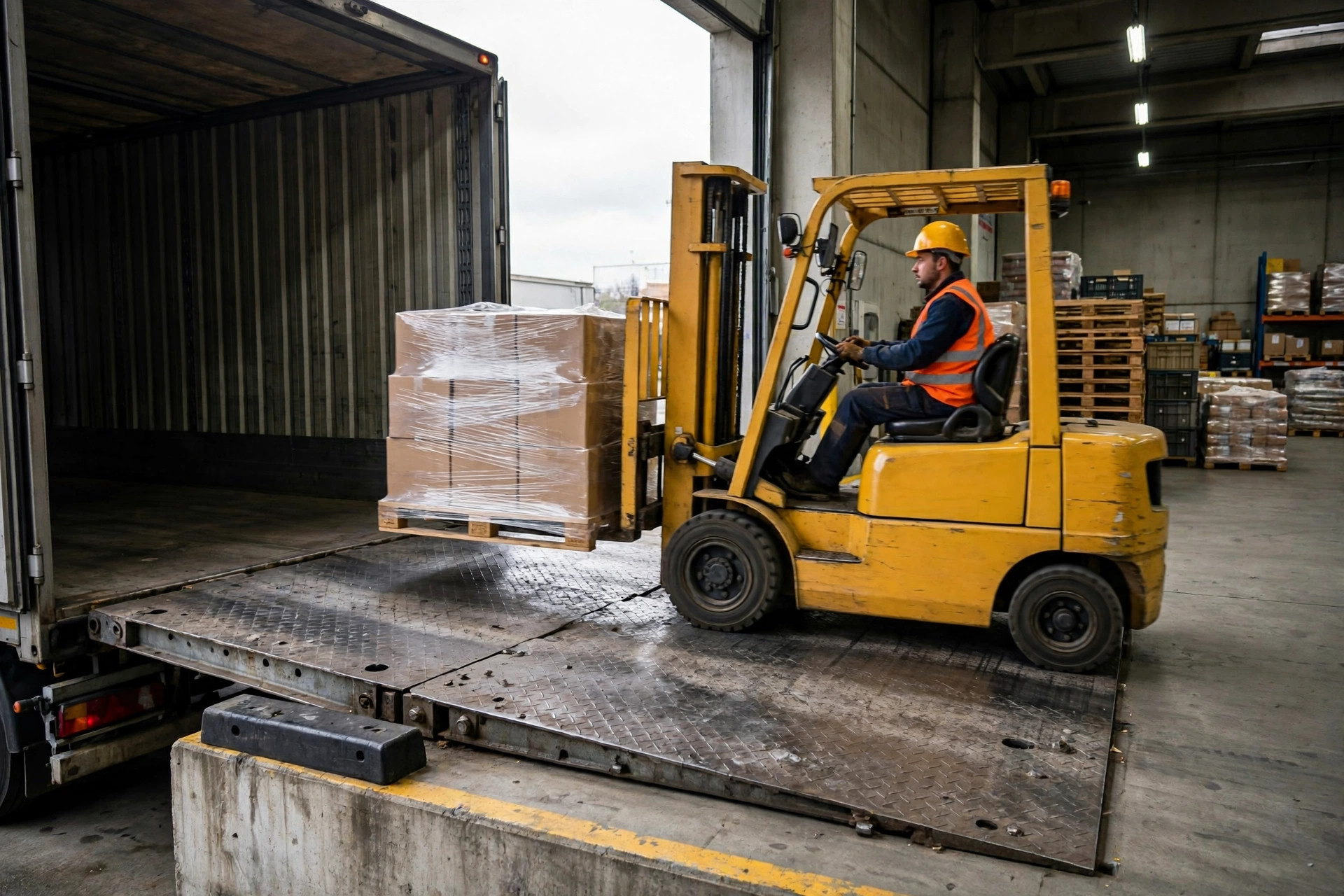
Nobody looks at a dock plate until it causes a problem. Forklifts roll over it all day, it stays quiet, and everyone treats quiet as healthy. Then a tire slips, or a curled edge catches a pallet, and suddenly the dock is shut down. Dock plate maintenance comes down to one rule: "not broken yet" is not the same as "still safe to use."
I learned this the hard way on someone else's dime. In September 2023, I walked into an export warehouse in Dongguan that had been running the same dock plates for almost six years. The surface looked fine. Drivers had mentioned twice that the plate felt shaky under load, and nobody followed up. Then a fully loaded forklift crossed it, the middle sagged, half the load tipped, and a tire wedged into the gap. The dock stopped for most of the day. When we flipped the plate, two stiffeners underneath had rusted through. The top skin had just been holding on. Dock plates rot from the inside out. By the time the outside looks bad, you are already late.
Dock Plate Maintenance Starts With Honest Load Math
Every dock plate ships with a rated capacity, and most buyers compare that number directly with forklift weight plus load weight. If the rating is higher, they call it good. That math misses three things: impact, off-center loading, and fatigue.
A forklift does not press down gently. It rolls onto the plate with speed, so the peak force is higher than the static weight. It also rarely crosses dead center. One tire carries more than the other, and that uneven load bends the plate differently every time. Run that cycle thousands of times and the safety margin quietly disappears.
Here is the rough rule I use. Take your heaviest forklift at full load, multiply by 1.5, and buy at or above that number. Say the truck weighs 3.2 tons empty and carries 1.8 tons. That is 5 tons total. Multiply by 1.5 and you get 7.5 tons, so you shop in the 8-ton class, not the 5-ton class. The price gap between those classes is usually small. The cost of one broken plate, one damaged load, and half a day of dock downtime is not.
Span matters just as much. The wider the gap between the dock and the truck bed, the harder the plate has to bend. The same plate spanning 30 centimeters versus 45 centimeters lives a completely different life. Measure the gap you actually see most days. If it regularly runs past 40 centimeters, either get a longer, thicker plate or fix the dock height difference. Do not leave a plate permanently stretched to its limit.
| Check | How to check it | How often | Replace or stop using when |
|---|---|---|---|
| Surface flatness | Lay a straightedge across the plate and look for curl or sag | Monthly | Edge curl passes 5 mm |
| Underside stiffeners | Flip the plate and look for rust or cracks | Quarterly | Any stiffener is rusted through |
| Anti-slip tread | Feel and inspect for worn-flat areas | Monthly | More than half the tread is worn smooth |
| Hinges and locks | Open and close several times, feel for play or noise | Weekly | It will not lock, or it wobbles |
Dock Plate Maintenance Failures That Stay Quiet: Curling Edges and Slip Resistance
Curl sounds harmless. People tell me, "it flattens out when the forklift rolls over it." Sure, it flattens under the tire. Then it springs back up. That daily flexing is a fatigue test running on your dock floor. In March 2024, I inspected a third-party warehouse in Suzhou where a plate edge had curled about 6 millimeters. The staff said it had always been like that and nothing had happened. We flipped it and found a crack in the weld under the curled corner. Two more months of traffic and that crack would have walked toward the middle. At that point you are not repairing an edge anymore.
The check is simple. Lay a straightedge across the plate. If you can slide a coin into the gap under it, that curl needs attention. A slight curl can be re-welded and reinforced. A bad curl, or a weld that has already cracked, means replacement. Do not nurse it along.
Slip resistance is even sneakier. A new plate has tread or coating. Six months in, patches wear smooth. On a rainy day, or near a cold-room door where condensation forms, a tire slips and the whole load sways. You do not need an instrument to test this. Wet the plate lightly, drive an empty forklift across slowly, and feel for that skipping sensation. Or just look: if more than half the tread is worn flat, the anti-slip performance is already gone. Recoating buys time, but coating is a consumable. If it wears out fast twice in a row, the steel underneath has thinned, and it is time to replace the plate.
Here is the counterintuitive part. Thicker is not automatically better. A very thick plate is heavy, hard for two workers to lift, and hard on the hinges. When opening it becomes a chore, workers skip flipping it for inspection, moisture sits underneath, and rust moves faster. The right plate is "enough plus one class," not "as thick as we can buy." The dividing line is your heaviest real load times 1.5. Hit that number, and the rest is noise.
Dock Plate Maintenance: Where the Money Actually Goes
Dock plate maintenance has its share of fake needs. Fancy rust sprays and miracle coatings sell well, while nobody looks at the structure underneath. Spray is fine, but only after you flip the plate and check the stiffeners and welds. If the structure is sound, rust prevention helps. If a stiffener has rusted through, all the spray in the world is just makeup on a broken plate.
Set three rhythms and stick to them: hinges and locks weekly, curl and tread monthly, underside quarterly. Write the results down with the date, the plate number, and what you found. A sheet of paper on the warehouse wall beats a perfect spreadsheet nobody opens. What matters is the trend. Curl going from 2 millimeters to 4 millimeters tells you the plate is heading downhill, and you can order a replacement on your schedule instead of in a panic. Dock plates and dock levelers are different machines with different maintenance logic, so comparing the two helps avoid mixing up their checklists; see this comparison of hydraulic vs mechanical dock leveler maintenance for how the leveler side approaches the same problem.
Run the total cost over five years. Annual inspection and recoating usually runs about a tenth of the plate price. One breakage easily costs ten times the plate price once you add damaged goods, forklift repair, and lost dock hours. So is this money worth spending? Look at one number: when was the last time someone on your team flipped your dock plates over and inspected the underside?
By Da Liu, Automation Engineer