To understand Djibouti port warehouse logistics, start not in Djibouti but at the junction of the Red Sea and the Horn of Africa. According to public data, Djibouti handled 1.29 million TEU nationally in 2024, up 49.6% year over year. In a global port ranking, that figure is unremarkable. Its structure is what deserves attention: a small country by area and population recording nearly 50% container growth in a single year is being moved by a force larger than its own domestic demand. That force is Ethiopia.
Ethiopia is landlocked. It has no seaport, and its imports and exports move mainly through Djibouti. That single fact sets the tone for everything about warehousing at this port: most of the cargo here is not consumed in Djibouti. It is passing through. The split between gateway cargo and transshipment cargo determines how warehouses should be built, how large they should be, and where they should sit. A port serving only its domestic market can build warehousing to the rhythm of local consumption. A gateway port serving a large landlocked hinterland must build to the rhythm of another country's trade — more volatile, and far more demanding of flexibility.
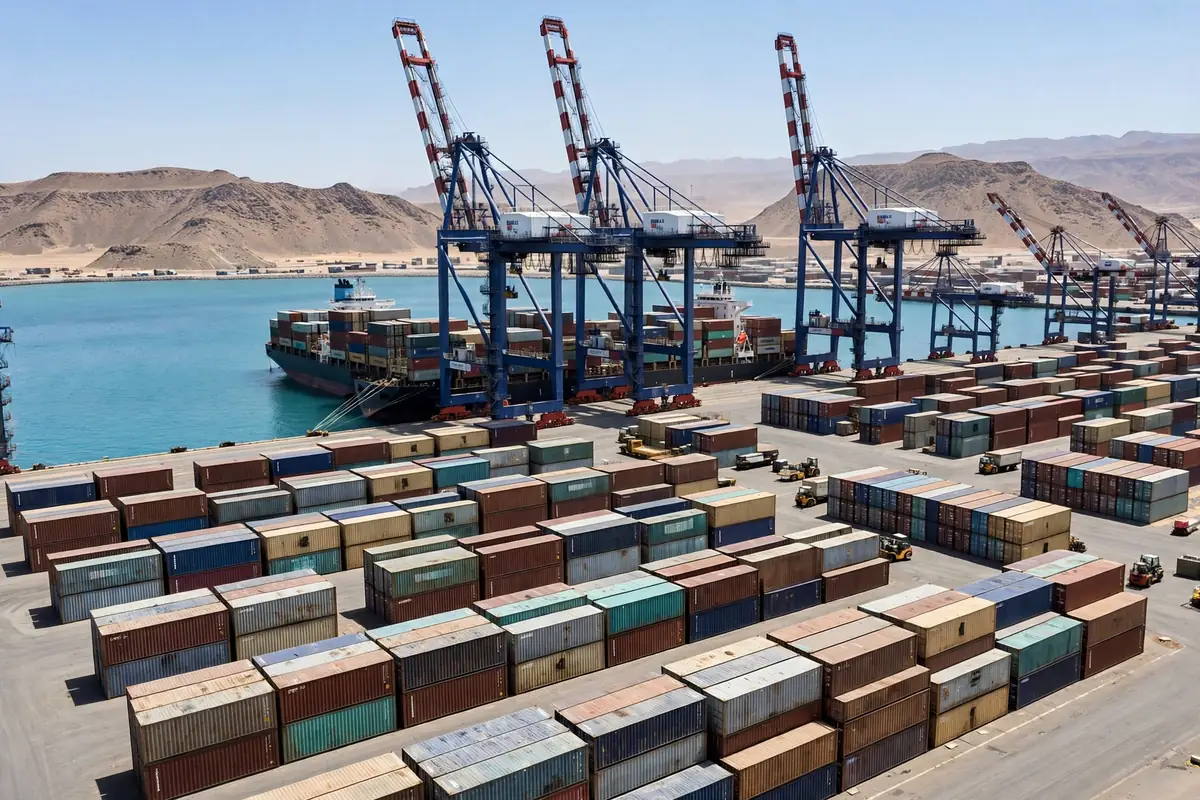
The Doraleh Container Terminal is the node that makes this port legible. According to public data, the terminal handled 1.2 million TEU in 2024, a record, including 110,000 TEU in the single month of March 2024. In the same period its annual handling capacity stood at 1.5 million TEU, with a plan to raise it to 3.5 million TEU by 2030. Read together, the three figures tell a clear story: actual throughput in 2024 already reached roughly four-fifths of capacity, so expansion is not a distant plan but a response to demand that is already pressing. For anyone in warehousing, that means terminal capacity is climbing, and warehouse and yard capacity has to climb with it — otherwise the bottleneck simply moves from the quay to the warehouse.
Djibouti Port Gateway Cargo and Transshipment Are Two Different Businesses
The first distinction in Djibouti port warehouse logistics is between gateway cargo and transshipment cargo. Gateway cargo moves in and out of Ethiopia: consumer goods, machinery, and building materials coming in; coffee, oilseeds, and other farm products going out. It is directional, steady in volume, and seasonal in a legible way. The warehouse work is transit, distribution, and consolidation, and what matters is turnaround speed, not long storage. Transshipment cargo passes through Djibouti on its way to another port. What matters there is the connection between sailings; the warehouse is mostly a short-stay yard, and yard turnaround matters more than storage area.
The two kinds of cargo demand different warehouses. Gateway cargo needs distribution warehouses near the terminal and the road corridor — moderate in size, easy in and out, capable of simple sorting and consolidation. Transshipment cargo needs yard efficiency: boxes in, boxes out, minimal circling inside the port area. A common mistake is to manage both in one warehouse on one schedule, so gateway cargo gets disrupted by the volatility of transshipment sailings while transshipment cargo gets held up by gateway customs clearance. Separating them — in analysis and in planning — is the first step.
The second structural feature worth noting is the free zone. Djibouti's free zone works in tandem with the port, offering bonded warehousing, processing, and distribution. For cargo owners, the value of the zone is not cheap rent; it is that goods can sit, be processed, and be re-exported under bond, stretching the rhythm of capital deployment. But a free-zone warehouse is not a universal answer. Its advantage lies in bonded storage and re-export, not in serving the local market. Parking cargo bound only for the Ethiopian market in a free zone for a long stay adds a procedure rather than removing one. Before choosing a warehouse, ask where the cargo is ultimately headed, and whether bonded storage saves money or adds friction for that specific flow.
Doing the Math in a Capacity Ramp-Up
A capacity plan that more than doubles — from 1.5 million TEU to a 2030 target of 3.5 million TEU — is a major move for any port. A researcher's first question is where the demand comes from. In Djibouti's case the answer is relatively clear: growth in Ethiopia's trade, transshipment demand along the Red Sea corridor, and the possibility of cargo diverted from other regional ports. Those three forces together make the expansion plan credible. But the other side of the picture matters too: a capacity target is a planning figure. Actual throughput will depend on the hinterland economy, liner network design, and regional conditions acting together. The classic warehousing error is to treat a planning figure as realized demand and build for it.
A comparison is worth running. Take a scenario — figures are illustrative, a hypothetical example: a shipper moves 200 containers a month through Djibouti, half gateway cargo and half transshipment. Gateway cargo sits in the warehouse an average of 10 days; transshipment cargo sits an average of 4 days. The two flows demand very different things from the same facility. Weighted by dwell time, gateway cargo consumes more than twice the warehousing resource of transshipment cargo, even though the box counts are identical. Once that math is clear, a leasing decision becomes legible: which flow deserves more area, and which deserves more turnaround capacity. The counterintuitive point is that the biggest customer by box count is not necessarily the biggest consumer of warehouse space. Dwell time, not volume, is the variable that decides warehousing cost.
A second counterintuitive judgment follows: a surge in port throughput does not automatically mean the warehousing business gets better right away. National throughput rose 49.6% in 2024, an eye-catching rate, but warehouse returns depend on how long cargo stays locally and how much value-added work it generates. If cargo only passes through quickly, the port gains throughput while the warehouse earns little more than a brief storage fee. What thickens the warehousing business is distribution, consolidation, labelling, and light processing — the work that stays local. Expanding warehouse space on the strength of a throughput curve alone risks building in the wrong place.
Djibouti Port: A Corridor Position That Is Both Dividend and Variable
Djibouti's location is its largest asset and its largest variable. The Red Sea corridor links Europe and Asia, and Djibouti sits near the Bab el-Mandeb strait, one of the gateways into the Red Sea. That position brings transshipment cargo, and it brings sensitivity to regional conditions. When shipping lines reroute, call patterns shift, and warehouse inbound and outbound plans have to shift with them. Anyone running Djibouti port warehousing has to build that volatility into the plan: safety stock thicker than at a port on a stable route, contract terms that leave room for schedule swings, and lease terms that do not lock in too long at the outset.
Looking ahead, three directions are worth watching. First, the changing structure of Ethiopia's trade: exports dominated by farm products, imports by industrial goods and consumer products. That structure shapes the cargo mix through Djibouti and is unlikely to change sharply in the short term. Second, the pace of Doraleh's capacity expansion: as capacity climbs from 1.5 million toward 3.5 million TEU, whether terminal productivity, yard capacity, and warehouse supply move in step will decide where the bottleneck appears. Third, competition among regional ports: other ports along the Horn of Africa and the Red Sea coast are also expanding, so diversion is always possible. Djibouti's durable advantage is the road corridor to Ethiopia that already works; its efficiency is something other ports cannot replicate quickly.
For shippers and warehousing providers considering Djibouti, the sensible sequence has three steps: first map your own cargo mix — how much is gateway, how much is transshipment, and how long each stays; then look at warehouse location and function — distribution close to the terminal, or transit close to the corridor; and only then discuss lease length and area, leaving room to absorb volatility. The story of Djibouti's port looks on the surface like a throughput record. Underneath, it is a story of interdependence between a landlocked country and a Red Sea gateway. Once that interdependence is understood, the warehousing math becomes clear. As for where the story goes next, the answer is not in the port's planning documents. It is in Ethiopia's trade data and in the direction of Red Sea shipping.
By Dr. Chen, Supply Chain Researcher