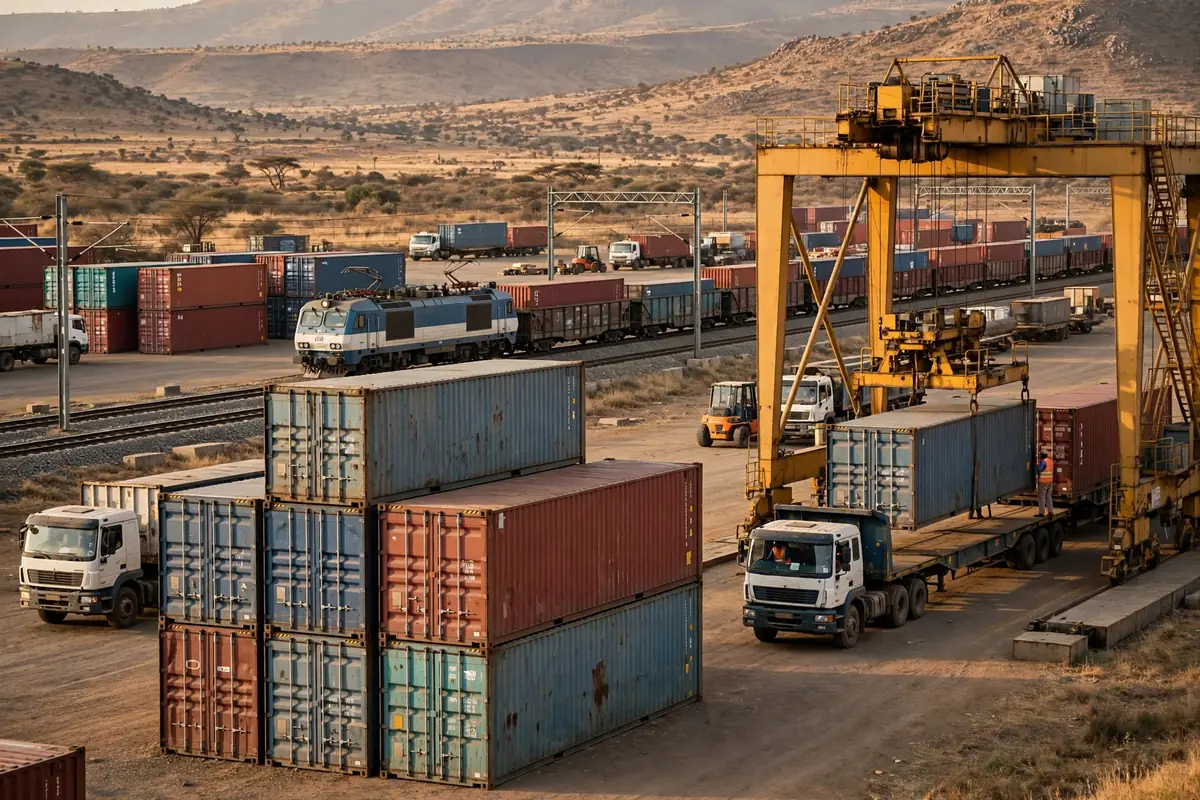
We had a client in Ethiopian coffee exports whose first shipment through Dire Dawa got stuck for nine days in early 2023. Not a late vessel. Not a stopped train. The paperwork and the yard handover at the dry port didn't line up — the cargo arrived, but the box couldn't be released. The shipment wasn't large, but he never forgot the lesson: a dry port doesn't sell land. It sells connection.
Dire Dawa sits in eastern Ethiopia, a little over 300 km from the port of Djibouti, on the Addis–Djibouti railway. Ethiopia is landlocked, and more than 95% of its foreign trade moves through Djibouti, so the location was right from the start. The dry port was established in 2013; the new terminal covers 34.1 hectares on a $68 million investment and went into service in 2022. That August, the Dire Dawa Free Trade Zone was inaugurated — the country's first — starting at 150 hectares with plans to grow to 4,000. By December 2022 the dry port was already handling more than 150 trucks a day. In October 2024 the railway was connected into the free trade zone, and the zone became fully operational that November. A year into operations it had more than 45 large investors and had moved goods worth over $100 million, with a government target of about $4 billion in goods passing through over five years. The numbers look exciting. But the question any shipper should actually ask is different: how does the math work?
What the Dire Dawa Dry Port Really Costs
Start with the route: a box lands at Djibouti, moves to Dire Dawa, then gets distributed to Addis Ababa or the eastern market. The Addis–Djibouti railway runs 759 km and opened in January 2018, cutting freight from about three days by road to roughly a day by rail. Road is flexible and door-to-door; rail is steady and built for volume. Which one wins depends on where your cargo is going and how much of it there is.
| Option | Transit time (illustrative) | Cost (USD per box, illustrative) | Best for | | Rail to Dire Dawa + dry port distribution | About 1 day | 1,800–2,600 | Large volumes, full trains, stable schedules | | Road direct to Addis Ababa | 2–3 days | 2,200–3,200 | Small lots, urgent orders, door-to-door | | Rail to Modjo + local distribution | About 1 day | 1,600–2,400 | Cargo headed for the capital region |
Costs are an illustrative scenario — always confirm against the carrier's latest quote — and times follow publicly reported figures. The number that matters is the port-to-door total: port storage, dry port handling, rail or road freight, customs clearance, distribution warehousing. Add it all up and that's what the client pays. An option that wins on one leg of freight often loses on the total.
One more number to pin down before you sign anything. In official statements, the new terminal claims annual capacity of 128,000 containers — yet the Ethiopian Shipping and Logistics Enterprise's own page for the old yard lists 3,852 TEU a year. Those two numbers are more than 30 times apart, and neither side is lying. They measure different things: one is the new terminal's design capacity, the other is the old yard's registered figure. Vendors love quoting the bigger one. Before you talk price, ask: which yard, which measure, and does it include yard turnaround? Get that answer first.
Rail, Road, and Free Trade Zone: How the Three Lines Fit Together
Another client of ours imports building materials and machinery. In year one he routed everything through Dire Dawa because it was closest to the port. But his cargo ended up at construction sites around Addis Ababa — one extra transfer, one extra handling — and in year two he switched distribution to Modjo and the per-box total came down. Modjo is Ethiopia's most important inland dry port, only 73 km from the capital. For cargo bound for the capital region, Modjo is simply closer. That's the counterintuitive thing about Dire Dawa: being near the seaport doesn't automatically mean cheaper. A dry port's value sits in distribution and pre-positioned clearance, not in distance from the quay. The cargo's destination picks the port, not its origin.
The railway holds a counterintuitive truth of its own. The Addis–Djibouti line was designed for 24.9 million tonnes of freight a year, but actual volumes run far below design capacity. Capacity isn't the bottleneck — connections and paperwork are. Train schedules, dry port yards, road shuttles and free trade zone warehousing: if those four don't mesh, it doesn't matter how fast the train runs. Our coffee client's nine lost days were lost to connection, not speed.
The free trade zone is the third line, and it plays a different game. The dry port does transit and distribution; the zone does processing, warehousing and re-export packing, for clients who want to add value in Ethiopia before shipping onward. It starts at 150 hectares with a 4,000-hectare plan, which sounds grand — but don't be dazzled by acreage. A free trade zone doesn't waive every procedure; customs and inspection still run their course. Before moving in, ask one question: exactly which procedure does my cargo skip inside the zone, and how much money does that save? If the answer isn't in writing, don't put the saving in your quote.
Three Questions to Ask Before You Sign in Dire Dawa
At the negotiating table, three clauses in a Dire Dawa warehousing contract get overlooked most often. First, the free storage period and the demurrage ladder. When the yard is busy and pickup slips two days, demurrage can eat the whole shipment's margin — get the free days and the escalation in the contract, never as a verbal promise. Second, who owns inspection and re-stuffing. After a box is opened for inspection, who re-packs it and who pays for damage — if that's unclear, the cargo owner ends up arguing about it. Third, who owns the rail connection. If a train is late or the handover misses, who is responsible, who pays, and how much — without those three answers in the contract, you've kept all the risk yourself.
So next time you sit down to negotiate, ask these three questions: one, "Is that annual capacity figure the new terminal or the old yard — design capacity or actual throughput?" Two, "If the train is late and the connection misses, who owns it and who pays?" Three, "How many free storage days, how does demurrage escalate, and what's the duty difference between warehousing inside the free trade zone and outside it?" Ask those three, and the other side will know this isn't your first warehousing negotiation in Africa.
Whether Dire Dawa works comes down to one thing, and it isn't the size of the yard or how new the railway is. It's whether the connections run smoothly. When they do, an inland port is a doorway. When they don't, even the biggest yard is just a parking lot.
By Susan, 3PL Sales Director