Here is the mistake most shippers make on Dar es Salaam before their cargo even sails: they treat it as a small, sleepy African port where containers can sit and wait. It is not. Dar es Salaam is Tanzania's largest port, handling about 95% of the country's international trade, and it is the sea outlet for Zambia, the Democratic Republic of Congo, Rwanda, Burundi, Malawi, and Uganda. Think of it as a motor: if you do not read the nameplate first, you will overload it and wonder why it burned out.
Read the nameplate: what this East African gateway can actually move
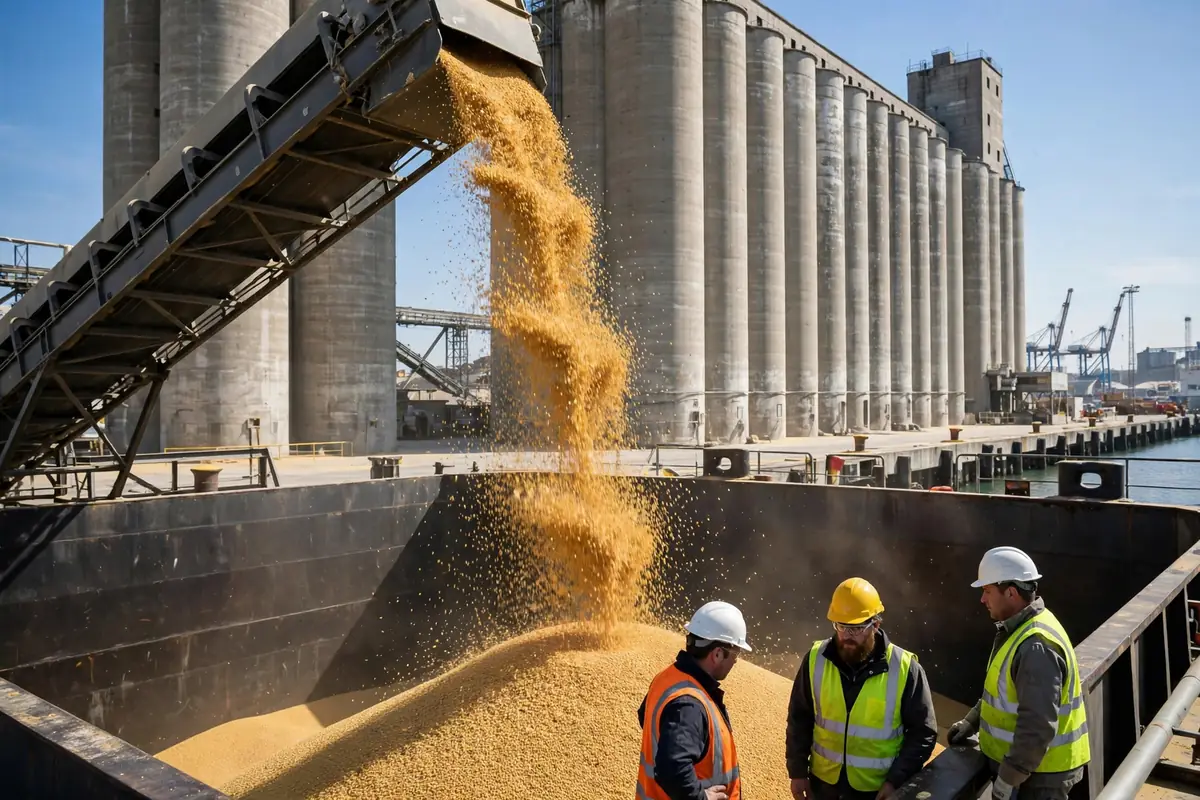
The Tanzania Ports Authority publishes the numbers plainly: rated capacity of 14.1 million tonnes of dry cargo and 6.0 million tonnes of bulk liquid, about 2,600 metres of quay, eleven deep-water berths. Throughput in the 2025/26 financial year reached 33.71 million tonnes, up roughly a fifth year on year, with transit cargo at 14.61 million tonnes, up about 17%. The machine has been getting bigger: DP World leases and operates four berths on a 30-year deal, eight new diesel-electric RTG cranes were commissioned in June 2026, and local media report average berth time has fallen from about 10 days to about 3 days.
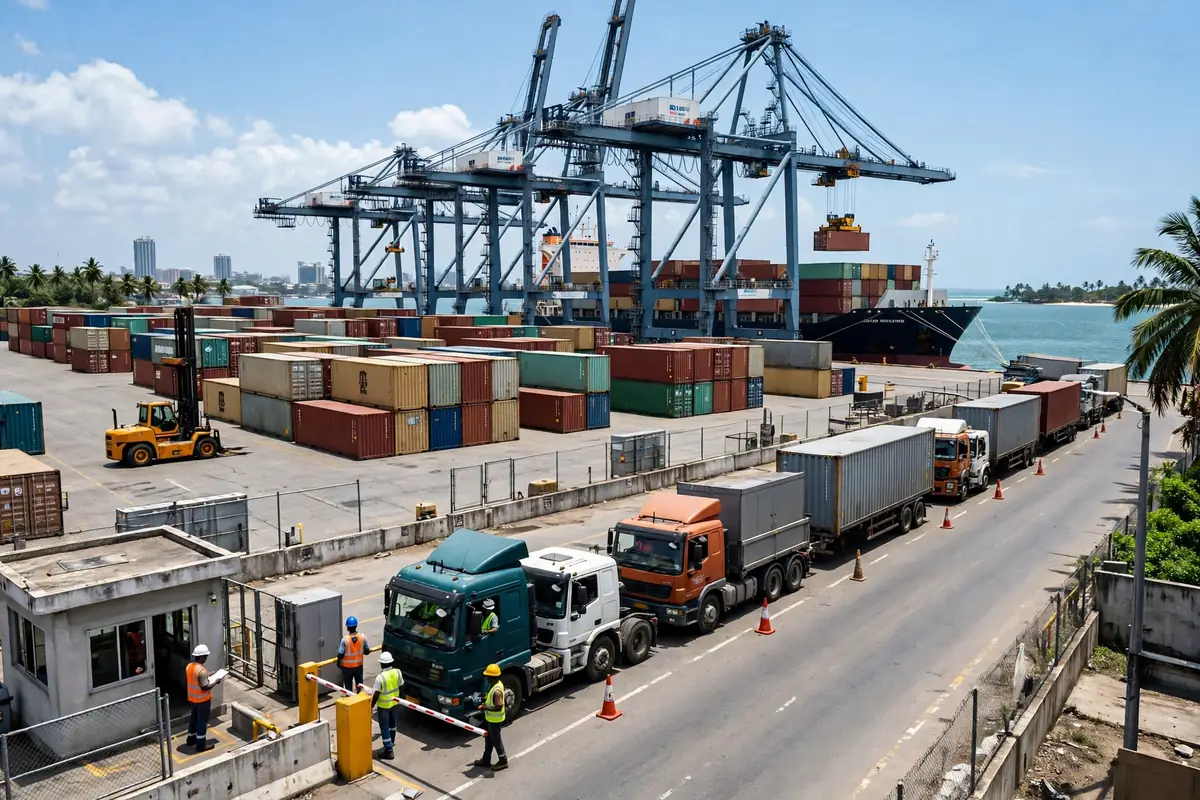
Good nameplate numbers do not mean your box moves fast. The faster the port handles cargo, the more crowded the roads outside it get. Tanzania's transport ministry has said roughly 3,000 trucks a day work the port area. That is the first dividing line in Dar es Salaam port distribution: the ship berthing is only the first half of the job. Getting the cargo out of the port is the second half, and it is the half that costs money.
From an equipment point of view, a port works on the same principle as an automated warehouse. The ship-to-shore crane moves boxes between ship and shore, the RTG crane does the finding and loading in the yard, and the truck is the outbound conveyor. No matter how fast the quay crane lifts, if the yard cannot find and turn boxes over, the whole line runs at yard speed. Think of it as a conveyor belt: the narrowest section sets the throughput of the entire line. The new RTGs are not there to unload ships faster; they are there so a box can be found in the yard and driven out.
A client of mine shipped electrical equipment to Zambia's Copperbelt a couple of years ago, two 40-foot containers through Dar es Salaam. The vessel berthed on schedule. The client expected the boxes out in three days. Instead the trucks queued outside the gate for two days, the clearing paperwork needed another round of corrections, and the containers sat in the port for several extra days. Nothing was lost, but the idle installation crew at the project site cost more than the freight. The lesson is a very engineering one: the bottleneck is never in the step you are watching. It is in the next step you did not look at.
Pickup: the race is won in the queue, not with muscle
Pickup is a four-step serial process: discharge, yard retrieval, gate release, load and leave. If any one step stalls, the whole chain stalls. Think of it as a production line whose cycle time is set by its slowest station. Discharge is faster now, but gate capacity and the roads outside have not doubled with it, so the cycle time sits at the gate.
There are only three ways to take delivery, and no fourth:
| Route | Best for | Upside | Price you pay |
|---|---|---|---|
| Direct pickup at the port, truck straight inland | Time-sensitive, full containers going straight to the customer | Fewest handoffs, cleanest accountability | Gate-peak queues are the least predictable part of the plan |
| Haul to an inland container depot, strip and distribute | Multi-customer consolidated loads that need splitting | Gets you out of port congestion; stripping and sorting can run at your own pace | One more lift and one more short haul, one more chance for damage or a mis-shipment |
| Rail plus dry port, in bulk, inland | Large, regular transit volumes on a fixed schedule | Bypasses the port-area roads, cheap per box at volume | You must lock the train schedule and the onward connection in advance; the least flexible option |
One coordinate worth remembering is Kwala Dry Port, designed for about 300,000 containers a year, built to pull transit cargo out of the port's crowded footprint early. Commercial freight on the standard-gauge railway between Dar es Salaam and Dodoma started in July 2025, and the TAZARA line is being rehabilitated. Rail distribution is no longer a line on a planning document. It is an option you can put in a schedule.
My rule for the road-versus-rail dividing line is simple: steady volume, destinations concentrated on one corridor, and delivery times that can follow a timetable mean rail is worth locking in. Scattered volumes, dispersed destinations, and customers who change their dates mean you stay on the road. Think of it as buying equipment: steady batches justify a dedicated automated machine, mixed variety calls for general-purpose machines plus people. Force scattered cargo onto a rail timetable and the freight saved comes straight back as waiting time.
Picking the wrong distribution point is a mistake I have watched twice over. For cargo bound for Rwanda, one client stripped containers at an old warehouse in downtown Dar es Salaam because it was close to the port and looked fast. Narrow streets kept big trucks out during the day, and onward delivery needed newly booked trucks. The job burned more than an extra day. Another client hauled the boxes to a yard outside the city and stripped there. It added a short haul, but stripping, sorting, and dispatch ran as one smooth line, and the total days were fewer. Close to the port is not the same as close to the customer. That is one of the most common false requirements in this business.
Inland distribution: do not just price the freight
Here is the counter-intuitive part: the more efficient the port gets, the more you should worry about the road outside it. Berth time falling from about 10 days to about 3 days does not automatically turn a saved week into your profit. It moves the queue from the anchorage to the gate, and from the gate to the border. On the Central Corridor, the slow variable was never the port; it is complete clearing documents and the border post's pace. One missing stamp, one extra day in the yard, and no quotation you ever received will account for it.
Price the job in total days, not in freight per leg. My formula is simple: total days equals berth waiting plus yard dwell plus pickup queue plus clearance plus inland transport plus border waiting. Add the six, then fix the biggest one first. Port charges, demurrage, and storage rates change, so check the latest published tariffs from the shipping line and the port authority rather than quoting last year's numbers. Clients often ask whether they should build their own overseas warehouse in Dar es Salaam. My answer is blunt: for transit cargo without a steady monthly volume, renting space at an inland depot plus a third-party distribution partner is far cheaper than building your own. A warehouse is a fixed cost you feed every month. Ride the volume swings with light assets first.
Then the maintenance pitfall, the part the equipment engineer in me cannot leave out. Dar es Salaam is hot, humid, and salt-laden. Steel corrodes far faster than inland, and RTG tyres, crane wire ropes, and cabinet sealing all need a maintenance plan written for tropical duty. Spares shipped from overseas take weeks by sea; without local stock, one machine down slows the whole line. When you select equipment, rent yard space, or sign a distribution contract, ask first whether spares and maintenance response exist locally — that question is worth more than any discount.
Whether the money was worth it comes down to one number: how many days your container took from berthing to the customer's signature. Get that number down, and the Dar es Salaam gateway starts working for you instead of against you.
By Da Liu, Automation Engineer