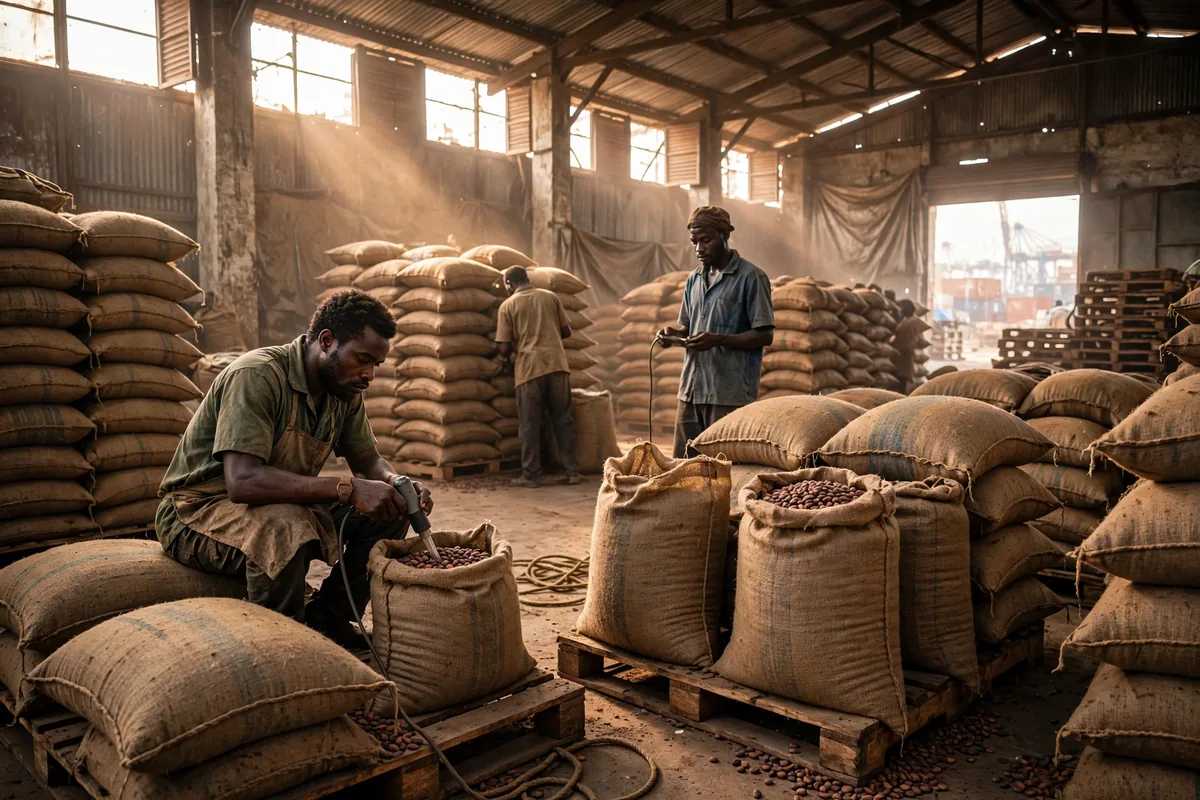
Cote divoire cocoa export warehouse work sounds like a big industrial operation, but let me introduce myself first. I am Xiao Ma, the owner of a small 3,000-square-meter warehouse. I do not have a large team, I do not have a big budget, and I definitely cannot afford the climate-controlled setup that the big companies use. In 2024, Côte d'Ivoire produced about 1.89 million tonnes of cocoa, roughly 36 percent of world output of about 5.23 million tonnes, on a calendar-year basis from the Food and Agriculture Organization. Cocoa bean exports were worth about 4 billion US dollars, and the Netherlands alone took nearly 25 percent. Local processing accounted for about 42 percent in 2024, with processing capacity of about 1.08 million tonnes. Those numbers sound far away from my little warehouse, but they are not. Every bean starts in a forest farm, travels through a warehouse like mine, and leaves through the port of Abidjan. If it gets damp once on that journey, mold follows, and mold eats the price. This is not a strategy paper. It is a working note about how a small warehouse keeps beans dry enough to ship. One note on data: the International Cocoa Organization uses a cocoa-year basis, while the Food and Agriculture Organization uses a calendar-year basis, so do not mix the two when you quote production figures.
Cote divoire cocoa export warehouse: ventilation beats sealing
The most common mistake is thinking that keeping rain out is enough. When I started, I thought a sound roof meant dry beans. Then I learned that the real enemy in the rainy season is not rain, but stuffiness. Beans carry moisture. If jute bags are stacked tight against a wall with no air gaps, warm air gets trapped, moisture settles on the bag surface, and mold finds exactly the damp, warm pocket it likes.
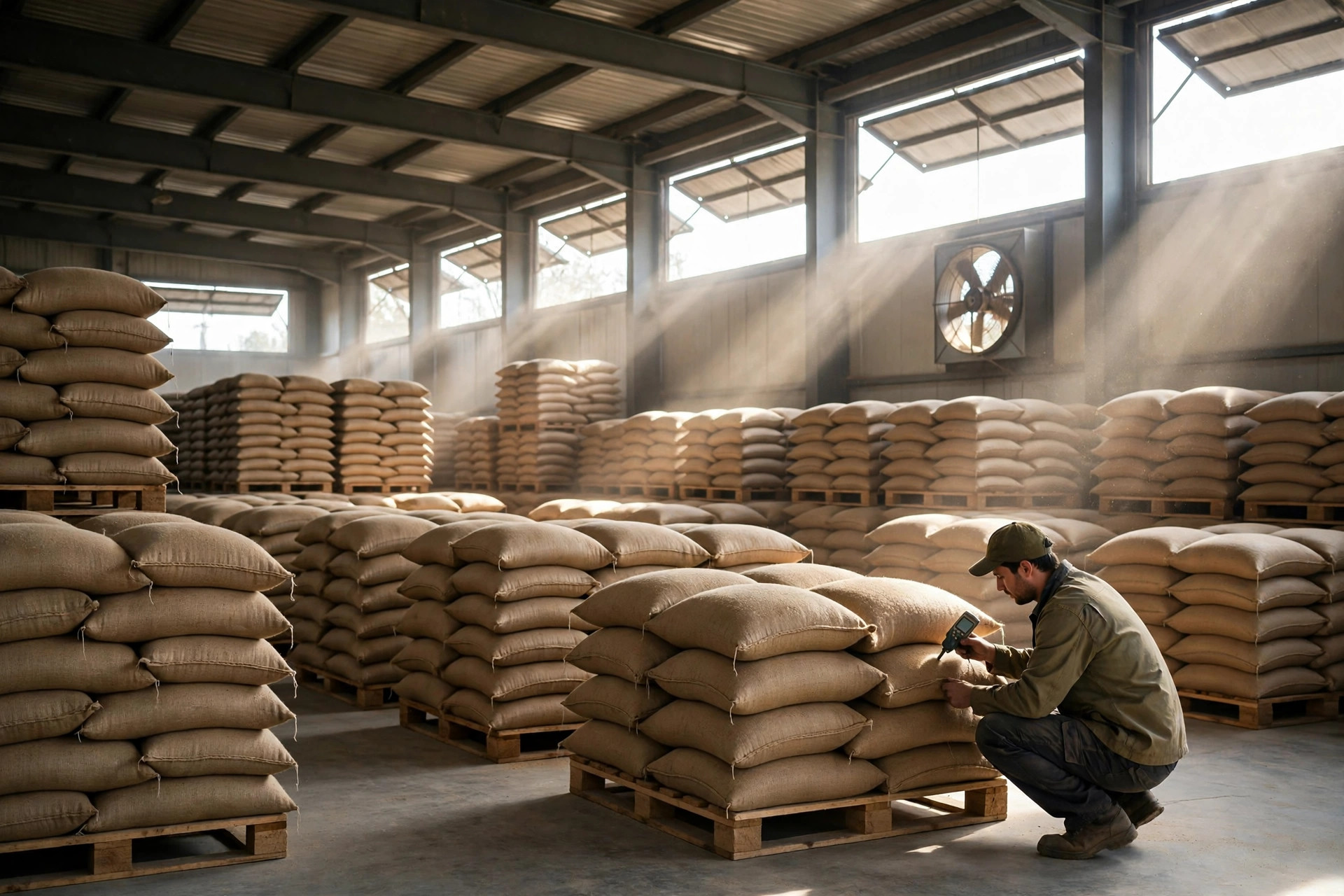
Here is the first scenario. The figures below are an assumed, illustrative example built around a small warehouse, not a record of a real transaction. In June 2025, in the middle of the rainy season, 120 tonnes of beans arrived from the Soubré area. On arrival, spot moisture tests averaged between 7.5 and 8.5 percent, and the bags felt dry to the touch. To save time, the workers stacked the bags six layers high, tight against the wall, with no ventilation aisle, then closed the doors and went to lunch. On the third morning, the warehouse smelled stale when we opened it. The bottom bags near the wall were damp, and when we opened ten bags, three showed white spots on the surface. That loss taught me three low-cost habits I still use. First, every bag goes on a pallet, at least 15 centimeters off the floor and at least 30 centimeters away from the wall. I would rather leave that edge space empty than fill it with stock. Second, leave an aisle wide enough to walk between stacks, keep the height to five layers or fewer, and never press the top layer flat against the roof. Third, measure warehouse humidity and bean moisture twice a day, morning and afternoon, and write the numbers down. If the readings climb for three days in a row, restack and ventilate at once. Do not wait until you can see mold. Restacking sounds labor-intensive, but two workers can turn the riskiest few dozen tonnes in half a day, and that is far cheaper than a downgraded lot.
Here is the counterintuitive part: plastic bags look more waterproof, but they are more dangerous for cocoa beans. Plastic does not breathe, so the moisture the beans release stays inside the bag, like tucking mold into a warm blanket. A humble jute bag lets that moisture escape slowly. My small warehouse cannot afford a full dehumidification system, so I rely on jute, airflow, and frequent testing. The approach is unglamorous, and it works because it catches trouble while it is still invisible.
Cote divoire cocoa export warehouse mold math: what one wet ton really costs
Talk is cheap, so let me show the math. The table below is also an assumed example. Prices and costs are invented practice figures for comparison only, not real market prices. Suppose one tonne of sound beans sells for 2,000 US dollars. With light mold it might sell for 1,700 dollars, and with heavy mold for 1,200 dollars. The gap is the loss.
| Method | Assumed cost per tonne | What it prevents | Loss in this assumed example |
|---|---|---|---|
| Tarp only, no moisture testing | About 5 dollars | Direct rain only | Light mold, lose 300 dollars |
| Pallets, ventilation, daily testing | About 18 dollars | Stuffy air and local damp | Almost no loss, spend 18 dollars |
| Outsourced fumigation plus sealed storage | About 45 dollars | Pests and heavy mold | Almost no loss, spend 45 dollars |
The cheapest option looks like it saves 13 dollars, but it can lose 300 dollars. The most expensive option is solid, yet it costs 27 dollars more per tonne than the middle option, which is 3,240 dollars on 120 tonnes. A small warehouse feels that difference. The middle option fits us best: pallets, ventilation, and daily moisture checks. Together they are cheap and they stop the most common problem, trapped damp. Fumigation still has a place, but I save it for two cases: visible signs of pests in the warehouse, or a buyer contract that explicitly asks for a fumigation certificate. Otherwise, I do not rush to pay for it. On duties, taxes, and official fees, I will not invent figures here. Please check the latest official data and follow what the contract says.
I also use a simple decision framework so a small team does not argue over every load. If moisture is below 7 percent, the weather is stable, and the vessel schedule is firm, stack normally and ship as planned. If moisture is between 7 and 8 percent, ventilate for two days first, retest daily, and load only when the numbers are falling. If moisture is above 8 percent, or rain keeps coming with no sun in sight, do not load. Restack, improve ventilation, and accept a two-day delay rather than sealing wet beans into a container. A container is even stuffier than a warehouse, and after many days at sea, wet beans arrive as moldy beans.
Do not race the big warehouses to the port
Here is the second scenario, again an assumed, illustrative example rather than a real shipment record. In October 2025, vessels were delayed outside the port of Abidjan, and I had 300 tonnes ready in my warehouse. The vessel was four days late. A large operator might keep sending beans to the port yard, paying yard charges by the day while the beans sit closer to sea air and open storage. I did the opposite. The beans stayed in my own warehouse, where I could control ventilation and keep testing moisture. One person checked the vessel schedule at the port each day, and the warehouse team restacked only where readings rose. Over those four days, the extra cost was labor for restacking, not yard rent. When the vessel arrived, we loaded overnight and sent the lot in one move. Some people worry this risks missing the vessel. In my experience, the risk is managed by communication, not by rushing damp beans to the yard. Tell the freight forwarder and the buyer early about the moisture readings and the expected loading time. A buyer would rather hear an honest two-day plan than receive a moldy delivery on time.
If you run a warehouse like mine, here are three suggestions from my own mistakes. First, do not accept more wet beans than you can handle. In the rainy season, check moisture before you take a lot in. It is better to take less than to fill your warehouse with beans you cannot dry. Second, a warehouse does not need to be large, it needs to be dry. Fix the roof, wall corners, and floor leaks before the rainy season. Repair work before the rain is far cheaper than emergency work during it. Third, keep records. Write down daily moisture, humidity, and restacking times. When a buyer asks, you have evidence. When something goes wrong, you can trace it to a specific lot and a specific day. A small warehouse has no big brand to hide behind. That notebook is our credibility.
A Cote divoire cocoa export warehouse run by a small team cannot match the equipment and capital of a large company, but it can match them on care and patience. If the beans arrive without mold, half the job is already won. The rest is doing the same careful work, lot after lot, all the way to Abidjan.
Small warehouses have their own way to survive. By Xiao Ma, Small Warehouse Owner