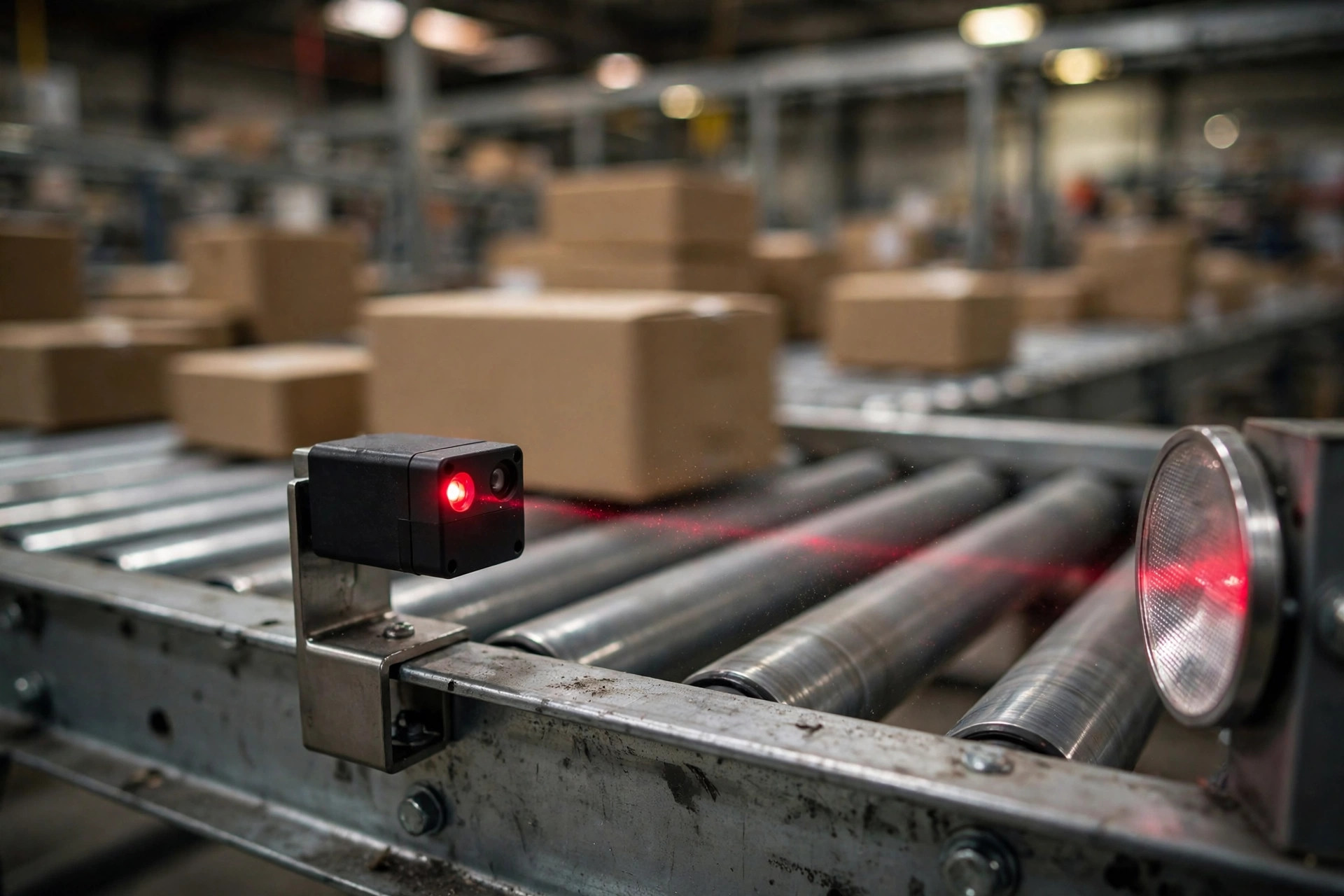
2:40 a.m. My phone rang. The sortation line was down again, the WCS throwing a "photoelectric fault." I got on site and found the through-beam sensor's indicator blinking like it was winking at me — the third false stop this week. I wiped the emitter lens with a cloth, the green LED went solid, and the line started moving. Alarm to recovery: under ten minutes. Driving back, I had one thought: this thing costs next to nothing, so how does it keep taking down an entire sortation line?
Here's the full story on photoelectric sensor false triggers: how the three types work, where the selection line sits, the three root causes, and a 5-minute field checklist.
How the Three Photoelectric Sensor Types Actually Work
There are exactly three types. Don't let vendor marketing blur the lines.
Through-beam: the emitter and receiver sit on opposite sides of the conveyor, with a beam stretched between them. Think of two people passing a note face to face — note interrupted means a product just passed. Longest sensing range, on the order of tens of meters, strongest penetration, toughest against interference. The price: you mount two units and align them.
Retro-reflective: emitter and receiver in one housing, with a reflector on the far side. Like shining a flashlight into a mirror — blocked light means product present. Mid-range sensing, roughly 0.1 m to the low tens of meters. One detail people miss: the reflector gets dirty too, and a dirty reflector false-triggers just the same. Wiping only the sensor and ignoring the reflector is wasted effort.
Diffuse (proximity): emitter and receiver in one housing, relying on a small fraction of light scattered back off the product surface. Like shining a flashlight at a wall and catching the bounce. Shortest range — centimeters to about 2 m. Easiest one-sided mounting, lowest price, and the most temperamental: product color, surface finish, or reflectivity shifts a little and the signal drifts.
All three typically respond in the sub-millisecond range (under 1 ms); check the manufacturer's datasheet for the exact figure. Remember the order of magnitude: a photoelectric sensor's speed is never the bottleneck. Installation and environment always are.
The Selection Line: Don't Ask a Diffuse Sensor to Do a Through-Beam's Job
The line is simple. Memorize it:
- Sensing distance over 2 m, or a dusty, oily environment → start with through-beam. Don't hesitate.
- One-sided mounting only, distance within the low tens of meters, non-reflective product → retro-reflective.
- Under 1 m, stable matte product surface (plain cardboard), tight budget → diffuse.
| Through-beam | Retro-reflective | Diffuse | |
|---|---|---|---|
| Principle | Separate emitter/receiver; broken beam = product | One housing + reflector; blocked return = product | One housing; relies on light scattered off the product |
| Range | Longest, tens of meters | Mid, ~0.1 m to low tens of meters | Shortest, centimeters to ~2 m |
| Dust tolerance | Best (large light-level margin) | Medium (reflector gets dirty too) | Worst |
| Reflection immunity | Strong (only cares broken-or-not) | Weak (hates mirror surfaces) | Weakest |
| Mounting | Two sides + alignment | One side + reflector | One side, easiest |
| Cost | Medium | Low | Lowest |
Rant time: I've seen diffuse sensors installed at a dusty divert because they were "easier to mount and cheaper." The line false-stopped a dozen times a day. That's a textbook pseudo-requirement — saving half an hour of mounting time and paying for it with the whole line's uptime. Whatever you save on selection, maintenance collects back with interest.
Photoelectric Sensor False Triggers: The Big Three Root Causes
Root cause 1: dust and oil on the lens. A dirty lens drops the received light level near the switching threshold, and then vibration or temperature swings flip the signal between "present" and "clear." The symptom is unmistakable: a flickering indicator, intermittent faults, fixed by a wipe, back again in a few days.
Root cause 2: specular reflection off shiny product. Stainless totes, stretch-wrapped pallets, galvanized parts — surfaces like mirrors. Diffuse and retro-reflective sensors get blinded: they miss product that is there and report product that isn't. Remember: a through-beam only asks "beam broken or not," which makes it naturally immune to reflection. That's why I default to through-beam whenever the product surface is out of your control.
Root cause 3: mounting angle and alignment drift. A loose bracket, a forklift bump, thermal expansion across seasons — the emitter and receiver no longer face each other squarely, and the beam spot drifts. Most of the light-level margin gets eaten up; everything looks fine until a vibration breaks the beam. Plenty of so-called "sensor quality issues" turn out to be bracket issues when you open the cabinet.

Two real cases.
Fall 2023, a 3PL sortation hub in eastern China. The main line's through-beam sensor false-triggered more than a dozen times a day; each stop cost 2–3 minutes to reset, eating nearly 40 minutes of daily capacity. The sensor wasn't broken — the emitter lens had a film of cardboard dust on it, light level decayed to the edge of the threshold, and any vibration "broke" the beam. The fix was embarrassingly simple: a dust shield costing pocket change, plus a weekly lens wipe added to the PM checklist. False triggers dropped to fewer than one a week. Do the math: 40 minutes of capacity versus a wiping cloth — which costs more?
Spring 2024, an e-commerce warehouse in southern China. After switching to stainless-steel totes, the diffuse sensors went haywire: empty totes reported as "product present," loaded totes missed entirely. Root cause was specular reflection — tote edges bounced light straight back into the receiver. The fix: swap to through-beam. The selection line to remember: product surface out of your control (reflective, transparent, mixed colors) means through-beam from the start. Don't argue with physics.
The 5-Minute Field Checklist
Minute 1 — read the LED. Note the indicator state first: solid, flickering, or dark. Flickering usually means the light level is hovering at the threshold — a dust or alignment problem.
Minute 2 — wipe the lens. Power down, clean the emitter, the receiver (or the reflector). If it recovers immediately, it's dust — put it on the preventive maintenance schedule.
Minute 3 — block the beam. Shade the beam path by hand with an opaque card and watch whether the output switches cleanly. No switch or erratic switching: suspect the sensor or the wiring. A crisp switch means the sensor is probably fine — look at mounting and environment.
Minute 4 — check alignment. For through-beam and retro-reflective, verify emitter and receiver still face each other and tighten every bracket screw. Realign if drifted, then do a shake test — nudge the bracket by hand and watch the indicator stay solid.
Minute 5 — swap the product. Run a different product, especially swapping out reflective or transparent items. If the fault disappears, it's product reflection — switch to through-beam or adjust the mounting angle to dodge the mirror bounce.
If five steps don't pin it down, then consider replacing the sensor. But in my experience, seventy percent of cases die in the first four steps.
Here's the counter-intuitive one: the most expensive sensor is not the toughest. Background-suppression (BGS) diffuse sensors cost several times a through-beam pair and come with gorgeous datasheets — but in a dusty plant, their delicate optics and clever algorithms lose to the dumb, thick beam of a through-beam. Through-beam logic is too simple to fail: beam broken means product, beam intact means clear. On the plant floor, simplicity is the scarcest virtue; complexity is where failures breed.
One more jab: don't start by replacing the sensor. About seventy percent of the false triggers I've fixed were installation problems — loose brackets, drifted alignment, dirty lenses. Run the 5-minute checklist first; odds are it costs you nothing. Reaching for "a more expensive one" isn't problem-solving, it's a donation to your supplier's revenue.
Whether the money is worth it comes down to one number: a through-beam pair costs tens to a few hundred yuan; a single unplanned line stop, in reset time and lost throughput, buys a whole box of sensors. A dust shield costs pocket change; wiping a lens takes two minutes a week. Your call: two minutes with a cloth, or a 2:40 a.m. phone call?
By Da Liu, Automation Engineer