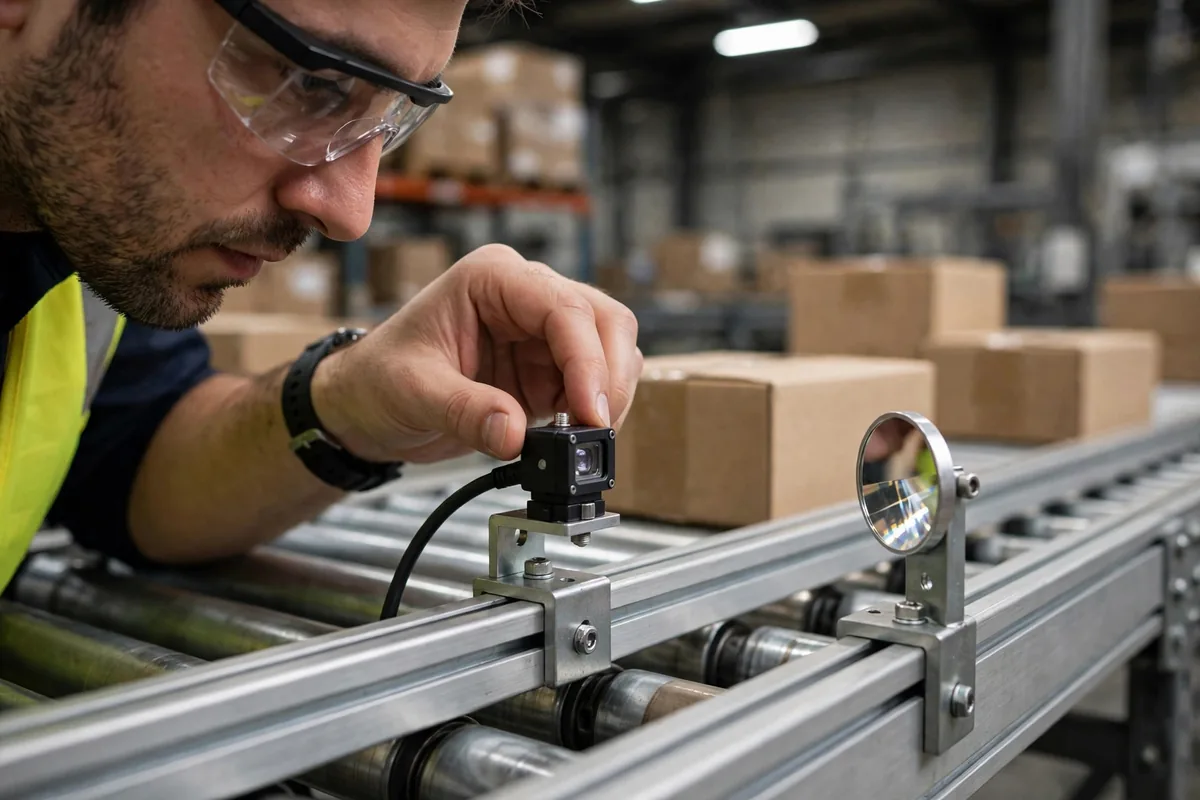
Good conveyor photo eye sensor maintenance is the difference between a line that runs and a line that stops for no visible reason. When a line faults, most crews blame the PLC first. In my experience that is backwards. Start with conveyor photo eye sensor maintenance: a dirty lens, a bracket knocked two degrees off, or a reflector covered in dust will create exactly the missed reads and random stops people blame on controls.
A photo eye is simple in principle. It sends light, receives light, and switches when that pattern changes. That simplicity is why it fails in simple ways. Dust, vibration, sunlight, and a loose mount will defeat it long before the electronics die.
Conveyor Photo Eye Sensor Maintenance Starts With Type: Through-Beam, Retroreflective, and Diffuse
There are three common types. Through-beam uses a separate emitter and receiver facing each other, offering the longest range and most excess gain, so it tolerates dirt best. Retroreflective puts emitter and receiver in one housing and bounces light off a reflector. Only one side needs power, but the reflector is a second failure point. Diffuse senses light reflected off the carton itself, with no reflector. It is cheap and compact, but dark, shiny, or clear targets reflect poorly.
Think of it this way. Through-beam is two people throwing a ball straight to each other. Retroreflective is throwing a ball at a mirror and catching the return. Diffuse is throwing a ball at a wall and hoping it bounces back, which depends entirely on what the wall is made of. Choosing the wrong type is not a maintenance problem you can clean your way out of.
Here is the counterintuitive point most technicians miss: maximum sensitivity is not maximum reliability. Cranking the gain to the top feels safe, but excess sensitivity makes the sensor react to dust clouds, steam, reflections from a neighboring line, and shrink wrap flashing at the wrong angle. A healthy setup has enough margin to survive some dirt, not so much margin that everything looks like a target. If the indicator flickers at rest, you are already on the edge.
The selection line is clear. Use through-beam for long distances, dirty areas, and mixed carton colors. Use retroreflective when you can only wire one side and the distance is moderate, provided you protect and clean the reflector. Use diffuse only for short distances with consistent, light-colored targets. Get this decision right and your maintenance load drops sharply.
Alignment in Conveyor Photo Eye Sensor Maintenance: A Five-Step Calibration That Holds
Alignment is where most repeat faults are born. I visited an e-commerce site where the infeed eye failed only on night shift. The sensor tested fine every morning. The real cause was a loose reflector bracket on the retroreflective pair. Daytime forklift traffic was light, but at night heavier vibration nudged the bracket just enough to push the beam off the reflector. No PLC change would have fixed a moving bracket.
Use five steps. First, clean before you align; aligning through dirt locks in a bad position. Second, rough-align so the visible red spot lands near the center of the receiver or reflector. Third, fine-align by sweeping the bracket slowly. Find the full range where the indicator stays solid, then set the bracket in the middle of that range, never at the edge. Fourth, lock it down, add a lock washer if vibration is present, and avoid thin brackets that bend on contact. Fifth, test with real product: cartons near, far, left-shifted, and right-shifted, several passes each. Stable switching on every pass is the only pass mark.
A second case shows why type matters more than brand. One line used a diffuse sensor on black returnable totes and missed randomly all day, even after three replacements. The permanent fix was switching that point to through-beam. A black tote reflects very little light. That is physics, not a defective sensor.
Cleaning Intervals, Spares, and a Simple Cost Check
Dirt is the number one enemy. Carton dust, tape haze, and wrap residue coat lenses gradually until one humid morning pushes performance over the edge. This is like a dirty windshield: you clean the glass, you do not replace the engine.
Clean with a dry soft cloth or lens tissue, or a cloth lightly dampened with water or mild cleaner for oily film. Do not blast the lens with compressed air, which often carries water and oil and can drive grit into seams. Do not scrub with rough towels either; a scratched lens loses margin permanently.
Set intervals by environment, not by habit. Use this framework as a starting point and adjust it from your own fault history:
| Environment | Typical area | Lens cleaning | Alignment check | Reflector check |
|---|---|---|---|---|
| Clean | Electronics, pharma packing | Monthly | Quarterly | Monthly |
| General warehouse | Standard carton flow | Every 2 weeks | Monthly | Every 2 weeks |
| Dusty | Decanting, returns processing | Weekly | Every 2 weeks | Weekly |
| Heavy contamination | Near tapers, dock doors | Twice weekly | Weekly | Twice weekly |
This table is an experience framework, not a manufacturer standard. If one station always fails first, shorten its interval alone instead of punishing the whole line.
Daily checks take two minutes: confirm clean switching, check for bent brackets, and look for dust or condensation. Flicker is an early warning.
Now the math, as an explicitly hypothetical example only, not an industry rate. Assume a line has 12 photo eyes. Assume one unplanned stop lasts 20 minutes on average. Assume downtime is valued at $3,000 per hour for the sake of this calculation example only. One stop then costs roughly $1,000. Three extra stops a month cost roughly $3,000. Cleaning and checking all 12 eyes takes an experienced technician about 30 minutes. Even without precise labor rates, the comparison is obvious: routine cleaning costs a fraction of one avoidable stop.
For spares, standardize. Stock a small number of the models you actually run, plus matching brackets and reflectors. A scratched reflector should be replaced, not polished and prayed over. After replacement, verify mode, distance, and output against your checklist, because factory defaults are a classic cause of a fault appearing right after a repair.
Troubleshooting False Triggers in Order: Do Not Start With the PLC
Two symptoms cover almost everything: missed detection and false triggers that stop the line with nothing present. Work this order every time. First, watch the indicator while blocking and unblocking the beam. No change at all points to power, wiring, or gross misalignment. Flicker points to low margin, dirt, or edge alignment. Second, clean the lens and reflector and retest immediately. A surprising share of faults end here at near-zero cost. Third, realign to the center of the stable range and retest with real product in off-center positions. Fourth, hunt for interference: direct sunlight on the receiver, light spill from an adjacent sensor, steam or dust crossing the beam, or glossy packaging reflecting at a certain angle. Fifth, check the electrical side: loose connectors, a cable crushed by a pallet, unstable supply voltage, and whether the PLC input indicator matches the sensor indicator. If they disagree, the sensor is not your problem. Sixth, and only sixth, swap the suspect sensor with a known-good position. If the fault follows the sensor, replace it. If the fault stays, your problem is mounting or environment.
One afternoon-only fault illustrates step four. A food warehouse line stopped randomly after lunch but ran clean all morning. Sunlight through a dock door gap was blinding the receiver at a low angle. A small shade hood and a few degrees of remounting fixed it. Replacing the sensor would have changed nothing.
Beware the fake upgrade. An expensive sensor on a bent bracket, facing a filthy reflector, in direct sunlight, will still false-trigger. Do alignment, cleaning, shading, and locking first. Only if a point still fails should you revisit type or logic. That discipline is what conveyor photo eye sensor maintenance means in practice: fix the light path before you touch the program.
Whether it pays comes down to one number: repeat stops per station per month caused by photo eyes. If that number falls after you tighten cleaning and alignment, your stops were never a PLC problem. If it does not fall, then investigate type selection and logic, with evidence instead of guesses.
By Da Liu, Automation Engineer