Think of conveyor selection like fitting shoes. It doesn't matter whether the shoe is good. It matters whether it fits your foot. In conveyor belt vs roller vs chain warehouse selection, belt, roller, and chain aren't ranked by quality — belt isn't the cheap one, chain isn't the premium one. Each one matches a different kind of freight, and the first thing to look at isn't the price. It's the underside of whatever you're moving.
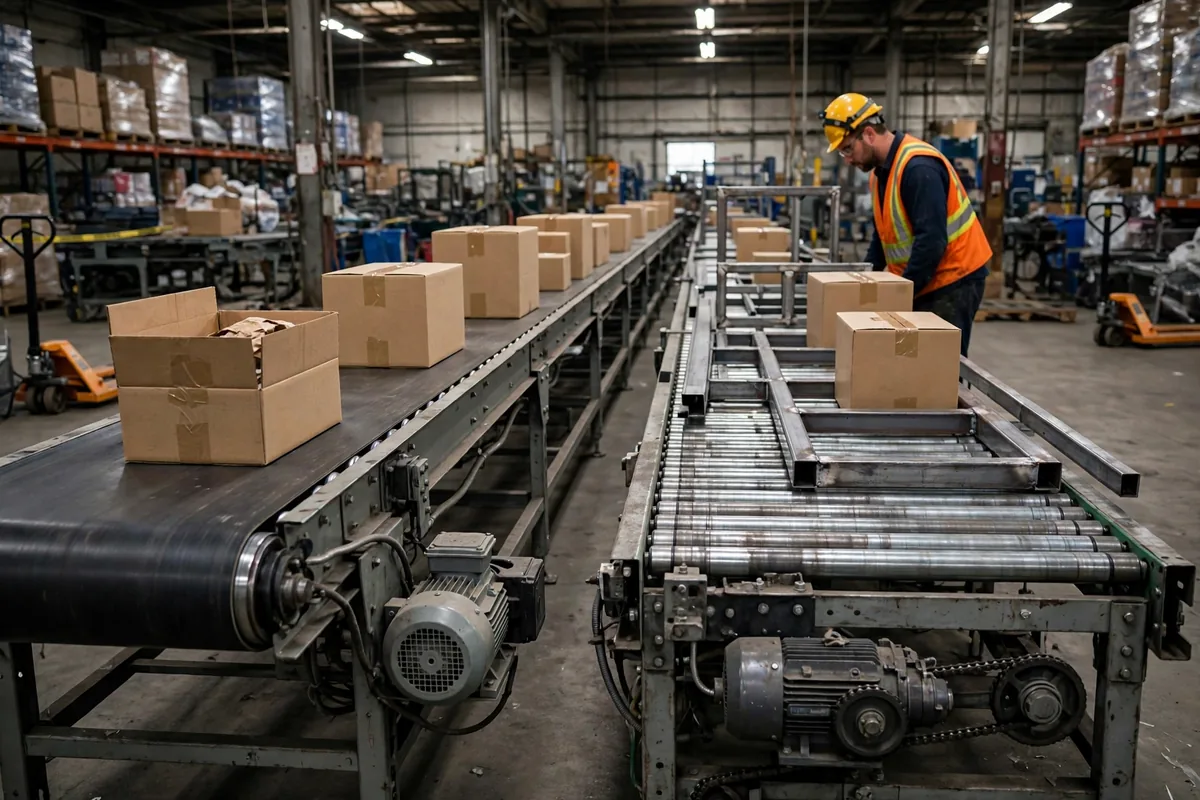
Here's the principle, because everything else follows from it. A belt conveyor carries freight on one continuous surface. Whatever the bottom looks like — soft, uneven, irregular — it's supported the whole way. A roller conveyor carries freight across a row of spinning rollers, so the support is interrupted: the gaps between rollers have to be bridged by the freight's own bottom. A chain conveyor is the most extreme — the load rides on two or three chain tracks, the smallest contact area of all, but every inch of it is hard support. You can think of it as three ways to carry a box: a belt is one person holding it on a flat board, rollers are ten people holding it up on their palms, and chain is two people carrying it on their shoulders. The board is the most stable, the palms are the most flexible, and the shoulders can carry the most weight.
Conveyor belt vs roller vs chain: where the lines fall
Published selection guides from conveyor manufacturers put the reference numbers roughly here: a slider-bed belt conveyor is rated around 75–100 lb per linear foot, a roller-bed belt 100+ lb/ft, a chain-driven live roller conveyor 100–500+ lb/ft, and a pallet accumulator zone up to about 4,000 lb. Medium-duty carton lines commonly run 30–80 feet per minute. Treat those as reference values — always confirm against the specific model's published spec before you buy.
But weight is never the first filter. The underside is. In 2022 I worked on a food plant where the cartons were light, under 15 kg each, and the owner picked roller conveyors to save money. The carton bottoms were soft, so every box dipped slightly between rollers, the tape seams wore through in two spots, and the line jammed three times a day in peak season. We swapped in a belt conveyor and the jamming simply disappeared. The rollers could handle the weight. They couldn't handle the bottom.
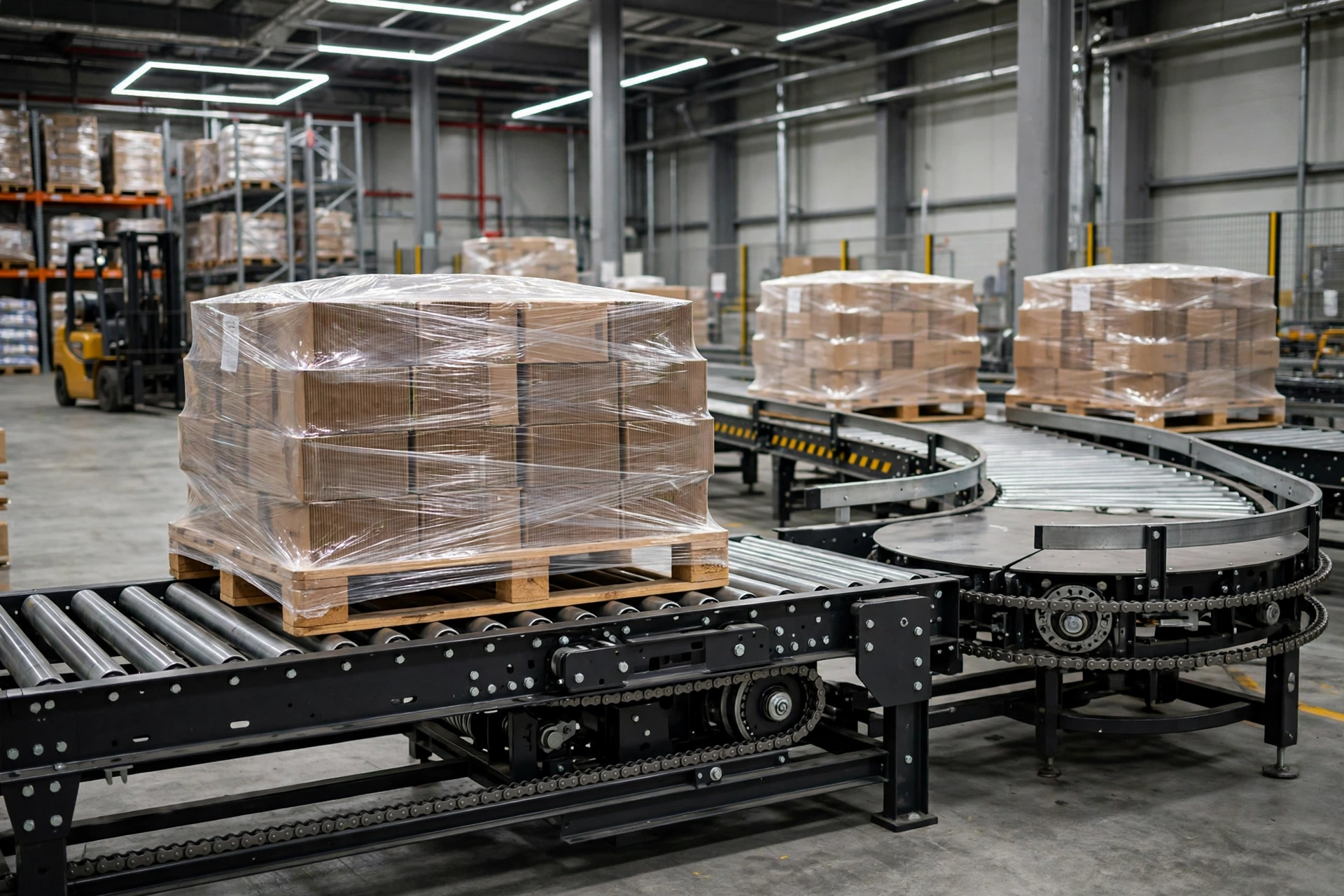
Pallet undersides are where chain conveyors earn their keep. An open-bottom Euro pallet has longitudinal runners with empty space between them — a roller conveyor can't support it properly, because a runner can dip into a roller gap and catch. A chain conveyor runs its tracks directly under those runners, which is exactly the job it was built for. Manufacturer selection guidance says it plainly: open-skid Euro pallets go chain first, and chain wins for heavy loads of 1,500 kg and up. In 2023 an auto-parts warehouse wanted roller conveyors for 1,200 kg pallets to save money, and I stopped them: the rollers would hold for a while, but the bearings wouldn't survive a year. Two years on chain conveyors, the only work has been routine lubrication. No wrench time to speak of.
So the dividing lines come down to three sentences. Soft bottoms, small parts, anything that hates vibration — belt. Flat bottoms, regular cartons, and a need to accumulate and buffer — roller. Open bottoms, heavy single pallets, and a need for positive positioning — chain. Weight, speed, and price all queue up behind those three sentences, and getting them right is what most conveyor belt vs roller vs chain warehouse selection decisions actually turn on.
How a wrong pick dies — the expensive ways
The most expensive conveyor mistake is never buying the dear one. It's buying the wrong one and having to rip it out. In 2021 I saw an e-commerce returns line running on a standard belt. Returns are full of soft parcels with zippers and odd shapes, and the belt kept tracking off-center and wearing at the edges. Two belt replacements in three months, half a day of downtime each time. In peak season, half a day is a number finance understands better than I do. Belts don't fear weight — they fear tracking drift and edge wear, and irregular freight drives maintenance cost straight up.
Roller conveyors die differently: dust and seized rollers. In a dusty environment, grit works into the roller bearings, drag rises a little at a time, motor current creeps up, and by the time anyone notices, the whole section is running 20% slow. And then there's the pseudo-requirement I love to call out: a line where freight moves at a steady pace, but someone insisted on zero-pressure accumulation — full controls, sensors, zoned drives, the works — and the accumulation function gets used three times a year. Is that money well spent? Look at one number: how many times a day does the accumulation zone actually back up? Fewer than twice, and you don't need zero-pressure accumulation.
Chain conveyors fail at the other end: lubrication and tension. Chain is metal on metal. Starve it of lubricant and it grinds, the wear debris falls into the track, and the wear accelerates. Let a stretched chain run without re-tensioning and one skipped tooth can shift a whole pallet half a body width sideways. I saw a warehouse that hadn't checked chain tension in three years; the chain finally snapped, a loaded pallet jammed in a curve, and it took four hours to clear. Chain isn't a bad choice — it just demands the most disciplined maintenance of the three, and if the maintenance doesn't keep up, chain becomes the most expensive conveyor in the building.
Conveyor belt maintenance is the real cost of conveyor selection
Here's an illustrative scenario to show where the money actually goes in conveyor belt vs roller vs chain warehouse selection. Take a 30-meter line, two shifts a day, 300 operating days a year, and count only maintenance labor and downtime:
| Item | Belt | Roller | Chain |
|---|---|---|---|
| What it fears most | Tracking drift, edge wear, irregular freight | Seized rollers, dust, bearings | Lubrication gaps, chain stretch |
| Hypothetical annual maintenance hours | ~40 | ~60 | ~80 |
| Hypothetical annual wear-part spend | Medium, mostly belt surface | Medium, mostly roller bearings | Higher, mostly chain and lubrication |
| Downtime to swap a wear part | Half a day to change a belt | Single roller swappable online | Broken chain needs emergency stop |
On this hypothetical example, the annual gap between the cheapest and dearest line to maintain runs into thousands of dollars — and over five years, picking the wrong conveyor can cost you the price of a whole second line. So when you're comparing quotes, don't just compare the price on the first page. The cheapest line on the quote is very often the most expensive line on the five-year ledger.
Here's the counterintuitive part: belt is not the budget option, roller is not the universal option, and chain is not the premium option. I've seen too many projects treat chain conveyors as a status symbol, running light cartons on chain and grinding the tracks empty while the noise carries into the next building. And I've seen small plants that thought belt was too basic, forced rollers in, and spent their days clearing jammed cartons. Whether the money is well spent comes down to one number: what does the bottom of your freight look like?
Next time a vendor brings you a proposal, skip the price page first. Ask them to run your three hardest products on their line, for real, in front of you. If it runs clean, then talk price.
By Da Liu, Automation Engineer