Last year I searched "belt vs roller conveyor warehouse selection" on Google, trying to figure out what kind of conveyor my warehouse actually needed. I went through a dozen pages. Every single one was vendor advertorial. Nobody would tell me the one thing I needed to know: is it even worth it for a small warehouse?
Here's my situation: a 3,000-square-meter warehouse in Dongguan, mostly e-commerce parcels, doing 4,000 to 5,000 orders a day in peak season. Before the 2023 peak, our bottleneck was embarrassingly low-tech: 40-plus meters between the picking zone and the packing zone, with people pushing hand carts back and forth all day. Pickers were walking extra kilometers every shift just moving goods. Backs were breaking. Mis-ship rates were climbing.
Then the equipment salesman showed up. His pitch: a full chain conveyor system, $52,000, with a beautiful PowerPoint. We are a small warehouse. We cannot burn that kind of money. But the pain was real, and peak season would have killed us without a fix. So I spent a month learning everything about roller, belt, and chain conveyors. I almost got led into a ditch. Here's what I actually learned.
Roller, Belt, Chain: Know Your Animals
They're all called conveyors, but these three are completely different animals.
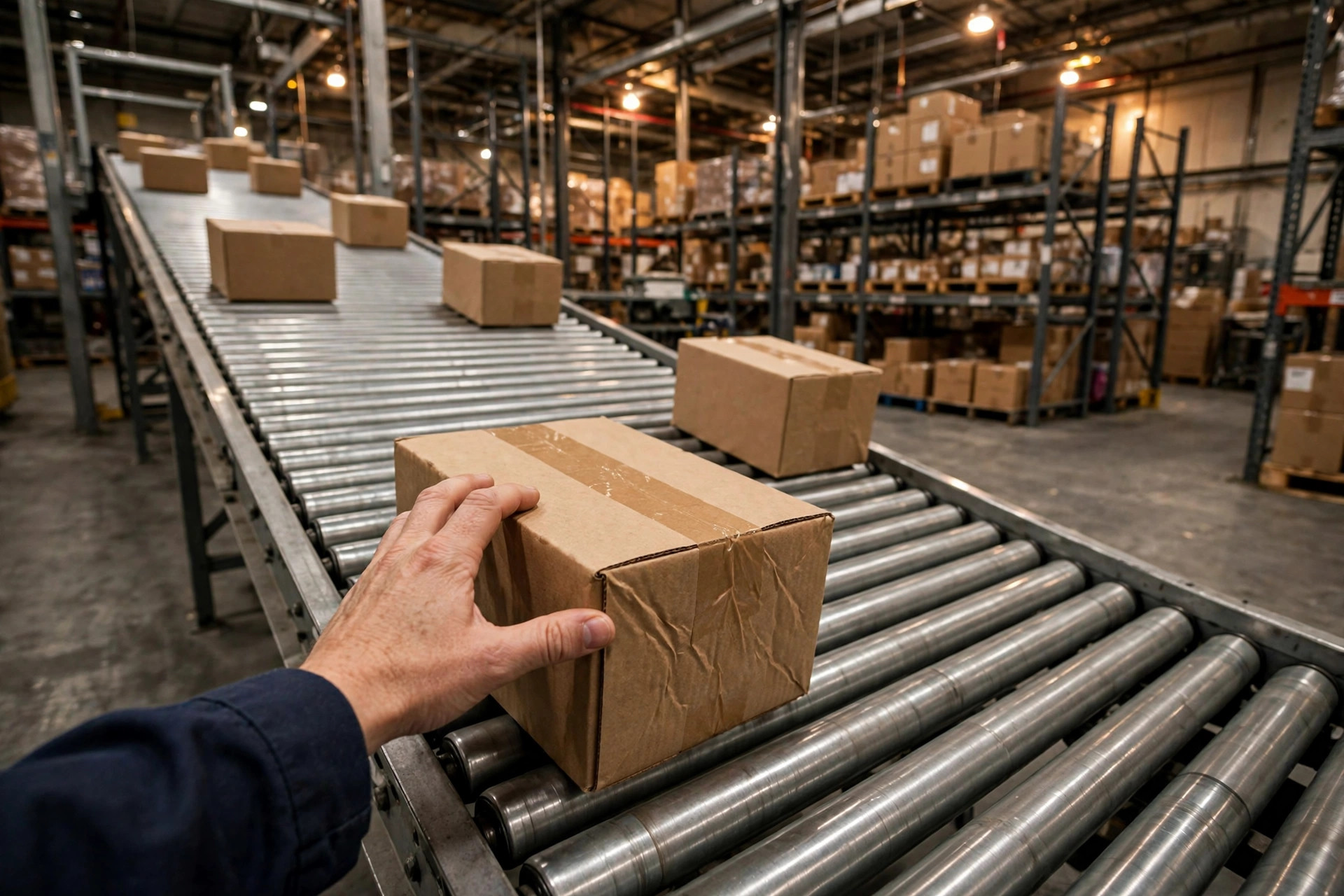
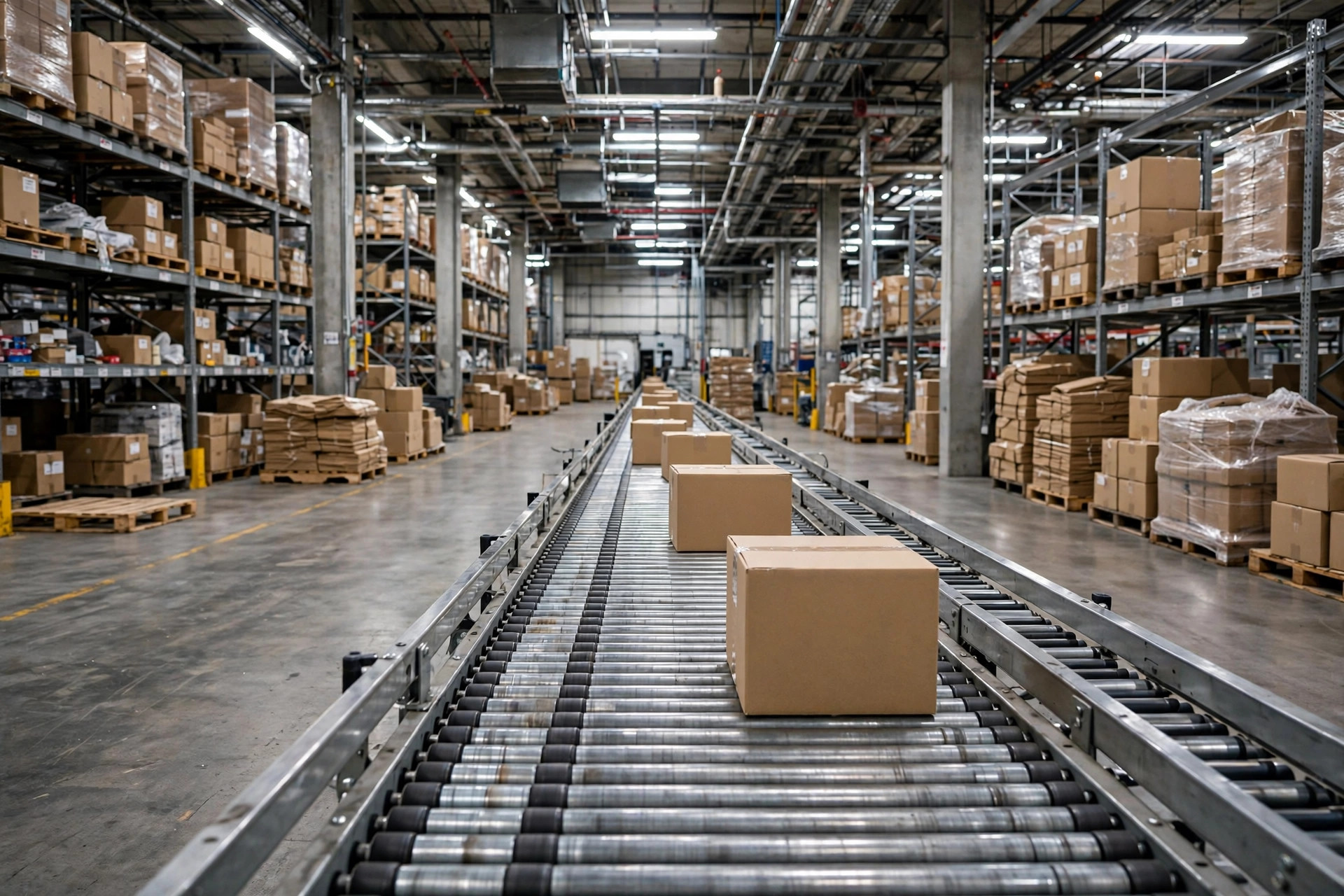
Roller conveyors are a row of steel rollers that cartons roll across. Powered versions have a small motor per section; unpowered ones just use gravity. Perfect for flat-bottomed cartons — the default for e-commerce warehouses. The design is almost stupidly simple: rollers, frame, motor. When one breaks, you swap a roller. Any old maintenance hand can do it.
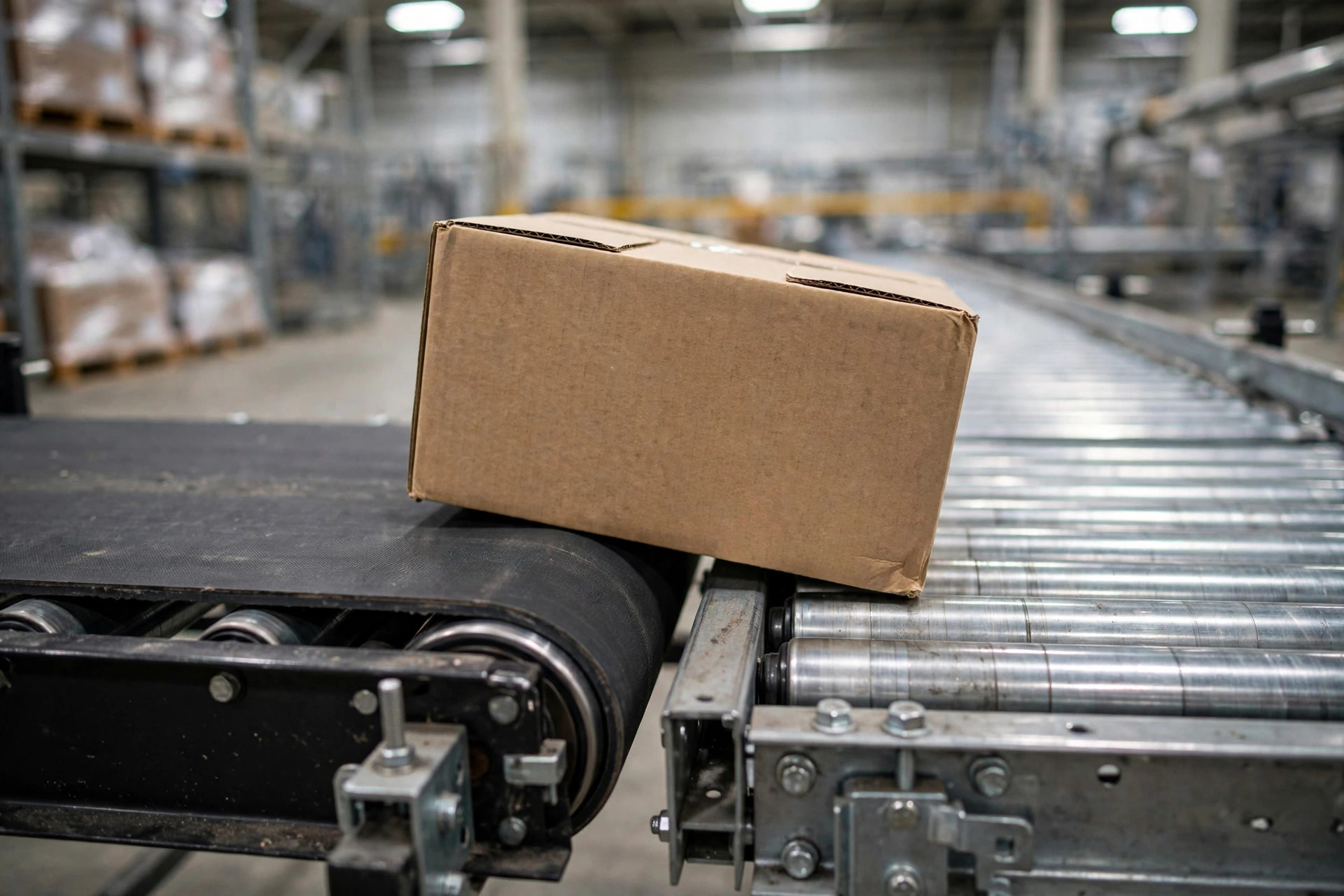
Belt conveyors carry goods on a black belt. The upside: they don't care what shape your goods are. Small parts, odd shapes, loose items — nothing falls through the cracks, and belts can handle curves and inclines. The downside: they're needy. Belts drift out of alignment, and adjusting a tracking belt can drive you insane. Belts hate oil and sharp edges, and replacing one costs thousands.
Chain conveyors drag a chain-driven slat bed. Enormous power — pallets, heavy freight, high-heat environments all belong here. The price: expensive, heavy, loud, and the most maintenance-hungry of the three. Chains need regular oiling and tensioning, and worn parts hurt to replace. These are built for heavy industry and pallet lines, not for cartons.
One-line version: cartons go roller, odd-shaped smalls go belt, pallets and heavy freight go chain. When a salesman tells you "chain is the most premium option," translate that as "chain has the fattest margin."
How I Almost Got Burned by a $52,000 Quote
Why did the salesman push chain? Because that's where the margin is. For the same length of line, a chain conveyor runs roughly 2 to 3 times the price of a roller line — that pattern was obvious across the quotes I collected from several vendors. Not an industry secret, just math.
But I stopped and asked myself three questions:
First, what are we actually moving? E-commerce parcels and cartons, rarely over 20 kg a piece. Chain's "heavy-duty" advantage was completely wasted on us. It'd be like buying a tractor when you need a delivery van — and paying BMW money for it.
Second, who fixes it when it breaks? Our warehouse has one part-time electrician who mostly services forklift chargers. Belt tracking adjustments and chain tensioning? Not his job. A vendor service call costs a small fortune each time. Roller lines have one great virtue: there's almost nothing to break.
Third, and this one stung: can our volume even support it? $52,000 of equipment would have eaten a year of our profit. If we changed product categories or moved warehouses next year, that line would become the most expensive drying rack in the building.
Then my friend Lao Li, who runs an auto parts warehouse, told me his horror story. In early 2024 he listened to a vendor and installed a $85,000 belt sorting line. Problem: his goods are mostly odd-shaped parts. The belt drifted out of alignment constantly, and he replaced it twice at over $1,100 a pop. During peak season the line couldn't keep up with the order surge and became the bottleneck itself. Half the line now sits idle collecting dust. His words: "I didn't buy equipment, I adopted a needy ancestor."
Our Cheap Fix: A Used Roller Line for $8,500
Once I figured that out, our solution was so low-budget the salesman stopped returning my calls:
- Used powered roller line: bought secondhand from a used-equipment market in Guangzhou — 60 meters for about $8,500. With rollers, used vs. new barely matters. A dead roller costs a few dollars to swap.
- Gravity skate sections: the 15-meter stretch from packing to the QC area got unpowered gravity rollers. Zero electricity, no motor, almost nothing that can break.
- Only the "last mile": we didn't automate the whole warehouse — just the straight run from picking to packing. Straight lines are cheap. Every curve and incline is where the money (and the breakdowns) hide.
Our own crew installed it over a weekend. A couple of cases of water, dinner for the electrician, under $1,100 in install costs.
The results, from our own books:
| Before | After | |
|---|---|---|
| Staff on pick-to-pack transfer | 3 | 1 (exceptions only) |
| Peak-season orders per picker per day | ~900 | ~1,400 |
| Mis-ship rate | Spiked every peak | Roughly flat vs. off-season |
| Monthly labor cost for transfer | ~$2,700 (3 × $900) | ~$900 |
Total equipment spend: under $9,600. Two people freed up, saving about $1,800 a month in labor — payback in under 4 months. And that was at our old wage levels; labor only gets more expensive, so payback gets faster.
Here's the contrarian take: for a small warehouse, a conveyor's biggest cost isn't buying it — it's being stuck with the wrong one. The moment equipment lands, your layout is locked. We only built one straight section precisely so we could back out — if we move warehouses next year, those 60 meters of roller come apart and resell as used equipment. We'd lose almost nothing. Those "automate everything in one go" plans sound beautiful. One wrong bet and you're bleeding.
And another one: unpowered gravity roller is the small warehouse's secret weapon. No electricity, no maintenance, nearly unbreakable, a fraction of the powered price. Short runs with a bit of slope? Gravity rollers. Buy with your eyes closed.
The 5-Question Checklist Before You Buy
If you're stuck on the belt vs roller conveyor question, don't call a salesman yet. Answer these five questions first and the answer will find you:
1. Are your goods flat-bottomed? Cartons and totes → roller. Small parts, odd shapes, anything that falls through gaps → belt. Pallets and heavy freight (dozens of kg per piece) → chain or heavy-duty roller. Product type is the first deciding factor. Everything else is secondary.
2. Has your transfer volume outrun human legs? Our rule of thumb: when a single transfer leg exceeds 3,000 pieces a day, people start losing the race — that's when a conveyor starts making sense. Below that, hiring two more people is often cheaper. Humans are the most flexible "equipment" there is; you can reassign them when volume drops.
3. Straight run, or curves and inclines? Straight → roller wins on price. Curves and inclines → belt is your only real option. Every curve adds cost and failure points. If you can go straight, go straight.
4. Does anyone on your team know how to fix it? Nobody → pick the simplest thing, which is roller. A mistracking belt will genuinely drive people mad. Before buying, ask yourself: at 2 AM with the line down, who gets it running again?
5. Is there used equipment on the market? Roller lines and gravity sections are simple machines — used feels about the same as new, at half the price or less. Local used-equipment markets and bankrupt-warehouse liquidations are treasure troves for small warehouses. Buying used isn't embarrassing. Overpaying is.
| Roller | Belt | Chain / Slat | |
|---|---|---|---|
| Best for | Cartons, totes | Smalls, odd shapes | Pallets, heavy freight |
| Relative cost | Low | Medium | High |
| Maintenance | Easy | Medium (tracking drift is normal) | Hard |
| Curves / inclines | No | Yes | Partially |
| Expansion flexibility | High (just add a section) | Medium | Low |
| Small-warehouse rating | ★★★★★ | ★★★ | ★ |
One last honest word: that big-company narrative — "full automation, do it right the first time" — is built for people with dedicated equipment teams and stable mega-volumes. Our way of surviving is different: fix the most painful leg first, buy used over new, go straight over curved, go gravity over powered. The money you save goes to payroll and inventory, and that beats everything.
Small warehouses have their own way of surviving.
By Xiao Ma, Small Warehouse Owner