I learned everything I know about conveyor belt splice repair vs replacement the hard way — standing in front of a dead conveyor line one week before peak season, doing math I really didn't want to do.
We run a 3,000-square-meter warehouse. The fanciest "automation" on our equipment list is two secondhand belt conveyors, and we treat them like treasure. Then this August, one week before peak, the 50-foot line in our packing area let out a crack — the belt splice split open, the belt nearly tore in two, and our entire packing rhythm flatlined on the spot.
I crouched down next to that split and had exactly one thought: how much is this going to cost me?
I called an equipment repair company. The tech took one look and said, "Vulcanized splice, several thousand dollars, and you'll have to wait for an open slot." I asked how soon he could come. "Next week." Next week? Our peak-season freight was already stacked up at the door. I just laughed: "We're a small warehouse. We can't burn that kind of money — and we definitely can't wait that kind of time."
Your Conveyor Belt Splice Just Cracked: Three Options, No Fourth
After a crash course, I learned there are exactly three ways to fix a belt splice. No fourth option exists.
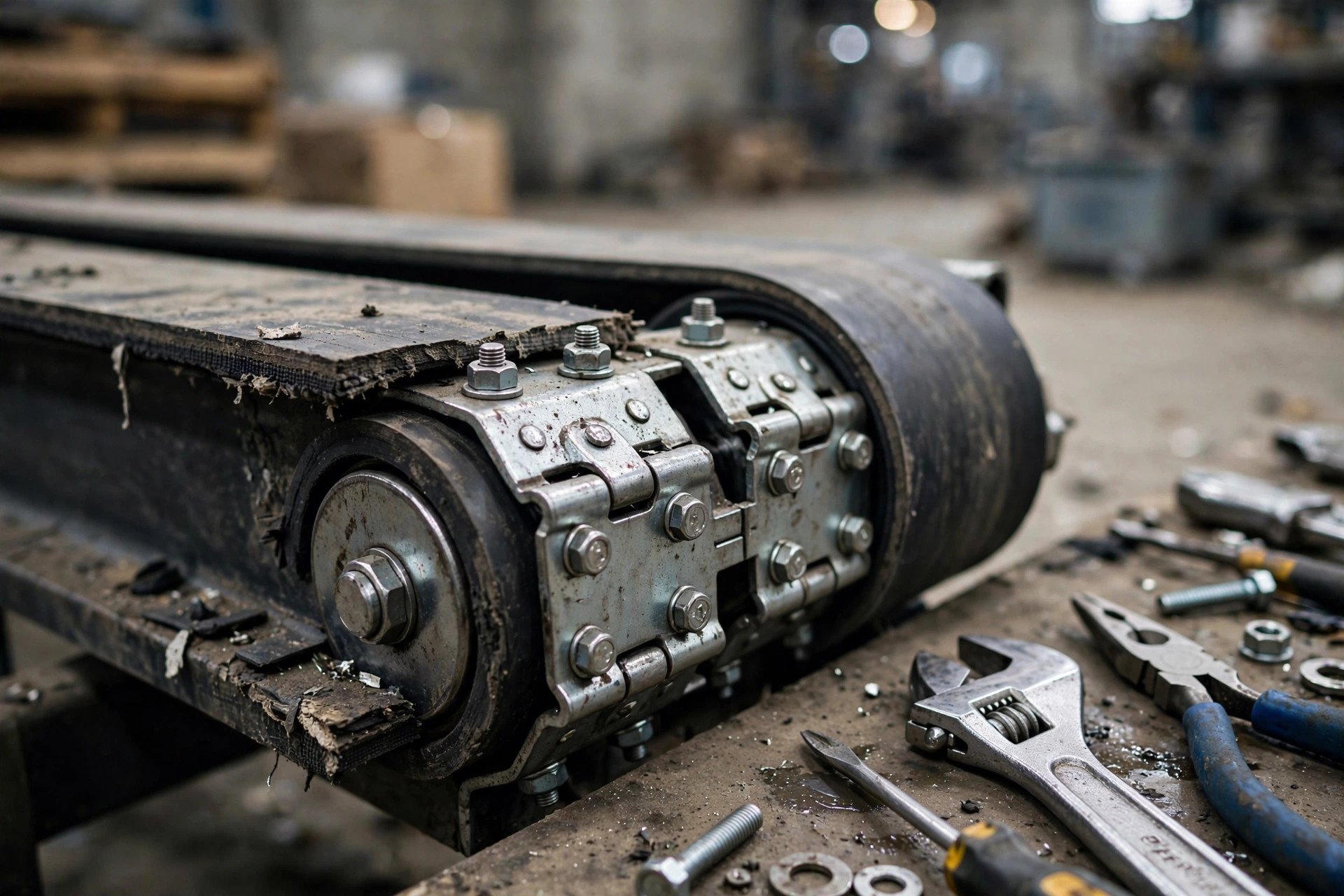
Option one: mechanical fasteners. Basically, you staple the two belt ends together with metal fasteners — think of it as an industrial-strength stapler for belts. A fastener kit costs a few hundred dollars online. I'm a total amateur, and after one afternoon of watching installation videos, I grabbed two of my guys and the three of us had it installed by end of day. Industry references describe this as "a few hundred dollars, done in an hour or two," and they're not exaggerating. The downsides are real too: the splice is stiffer than the belt, it clunks over the rollers, and you should plan on 6 to 12 months of life. Not for heavy-duty, long runs.
Option two: vulcanized splice. The belt ends get skived at an angle, then bonded with adhesive and heat-cured into one piece, with strength close to the belt itself. This is the big facilities' favorite — and the repair companies' favorite to recommend. Why do they love recommending it? Because it's a several-thousand-dollar job that requires a specialist crew with a vulcanizing press, and a hot splice means 4 to 8 hours of downtime at minimum, plus whatever queue you're stuck in. It's a great splice. It's also expensive, slow, and puts you at someone else's mercy.
Option three: full belt replacement. When the belt carcass itself is worn out, even the prettiest splice is just makeup on a corpse. Cost depends on belt length and width — for our 50-foot line, a new belt plus labor lands in the several-thousand-dollar range, with half a day to a day or two of downtime.
I put the three options in a table and pinned it to the office wall:
| Option | Cost magnitude | Downtime | How long it lasts | When a small warehouse picks it |
|---|---|---|---|---|
| Mechanical fasteners | A few hundred dollars, DIY | 1–2 hours | 6–12 months | Emergency fix, stopgap, light-duty short lines |
| Vulcanized splice | Several thousand dollars, specialist crew | 4–8 hours + waiting for a slot | Near the belt's own lifespan | Critical lines, long runs, heavy loads |
| Full replacement | Several thousand and up, depends on length | Half a day to a couple of days | Fresh start | When the belt carcass is done |
(Those magnitudes come from industry references: mechanical splices are commonly described as "a few hundred dollars," vulcanized splices as "several thousand dollars," and hot splicing as 4–8 hours of downtime. Get your own quote for exact numbers.)
You're probably wondering which one I picked. The cheapest, most lowbrow option: mechanical fasteners. My reasoning was dead simple — one week before peak season, I couldn't gamble on "waiting for a slot." The result? That mechanical splice has been running for over a year now. All I do is check the bolts once a month. Zero issues. The several thousand dollars I saved bought two pallets of packing supplies. Tell me that wasn't the better deal. Nobody hands you a manual for conveyor belt splice repair vs replacement when you open a small warehouse — you learn it standing next to a dead line.
The Cautionary Tale: A Good Splice Can't Save a Dead Belt
Now the horror story. My neighbor Lao Chen runs the warehouse next door. The belt on his conveyor was polished shiny in the middle, the top cover nearly gone, the fabric carcass showing through. His repair guy took the lazy route: slapped a mechanical fastener on it, three times in a row. The fourth failure didn't happen at the splice — it happened right next to it. The snapped belt end whipped around and nearly hit a picker working nearby.
Lao Chen ended up replacing the whole belt anyway. The money he'd spent on three rounds of splices would have covered most of a new belt, plus he'd eaten three rounds of downtime. That taught me the most counter-intuitive lesson in this whole article: when a conveyor belt splice fails, the first question isn't which splice to use — it's how much life the belt itself has left. The splice is just a connector. The belt carcass is the life. When the life is gone, no splice on earth will save it.
Conveyor Belt Splice Repair vs Replacement: Three Questions That Decide It
I've made it a house rule now. When a splice fails, we walk through three questions:
Question one: is the belt carcass still healthy? Top cover worn through, fabric showing, frayed edges, belt tracking that won't stay straight no matter how you adjust it — if you see any of these, stop repairing and replace the whole belt. Lao Chen paid good money to learn that one.
Question two: how long can this line stay down? Two hours versus two days is the difference between life and death for a small warehouse. If you can't wait, put a mechanical splice on it to survive peak season, and revisit the long-term fix later. Mechanical splices have a hidden superpower: they warn you before they fail. Loose bolts, lifting fastener edges — you can see it coming with your own eyes. A vulcanized splice, on the other hand, looks perfectly fine right up until the moment it catastrophically isn't.
Question three: how many times have we fixed this splice? If the same splice has failed twice already, the problem isn't the splice — it's the belt or the operating conditions of that line. Don't install a fourth mechanical fastener. Either vulcanize it once and be done, or replace the whole belt.
One last grassroots hack from our little warehouse: I now keep a mechanical fastener kit in the corner year-round. Takes up almost no space, costs a few hundred dollars, and it's pure insurance. A belt splice is like a flat tire — you can't prevent it from happening, but you can make sure that when it does, you've got a spare and a jack in the trunk instead of standing on the roadside waiting for a tow truck until dark.
Big companies optimize for "maximum splice strength." We small warehouses optimize for "can we ship tonight." Once the math is clear, the decision in any conveyor belt splice repair vs replacement debate makes itself.
Small warehouses have their own way of surviving — spend the money where it keeps the line moving, because "don't stop the line" is the whole strategy.
By Xiao Ma, Small Warehouse Owner