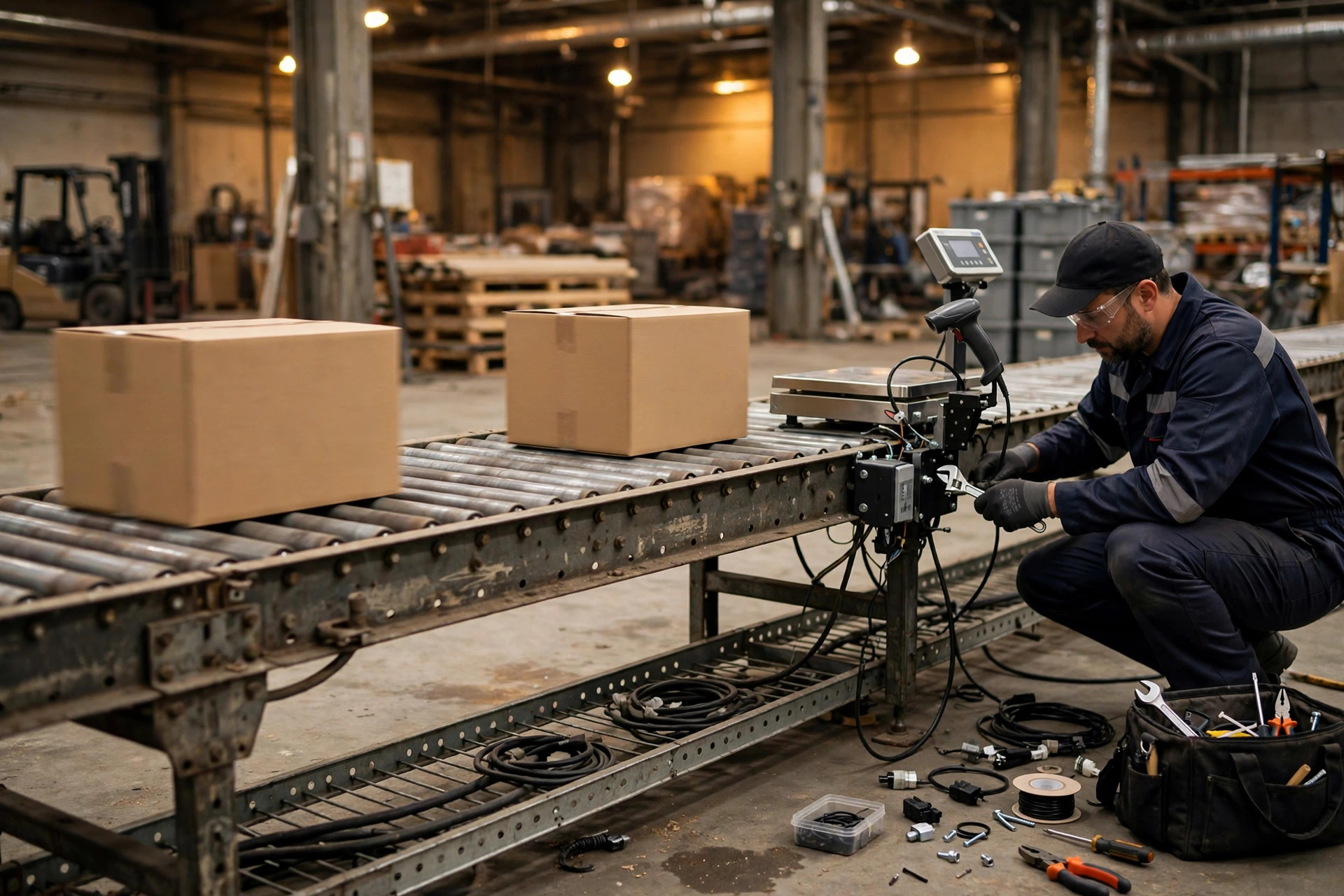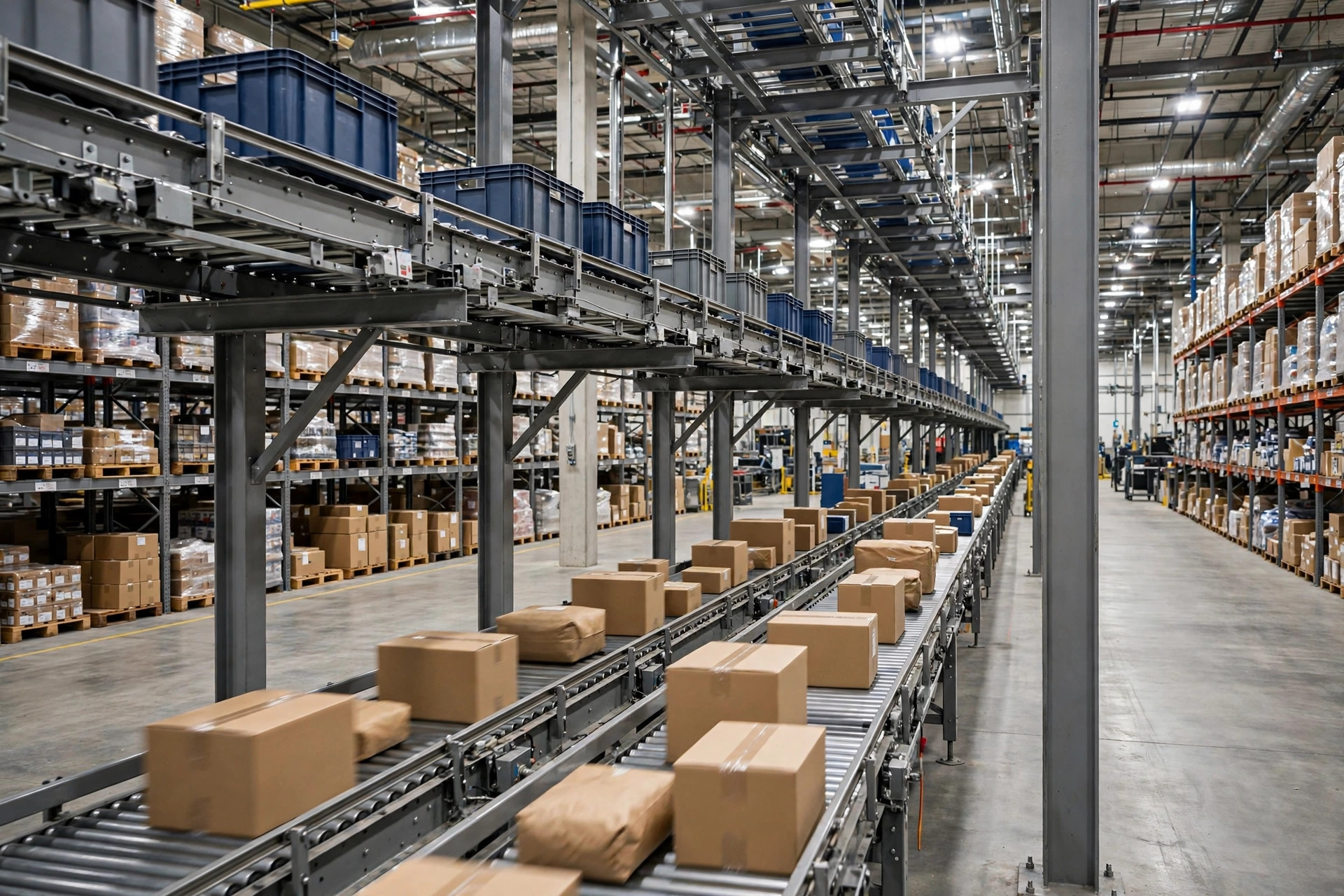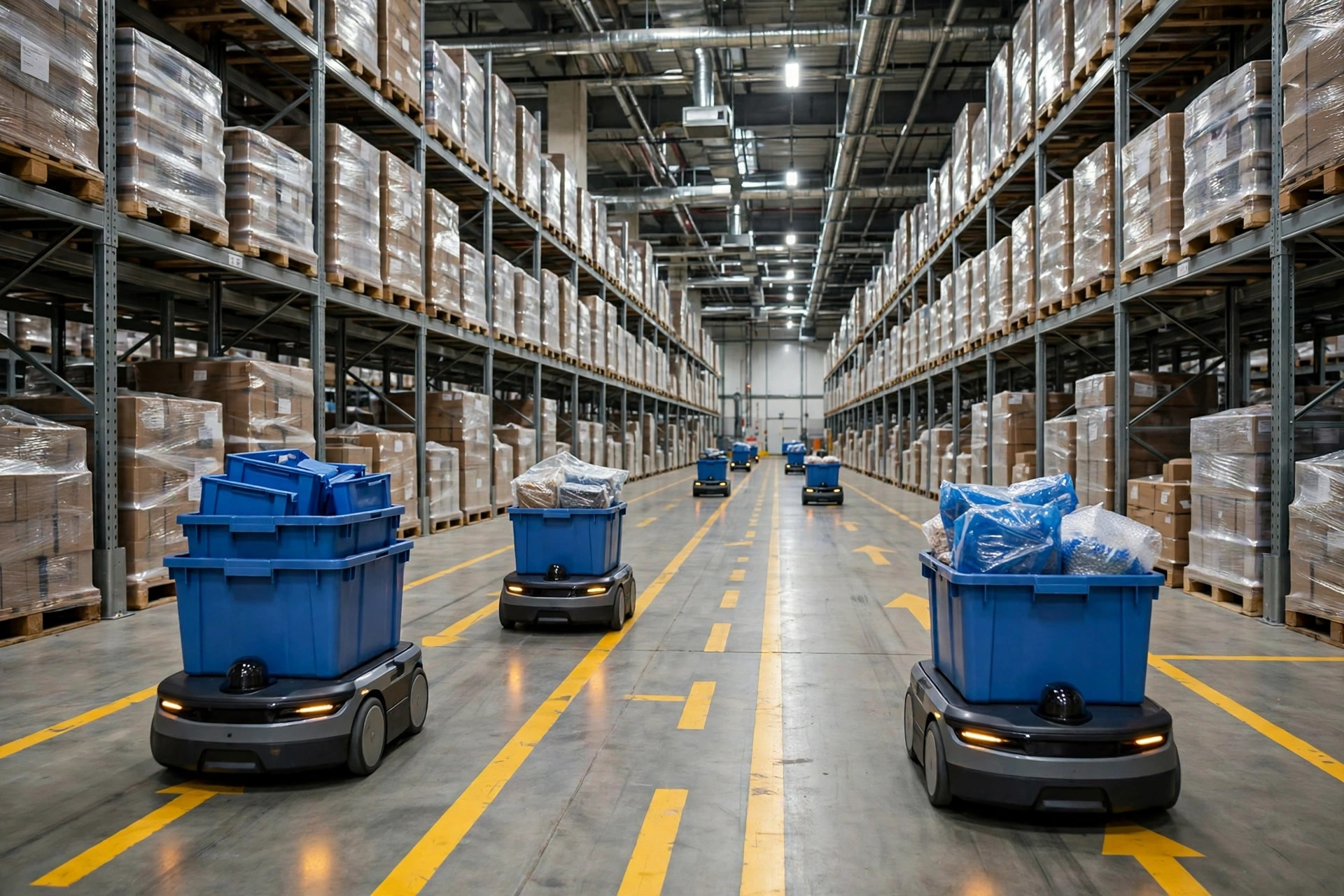
Folks, let me tell you about our worst conveyor–AMR docking jam during last year's peak. Mid-October, volume had just started climbing, and the end of the conveyor line started jamming — not the line itself, the AMRs. Cartons piled up on the rollers at the line's end while four AMRs queued for loads. The longest one waited nearly 40 minutes. The dispatch screen was all yellow. The conveyor crew blamed the robots for being slow; the robot side blamed the line for feeding too fast. Let me be straight: neither side was the problem. The problem was the handoff — nobody had ever done the math on it.
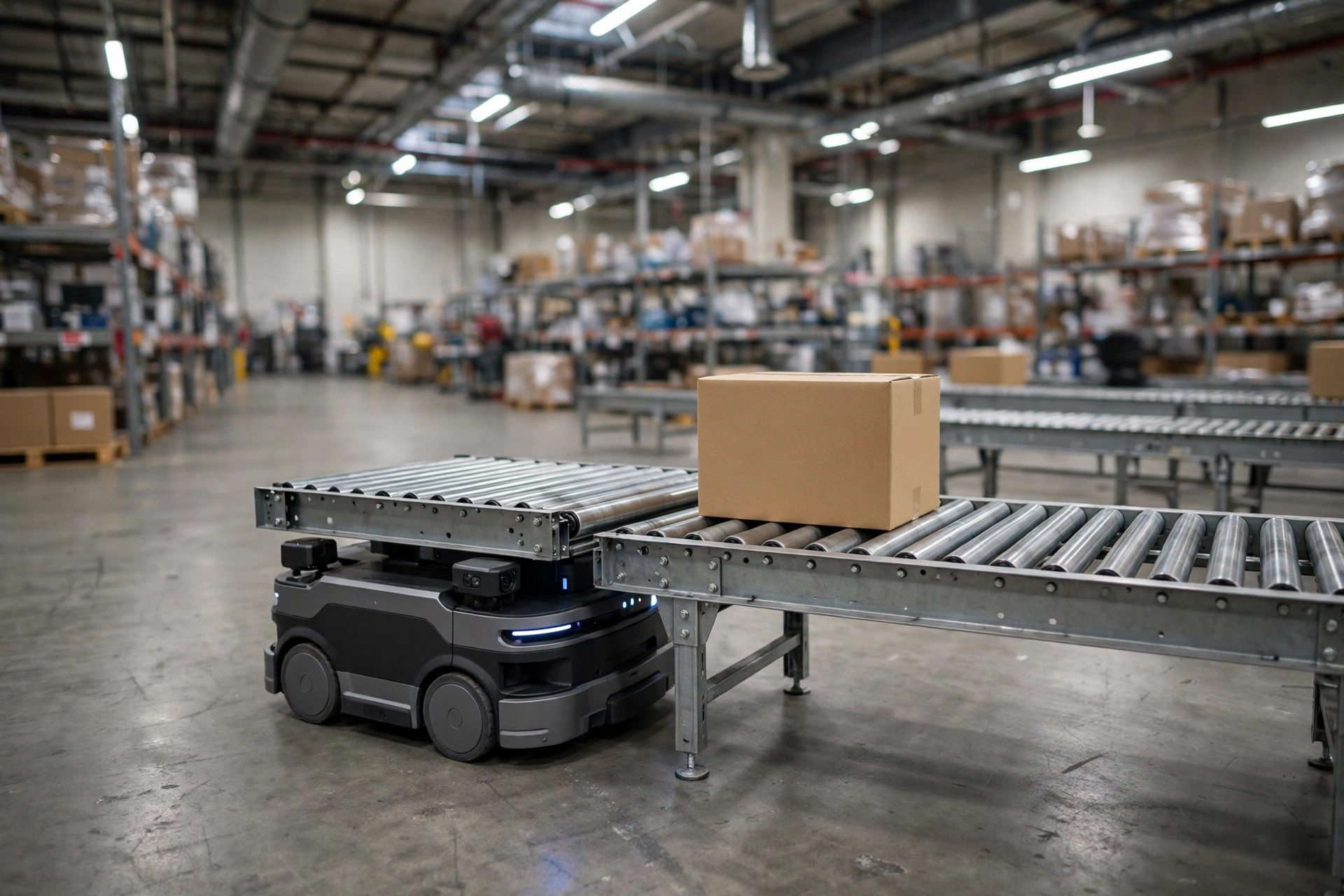
That's today's topic: conveyor–AMR docking, how robots pick up and drop off at the head and tail of a conveyor line. It looks like a small detail. In an automated warehouse, half of all exceptions come out of this one spot.
Three Ways to Make Conveyor–AMR Docking Work
For AMRs loading and unloading at conveyor ends, there are three mainstream methods. We've tried all three. Here's the scar tissue:
First, the lift type. The AMR drives under a cart or pallet at a station beneath the conveyor, lifts, aligns, sets down, and leaves. The upside is cost — the line barely needs modification. The downside is speed: one lift-and-align cycle takes 20 to 30 seconds, and all carts and pallets must be the same spec. We started with this. When peak hit, the takt couldn't keep up, and the line jammed.
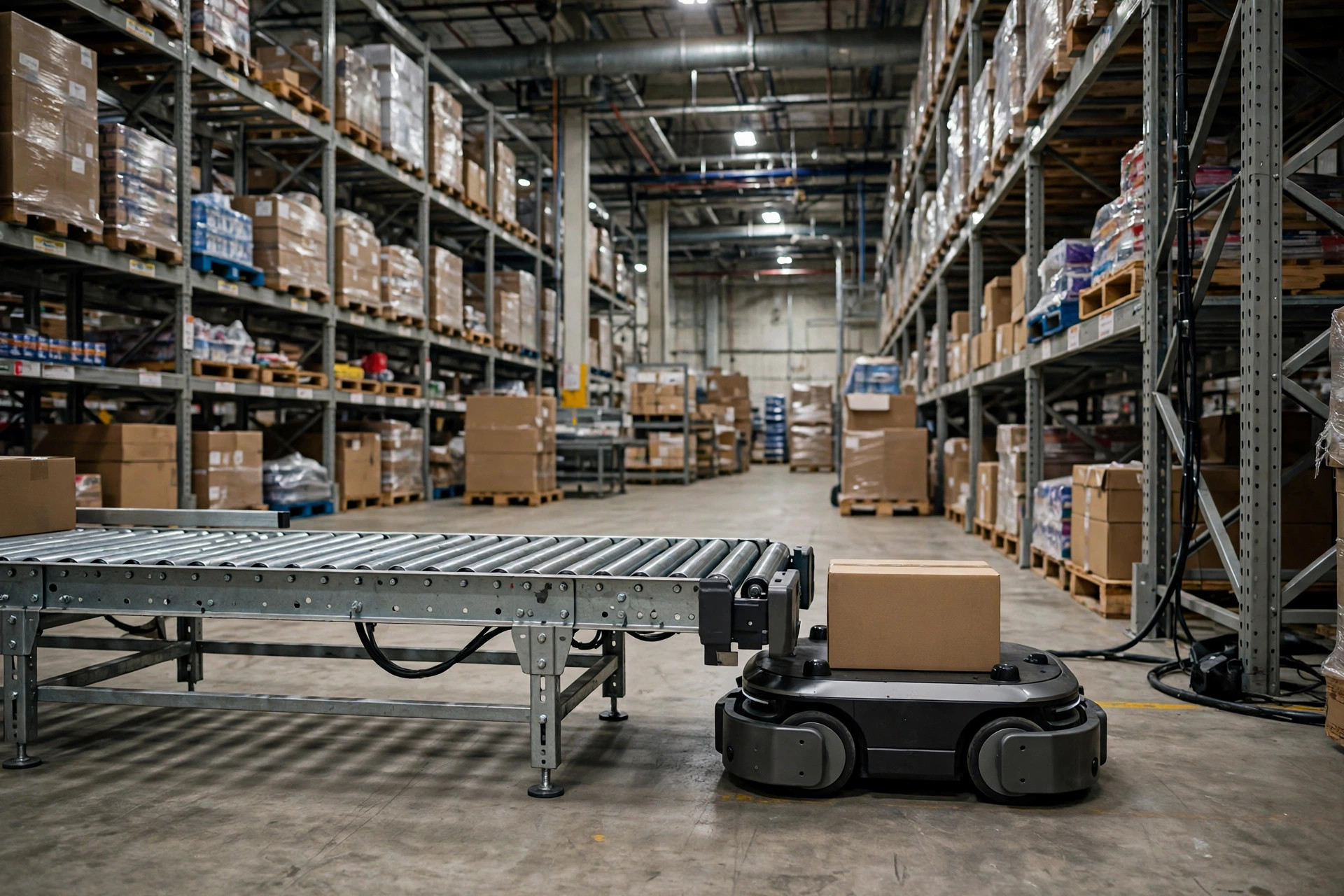
Second, roller docking. The AMR carries its own roller section. It drives to the line end, its rollers line up with the conveyor's rollers, and the carton rolls straight across. The upside is speed — a handoff takes about ten seconds, and it can run continuously. The downside is cost, plus precision: if the height difference between the two roller beds exceeds 5 millimeters, the carton jams. We eventually gritted our teeth and bought several roller AMRs for our best-selling SKU lines. The effect was immediate.
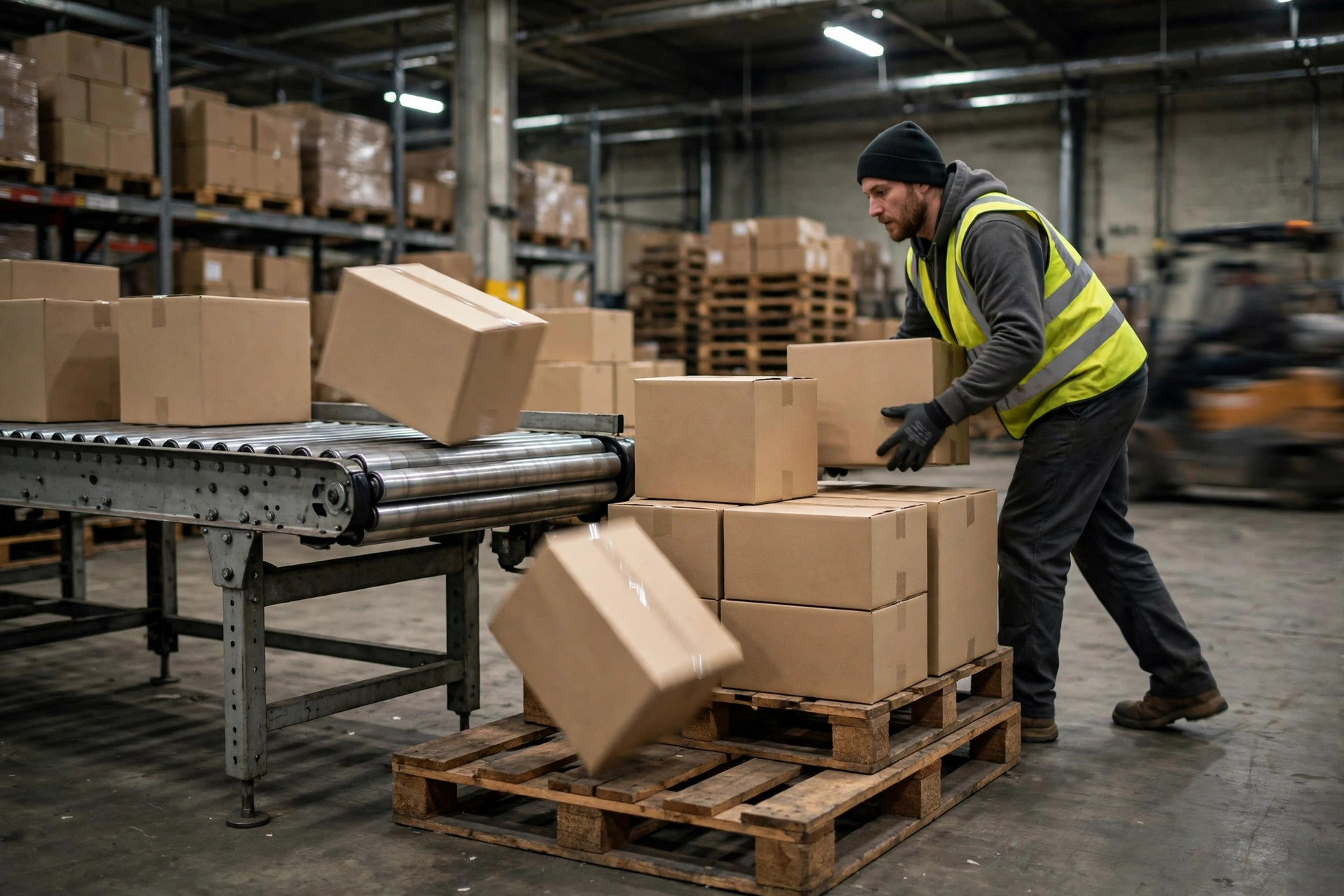
Third, manual transfer. Park a person at the line end; cartons come down and get hand-stacked onto the AMR's rack. Don't laugh — this is reality in a lot of warehouses. Zero retrofit cost, the most flexible exception handling. The downside: the moment that person steps away, it jams — and nobody wants that job on the night shift. Our current policy: roller docking on the main lines, manual transfer on the volatile ones like tail lines and returns.
| Method | Handoff takt | Retrofit cost | Exception handling | Best for |
|---|---|---|---|---|
| Lift type | 20–30 sec per cycle | Low | Medium | Pallets and carts, low takt demand |
| Roller docking | ~10 sec per cycle | High | Hard — jams need a human | Carton goods, high-takt main lines |
| Manual transfer | Depends on the person | Zero | Most flexible | Volatile, exception-prone lines |
The Takt Math: Idle Time Between Line and Robot Is the Most Expensive Waste
Docking comes down to one thing: takt matching. The line's feed rate and the AMR's haul-away rate have to line up. Run the numbers and it gets obvious:
On one of our main lines, the conveyor drops 120 cartons an hour. An AMR takes 90 seconds one way from the line end to the sort zone, 30 seconds to load and unload — a 4-minute round trip. One robot hauls 15 cartons an hour. 120 divided by 15 is 8. In theory, you need 8 robots to keep up. We had 4 at the time — so the jam was no surprise at all.
But don't size to the theoretical number. Once AMR utilization passes 80%, the dispatcher starts queueing; past 90%, a single exception takes down the whole line. We now size at 70% utilization: 8 divided by 0.7 is about 11, so we run 11 — three spare robots absorbing exceptions and charging. Those three look like waste on paper. During one peak week, they saved us three times.
Here's the counterintuitive part: the most expensive part of docking isn't the equipment — it's the idle time when the line and the robots wait on each other. A roller AMR costs well into six figures; an hour of it sitting idle, nobody ever prices the depreciation plus the opportunity cost. But an hour of line jam, with dozens of people on the sort line standing around waiting — finance does that math and breaks into a sweat. So when sizing the fleet, one robot too many beats one too few. The extra one is insurance; the missing one is an incident.
When Conveyor Docking Jams: Three Tiers of Exceptions
Docking exceptions boil down to three tiers, and we handle them by tier now.
Tier one: carton jams. A carton twists or wedges at the roller handoff. Happens a few times a day, always. Our fix: photoelectric sensors at the line end, auto-alarm if a jam lasts more than 15 seconds, and the nearest patroller walks over and straightens it. One rule: never let the AMR "push through" a jam — one shove deforms the carton, the sorter downstream can't scan it, and the chain reaction begins.
Tier two: robot offline. The AMR loses network or localization and freezes in place. The dispatcher has to auto-reassign its tasks to other robots while someone pushes the dead one back to the charge zone for a reboot. We learned this the hard way: early on our dispatcher had no task takeover, one robot died, three queued behind it waited, and the line end filled up in 10 minutes. Now a downed robot gets human attention within 2 minutes. It's in the SOP.
Tier three: batch exceptions. A batch of oversized cartons, or bad task data from the WMS, and the line end jams repeatedly. Don't fight it — switch straight to manual transfer: open the backup manual station next to the docking point and reroute the AMRs to other lines. Our principle: always keep a manual backup station next to every docking point. The more automated you get, the more you need the manual fallback. Sounds contradictory. It saved us twice during peak.
One more detail: the floor at the docking point. AMRs brake hard and turn in the exact same spot all day, so the floor wears faster there than anywhere else, and the floor markers used for localization need checking every couple of months. Don't underestimate this — nine times out of ten, lost localization is just a worn-out marker.
When Docking Is Worth It: Three Conditions
Not every line deserves AMR docking. Our rule has three conditions, and if any one is missing, we don't do it:
First, stable volume. On a line where daily volume swings more than 30%, the takt never lines up. The AMRs spend all day oscillating between "waiting for cartons" and "chasing cartons." Manual transfer is more flexible there.
Second, uniform carton sizes. If carton dimensions vary too much, the roller dock's guide mechanism can't adjust, jam rates climb, and the labor spent clearing exceptions exceeds the labor saved. Standardize carton sizes first, then talk docking.
Third, long enough distance. If the AMR's run is too short — say 20 meters from line end to sort zone — the robot spends more time turning and docking than driving, and the math doesn't work. Our internal bar: we only consider docking for one-way runs over 50 meters.
And don't get the order backwards: set the takt first, pick the equipment second, modify the line last. Our most expensive mistake was buying the AMRs first, then discovering the conveyor height didn't match the robots — and reworking the line a second time. The equipment vendor won't volunteer that warning. They just sell robots.
One reminder for fellow operators to close: conveyor–AMR docking stopped being a technology problem a while ago. It's an operations problem — did anyone do the takt math, who handles exceptions, how do you absorb volatility. Get those three answered before you buy, and it matters ten times more than which vendor you pick.
By Chen Feng, Warehouse Operations Manager