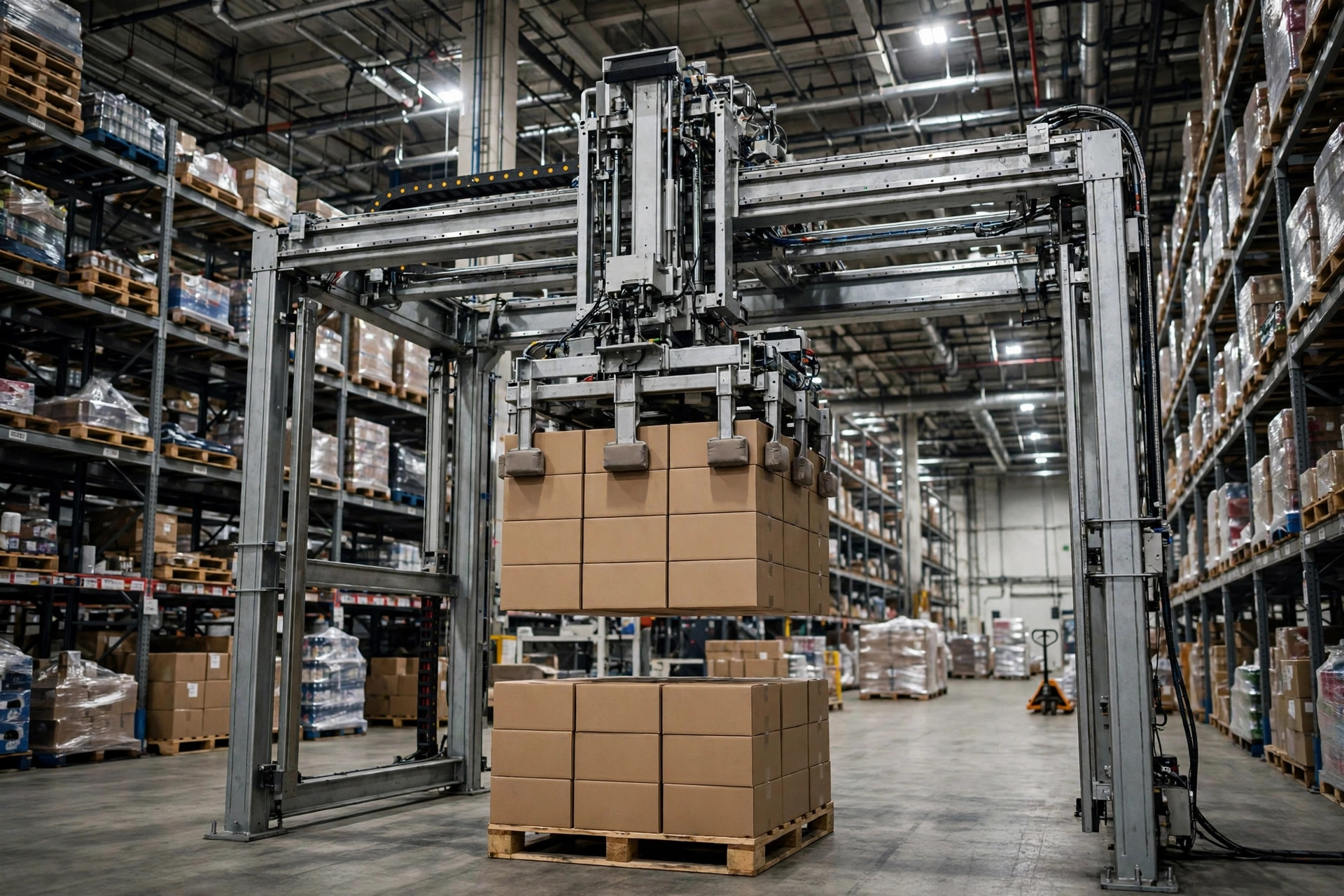
Last November, the owner of a 3PL doing apparel e-commerce fulfillment called me. He wanted to replace manual unloading at the end of his conveyor line with a robotic palletizer and asked which brand I recommended. I didn't answer. Instead I asked him three numbers: how many cases per hour actually come off the end of the line? How many box sizes? How many people work that station today? He stared at me. He couldn't answer a single one.
I told him to hold off on buying anything. When it comes to conveyor discharge, most people get the math between manual unloading and automated handoff wrong from the very first step.
What Actually Happens at the End of the Line
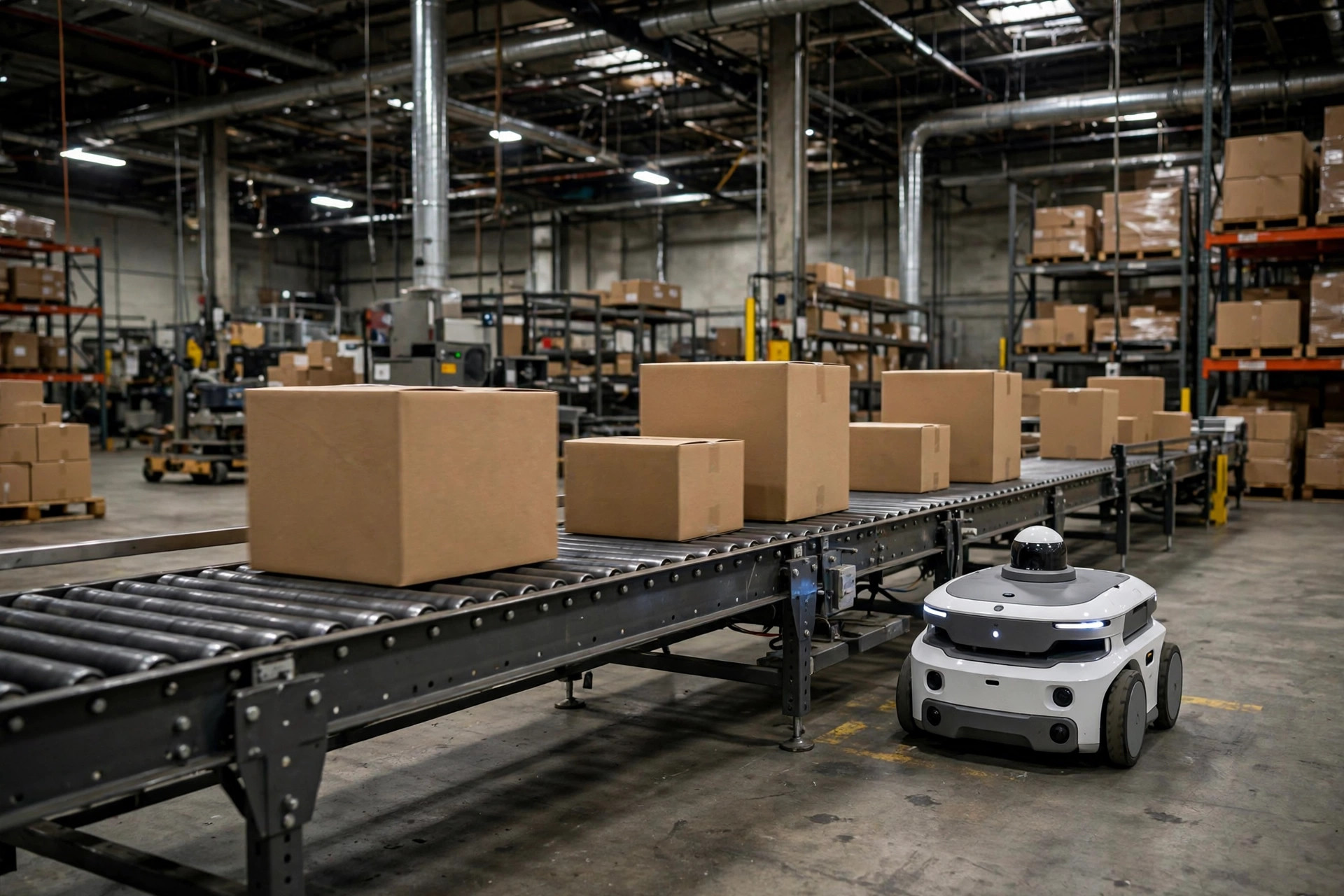
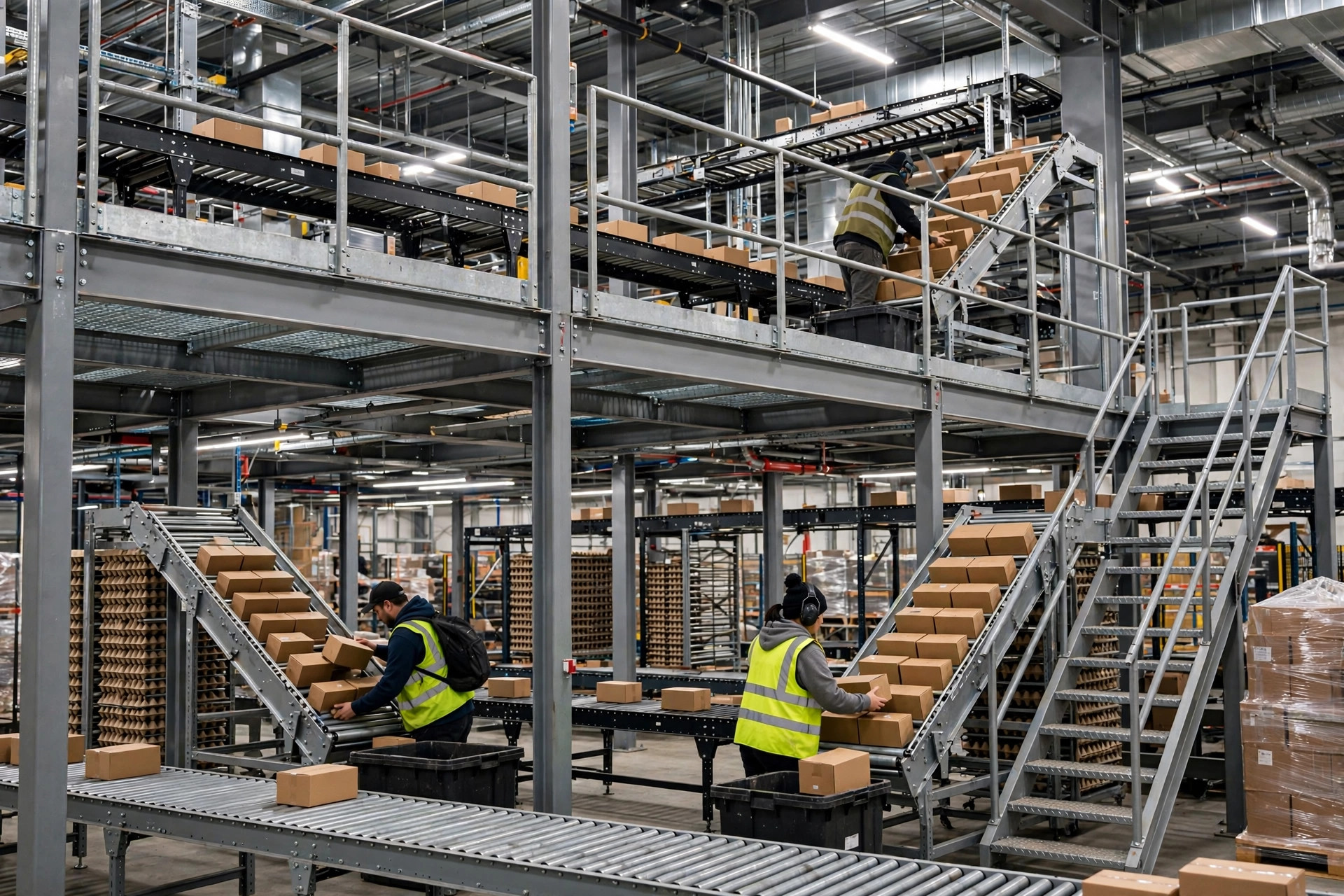
Start with the principle. Conveyor discharge is one job, stated plainly: cases come off the line, someone — or something — takes them off and stacks them onto pallets, and then a forklift or an AGV hauls the pallet away.
Think of it like the pass in a restaurant kitchen. You can think of the upstream sortation as the kitchen cooking as fast as it can; if the person at the pass can't keep up, or sends dishes to the wrong table, the whole restaurant jams. The discharge station is the warehouse's pass — it creates no value itself, but it sets the effective output of the entire line. A line rated at 6,000 cases an hour with a discharge station that can only handle 3,000 gives you a 3,000-case line. The extra speed is decoration.
Three parameters decide which discharge method fits, and they're the first three things I check on every site visit:
First, takt — how many cases per hour actually come off the end, sustained, not the peak number on the nameplate. Second, carton consistency — how many sizes, whether the seals hold, whether you get crushed boxes and soft packs mixed in. Third, the palletizing rule — full-pallet per order or mixed orders, labeling, stretch wrap or not.
Whether automated discharge works, and whether it's worth it, is 90% these three numbers and 10% the equipment brand. Anyone who disagrees can measure the three numbers for a week and then come argue with me.
The Real Cost of Manual, the Real Pitfalls of Automated
Manual first. Most people cost manual labor as "monthly wage times headcount." That math is far too crude. Manual discharge has three real cost buckets, and wages are only the first.
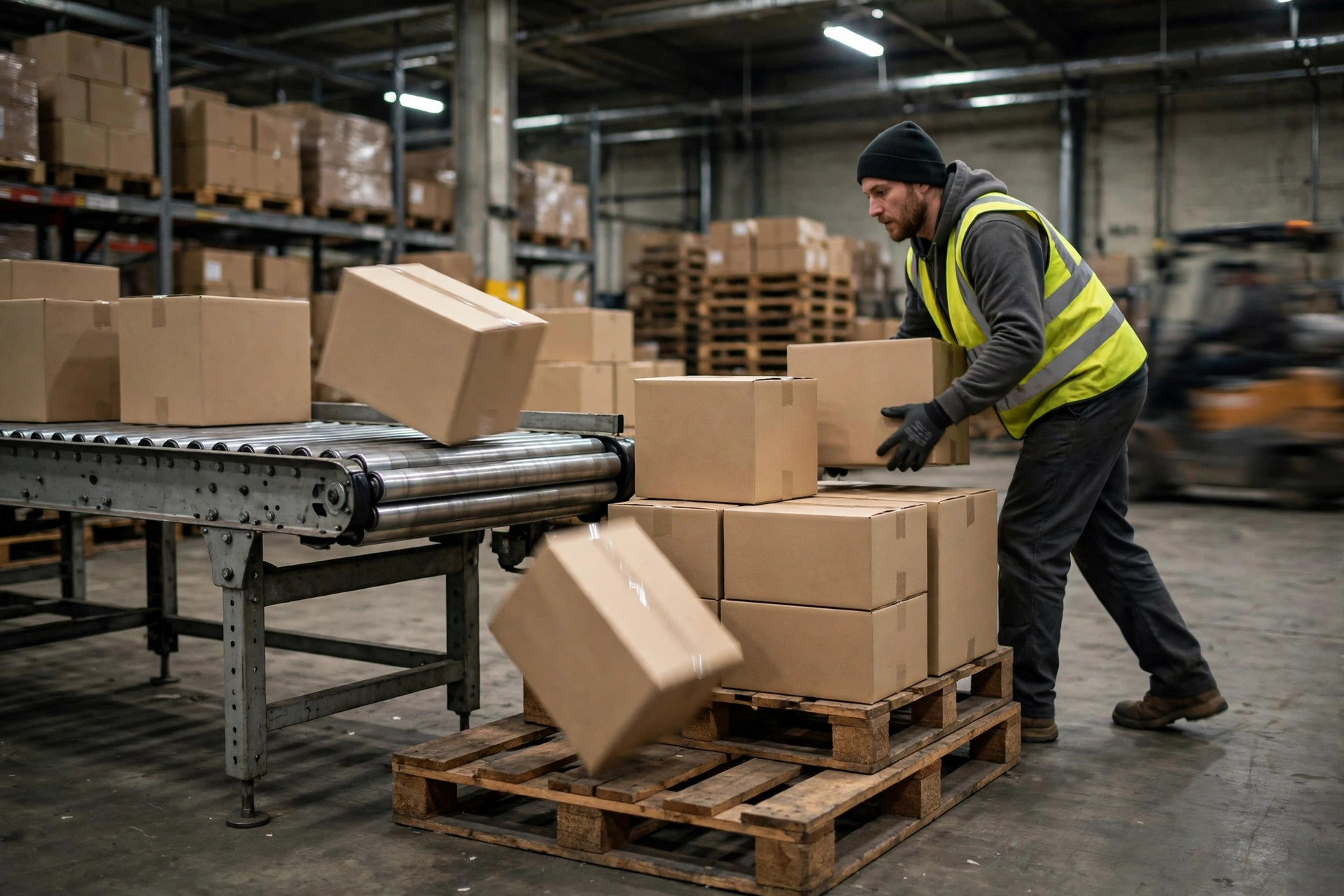
The second is injuries and turnover. Moving and stacking cases by hand is pure repetitive physical work — back injuries, crushed fingers, and tendonitis come standard with the station. At an e-commerce warehouse I worked with in 2023, the discharge station burned through 9 people in one year, average tenure under 4 months. New hires run at maybe 60% of a veteran's pace for their first two weeks and mis-stack more often. None of that shows up as its own line on the P&L.
The third is the takt ceiling. People aren't machines. Pace drops after about two hours of continuous work, and when peak season forces the pace up, the price is mis-stacked pallets, toppled loads, and rising damage rates. Think of it this way: the limit of manual discharge isn't "how fast can someone move" — it's "how long can they hold it."
Now automated. Robotic palletizing, AGV handoff at the line end — sounds beautiful, and the pitfalls are equally clear:
Pitfall one: irregular inbound cartons. Crushed boxes, popped tape, soft packs mixed with rigid cases — the vision system can't get a fix on them. Of every automated discharge failure I've troubleshot, roughly eight in ten trace back to upstream cartons, not the equipment. The machine was designed for a "standard case." Your cases aren't standard, so it stops. That's not the equipment failing — it's being fed the wrong thing.
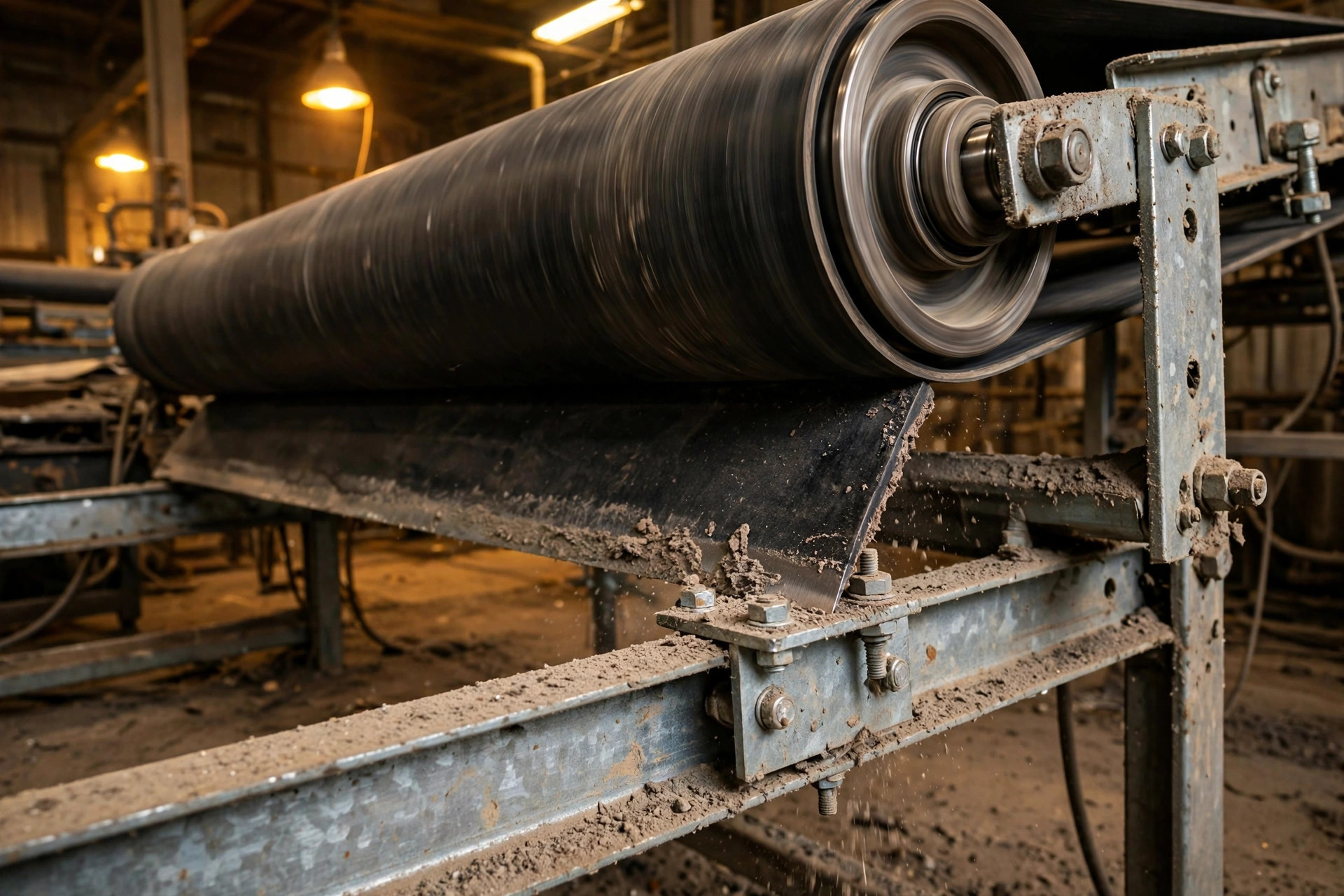
Pitfall two: docking accuracy. The handoff between robot and pallet, between line end and AGV — accuracy drift is chronic. You dial it in to 2 millimeters today; three months later it's 8 millimeters and you get occasional stalls; six months later it's a daily stoppage. Accuracy is like eyesight — it fades silently, and by the time you notice, you can't see.
Pitfall three: changeover cost. SKUs change, box sizes change, and the pallet pattern has to be re-taught. A person just thinks differently; a machine needs re-teaching or reprogramming. The more variety you run, the heavier the flexibility debt of automation.
Here's where I'll call out a fake need directly: plenty of warehouses run their lines at half the design speed and still dream about robotic arms. That's like blaming the faucet when your water pressure is low. Fix the upstream carton quality first, measure your real takt, and a lot of "we need automation" problems evaporate on their own. Equipment vendors won't tell you this, because they sell faucets.
The Dividing Line: Three Numbers and One Calculation
Time for the verdict. When is automation mandatory, and when is manual the smarter play? Here's my dividing-line framework:
| Situation | Sustained end-of-line takt | Box size variety | Shifts | Recommendation |
|---|---|---|---|---|
| Small batch, high variety | Low | 5+ sizes | Single | Manual — flexibility is money |
| Mid scale | Medium | 3–4 sizes | Two | Semi-auto first (lift assist, lift tables) |
| High volume, low variety | High and sustained | 3 or fewer | Two or more | Automated discharge — the math works |
For the calculation, here's the formula. Plug in your own local numbers; don't copy someone else's conclusion:
Annual manual cost = people per station × fully-loaded annual cost per person (benefits, supervision, turnover replacement) × shift factor Annual automated cost = (equipment investment ÷ depreciation years) + annual maintenance + annual energy + residual labor (pallet infeed/outfeed and exception handling still need 0.5–1 person)
Payback period = total equipment investment ÷ (annual manual cost − annual automated cost)
Note the denominator: you must subtract residual labor and annual maintenance. Plenty of ROI spreadsheets quietly drop both, showing 1.5-year payback that turns into 3+ years in reality. Budget maintenance at 8–12% of equipment price per year (use the vendor's actual service quote), and don't believe "maintenance-free" marketing — there is no such thing as a maintenance-free moving part, only moving parts that haven't broken yet.
A worked example, illustrative numbers only — substitute your own: one discharge station, two shifts, 3 people rotating, annual manual cost around $60k. A robotic palletizing cell, installed, $120k, depreciated over 6 years = $20k/year, maintenance at 10% = $12k, energy $3k, residual labor half a person ≈ $10k. Annual automated cost = 20 + 12 + 3 + 10 = $45k. Payback = 120 ÷ (60 − 45) = 8 years. Run that math and a lot of "beautiful" projects go quiet fast — without the takt and carton consistency to back it, automation is an 8-year payback buying peace of mind.
My rule of thumb for the dividing line: sustained takt beyond what people can hold steadily, carton variety down to 3–4 sizes, two shifts or more. When all three hold, automated discharge usually pays. Miss even one, and you're better off maxing out manual plus simple assist tooling first.
After You Automate, Maintenance Is the Real Bill
Finally, the maintenance pitfalls — the part nobody details when you're buying.
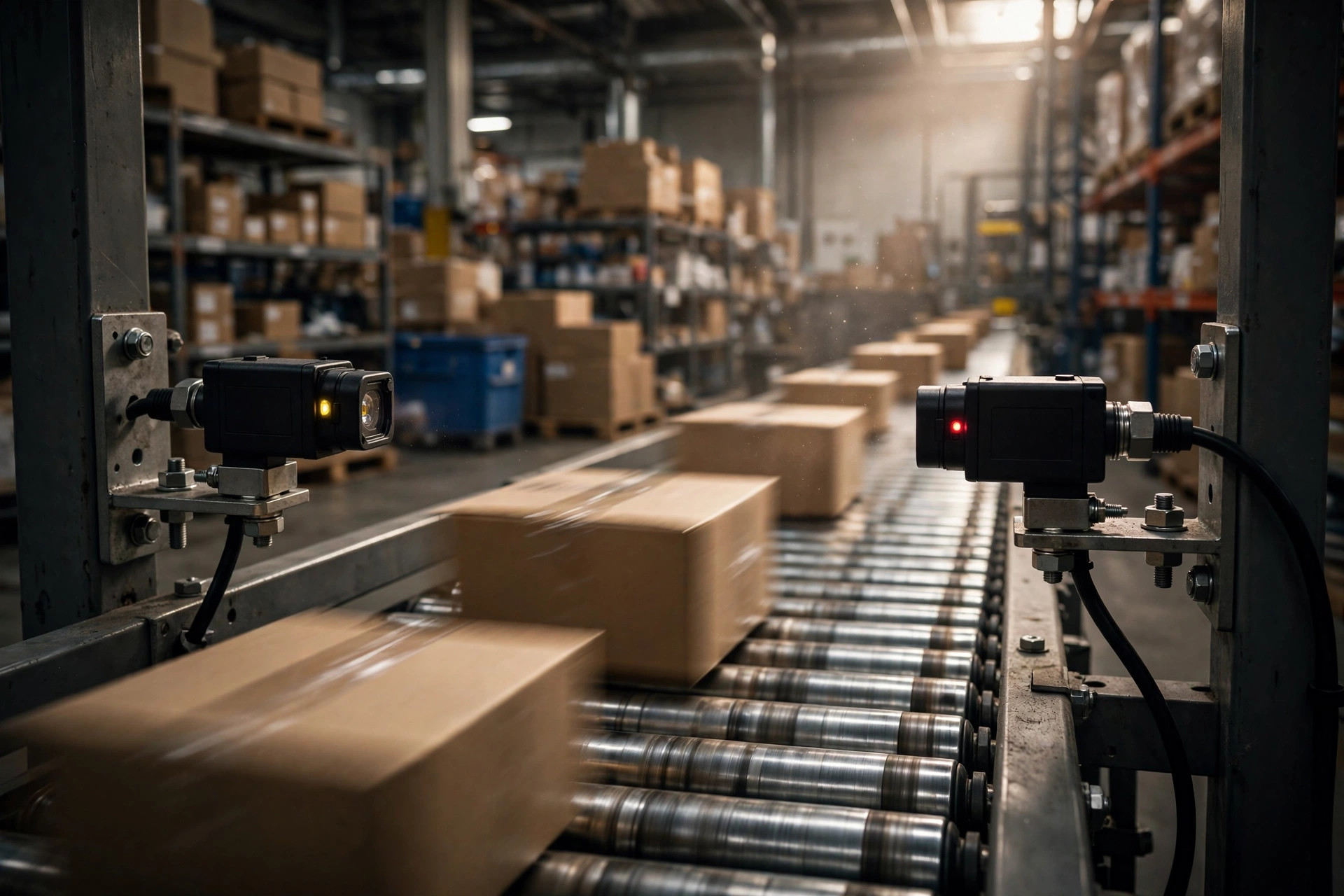
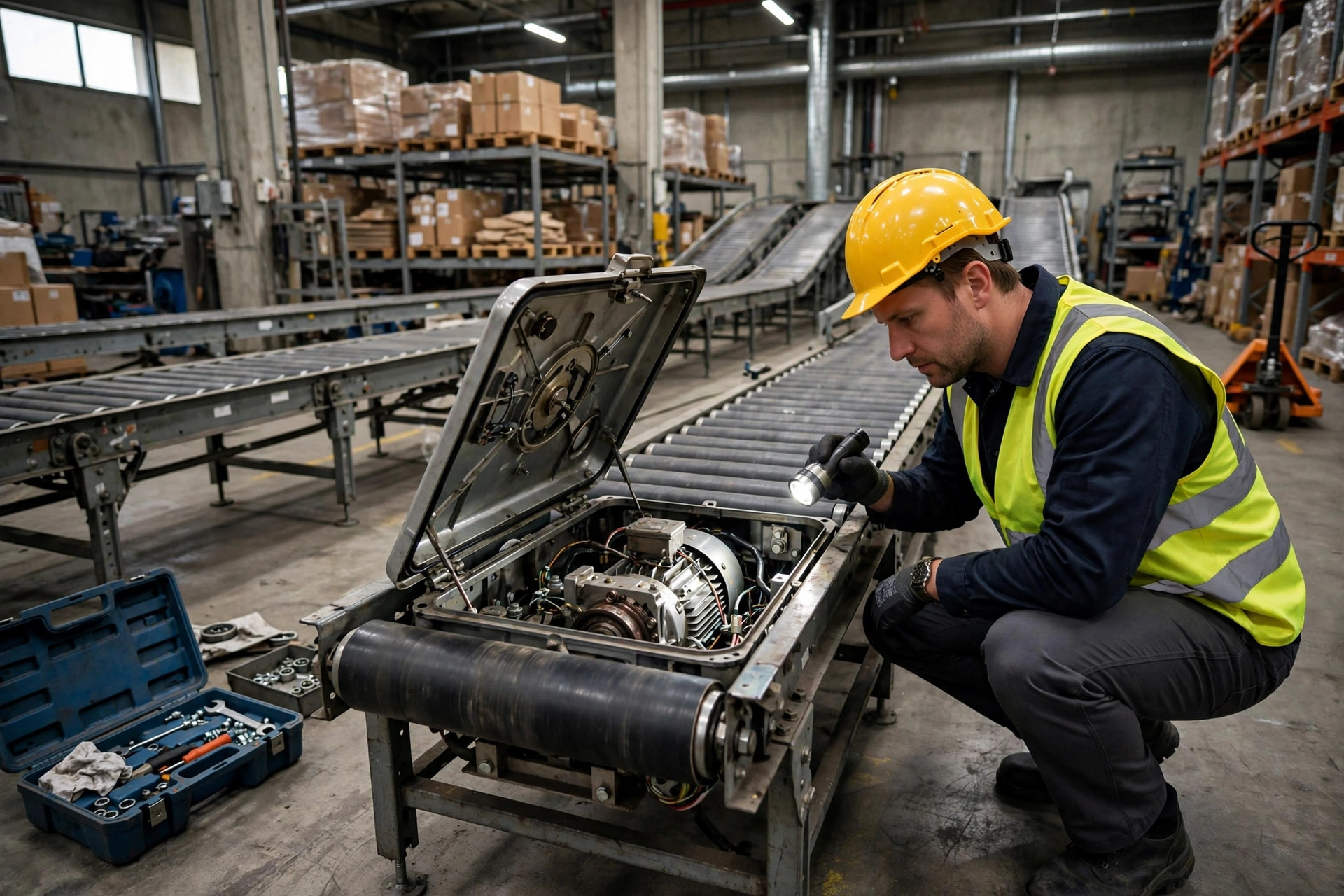
Wear item number one is the end effector: suction cups age, grippers wear, and they live on a cycle-count life. Replace on count, not when they start dropping cases — one dropped case and 20 minutes of line stoppage costs more than a box of suction cups. Number two is sensors; dust is the mortal enemy of photoelectric sensors, and in apparel or food DCs with heavy particulate, cleaning belongs on the inspection sheet. Number three is the vision system: the day the carton printer changes the logo position, the visual features shift, and you get a week of intermittent mis-picks while everyone hunts the cause.
Then the hidden one: pallet quality. Automated palletizing is brutally sensitive to pallet consistency. Recycled pallets with varying dimensions, missing nails, broken boards produce leaning stacks, and the stretch wrapper finishes the job by toppling them. Standardize your pallets before you automate the stacking — otherwise you're buying a robot and maintaining pallets.
On uptime: vendors talk 99% at purchase. In the field, holding above 97% means your maintenance is solid. The missing points split roughly in half — spare-parts lead time (6–8 weeks for imported parts is normal) and "someone who can actually tune it." People who understand both the line PLC and the robot are harder to hire than the equipment is to buy.
So whether the money is worth it comes down to one number: cost per case discharged.
Cost per case = (annual equipment depreciation + annual maintenance + annual energy + residual labor) ÷ annual cases discharged. Put it next to the all-manual cost per case. Lower, and it's worth it. Higher, and you've bought yourself anxiety. Don't talk to me about "looking high-tech" or "brand image" — a warehouse is a place where you do math, not a showroom.
By Da Liu, Automation Engineer