When people spec an AMR, nine out of ten obsess over navigation accuracy and payload, then go vague on the top docking module. Think of it this way: that's like buying a truck for its engine and ignoring the trailer hitch. An AMR's value isn't how fast it drives — it's what happens in the five seconds it hands off the load. Pick the wrong top module and your line will page you about jams every day.
Here's how I structure this: first the principles of all four module types, then the dividing lines for selection, and finally the maintenance traps.
The Four Modules, Principles First
1. Lift module: dive under and jack it up
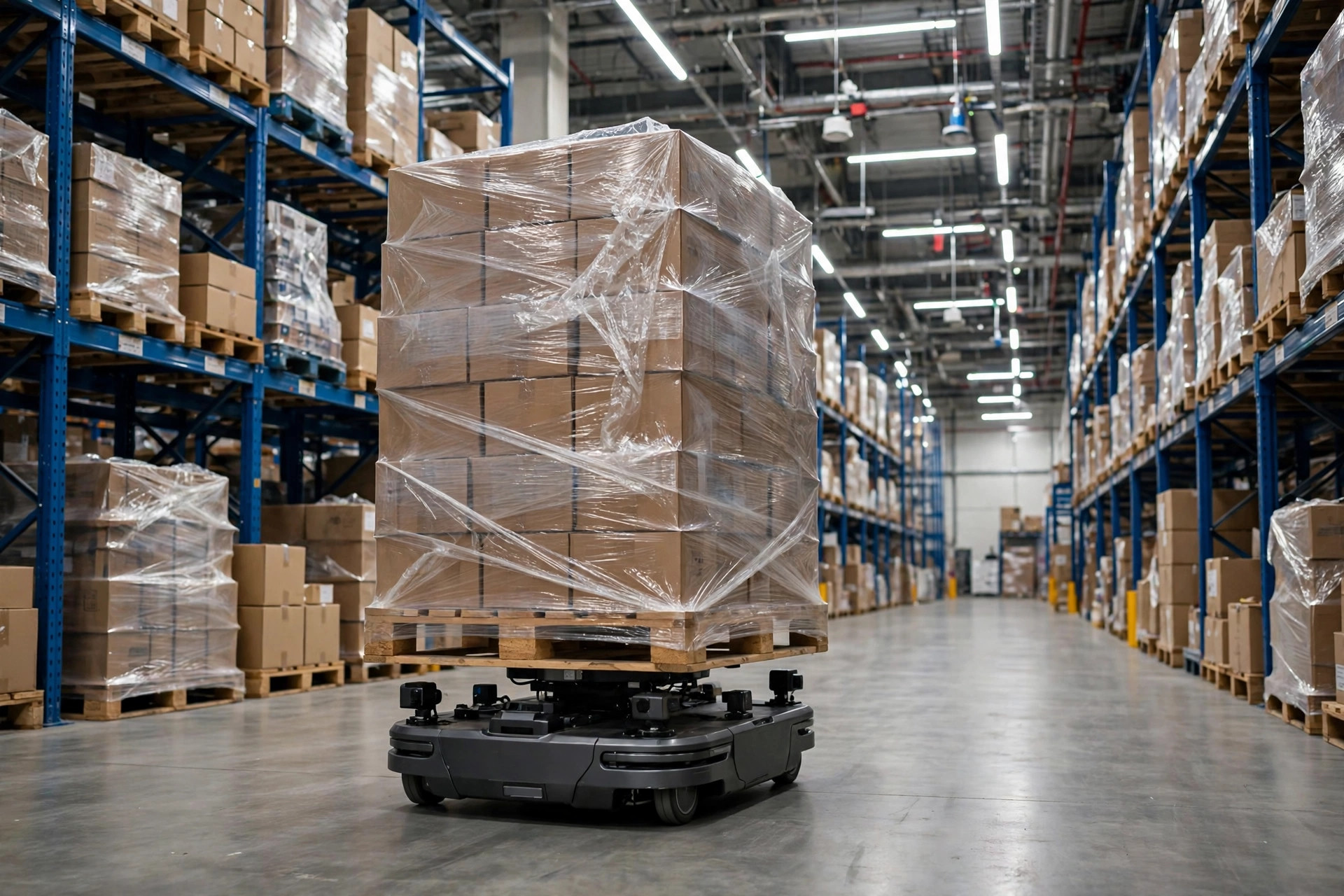
The idea is dead simple. The AMR drives underneath a cart or pallet, raises its top platform, and carries the whole load away. Think of a car jack.
What it docks with: carts and floor-level pallets. Note the wording — it docks with carriers, not with conveyor lines. Tolerance is generous: as long as the lift points land on the pallet feet or the cart's support beams, ±30mm of lateral error is fine. Cycle time goes into two moves — driving under and lifting — typically 15 to 25 seconds per dock.
The limits are real too. The carrier needs clearance underneath; a pallet sitting flat on the floor can't be lifted. And once raised, the load rides high, so hard stops risk throwing it — lift-type AMRs generally run a speed grade slower.
2. Roller module: let the box roll itself across
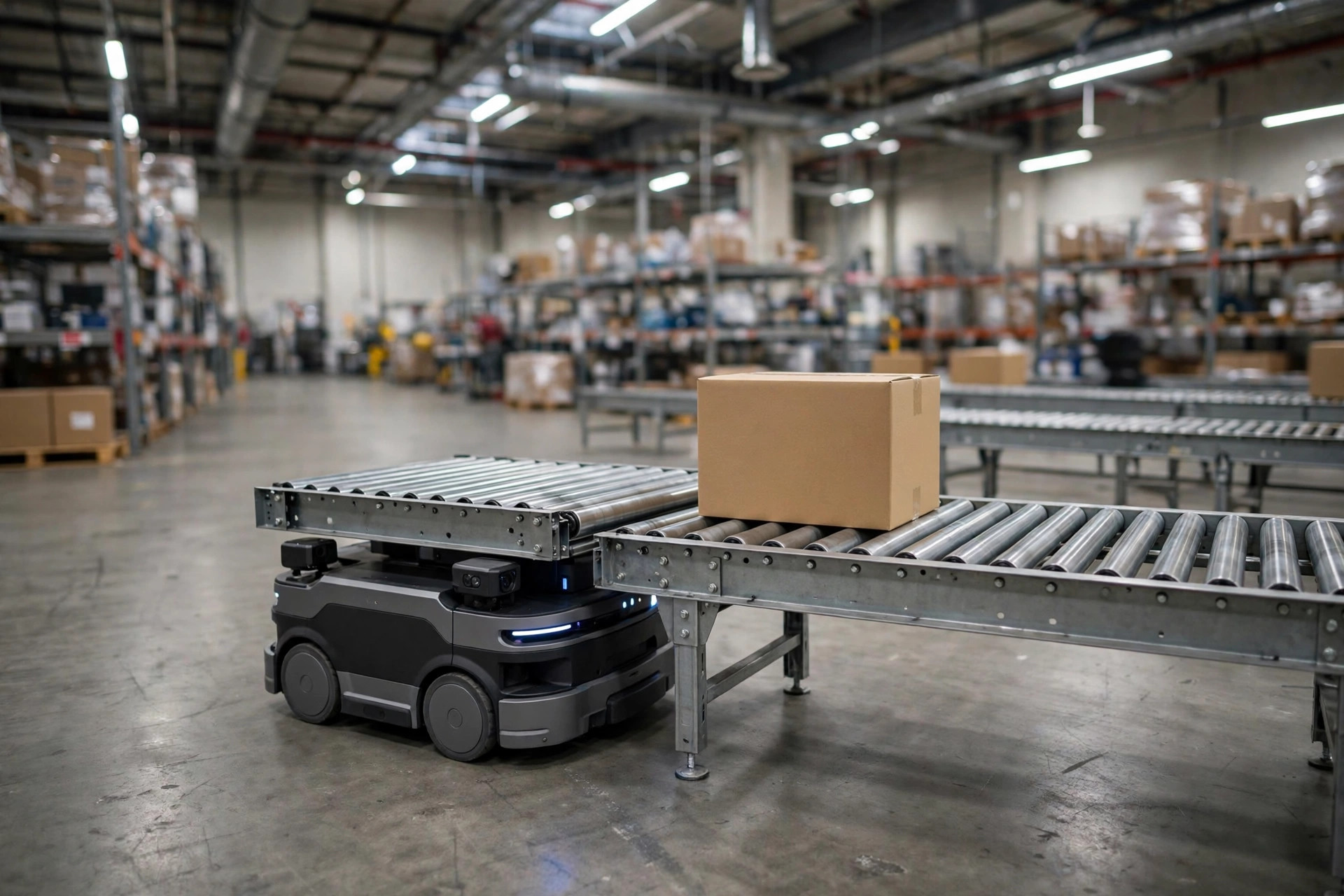
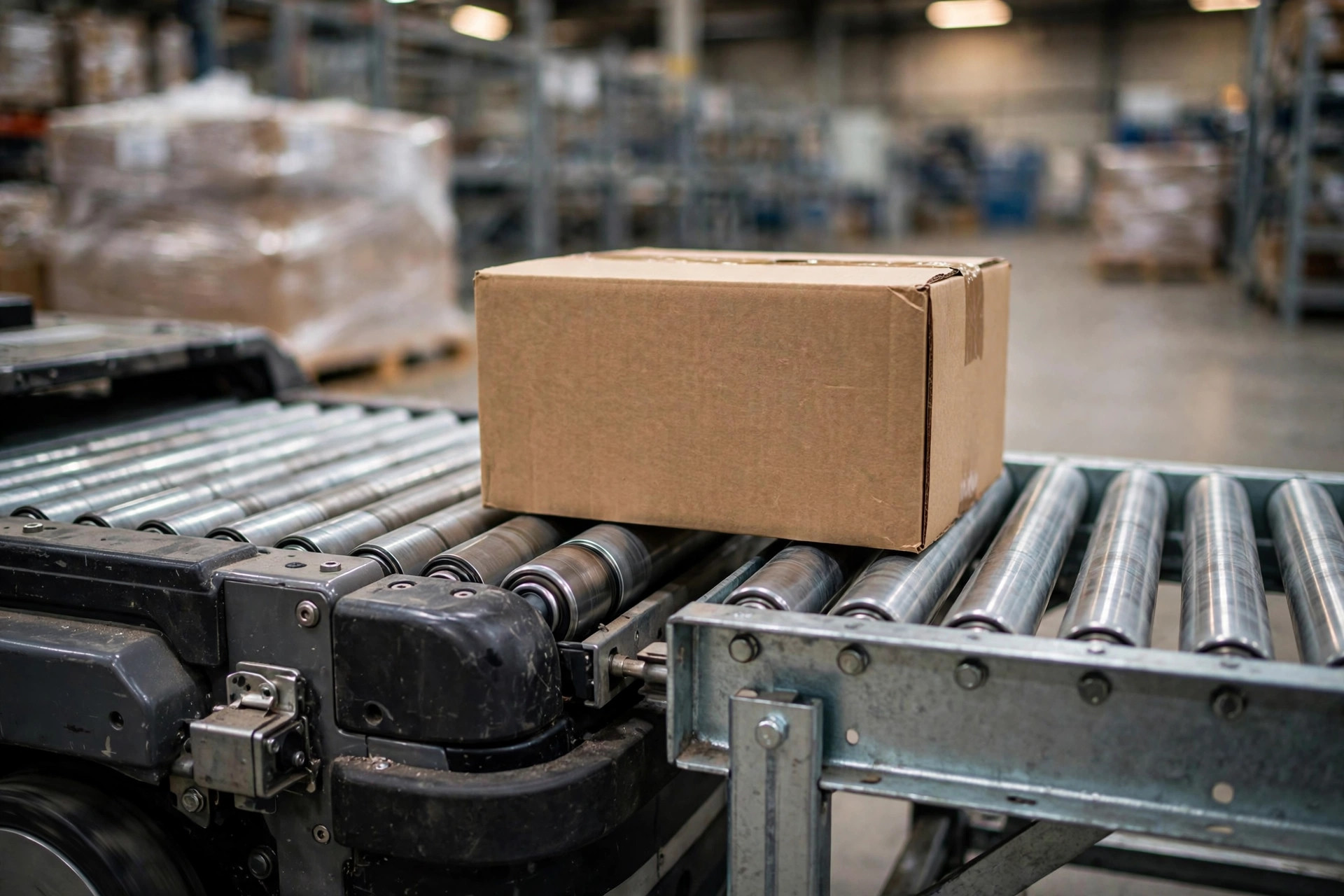
The AMR carries a short powered roller conveyor on top. It parks at the end of a fixed conveyor, both roller beds spin up, and the box rolls across. Everything depends on how clean that joint is.
What it docks with: roller or chain conveyor ends. This is one of the two most alignment-hungry options: height mismatch usually needs to stay within ±5mm, lateral within ±10mm, and more than about 1° of angular error will wedge a box in the gap. Cycle time is fast — 3 to 8 seconds per box — the choice for high-frequency handoffs.
There's a hidden gate, though: the load's underside has to be flat. A crushed carton bottom, a woven bag, or an odd-shaped part will slip or jam on rollers.
3. Belt module: roller's fancier cousin, and the one with the most traps
It docks with the same things rollers do: belt conveyor ends. Alignment demands are identical (±5mm on height). But it costs more: for the same payload class, a belt module runs 30% to 50% more than a roller module, and the belt is a consumable — expect to replace it every year or two.
Belt problems are chronic illness; roller problems are a broken bone. One real case: in 2024 a small-appliance factory in southern China got belt modules for "better carton compatibility." The cartons had a wax coating; as the belts wore they slipped and boxes piled up at the joint. The fix turned it into a belt-roller hybrid — they could have saved the 40% premium by starting with rollers.
4. Fork module: the AMR grows forklift arms
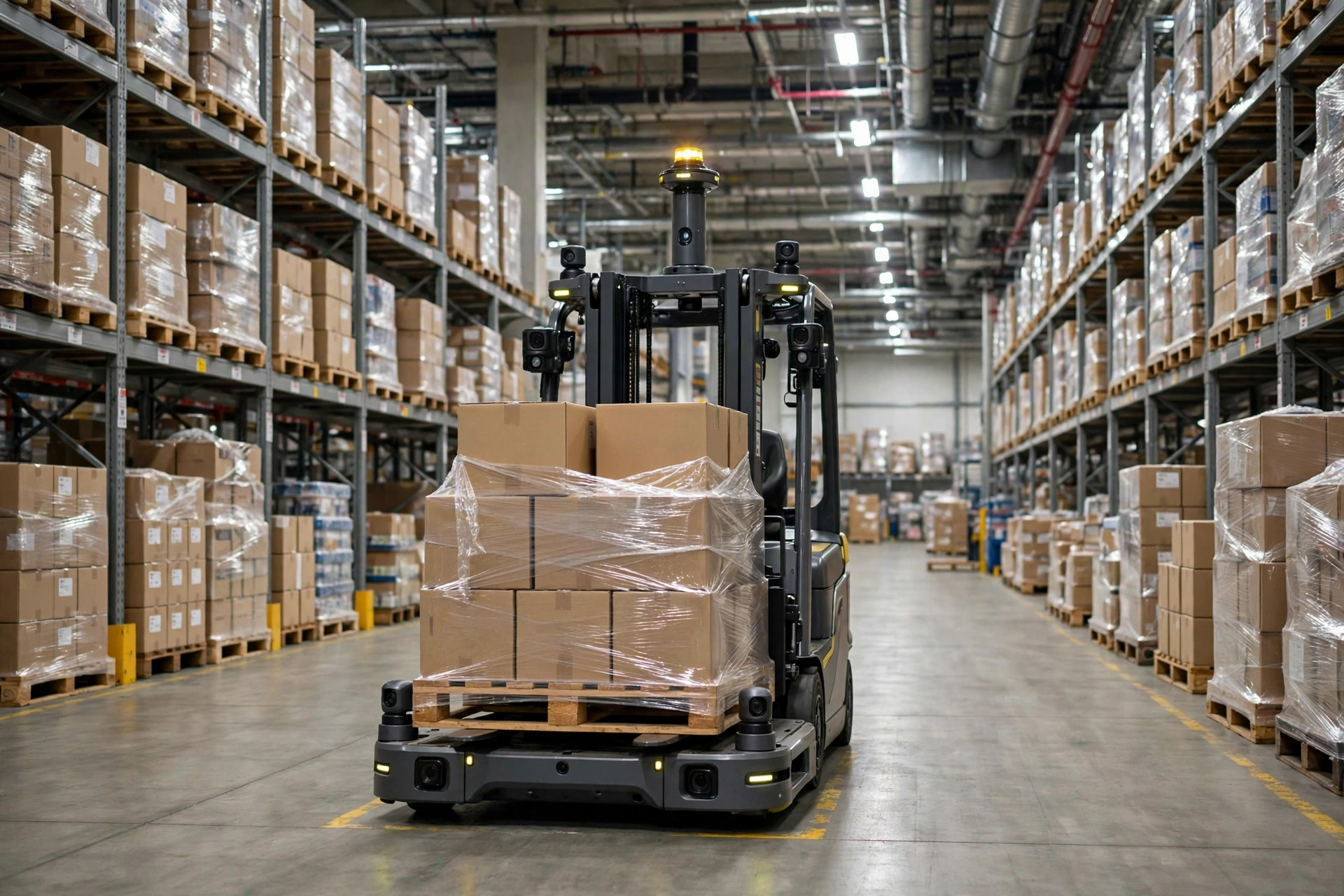
A pair of telescoping forks on top extends like a forklift's, pulling pallets off racking or placing them onto it. More capability, more complexity.
What it docks with: pallet racking (drive-in or selective) and floor-stacked pallets. Alignment demands are the highest of all four: the forks must thread the pallet's fork openings, so lateral error stays within ±15mm and height within ±10mm, or the forks spear the pallet. Cycle time is the slowest: extend, lift, retract, set down — 30 to 60 seconds.
The biggest trap with forks isn't accuracy. It's the racking. Beam heights, pallet opening dimensions, and pallet types (3-stringer, block, 9-foot) must match the fork parameters exactly. Mixed pallet types plus fork AMRs is gambling every shift.
The Selection Dividing Lines: Three Lines, Drawn Clearly
Line one: what are you docking with?
Docking with carts or pallet carriers → lift. Docking with conveyor ends → roller or belt. Picking and placing pallets on racking → fork. Cross it and you're buying a pseudo-requirement. I once saw an owner insist on roller AMRs docking with mesh-bottom carts — rollers physically couldn't transfer anything onto them. They added a lift transfer station in the middle: two modules' money for one lift module's job. I'm blunt about pseudo-requirements: that's not selection, that's paying tuition.
Sub-10-second handoffs, hundreds of docks a day → roller. Thirty seconds is fine, a few dozen docks a day → lift or fork. Belt matches roller's cycle time — pick it only for uneven-bottomed loads you won't repackage.
Don't look at single-dock time, look at effective docks per day. A roller dock at 8 seconds looks beautiful, but if the joint jams daily and each manual clear takes 5 minutes, ten jams a day destroy your effective cycle time.
Line three: can the heights and the interface actually meet?
This is where most projects die. An AMR's top module sits at a fixed height — say a 450mm deck — and your conveyor end must match it. In 2023 a 3C electronics plant in eastern China had conveyor ends at 470mm against a 450mm AMR deck; the 2cm step stopped every lightweight box cold. Shimming the deck up 2cm worked, but navigation calibration and load-center math had to be redone — two extra weeks.
The interface protocol is the other dark corner. The handshake signals between the AMR and the line PLC — "I'm here," "you can run," "the load crossed" — must be hardwired I/O or an agreed protocol, jointly tested before go-live. Never trust "we'll sort out the software later." Different vendors, mismatched protocols on site: expect a month of finger-pointing. The contract must name who defines the interface and reserve the joint commissioning weeks.
Four Modules Side by Side
| Lift | Roller | Belt | Fork | |
|---|---|---|---|---|
| Docks with | Carts / pallet carriers | Conveyor ends | Conveyor ends | Racking / floor pallets |
| Height tolerance | Generous (±30mm class) | Tight (±5mm) | Tight (±5mm) | Tight (±10mm) |
| Dock cycle | 15–25 sec | 3–8 sec | 3–8 sec | 30–60 sec |
| Module cost | Lowest | Mid | Highest (30–50% over roller) | Mid-high |
| Maintenance | Easy | Easy | Hard (belt is consumable) | Medium (fork slide wear) |
| Biggest weakness | Carrier needs underside clearance | Load bottom must be flat | Tracking/slip hard to diagnose | Pallet/rack specs must be uniform |
On the cost row: at the same 1-ton payload class, lift is cheapest, roller sits in the middle, belt runs three to five tenths above roller, and fork costs more than roller but less than belt. Exact numbers vary wildly by vendor — treat online reference prices as fiction. Every dollar shaved off the quote comes back as waiting time during commissioning.
Maintenance Traps: Three Things to Settle at Selection Time
First, put the consumables list in the contract. Belts, roller bearings, fork slide blocks — all consumables. Before signing, ask: belt compound, rated life in operating hours, spare-part price, lead time. Don't discover after a line stop that the belt ships from overseas with a multi-week lead time.
Second, the dock joint is the failure hotspot — leave service access. At every roller or belt joint, both sides need room for a hand to reach in and clear debris. I've seen joints designed perfectly flush, where a wedged carton corner couldn't be fished out without a pry bar — and every pry knocks the alignment off a little more.
Third, alignment drifts — scheduled rechecks are mandatory. After six months, tire wear and floor settlement shift dock heights. Roller and belt docks demanding ±5mm start jamming at 3mm of drift. The SOP needs a line: verify dock height monthly with gauge blocks or a laser measure. Lift and fork are more forgiving — quarterly is fine.
"Can one module do everything?" Technically yes — build a combo with lift plus rollers. But it has twice the failure points, costs 60%+ more, and when it breaks the whole vehicle is down. My call: segmenting the line with single-purpose modules beats one do-everything combo. Simple things don't break.
Whether the money was well spent comes down to one number: three months after go-live, what share of operating time is lost to unplanned stops at the docking points? Over 2% — the selection or the interface work was wrong. Under 0.5% — the money was well spent. Forget the ROI model. Watch that number. It doesn't lie.
By Da Liu, Automation Engineer