We had a client — small home appliances, exporting to the Indian subcontinent — who came to me last autumn with one question: can you get the transshipment warehousing cost down on the Colombo port warehouse logistics lane? His cargo sailed from Ningbo, split for India, Bangladesh and Pakistan, and the carrier's plan was to transship at Colombo, strip the boxes and re-stuff for three feeder services. Direct sailings in three separate bookings cost more in freight; the Colombo relay saved freight but added warehousing and re-handling, and by the time he added it all up, nothing was saved. I told him the maths doesn't live in the freight line. The transshipment warehouse quote hides far more than the freight does.
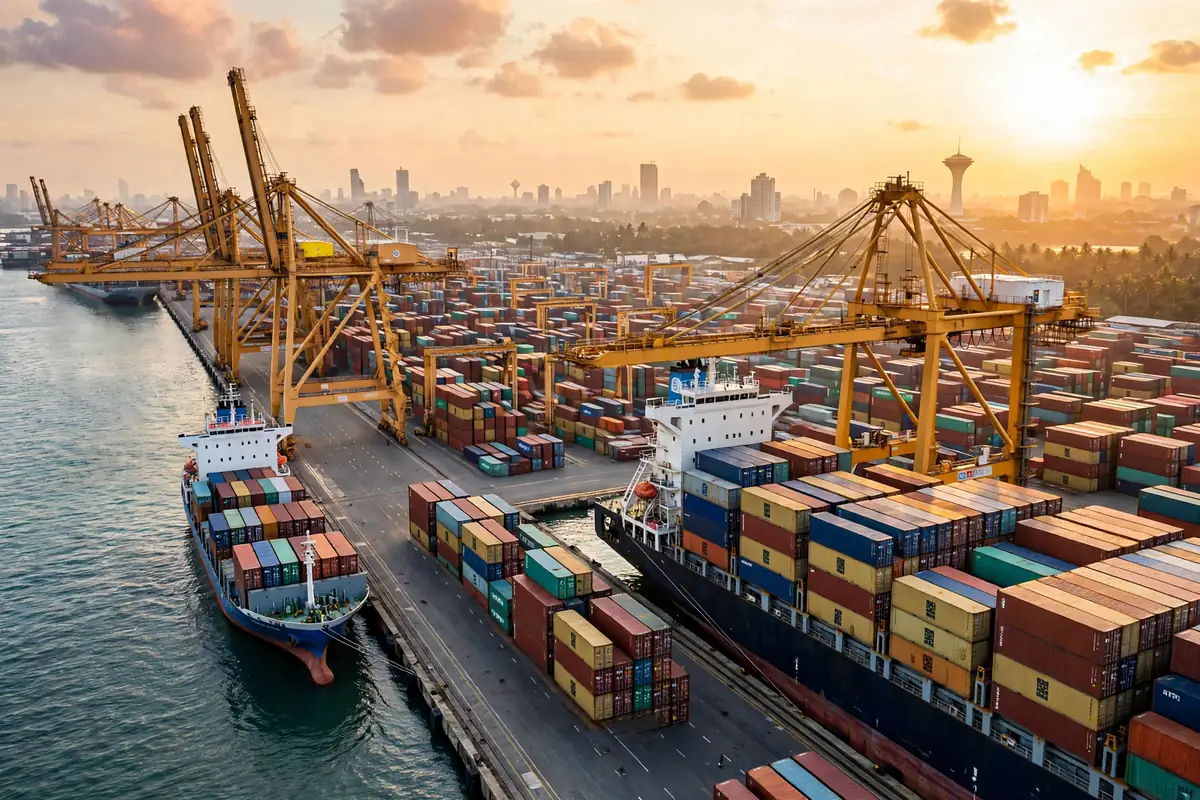
Most people hear "Colombo" and think of a Sri Lankan island port. People in our trade see it differently: it is the large transshipment port sitting closest to the Indian subcontinent in the Indian Ocean. The Sri Lanka Ports Authority reported a record 8.29 million TEU handled in 2025, up about 6.4% on 7.79 million TEU in 2024. The total is not the interesting number. The structure is: transshipment has run at roughly 80% of throughput for years — 6.31 million TEU in 2024, about 81%, and 5.52 million of 6.92 million TEU in the first ten months of 2025, close to 80%. A port whose own national import-export trade is barely over a million TEU sustains an 8-million-TEU business by acting as the relay station for everyone else. That is the first truth of the Colombo port warehouse logistics business: its warehouses serve the whole South Asian feeder market, not Sri Lanka.
When 80% of Boxes Are Transshipment, Colombo Port Warehousing Maths Changes
Here is the counter-intuitive part: at a transshipment hub, warehousing is not about floor space, it is about how fast boxes connect between vessels. An inland warehouse lives on space utilisation and pick rates. A relay warehouse lives on dwell time. The mainline vessel discharges, the feeder hasn't arrived, the box waits. The feeder arrives early, the mainline is late, the box still waits. One day of waiting is normal. Three days starts burning money. So when a client asks me whether Colombo storage is expensive, I ask back: how many days does your cargo sit in the port on average? Dwell days times the daily rate is the real cost. A cheap daily rate for ten days costs more than an expensive rate for two.
My appliance client's real story makes the point. His cargo reached Colombo in September 2025, the mainline on schedule, but the feeder to Bangladesh slipped four days because of congestion at Chittagong. Four 40-foot boxes sat in the terminal yard for four extra days, and the storage bill alone wiped out the freight he had saved. When we reviewed it, the problem wasn't the port, it was his own sailing plan: he had squeezed the feeder connections so tight that the relay buffer was only two days, so any single delay anywhere charged him storage. The fix was unglamorous and it worked: stretch the relay buffer to five days, let the cargo wait an extra sailing at Ningbo rather than gamble on the Colombo connection. Three months later his average transshipment dwell fell from six days to just over three, and the storage line of his bill was cut roughly in half.
The second thing to learn before you negotiate anything is how the four terminals divide the work. Colombo is not one terminal, it is four stitched together: the Sri Lanka Ports Authority's own Jaya Container Terminal and East Container Terminal, about 2.4 million TEU combined in 2024; the Colombo International Container Terminal, about 3.3 million TEU, the largest deep-water terminal in the port and the one that takes ultra-large container vessels; and South Asia Gateway Terminal, about 2.0 million TEU, focused on regional transshipment and feeder cargo. In April 2025 the West Container Terminal, backed by the Adani Group, started operations, adding fresh capacity, and the Ports Authority expects total port capacity to double to 15 million TEU by 2026. The number sounds impressive, but a buyer should read the other side of it: new capacity coming on stream means yard space and berth slots will not be as tight as they were in 2024, when Red Sea diversions around the Cape of Good Hope pushed transshipment up 9.7% and vessels queued for berths. When capacity loosens, your negotiating posture should change with it.
The Lines on the Colombo Port Quote Are Where the Profit Actually Leaks
Quoting logic is my home turf as a sales director. A Colombo transshipment warehouse quote usually arrives broken into pieces: discharge, storage, stripping, re-stuffing, feeder loading. The classic trap is comparing only the total. Two quotes differ by 8% on the total, you pick the cheaper one, then discover the cheaper one gives three free storage days while the expensive one gives seven. Your cargo averages four days in port, so the cheap quote charges you four extra days of storage and ends up costing more. I have seen that play too many times. Free storage days, the tiered overtime storage rates, and whether stripping is charged per box or per labour hour — those three lines matter ten times more than the total.
Here is the comparison framework I use when negotiating a Colombo transshipment contract. Ask every one of these, and you will rarely miss something big (figures are an illustrative scenario, not a quote):
| Item to compare | The wording to pin down | Illustrative scenario |
|---|---|---|
| Free storage period | How many days, weekends included? | 3 days vs 7 days can differ by tens of dollars per box per day |
| Overtime storage tiers | Rates for days 4–7, then day 8 onward | Tiered escalation is common; rates often double after day 7 |
| Stripping / stuffing basis | Per box, per tonne or per labour hour | Mixed cargo billed per labour hour can run away from you |
| Feeder connection commitment | Who bears the cost when the feeder slips | Only counts if it is written in the contract |
| Bonded / customs inspection | Who pays the shifting fee for inspection | Inspection is rare but expensive per occurrence |
Then there is the difference between the terminal yard and the off-port warehouse. The terminal yard sits next to the vessel, connects fast, and charges for it: expensive, short free period, and no value-added work. Off-port bonded and near-port warehouses are cheaper, and they can strip, sort, re-pack and re-label — but they add a shuttle move and a trucking charge. The choice depends on whether your cargo needs to be "touched". Pure relay, box untouched, belongs in the terminal yard. Cargo that needs splitting, re-packing or market-specific labelling belongs in the off-port warehouse. My appliance client ended up splitting exactly that way: straight relay boxes stayed inside the port, the three split consignments went to an off-port warehouse for secondary sorting, and the blended cost came in about 20% below his old all-in-port routing — an illustrative estimate, to be confirmed against real quotes.
A third story, a cautionary one. In early 2025 a building-materials client heard Colombo relay was cheap and routed cargo for India's east coast through Colombo too, because mainline services call there so often. The cargo arrived, but feeder sailings to India's east coast run only twice a week, the connection missed, and the boxes sat in port for nine days. Storage plus shuttle charges ate the freight saving and then some. That is the trade-off of the hub business: a hub's value is in feeding, not in being universal. Colombo feeds India's west coast, Bangladesh and Pakistan on the natural route; feeding India's east coast is a detour. No port is bigger than geography.
Next time you negotiate, ask three questions. One: how many free storage days, and how many tiers do the overtime rates have? Two: what is stripping charged on, and where in the contract does feeder-delay liability sit? Three: does my cargo actually need to be touched in an off-port warehouse, or is the terminal yard enough? Get those three answered and you will not bleed money on the quote for Colombo's relay business.
By Susan, 3PL Sales Director