
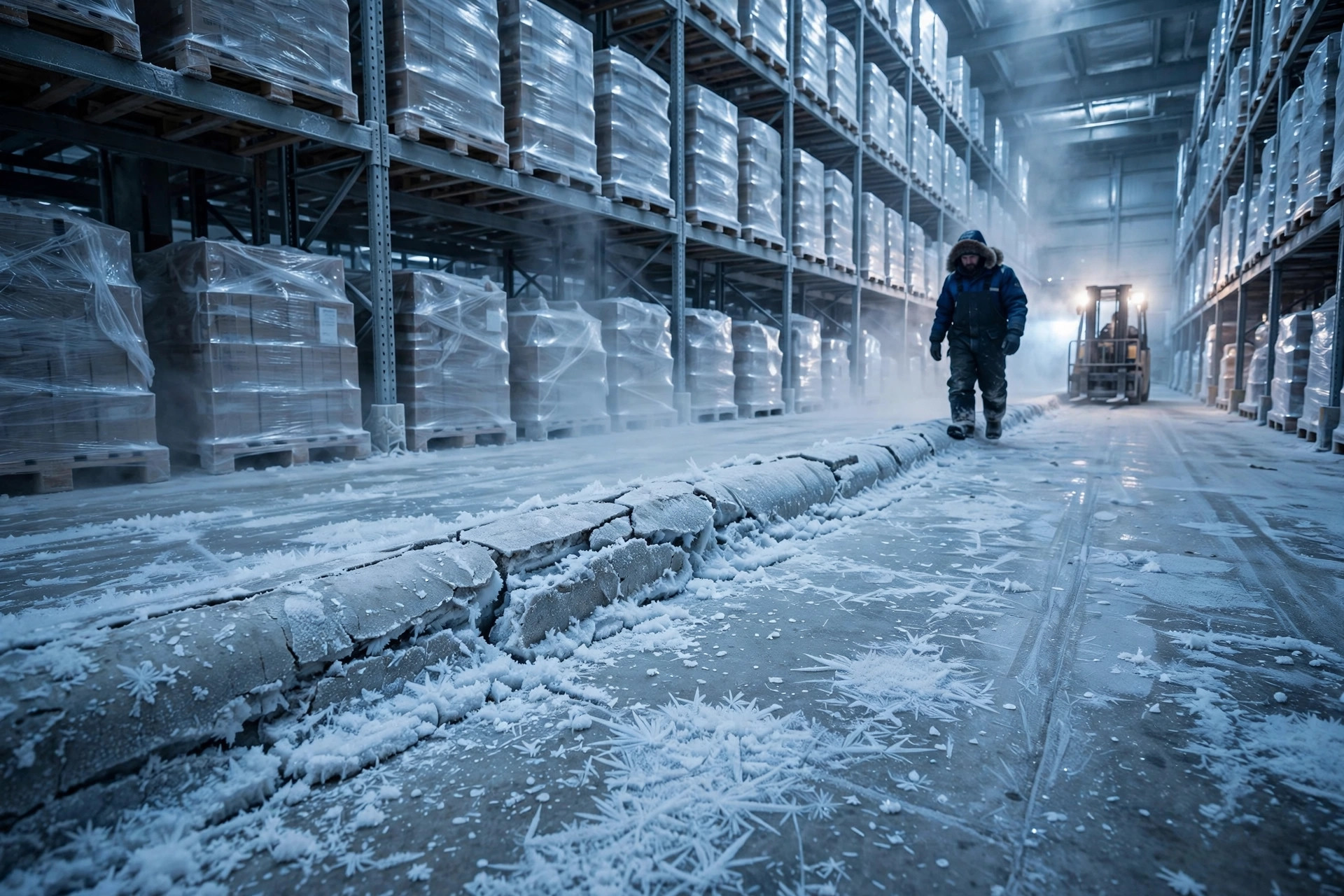
At 3 a.m., my night-shift forklift driver hit the brakes and waved me over to aisle C. 'Boss, come feel this — the floor grew a bump.' I crouched down and ran my hand across it: inside a minus-25 freezer, the concrete had risen into a ridge, a spine running from under the racking out into the middle of the aisle. That was cold storage floor frost heave — ice under the slab, pushing the ground up.
Listen, in all my years running cold storage, frost heave is the sneakiest problem I have seen. No leaks, no smoke. Just the floor rising a millimeter at a time, right under your nose. By the time the forklifts start bouncing, the bill is already big.
How Cold Storage Floor Frost Heave Starts
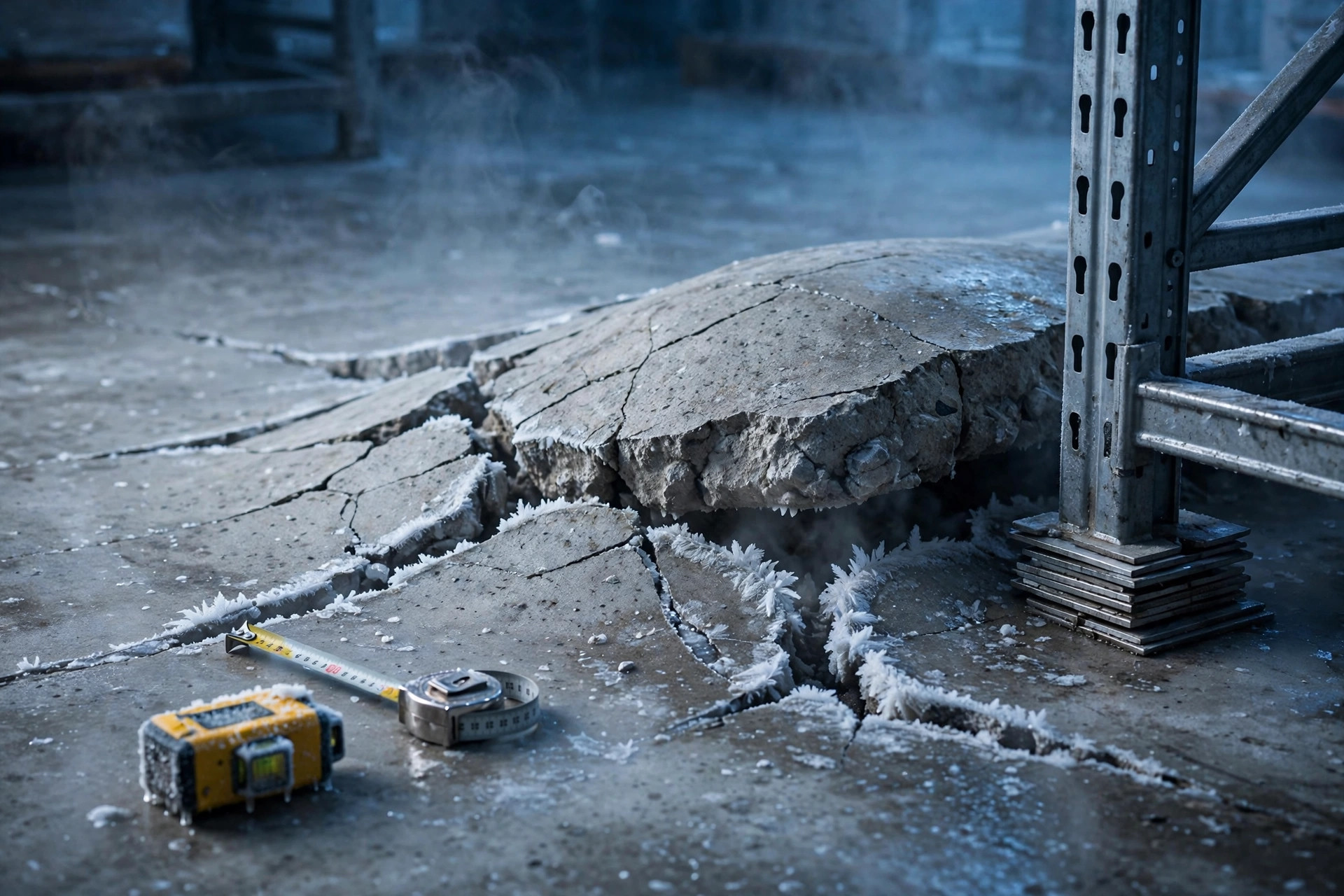
The mechanism is simple. Under a freezer floor you usually have the concrete slab, then insulation, then the subgrade soil. The cold — minus 25, day in and day out, 365 days a year — keeps drilling downward, through the concrete, through the insulation, into the soil. Soil holds moisture. Moisture freezes, ice takes up about 9 percent more volume than water, and an ice lens forms — shaped, the engineers say, like a flying saucer flipped upside down. It keeps growing, and it lifts the slab.
That is why every new freezer build has one non-negotiable rule: a heating system under the floor. Several types exist — static vent tubes, forced-air tubes, electric heat cables, or pipes running heated glycol. The goal is always the same: keep the subgrade soil above 0°C (32°F) so it never freezes. The rule of thumb the old hands taught me is that frost protection only takes about 10 to 12 watts per square meter — not a big load at all.
The trouble is that nobody watches the heating system. A pump dies, a pipe clogs, a temperature probe drifts, and nobody notices. The soil freezes, and the heave begins. And here is what a lot of people get wrong: frost heave has nothing to do with how cold the winter is outside. The cold source is your own freezer, and it runs all year.
The early warning signs are four: cracks in the floor, a change in the floor grade, racking starting to lean, forklifts bouncing as they drive. If you see two of those, get the laser level out.
When My Neighbor's Warehouse Lost Half a Year to It
In January 2023, a buddy of mine — Lao Zhang — called me from his rented freezer outside Chicago, voice shaking. 'Get over here. I think we had an earthquake.'
One whole aisle had heaved; at the worst spot the floor was up nearly 10 centimeters, a little mountain ridge. The rack uprights had tilted with it, and two beams had popped out of their clips. The story: the building had been converted from ambient to freezer, and to save money on the retrofit, they had skipped the underfloor heating entirely — insulation laid straight over the old slab, new concrete poured, refrigeration switched on.
The cleanup took three steps. First, empty the building. Frozen product cannot break the cold chain, so he rented reefer trucks as a buffer and parked the inventory at a third-party cold store. Second, demolish. The heaved sections were broken out and the frozen soil dug out and recompacted. Third, rebuild — new insulation, glycol heating pipes buried underneath, new concrete, curing time.
Nearly six months, start to finish. Lao Zhang told me later that the construction bill hurt, but what really stung was the half year of chaos: rent still due, product sitting in someone else's warehouse, reefer trucks running back and forth. His words: 'If I had buried those heating pipes during the retrofit, it would have cost a fraction of this.'
We Tried the Cheap Fix First. It Didn't Hold.
Our turn came in the summer of 2024. During a routine walk-through I found a spot in Zone B heaved about 3 centimeters. Peak season — no way we could do surgery. So we went cheap: shimmed the rack uprights, ground the floor flat. A few thousand dollars, one weekend, done. Everybody figured that was the end of it.
Six months later the same spot was up 5 centimeters, and the shims were nearly maxed out. No choice left: break it out. We moved everything off that section, tore up the slab, and sure enough, there was the ice lens sitting in the frozen soil. While we were in there, we buried glycol heating pipes and repoured the floor.
I ran the numbers with our finance guy afterward. The first grind-and-shim job was a few thousand dollars. The breakout and rebuild was in the hundreds of thousands. Honest truth: that first few thousand was tuition. With frost heave, money spent on symptoms is money thrown away.
Cold Storage Floor Frost Heave: Three Ways to Fix It, and What Each Costs
There are really only three ways to deal with it. Here is the table I show people — order-of-magnitude numbers; they move with area and local labor rates:
| Approach | What you do | Cost (order of magnitude) | Downtime? | Result |
|---|---|---|---|---|
| Shim and grind | Shim the rack uprights, grind the floor level | A few thousand to low tens of thousands of dollars | None | Buys you months to a year; it comes back |
| Local breakout and repour | Break out the heaved section, treat the frozen soil, repour — and bury heating pipes while you are in there | Hundreds of thousands of dollars | That section must be emptied | That section fixed for good |
| Full rebuild with underfloor heating | Redo the whole zone with a complete heating system | Over a million dollars | Major shutdown, inventory relocated | Fixed for good |
Look at that table and you will see the real lesson: the biggest cost of floor repair is never the concrete. It is the downtime. Shut down a freezer and the product has to move — refrigerated transport, rented space at someone else's cold store. That bill routinely runs bigger than the construction itself. In Lao Zhang's case, construction cost versus the indirect chaos was roughly thirty-seventy.
And here is the counterintuitive part: burying heating pipes in a new build is the cheapest money in the entire table. Frost protection needs only 10 to 12 watts per square meter; in a new facility the pipe grid, pumps, and controls are a rounding error in the total budget. But do it as a retrofit and you are breaking concrete, moving inventory, shutting down — tens of times more expensive. The most expensive option is actually the cheapest one, as long as you do it on day one.
How We Handle Floor Frost Heave Now
After getting burned, we made it a fixed routine. Every fall, before winter, we walk every aisle with a laser level, shoot elevations, and compare against last year's numbers. Anything up more than 2 centimeters gets flagged red and remeasured the next month.
The decision framework is three levels, dead simple:
- Under 2 cm and growing slowly: watch it closely, and first check the heating system — is the pump running, glycol temperature right, probes reading true?
- 2 to 5 cm: local fix, and give the whole heating system a full inspection while you are at it.
- Over 5 cm, or the racking is already deformed: don't hesitate, break it out and redo it. Waiting only lets the ice lens grow. And when summer comes and the ice melts, the buckled concrete and shifted racking don't go back. They never go back.
One more hard rule: before signing any lease or new-build contract for freezer space, ask one question — is there a heating system under the floor, what type, and who maintains it? Skip that question and the frost heave bill will find you sooner or later.
Listen, with cold storage floor frost heave, the question was never whether you would pay. It is when, and how much. The pipe you skip on day one, the ground collects later — with interest. Every fall, walk the aisles with a level. It takes half a morning. Don't wait until the forklifts are bouncing — by then, the bill is already big.
By Chen Feng, Warehouse Operations Manager




