Last summer, a friend who distributes frozen food sent me his July power bill. One month of electricity cost more than two months of his labor payroll — and that is not a typo. He asked whether the utility company had made a mistake. I had him send the full bill, asked what was sitting in his compressor room, and told him: the bill is correct. Your cold storage electricity bill was decided the day you bought that refrigeration system.
In this business, electricity is the number one operating cost, no contest. Getting that bill down is 70% equipment selection and 30% operation — buy the wrong system, and every parameter tweak afterward is window dressing.
Where Your Cold Storage Electricity Bill Actually Goes
A refrigeration system does one beautifully simple job: it hauls heat out of the building. Think of it as a giant water pump — the higher the lift, the more power it burns. In refrigeration, the temperature difference between inside and outside is the "lift" — bigger delta, more electricity per unit of heat moved.
Here is where the power goes, in order:
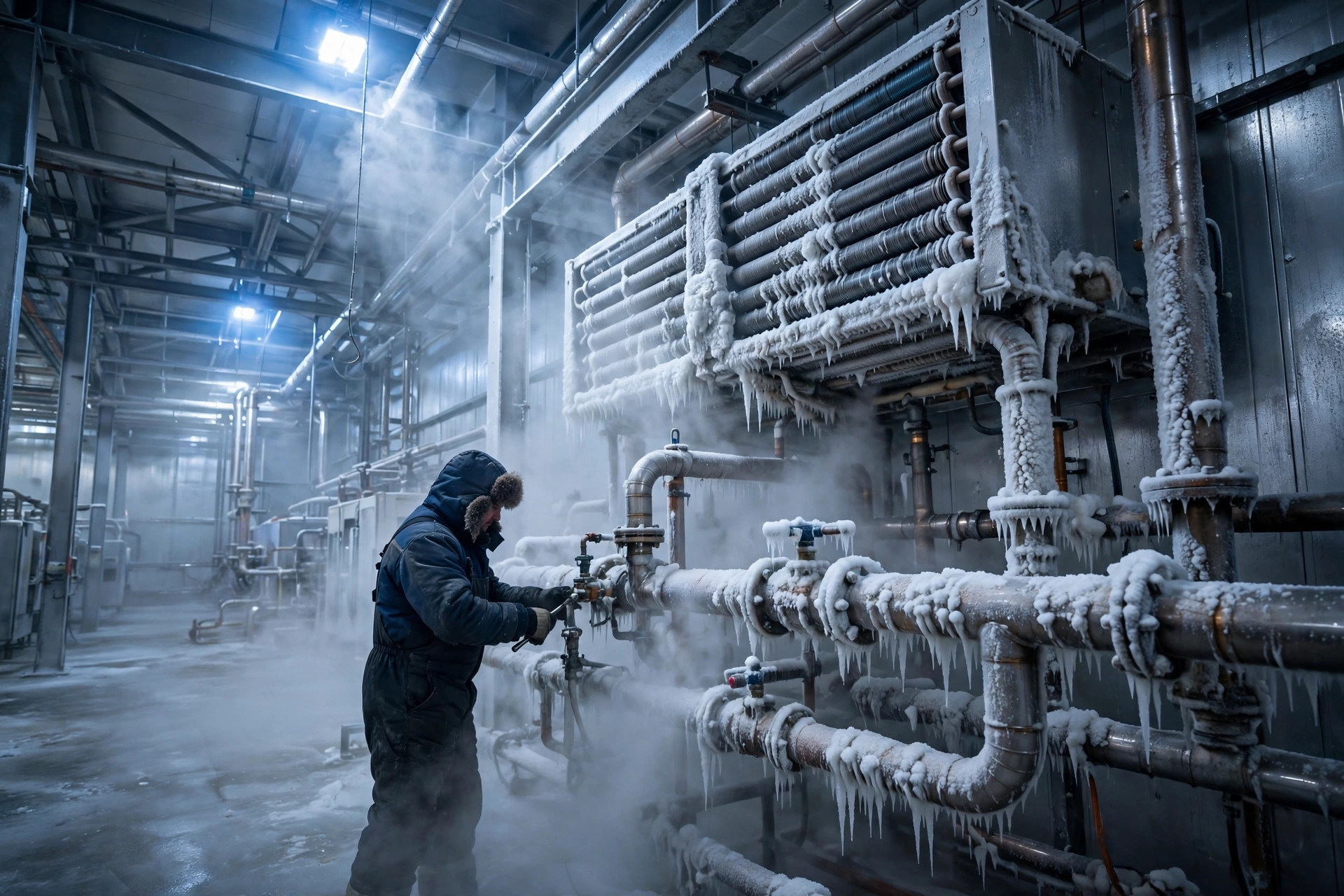
The compressor is the undisputed hog, typically 70–80% of the whole refrigeration system's electricity use. The rest goes to evaporator and condenser fans, electric defrost (which is literally burning electricity to melt frost — the most wasteful kind), plus lighting, forklift charging, and miscellaneous loads.
The efficiency metric is COP: how many units of "cold" you get per unit of electricity. A low-temp freezer room (around -25°C) typically runs at a COP of only 2–3; a medium-temp chiller (0–4°C) can reach 3–4. Memorize this: compressor power ≈ cooling load ÷ COP. Two levers exist, and only two: move less heat (cut the load), or move it more efficiently (raise the COP). Every energy-saving trick below works on one of these two.
Ammonia vs. CO₂ vs. HFCs: Where the Energy-Saving Line Is
Bottom line first: no refrigerant is "best" — only "best for which scenario." Rant time: any salesperson who tells you "ammonia is the most efficient so you must go ammonia" should read this table first.
| Ammonia (R717) | CO₂ (R744) | HFCs (e.g., R404A) | |
|---|---|---|---|
| Efficiency | Highest; lowest power per unit of cooling | Good at low temps; drops in hot climates | Mid-range; degrades as old systems age |
| Upfront cost | High (machinery-room safety investment) | Medium-high (high-pressure components) | Low (simple systems) |
| O&M bar | High: toxic, needs licensed operators | Medium: high pressures, strict piping | Low: technicians everywhere |
| Regulatory risk | Low (zero GWP) | Low (zero GWP) | High: phased down under EU F-gas and the US AIM Act; every recharge costs more than the last |
| Best fit | Large low-temp warehouses (-25°C and below) | Medium-temp chill, projects with strict environmental requirements | Keep old systems running; not recommended for new builds |
Ammonia has the best thermodynamic properties — least electricity per unit of cooling, zero GWP. But it is toxic: the machinery room needs code-compliant safety investment, plus licensed operators on staff. CO₂ is also zero-GWP; its transcritical cycle performs well at low temperatures, but once ambient temperatures climb past the mid-30s°C, efficiency sags — you need "bolt-ons" like adiabatic condensers and parallel compression to close the gap. HFC systems are the easiest to live with, but their high GWP puts them on a legislated phase-down path; leak once, recharge once, and the refrigerant only gets pricier.
How do I draw the line? Three numbers: scale, temperature, climate. A frozen-food warehouse with several thousand pallet positions at -25°C — go ammonia with your eyes closed; the electricity savings pay back the extra investment in a few years. A mid-size medium-temp chiller — CO₂ is the more balanced pick. An old HFC system that still runs fine — don't rush to replace it, but specifying R404A for a new build today is willful negligence.
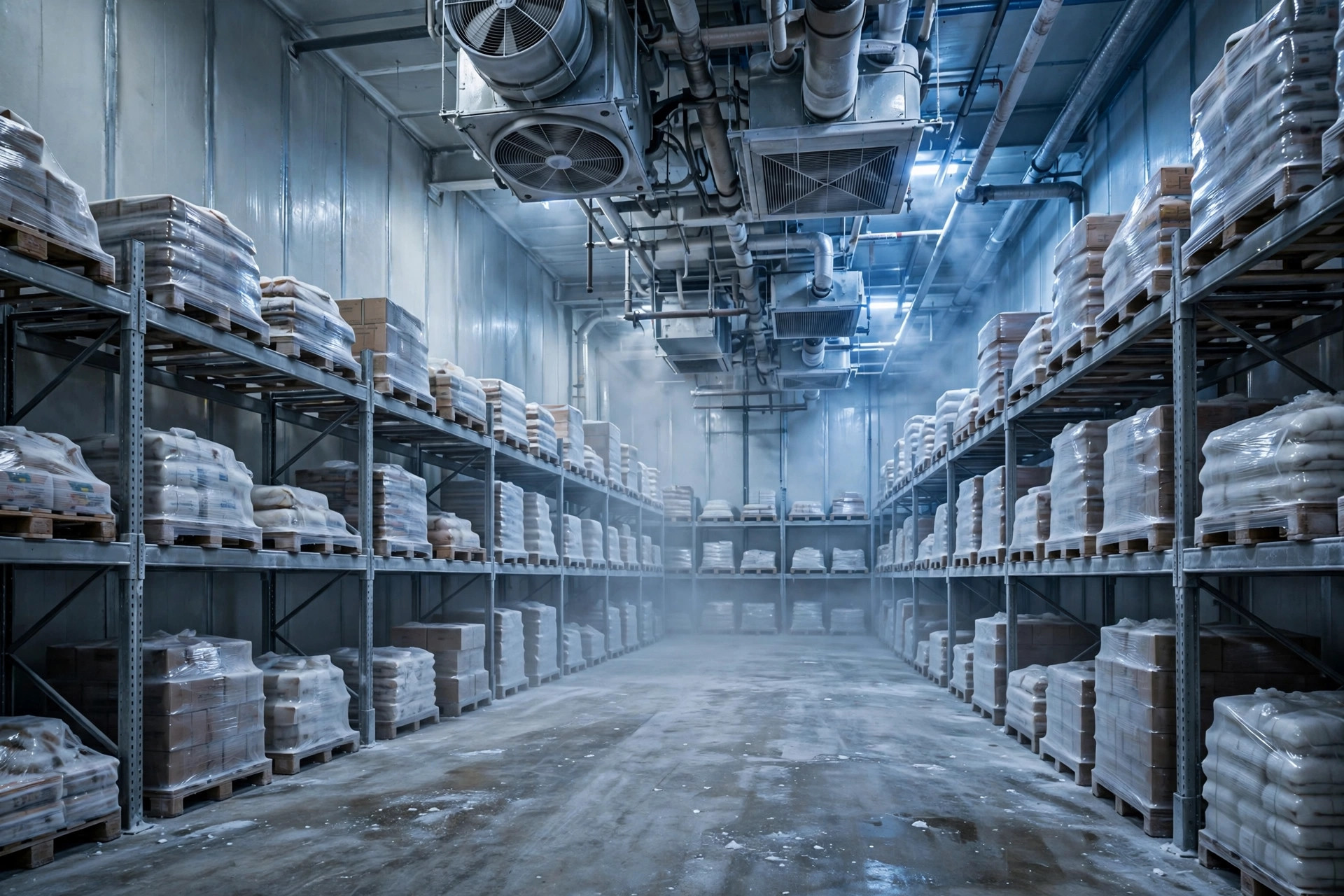
In 2019 I worked on a frozen 3PL in the western US: 8,000-plus pallet positions at -25°C, still running old fixed-speed R404A screw compressors, with summer power bills that made the owner wince. The retrofit: an ammonia system, VFDs on the compressors, and floating head-pressure control. By the owner's own finance numbers (I did not independently audit them, so take them as claimed): refrigeration power consumption dropped roughly 30%, and the retrofit paid for itself in under four years. Big freezer plus ammonia is the classic "buy expensive, run cheap."
Here is the counterintuitive part: the most energy-efficient equipment is not necessarily the cheapest choice. Two years ago, the owner of a 500-pallet chiller asked about going ammonia "once and for all." A ten-year total cost — machinery-room safety upgrades, licensed labor, inspections — showed the electricity savings never covered it. For a small facility, energy saving is an engineering calculation; saving money is a business calculation. Anyone who talks COP without talking scale is selling you something.
Refrigeration Settings That Cut Electricity Cost Without New Equipment
The equipment is fixed, but the operating strategy can still squeeze out real power — no new compressor required:
Floating head pressure. Plenty of older systems hold condensing pressure at one fixed setpoint all year. On a cool winter night, the compressor is still "lifting" as if it were a 35°C summer afternoon — pure waste. Switch to floating control that follows ambient temperature, the lift shrinks, and the electricity savings show up immediately.
Variable-frequency drives. A cold store runs at full load only a tiny fraction of the year; most of the time the compressor is a big engine pulling a small cart. VFDs let it slow down to match the actual load, and part-load efficiency gains are substantial.
Defrost. Frost is a down jacket on your evaporator — a few millimeters and heat-transfer efficiency visibly tanks. Electric defrost burns money; switch to hot-gas defrost where you can, and tune cycles to actual frost buildup instead of gut feel.
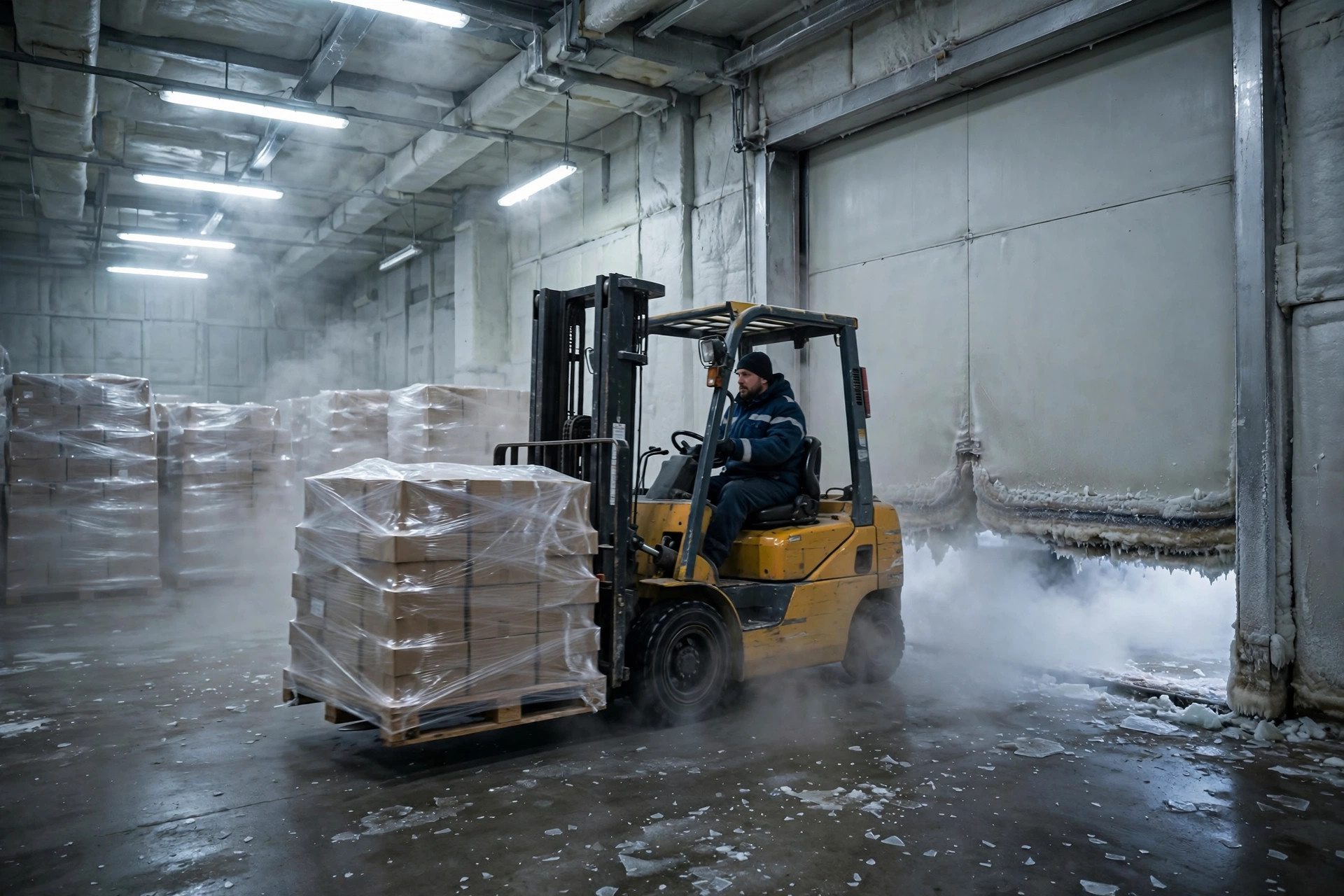
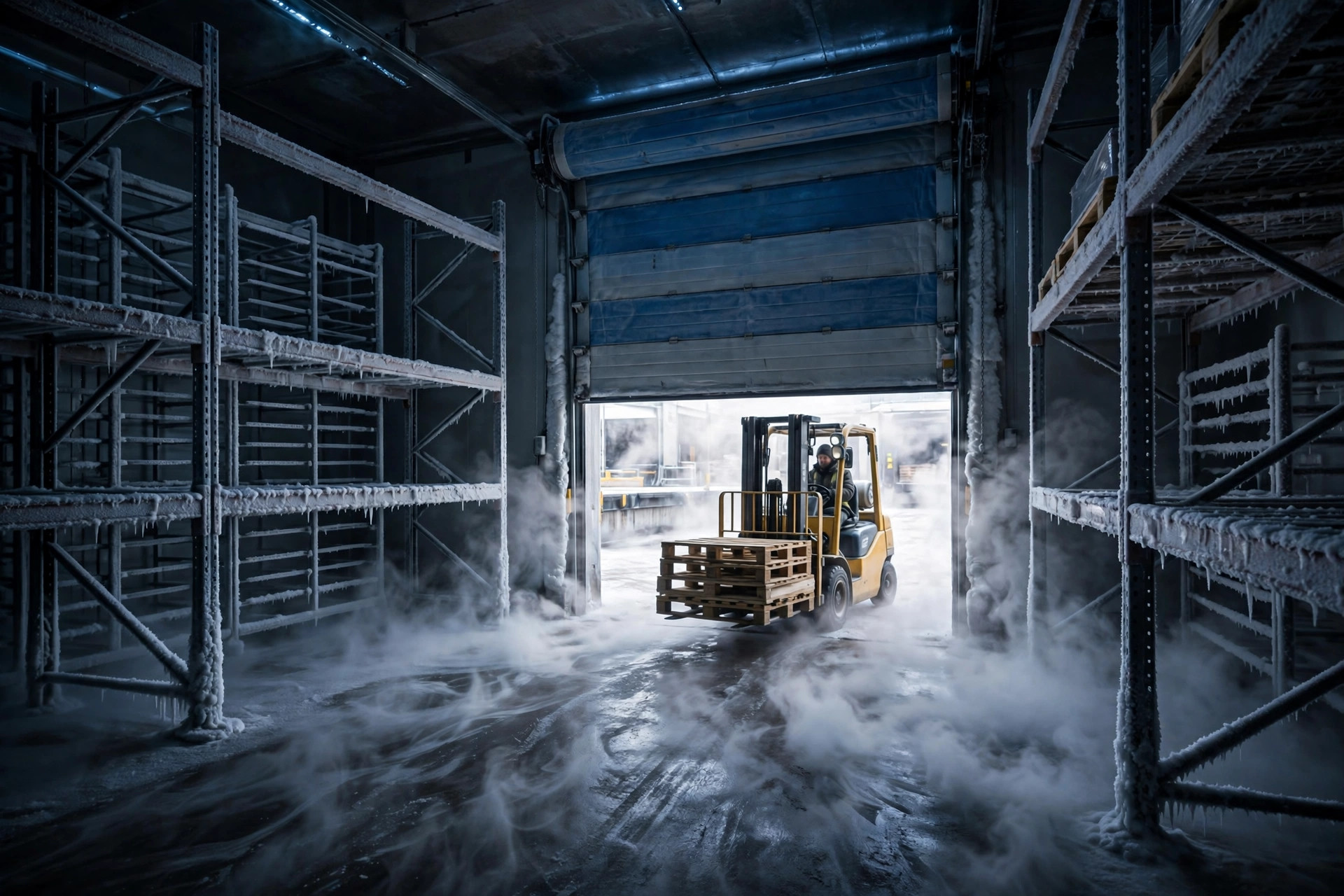
Doors. Every door opening floods the room with warm air, and the compressor grinds an extra half hour to pull the temperature back down. Door seals, air curtains, and high-speed roll-up doors are the cheapest energy retrofit in the entire building. In 2023 I visited an e-grocery fulfillment center (0–4°C, about 1,500 pallets, CO₂ transcritical) with stubbornly high summer bills. The survey found: condenser coils choked with dust, dock-door gaskets you could slide a finger through, and a permanent sheet of ice by the door — warm air pouring in. Clean the coils, replace the gaskets, add high-speed doors, re-tune defrost: the next month's bill dropped about 10%. Not one compressor was replaced.
Maintenance: How Electricity Quietly Leaks Out
Most refrigeration electricity is not "used." It leaks:
Dirty condensers are the most common leak. Poor heat rejection pushes condensing pressure up, the compressor's lift grows, and power follows. It is like making someone run a fever in a winter coat. Condenser cleaning belongs on the monthly maintenance list, not on the "we'll deal with it when summer hits" list.
Slow refrigerant leaks. Low charge means fewer hands on the job — the same work takes longer. Scheduled leak checks are cheap insurance.
Room temperature setpoints. If -18°C does the job, don't run -22°C. The industry rule of thumb: every 1°C lower costs roughly a few percent more energy. -18°C is the standard for frozen storage; every degree below that is bought with electricity. Ask yourself whether it is worth it.
Blocked airflow. Pallets crammed against the evaporator discharge kill air circulation, hot spots force the system to overwork, and power burns for nothing. Airflow layout is a design decision — don't undo it with sloppy stacking in operations.
The math: annual savings = annual kWh × electricity rate × savings rate; payback years = retrofit cost ÷ annual savings. A mid-size cold store's annual power bill easily reaches the hundreds of thousands of dollars (US) or over a million RMB (China) in magnitude terms — shave even 10% off that and it is real money. Conversely, anyone pitching you an "energy retrofit" who won't show you the payback calculation can be shown the door.
Is the money worth it? Watch this one number: refrigeration electricity cost per pallet position per year. Calculate it, benchmark it against peers and retrofit proposals. If yours runs high, your system is leaking electricity. One thing you can do tomorrow: walk into the machinery room and look at the condensing-pressure setpoint. If it is the same number all year round, at least ten percent of this month's bill was money burned for nothing.
By Da Liu, Automation Engineer