Have you ever actually counted how many times your freezer door opens in a single day?
Not a guess — a real count, clipboard in hand. In twenty years working warehouses across the US, I've asked dozens of cold storage managers that question, and most of them can't answer it. Everyone treats the door swinging open and shut as background noise, assuming the refrigeration system will always catch up. Then the power bill lands on someone's desk, or an auditor asks for the temperature logs, and that door turns out to be the most expensive piece of "equipment" in the building.
Here's some math that isn't mine. The University of Wisconsin's Industrial Refrigeration Consortium ran a parametric study on dock refrigeration loads: a 10-by-9-foot truck bay door, dock at 35°F, ambient at 91°F, standing open with no protection — every minute costs roughly 1.1 ton-hours of refrigeration load pouring in. And that's a dock door. Put subzero air on one side and a summer heat wave on the other, and the number only gets uglier. A busy facility cycling that door a few hundred times a day, thirty seconds to a couple of minutes each time, can easily pile up hours of cumulative open time. For hours every day, your compressors are air-conditioning the outdoors.
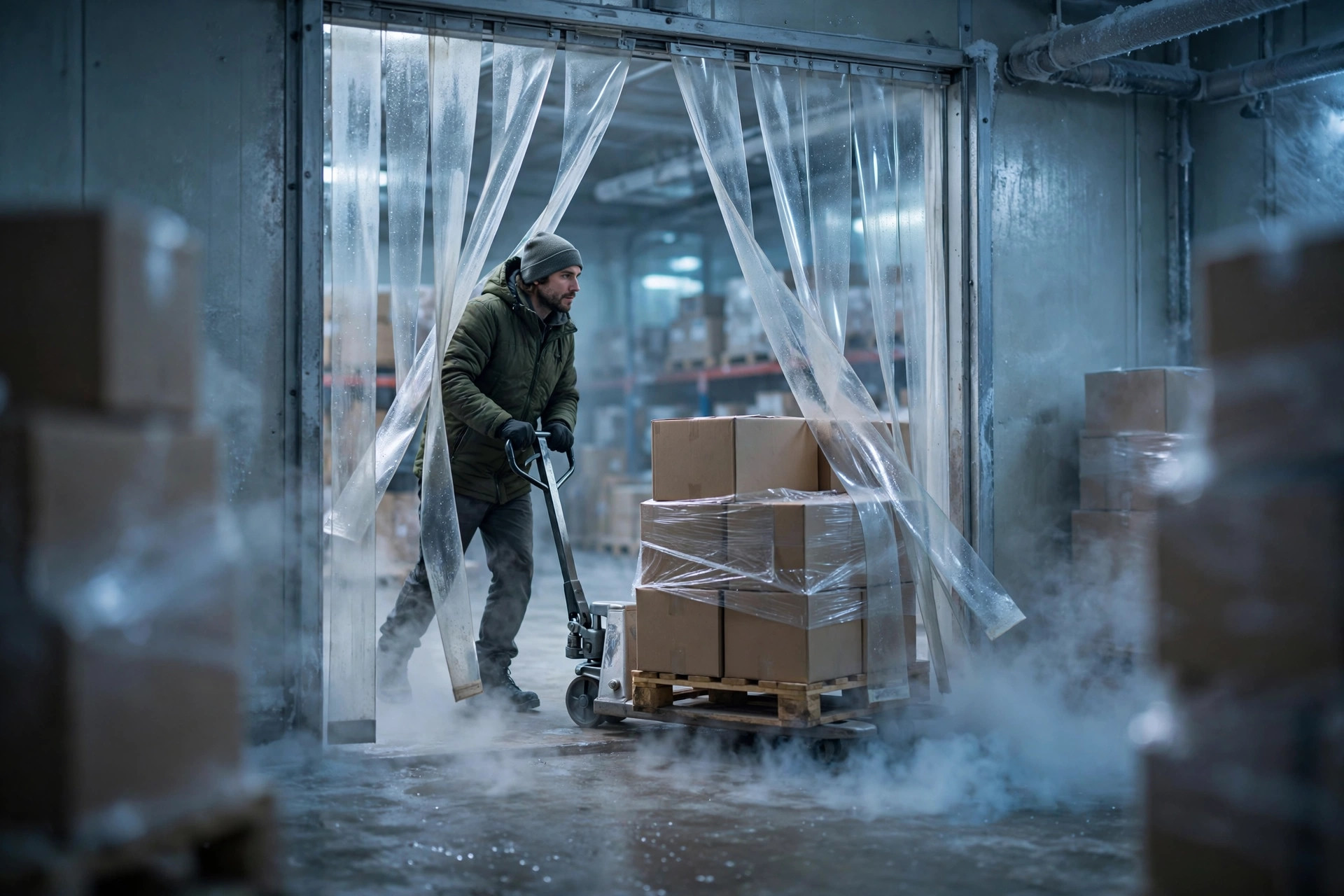
What happens when the door opens isn't just cold air "leaking out." Cold air is dense — it spills out along the bottom half of the doorway while warm, humid air rushes in across the top. That's air exchange, not a leak, and the incoming air brings two loads with it. The first is sensible heat, the temperature rise you can read on a thermometer. The second is latent heat: moisture that freezes onto every cold surface it touches. Frost is the quiet killer in this story. It cakes onto evaporator coils, strangles heat transfer, forces defrost cycles closer together — and every defrost is itself a warming event. I've watched managers stare at temperature curves, convinced their compressors were dying, when the real problem was standing in the doorway the whole time.
I remember a food processor in eastern Ohio: a 20,000-square-foot freezer holding -5°F, with 60-to-95°F air on the other side of the door, cycling it hundreds of times a day. Swings of 8°F were routine. Ice built up at the entrance, the floor turned slick, and frost chewed on the refrigeration system and the door tracks. They put in an air curtain, and the swings dropped to under 2°F. The monthly savings on energy and maintenance paid the equipment off within a year. Those numbers came off their meters, not out of a sales brochure.
An Air Curtain Blocks 80% — If You'll Close the Door
The physics is straightforward: fans above the doorway blast a high-velocity sheet of air downward the moment the door opens, forming an invisible wall. The ASHRAE handbook puts air curtain effectiveness at up to 80% against infiltration through an open door, and the British cold-store industry's air curtain guide lands in the same neighborhood — heat loss cut by as much as four-fifths. Impressive, with two catches. First, the curtain has to be installed and tuned correctly — too little velocity or a bad discharge angle leaves gaps in the wall. Second, the door has to actually close. An air curtain is a reduction, not an exemption. Leave the door standing open and even the best curtain is just slowing down the inevitable.
Strip curtains are the cheaper answer: clear plastic strips the forklift drives straight through, swinging back into place on their own. Cheap, no power draw — and unpopular with just about every forklift driver alive. They block sightlines, and once strips deform or go missing, every gap is a hole in your defense. High-speed roll-up doors are the other route: open and close in seconds, interlocked with the curtain so the air wall hits full velocity before the door moves and lingers a second after it shuts. That's the setup the Ohio plant went with. Expensive, yes — but when the energy, maintenance, and product-loss math pencils out to a one-year payback, "expensive" needs an asterisk.
Door discipline, then, comes down to a handful of rules, every one of them paid for in power bills and product losses. Don't open the door if you don't have to. Batch trips so one opening does the work of three. Stage forklifts outside instead of holding the door open while someone "will just be a minute." A torn strip curtain or a rattling air curtain gets fixed on the shift, not "next week" — every day your doorway protection is down, your compressors work a day of overtime for nothing. Keep freight clear of the doorway so pallets can't block the curtain's swing or prop the door ajar. And in peak season, concentrate inbound and outbound moves into defined windows instead of dribbling them across the whole day. Batched work with the door firmly shut between waves is easier on the system than a door that never quite closes.
Learn to Read the Curve
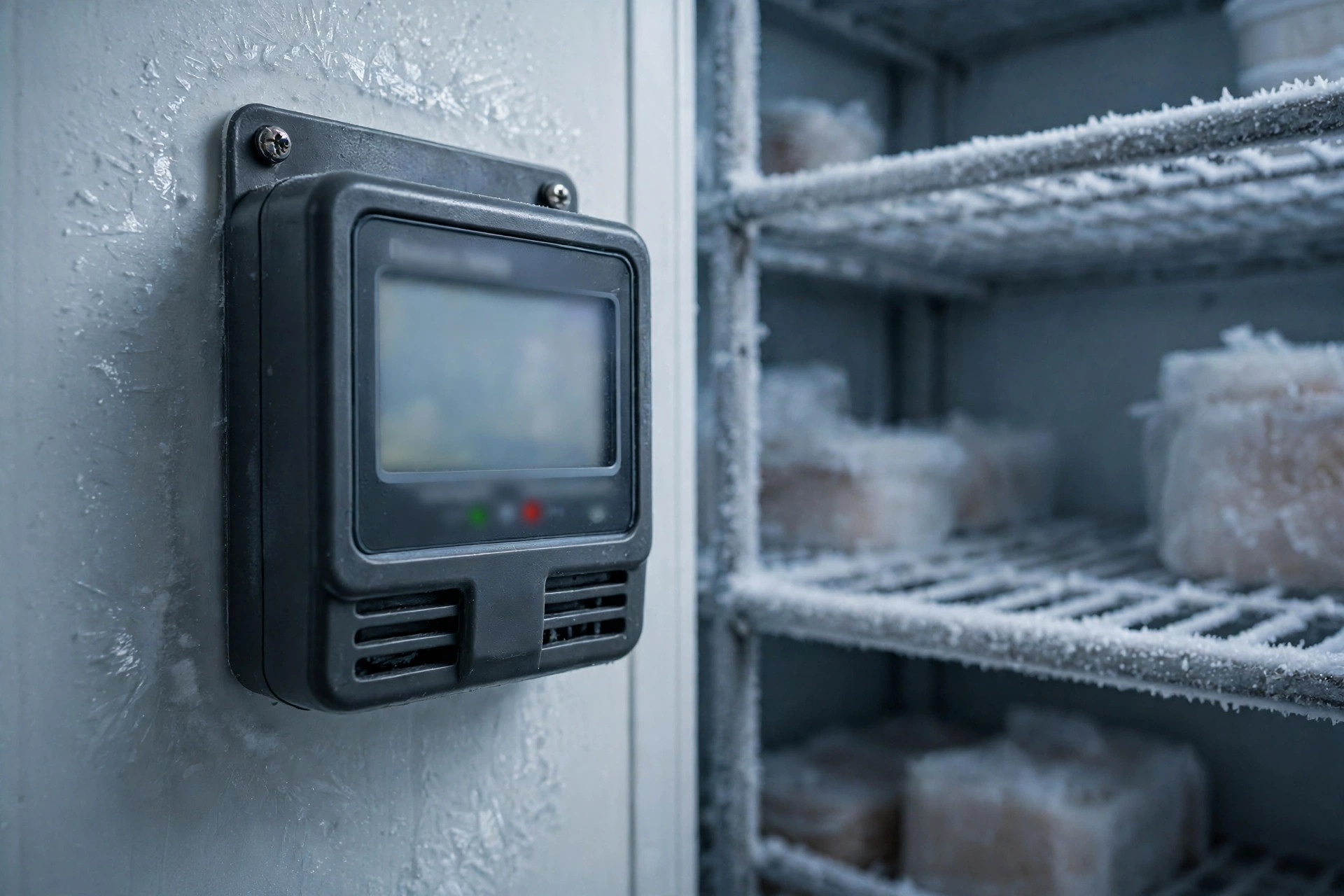
The temperature logger's trace is the single most important thing a cold storage manager looks at each day — more telling than any report. A healthy curve looks like a sawtooth: the door opens, temperature jumps; the door closes, the system pulls it back down. Hundreds of little teeth a day, flat overall — that's normal door work. An unhealthy curve climbs in steps: each recovery starts higher than the last, the roots of the teeth marching upward. That means the system can't keep up — more heat is entering than the compressors can remove. Ignore that pattern and the sawtooth becomes a ramp, and eventually product temperatures get dragged along with it.
Where's the red line? The FDA Food Code is explicit: refrigerated perishables must be held at or below 41°F (5°C), and FDA recommends 0°F (-18°C) for frozen. Note that's a product-temperature line, not an air-temperature line — product has thermal mass and buys you time, since it takes a while for air swings to reach the center of a pallet. So the real danger was never "the air warmed three degrees." It's loss of control: doors open too long or too often, recovery after closing takes longer each time, every bounce-back slower than the last. That's your signal to stop work and shut the door until the room pulls back down.
When it reaches that point, don't panic — work the sequence. Stop all inbound and outbound moves and get the door fully shut; let the system recover instead of bailing water from a leaking boat. Then verify three things: the refrigeration is genuinely running right, the defrost schedule hasn't gone haywire, and the curtain or strips at the door are intact. An embarrassing share of "temperature emergencies" turn out to be a door propped open by a pallet or a tripped curtain breaker nobody noticed. Then check the logs — which lots were exposed, and for how long. Pull product near the doorway for center-temperature probing; anything over the line gets quarantined and dispositioned under your SOP, no sentimentality. And finally, write the incident down and find the root cause: scattered scheduling, broken door hardware nobody fixed, or peak-season volume beyond what the system was sized for. Log it once, and you'll panic less the next time.
Door work is a genuine trade-off: throughput wants the door open early and often, compliance wants it shut. You can't have both for free — you buy the difference with discipline and equipment. The best-run freezer I know, the manager's first move every morning isn't opening a report. It's pulling up yesterday's temperature curve next to the door-cycle log: how many openings, how long each one, what the curve looked like. Line those three up, and problems have nowhere to hide.
So here's my challenge for you: tomorrow, hand someone a clicker — or just a sheet of paper — and count your freezer door's openings and durations for one full day. That evening, lay those numbers next to the temperature log. Most people are shocked the first time they do the math. And once you've been shocked, the door gets a lot easier to manage.