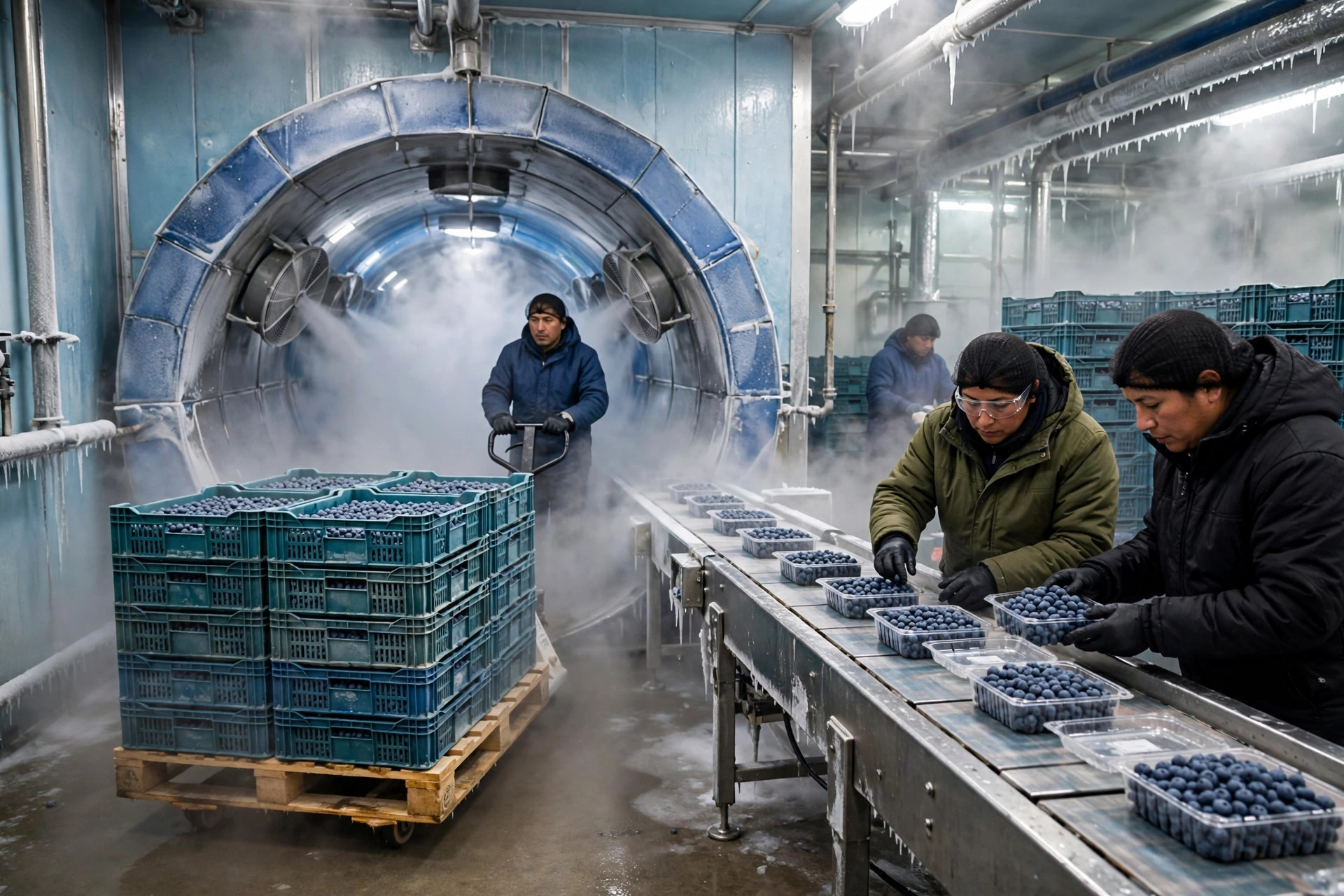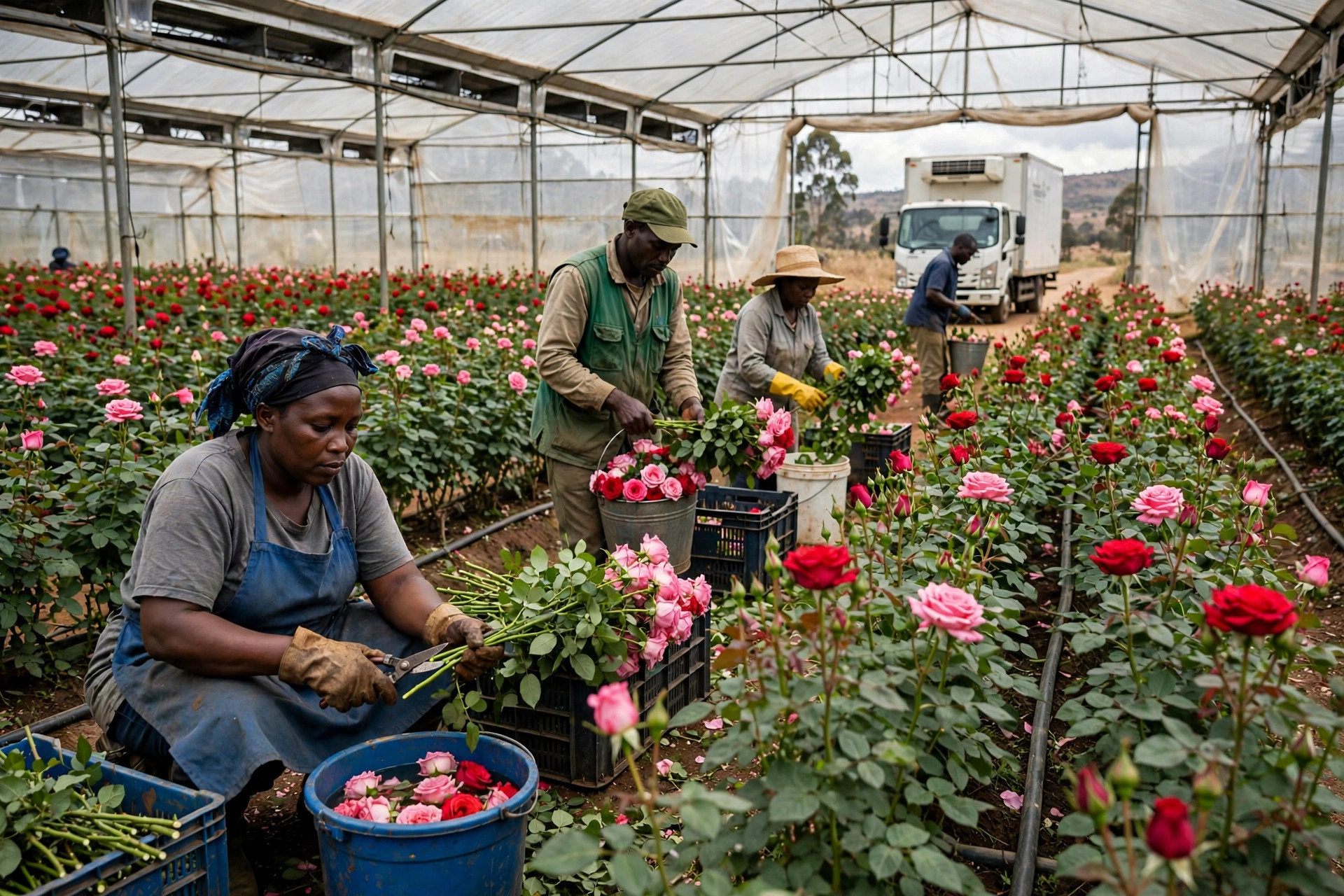
To understand Kenya's flower export cold chain, start with a number. In May 2026, Kenya's Plant Health Inspectorate Service (KEPHIS) stated that the country holds approximately 38 percent of the European Union's cut-rose market (cited via the International Association of Horticultural Producers, AIPH). Behind that number sits an extraordinarily fragile supply chain: nearly every stem is cut in a greenhouse near the equator and put on a Europe-bound freighter within 48 hours. Contrast this with Peruvian blueberries, a topic covered in an earlier piece — blueberries travel at 0°C, mostly by sea. Roses target 1–3°C, fly by air, and the real bottleneck is not in the sky. It is on the ground.
Consider what happened in March 2025. During the state visit of King Willem-Alexander of the Netherlands to Kenya, a refrigerated container full of cut flowers departed the Naivasha Inland Container Depot, traveled by Standard Gauge Railway (SGR), arrived at the port of Mombasa the same day, and sailed for Rotterdam. It was Kenya's first end-to-end "rail plus sea" cold-chain flower trial. The partner list was long: grower Nini Flowers, Dutch Flower Group, Maersk, Kenya Railways Corporation, Kenya Ports Authority, and project coordinator Flying Swans. The question worth asking: why now, and why rail?
The First Ledger of Kenya's Rose Export Cold Chain: Field Pre-Cooling
According to technical material from cold-chain equipment supplier InspiraFarms, drawn from its measured project at a farm in Timau, Kenya, the flower cold chain starts in the field. After harvest, stems pass through a receiving cold room that pulls field heat down to +5°C quickly; after grading, they are cooled further to +1°C before being boxed for export. For most exporters, the window from picking to arrival at Nairobi's Jomo Kenyatta International Airport (JKIA) is 24 to 48 hours. After grading and packing, the ideal control band for the entire journey is 1–3°C, with the transport leg typically held at 2–5°C.
A distinction many get wrong: the temperature of the cold room is not the temperature of the flower. A room reading 2°C does not mean the core of a freshly arrived pallet of roses is 2°C. Vacuum pre-cooling can bring flower tissue to target temperature in 15 to 60 minutes; conventional room cooling can take a full day — and during that day, the flower's "temperature ledger" keeps accumulating. The first ledger of the cold chain, in other words, is not "is the room cold enough" but "how fast does the flower itself reach target temperature."
The Temperature Ledger of Kenya's Flower Export Cold Chain: the 500-Degree-Hour Rule
The cut-flower industry widely references a standard originating from FlowerWatch: one degree-hour equals flower tissue deviating from its target cold-chain temperature by 1°C for one hour; 500 accumulated degree-hours cost one full day of vase life. InspiraFarms, writing for growers, compresses this into a punchier line — "every hour away from target temperature costs a day of vase life." Strictly speaking, that is a vendor's simplification; the rigorous version is the degree-hour accumulation above. Either way, the conclusion is identical: temperature multiplied by time, billed by the minute.
A quick calculation shows how tight this chain is. Suppose a batch takes five days (120 hours) from harvest to retail, but a poorly managed leg means the flowers actually travel at 7°C instead of 2°C: (7−2)×120 = 600 degree-hours — more than a day of vase life gone. The wholesaler sees flowers that look fine; the consumer watches them wilt two days after purchase. What is lost is not this order, but the repeat purchase.
Split the journey into four legs and the temperature ledger looks like this:
| Leg | Typical duration | Target | Main risk |
|---|---|---|---|
| Field → pre-cooling | Within hours of harvest | Rapid pull-down to 1–3°C | Delayed pre-cooling, field heat trapped |
| Pre-cooling → grading & packing | Hours | 1–3°C | Grading hall doors cycling, temperature swings |
| Naivasha → JKIA by road | Hours | 2–5°C (reefer truck) | Traffic, refrigeration failure |
| Airport handling → loading | Hours | 2–5°C | Tarmac sun exposure, flight delays |
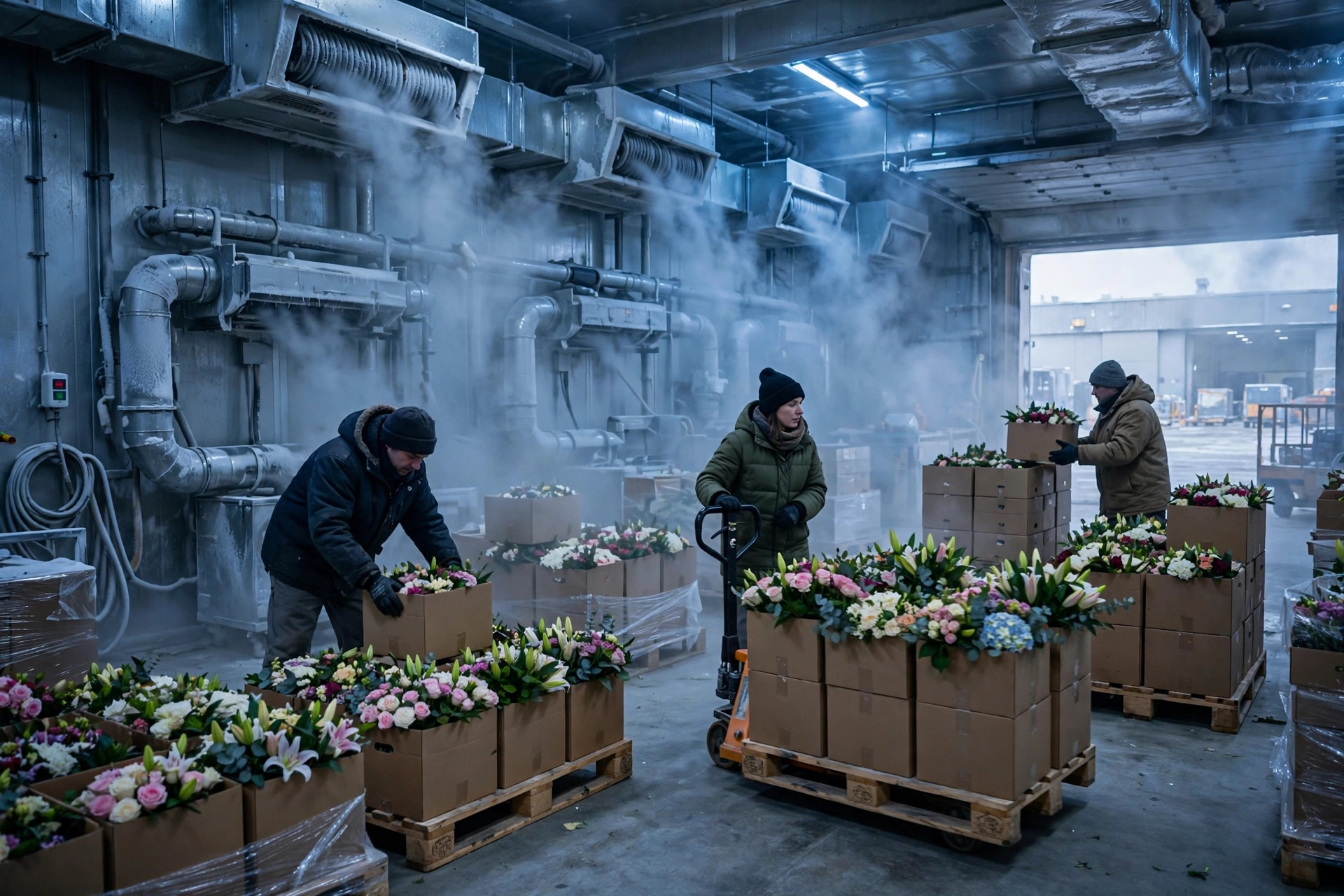
Note legs three and four. Most people assume long-haul transport is the enemy of the cold chain; the most dangerous moments are actually the breaks — the stretch after the reefer truck unloads at the airport and the flower boxes wait on the tarmac for loading. A Delft University of Technology study modeled a typical flow: the farm leg accumulated roughly 55.5 degree-hours, while the airport freight-handling leg (about 18 hours at 5°C) accumulated 90 degree-hours. The "temperature tax" of ground handling outweighs the farm leg. That is the counterintuitive finding: the most fragile link in the rose cold chain is not the aircraft hold but the hours the flowers spend waiting on the ground before boarding.
The Time Ledger: Air, Sea, or Rail Plus Sea?
Kenyan flowers have long depended on air freight for one reason: speed. Stems cut near Lake Naivasha can appear in Amsterdam's auction halls within days. But air freight is expensive and increasingly contested on carbon grounds. The sea-freight ledger tells a different story. In 2021, Kenya shipped only about two containers of flowers by sea per week; by late 2023, that number had risen to 25 per week, according to Kenyan floriculture media. A single sea reefer can hold 320,000 to 400,000 roses (per Floraldaily's trial reporting) — meaningful scale economics.
Sea freight has one precondition: the route must be reliable. During the Red Sea disruptions, rerouting around the Cape of Good Hope stretched transit to Europe to 40–50 days — catastrophic for flowers. Maersk later introduced a feeder service running Salalah → Jeddah → Tangier → Europe, clawing back part of that time. Even so, sea freight demands far stricter cold-chain discipline than air: the longer the journey, the more room for degree-hours to accumulate, and any single lapse gets amplified.
That is the context of the March 2025 rail trial. It was never about replacing air freight; it was about proving a second route viable. Load at the Naivasha inland depot, same-day SGR arrival in Mombasa, sail to Rotterdam — refrigerated end to end. If this corridor scales, Kenya's rose logistics cost structure gets rewritten: sea freight costs a fraction of air, emits far less carbon, and aligns with European buyers' tightening sustainable-sourcing requirements.
Attribution: Where the Unbroken Chain Actually Breaks
Put the data together and the attribution becomes clear.
First, the bottleneck sits in the first-mile and last-mile ground legs, not in the sky. Get pre-cooling right and sea freight becomes viable; get it wrong and air freight cannot save you — because the temperature ledger starts accumulating at the moment of harvest, not at the moment you buy the air waybill.
Second, Africa's cold-chain infrastructure is catching up, but it is catching up as a system, not as isolated projects. The Timau farm case shows the growing end investing in turnkey pre-cooling (dual receiving/dispatch cold rooms with real-time temperature monitoring); the SGR trial patches the trunk leg. Airport ground handling remains the darkest stretch of data — the fewest temperature loggers, the most fragmented accountability.
Third, the standard exists; execution lags. The 500-degree-hour rule is written down clearly, yet how many exporters deploy loggers end to end and settle quality claims on degree-hours? Most still rely on experience and on flowers that "look fresh." The gap between standard and execution is the chain's largest hidden cost.
Outlook: What Happens When the Second Route Works
A few timeline-bound judgments follow from the data:
Near term (1–2 years): rail plus sea will first take price-sensitive orders with looser vase-life requirements — supermarket roses, for example — while top-grade auction flowers (zero tolerance on quality) stay on air. Two chains coexist; one does not replace the other.
Medium term (3–5 years): if cold-chain data truly connects — from field temperature loggers to in-transit container monitoring — confidence in sea-freight quality will rise, and air's share may retreat from today's near-monopoly to a "premium plus urgent" role. That would reshape cargo economics at JKIA: the airport's flower handling zone may need to reprice itself for freight that is scarcer but more valuable.
Long term: Kenya has already put market diversification on its agenda — KEPHIS explicitly names Asia, Australia, and the Middle East. Once sea freight works, the geographic arbitrage available to Kenyan roses widens: markets unreachable in the air-freight era may become reachable in the sea-freight era.
One open question to close with: if, one day, a Naivasha rose travels by rail and sea and arrives at a Middle Eastern supermarket more than a month later with no perceptible difference in vase life from its air-flown counterpart, does the industry consensus "air equals fresh" still hold? When the transport mode no longer determines quality, all that determines quality is cold-chain management itself — which is precisely the lesson Kenya is now studying hardest.
By Dr. Chen, Supply Chain Researcher