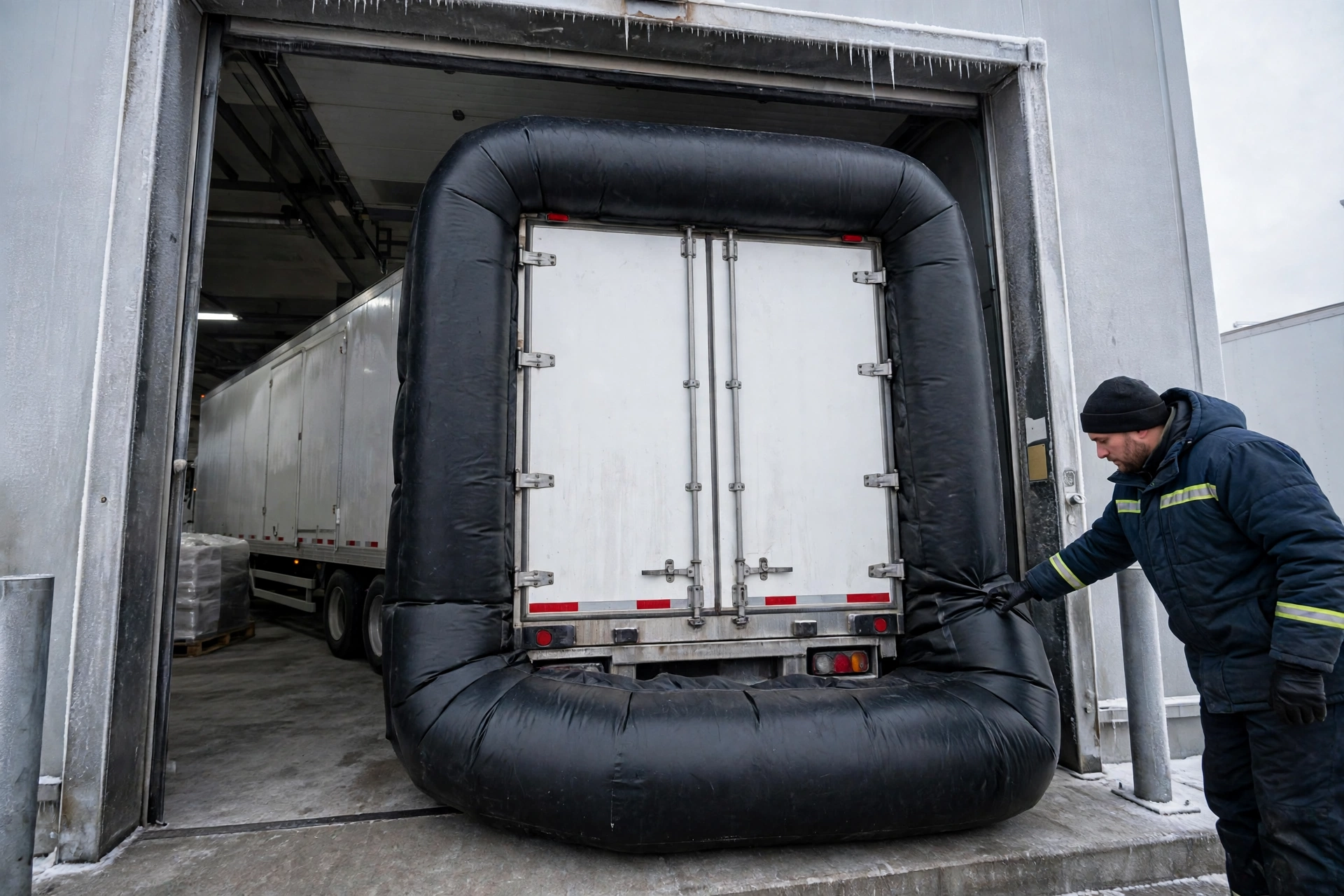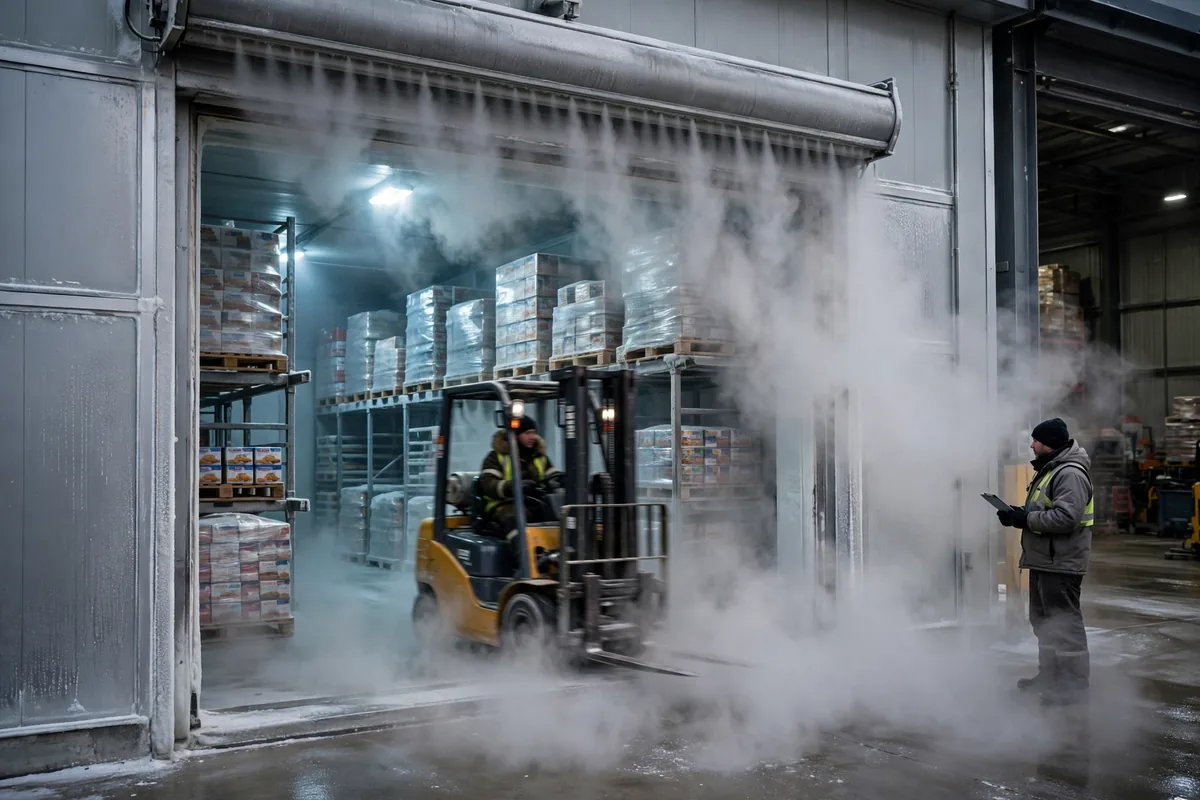
The hardest season for a cold-storage dock door is not winter. It is summer. That is where loading dock seals earn their keep — or fail.
A refrigerated trailer backs in, sub-zero inside, thirty-plus degrees and humid outside. Warm moist air slips through the gap around the door, hits a cold surface, and turns to frost and condensation. If the seal does not sit tight, frost builds until the door will not close properly. It is like a refrigerator door gasket gone bad — except this refrigerator is 8,000 square meters and dozens of trucks use the door every day.
Loading dock seals are a different craft at a cold-storage dock. In an ambient warehouse a seal blocks wind, dust, and rain. In cold storage it has to stay flexible and keep contact below freezing, without icing up or leaking cold. The selection logic is different. Apply the ambient playbook to a freezer dock and it will fail.
How a Seal Fails in the Cold: The Physics First
Three enemies attack a cold-storage seal, all at once.
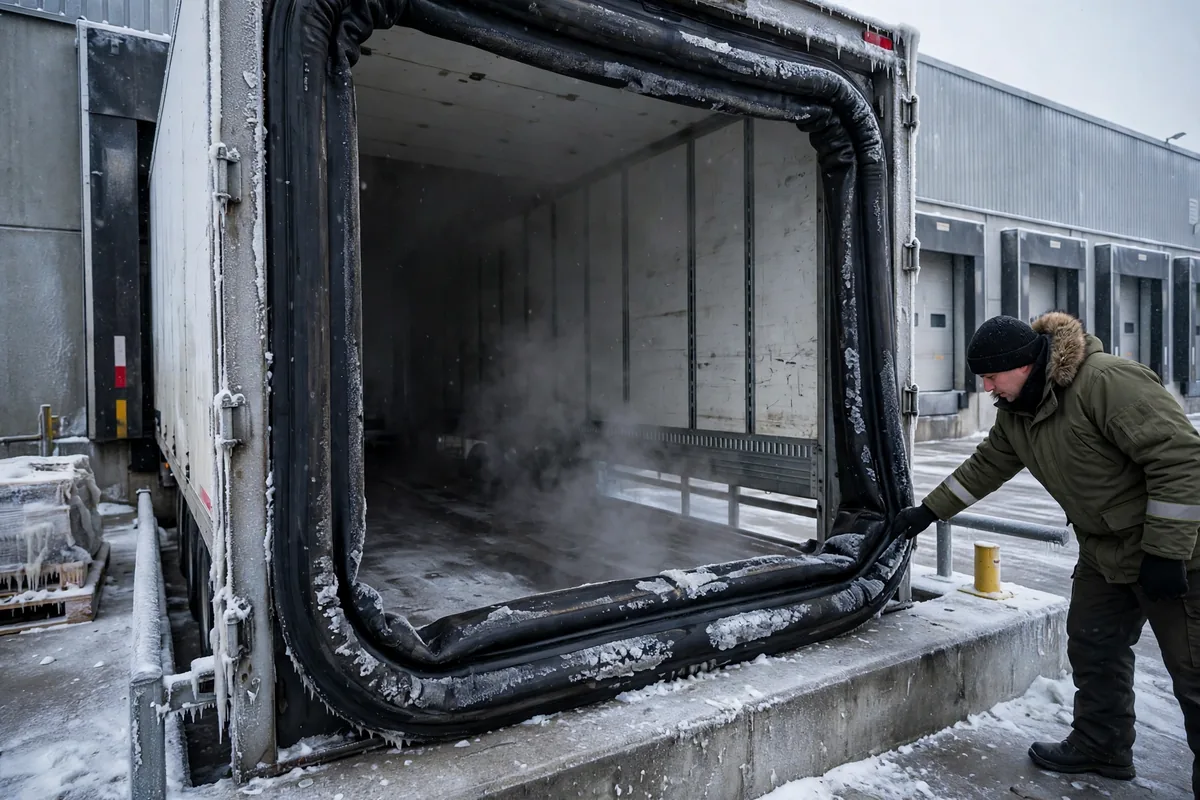
The first is frost. Warm humid air reaches a metal door frame below freezing, and moisture turns straight into frost. Frost itself is not the problem — frost growing on the sealing contact face is. The seal presses onto a layer of ice crystals, contact breaks, more moisture enters through the gap, and the frost grows thicker. It is a feedback loop: ignore it for a few days and the seal is jacked open by its own frost.
The second is condensation. With a big temperature gap between trailer and dock, any seal surface below the air's dew point weeps water. The water runs down, freezes on the floor, and forklifts start slipping. Worse, water soaks into foam seals from the inside; wet foam loses insulation value, then freezes hard and cracks in winter.
The third is material stiffening. Ordinary rubber and foam harden below freezing and lose rebound. You can think of it as a rubber band left in a freezer: press it at room temperature and it springs back; press it frozen and it keeps the dent. A dock seal's whole job is rebound — pressing itself against the trailer side. Lose the rebound and you lose the seal. Cold-rated seal materials use a different low-temperature formulation from the start.
Of the three, frost is the most underestimated. I have seen a cold-chain warehouse replace its seals three times for a cold leak, only to find the real fault was a dead heater above the dock door: the frame temperature had dropped below freezing, frost started on the frame, and no seal could seat against it. Before replacing a seal, measure the frame temperature.
The Selection Lines: Which Loading Dock Seal Survives Sub-Zero
No single design of loading dock seals fits every cold store. Selection starts with three dividing lines.
First line: storage temperature. A chilled store above zero can get by with a standard seal plus moisture protection. A frozen store around minus 18 degrees needs cold-rated material plus a heated seal strip. The heater is simple and blunt: it keeps the contact face just above freezing so frost cannot form. You can think of it as a car's heated side mirror — not for warmth, but to deny moisture a surface to condense on. The wattage does not need to be high; what matters is even heat and no power interruptions. Lose power for one night and the seal wears a coat of frost by morning.
Second line: how mixed the fleet is. The more trailer sizes, heights, and tail-lift designs vary, the less a rigid fixed seal works. Inflatable seals win here: they inflate to conform to different widths and heights, then deflate out of the way. A dock with one uniform trailer type can use high-rebound foam seals — cheaper and easy to maintain. Forcing fixed foam onto a mixed fleet is like using one key for ten locks.
Third line: traffic frequency. A dock with dozens of trailers a day treats seals as consumables and should pay for a wear-resistant face. A low-frequency dock can spend on insulation performance instead; a high-frequency dock should spend on wear resistance and easy replacement. A replaceable seal face is far cheaper than replacing the whole seal assembly — the maintenance traps are below.
For the general comparison — seals versus shelters, which suits which truck — the dock seals vs dock shelters selection guide covers it thoroughly. That guide is the ambient, general-purpose selection logic. This piece covers only the three extra problems the cold adds: frost, condensation, and stiffening materials. That is the division of labor between the two.
One piece of pseudo-demand to shoot down: hanging thick insulation curtains at a freezer dock as if one more layer buys one more unit of protection. A curtain blocks people, not moisture — a forklift lifts it, moisture walks in, and the curtain itself absorbs moisture and ices up, becoming a new frost surface. Money spent on heated seals and frame insulation beats money spent on curtains.
Loading Dock Seal Maintenance Traps: A Seal Is a Consumable, Not a Fixture
The biggest trap is treating a seal as a fit-and-forget fixture. It is a consumable, and consumables need a replacement rhythm.
Trap one: waiting for a cold leak before replacing. Seal rebound fades gradually; by the time you can see it, cold has been leaking for months. The right routine is to measure: squeeze-test rebound monthly, log frame temperature, keep a record. Replace when rebound is clearly degraded — do not wait for a visible gap.
Trap two: fitting heaters and never checking them. Heater strips fail most often at joints and thermostats — a damp joint, a dead thermostat, and the strip either stays cold or overheats and cooks the seal. Take an illustrative scenario: a 12-dock cold store with two heater circuits failed and unnoticed could spend a peak season's worth of frost-driven seal replacements and extra refrigeration load that would have bought several heater strips outright. The figure is an illustrative estimate, not a measured case — the point is real: heaters belong on the monthly inspection sheet, not on a fit-and-forget list.
Trap three: cleaning with the wrong method. Blasting a seal with a pressure washer feels thorough. Water soaks into the foam, freezes in winter, and cracks it from the inside. Wipe seals dry, defrost with warm air, and keep the pressure washer away.
Trap four: ignoring collision damage. A tail lift or trailer corner nicks the seal, and the nick becomes a moisture channel. I will not give you a universal "one nick leaks this much energy per year" number, because it depends on storage temperature, humidity, and traffic frequency. Do not trust any article that quotes one. Trust your frame temperature and your electricity meter.
Whether the Money Was Worth It: Watch One Number
The loading dock seals question in cold storage comes down to one number: the temperature of the frame contact face.
Heated strips, materials, seal types — set the selection arguments aside for a moment. Measure the frame and seal contact temperature before every shift. Hold it steadily above freezing and the seal is doing its job; drop below freezing and even the most expensive seal is wasted. A thermometer is more honest than a quote.
My suggestion: give every cold-storage dock an infrared thermometer, measure daily, log weekly. Once the temperature holds, then talk about which seal to buy. If it does not hold, fix the heating and frame insulation first. Do not get the order backwards.
By Da Liu, Automation Engineer