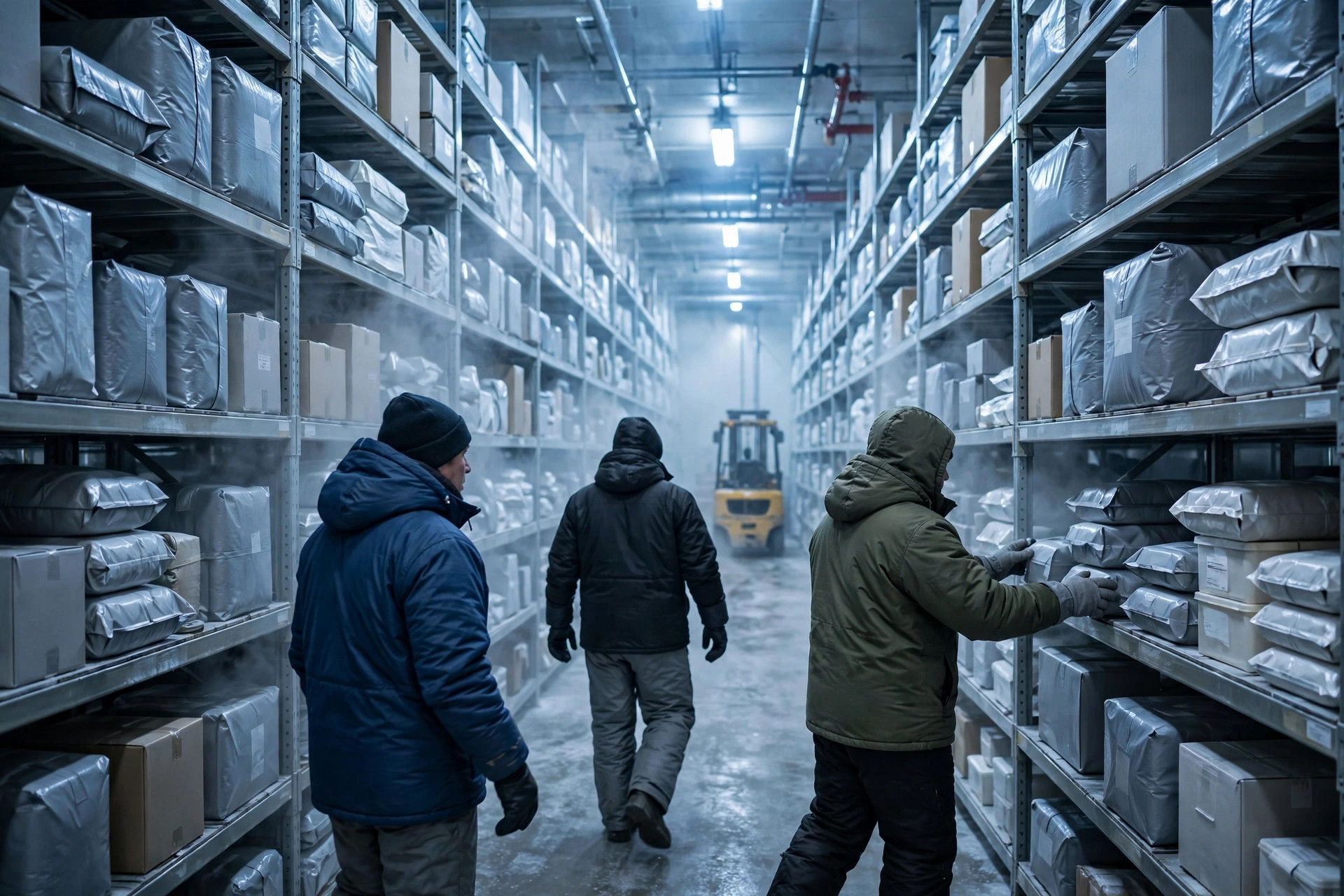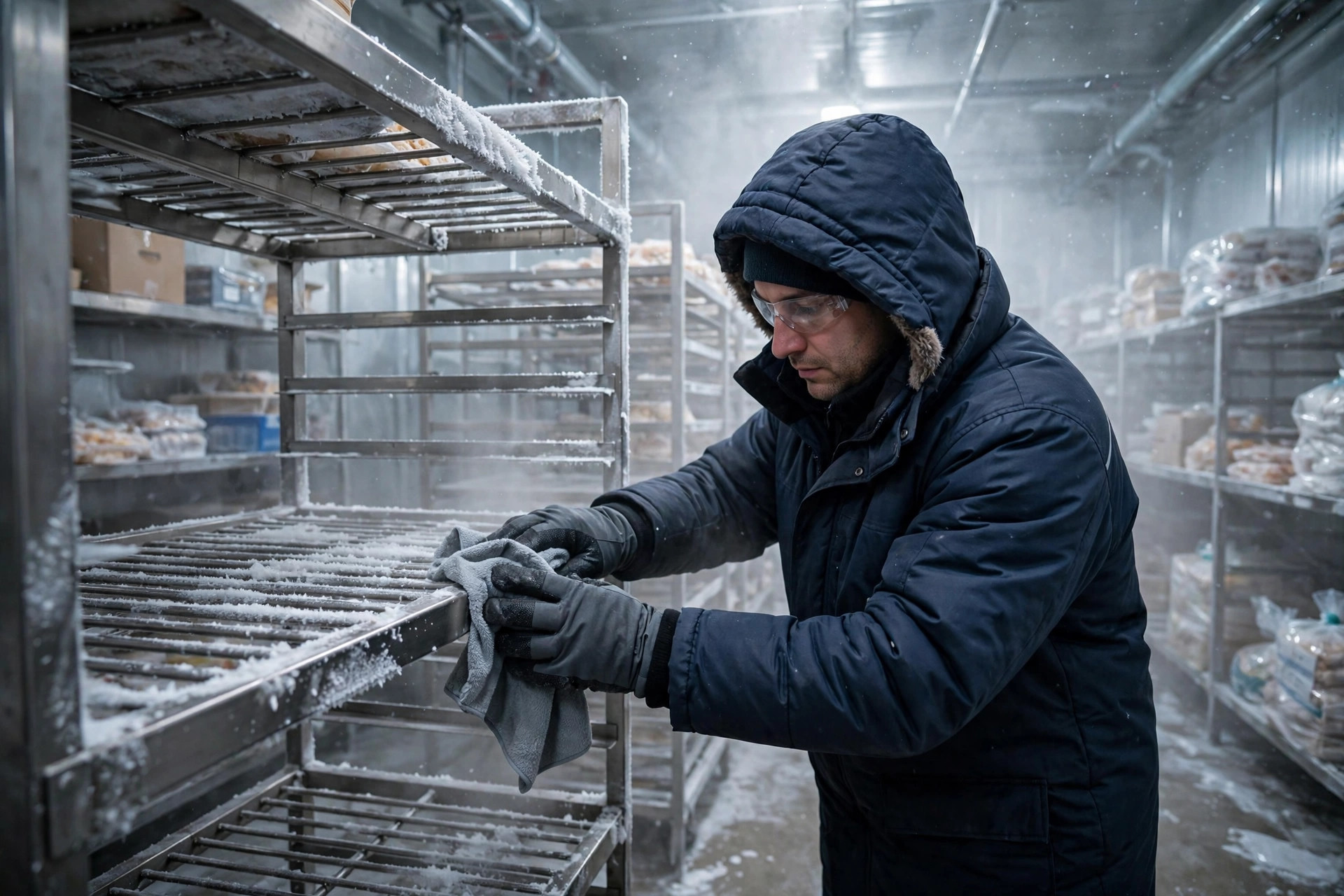
Conclusion first: cold storage cleaning sanitation food warehouse work is not about how shiny the floor looks. It is about three things — a schedule that actually holds, a sanitizer that still works in the cold, and a way to clean without shutting the whole warehouse down. Miss any one of the three, and you are mostly moving dirt around.
I have seen this pitfall three times. A frozen-food warehouse in Hangzhou in November 2024 kept its rooms at -18°C year-round. The manager told me, “It is too cold for bacteria to live.” We pulled a fan cover off and found a dark layer of dust and frost on the blades, and a slimy film on the back of the door curtain. Swab results told the real story. Cold slows bacteria down. It does not stop them. The places nobody touches — fan outlets, curtain backs, pallet bottoms, rack joints — keep collecting residue until an inspection finds it.
A lot of warehouses treat cleaning as a monthly deep clean. The floor gets swept, the racks get wiped, and everyone feels good. Then an inspector swabs a seam, the count comes back high, and a whole batch has to be quarantined for re-checking. That one event costs more than a year of cleaning labor.
Cold Storage Cleaning Sanitation: How to Schedule Without a Shutdown
The trick to cleaning without a shutdown is to split the warehouse into two kinds of zones. Aisles, staging areas, and picking zones can be rotated out of service. Refrigeration units, fans, and main travel lanes cannot. So you clean in rotation: Zone A today, Zone B tomorrow. Move the product to the neighboring zone, clean, let it dry, move it back. The warehouse always has somewhere to put product, so you never need a full stop.
Here is the frequency I usually start with. Adjust it to your product type and inspection requirements:
| Area | Frequency | Method | | Floors, aisles, staging tables | End of every shift | Remove debris, wash, squeegee, air-dry | | Pallets, totes, rack contact surfaces | 1 to 2 times per week | Wash, then sanitize, dry before reloading | | Door curtains, frames, gaskets | Once per week | Remove, wash, brush the seams | | Fan outlets and returns | Once per month | Stop the fan, remove dust, sanitize | | Walls, ceilings, light covers | Once per month | Dust high surfaces first, then wipe | | Drains and floor gutters | Once per week | Clear sludge, flush, sanitize, do not just replace the cover |
The schedule has to live in the shift plan, not on a poster. I have seen too many warehouses where cleaning is written on the wall and executed “when there is time,” which means it gets skipped when it is busy. My rule is simple: cleaning goes into the shift checklist. Who cleaned, when, which area, which sanitizer — photo plus signature. Inspectors do not care what your poster says. They care whether the log matches reality.
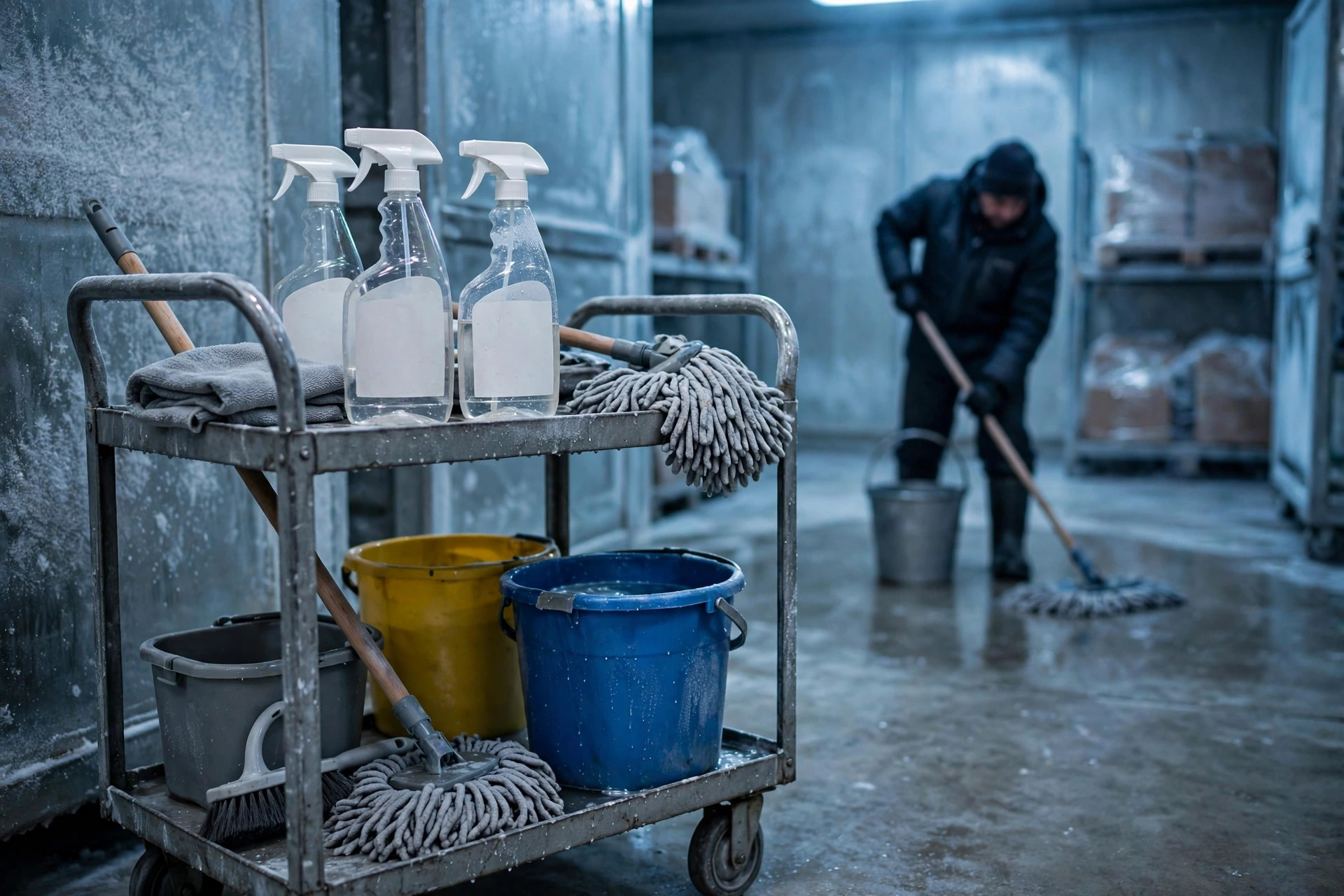
In February 2023, an imported-seafood cold store in Shanghai washed its floor every day. It looked spotless. The problem was the drain. The gutter had been collecting ice fragments and bloody water for months. The cleaner kept putting the cover back without ever brushing inside. One day the drain backed up, water spread into the aisle, and a forklift splashed it onto the bottom pallets. More than a dozen pallets had to be isolated. After that, the drain went onto the weekly must-clean list, each cover numbered, each cleaning photographed. No repeat since.
Cold Storage Cleaning Sanitation Food Warehouse: How to Pick a Sanitizer That Works in the Cold
This is where most programs quietly fail. Many sanitizer labels are written for room temperature. Drop below freezing and the kill rate slows down sharply. Some products basically stop working. If you mix at the room-temperature concentration and spray it in a cold room, you are mostly spraying water.
Before you pick a product, ask three questions. First, does it have tested data at low temperature, and does the label state a low-temperature use range? Second, what is the residue risk for your product — for food-contact surfaces like racks and totes, can you use a chlorine-based product, and does it need a rinse after? Third, is it compatible with your materials? Some sanitizers are fine on stainless steel but chew up aluminum or rubber gaskets. Use them long enough and the door seal cracks.
My advice is to stop relying on a single sanitizer for the whole warehouse. Use one product for floors and drains, another for food-contact surfaces. Store them separately, label them clearly, and write down the dilution, contact time, and expiration for each batch. Do not eyeball the mix. A solution mixed yesterday and left sitting has lost strength. Spraying it is theater.
And never sanitize a dirty surface. If there is still a layer of grease, blood, or frost, the sanitizer cannot reach the bacteria. The order is fixed: clean, rinse, sanitize, dry. Skip a step and the rest does not count.
Here is the counterintuitive part: the dirtiest spots in a cold store are rarely the floor. They are the places people assume are clean because they are cold. Fan outlets blow whatever is on the blades straight onto product. The back of a door curtain feels slimy because it is biofilm, and a quick rinse will not remove it. Pallet bottoms sit against damp floors and collect residue. If those spots are not on your list, a shiny floor means nothing.
Cleaning Without a Shutdown: Sequence and the Pre-Flight Checklist
The sequence I hand to clients looks like this:
- Notify one shift ahead. Clear the zone to be cleaned. While moving product, check for damaged packaging and leaks.
- Remove debris, frost, and dust first. Do not hose it straight into the drain or you will clog it.
- Wash, rinse, squeegee. Do not leave standing water. Overnight it freezes, and the next morning you have a slip hazard.
- Mix sanitizer per the label, spray, and leave the full contact time. Short contact time equals no sanitizing.
- Dry before reloading. Product placed on a wet floor gets damp cartons and peeling labels, and that creates a second round of problems.
- Photo, log, sign. Record the zone, time, person, product, and concentration.
On my pre-launch checklist, I always add three lines: was the drain cleaned today, was the sanitizer mixed fresh or left over from yesterday, were the fans and curtains cleaned this week. Miss any one of those and an inspector will probably find it.
There is a trade-off worth naming. More frequent cleaning costs more labor and more rotation effort. But the cost of a failed inspection or a quarantined batch is higher. Do the math once: what does two extra cleanings a month cost in labor, versus what does one day of stopped shipping plus an isolated batch cost? Most warehouses find the extra cleaning is the cheaper insurance. Cleaning is not a cost center. It is insurance.
If you only do one thing after reading this, go touch the back of a door curtain and the inside of a fan outlet. If it feels slimy or smells off, your list is missing the critical zones. Add those two spots, fix the frequency, and keep the log honest. That is when cold storage cleaning sanitation actually closes the loop.
By Lin Xiao, WMS Implementation Consultant