Let me start with something that will annoy a few people: when executives ask me how long ASRS installation takes, eight out of ten are asking the wrong question. What they really want to know is "when does this pile of steel start making me money"—but "installed" and "making money" are separated by software integration, acceptance testing, and a production ramp-up. Sign-to-first-crane-move and sign-to-full-rate can be two completely different numbers.
Think of an ASRS project like renovating a house. Dropping in a few off-the-shelf bookshelves is not the same job as knocking out load-bearing walls and redoing the plumbing. The answers out there range from "3 months" to "2 years" because people are describing different machines. Get the machine type straight first, then talk schedule.
How Long Does ASRS Installation Take? Start With What You're Buying
The principle first: total project time equals the longest of three legs—equipment manufacturing, site installation, and software integration—plus the serial parts. Three mainstream configurations, and the timelines differ by an order of magnitude:
| System type | Sign to go-live | Where the bottleneck sits |
|---|---|---|
| Shuttle / 4-way shuttle subsystem | 3–6 months | Relatively standardized hardware; software integration eats the biggest share. Industry rule of thumb: 3–6 months from site survey to commissioning |
| Mini-load tote system | 6–12 months | Racking, cranes, and conveyors run in parallel; civil-works handover is the critical path |
| Heavy unit-load ASRS | 12–24 months | Stacker cranes are custom-built with a long manufacturing lead time; large pallet automation projects average 12–24 months end to end |
(Sources: 3–6 months for shuttle systems—SSTC Storage's project methodology; 12–24 months for pallet ASRS—Bastian Solutions via MHI.)
Now let me fire at a fake requirement I hear constantly: people read "18-month payback" on a sales deck and hear "18 months to install." Correction. Small, simple ASRS projects pay back in around 18 months; large complex ones take three years or more (the industry figures cited by Supply Chain 24/7). Payback assumes on-time go-live—slip three months and the whole ROI model goes in the trash.
The Six-Phase ASRS Installation Timeline, Priced Honestly
I break a standard project into six phases. Take these ranges and hold your integrator to them:
- Requirements freeze and simulation (4–8 weeks): SKU profiling, peak-rate simulation, seismic and fire parameters. This is the phase executives love to compress and the one you should never compress—every change after the freeze costs you two weeks of rework.
- Detailed design (6–12 weeks): CAD layout, structural FEA on the racking, electrical load planning. The crane vendor only locks rail parameters here. Can't be rushed.
- Manufacturing and shipping (12–20 weeks): A stacker crane is a custom machine, not a forklift—there is no "in stock." Add 4–6 weeks of ocean freight for overseas brands. This is the natural floor for heavy systems; yelling doesn't help and money barely does.
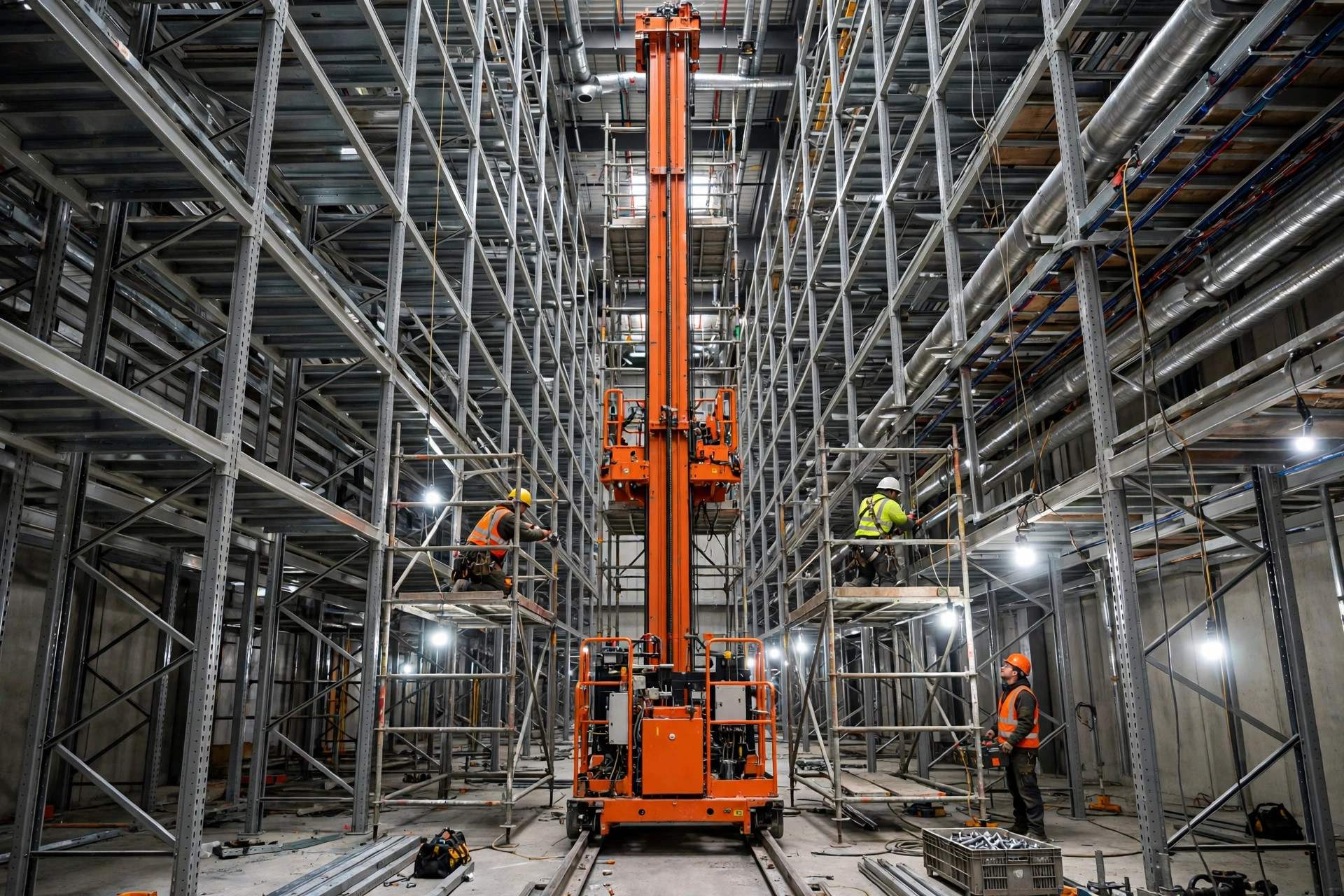
- Site installation (8–16 weeks): Racking goes up fast; rail alignment goes slow. Alignment tolerance is measured in millimeters—2 mm off and the crane faults at high speed.
- Software integration (6–12 weeks): WMS/WCS interfacing, stress testing, exception-flow drills. The most underestimated phase in the entire project. Owners always think "software, that's a few days"—naive. This is the deep water.
- Trial operation and ramp-up (4–8 weeks): SAT acceptance, operator training, capacity climbing from 50% to full rate. Nobody hits full rate on day one; cranes and people both need break-in.
Two scenes I've actually watched play out. In 2023, a cold-chain food plant in eastern China put in a shuttle subsystem: contract said 5 months, they went live in four and a half. They won because civil works handed over the floor slab two months early and software integration took only five weeks—zero rework. The counterexample: a big e-commerce DC in southern China, heavy unit-load system, 14 months contracted, 19 months actual. All five extra months died in fire-code approval—the sprinkler retrofit design for the high-bay racking went through three review rounds. The equipment was never one minute late. The owner's own supporting work was. Daifuku alone has delivered over 34,000 stacker cranes worldwide (their official figure), and this industry's biggest shared lesson is simple: there is no such thing as a three-month heavy ASRS install. Anyone who promises you one—walk away.
Three Traps That Blow Up the Schedule
Trap one: equipment arrives before civil works are done. The floor slab isn't flat enough, rail alignment gets reworked twice, a month evaporates. It's like building on a bad foundation—not slow, rework. You can think of it this way: ASRS is a millimeter game played on top of a centimeter habit. When the two don't meet, the site argues every day, and even winning the argument costs time.
Trap two: software integration never made it into the plan. The WMS counterpart never shows up, master data never gets cleaned, integration drags two months. I've watched the identical movie three times: hardware finished early, cranes sitting idle in the building for two months waiting on software. Integration is not "a few days"—put 6–12 weeks in the master schedule, in the contract, with consequences.
Trap three: fire and acceptance sign-off. High-bay fire ratings, sprinklers, and local approval procedures vary everywhere. One failed inspection means rework plus re-inspection—figure 4–6 weeks minimum. There is exactly one fix: get fire-code drawing review done during the design phase, not after the racking is standing.
Here's the contrarian read: the number-one killer of ASRS schedules is never late equipment. It's the owner's own civil works, software, and approvals not being ready. I've seen integrators run late, but seven or eight out of ten slips are the owner's side dropping the ball. So when you pick an integrator, don't stare at the 3% price gap—stare at whose project plan documents the civil handover, the integration window, and the approval lead items in the most detail. The detailed plan slips less. That's not mysticism; it's the experience of tens of thousands of cranes.
The Numbers to Watch Before Sign-Off
For SAT (site acceptance testing), don't just check "does it run." Watch three numbers: continuous fault-free operating hours, peak-rate attainment, and exception recovery time. MTBF (mean time between failures) belongs in the acceptance criteria—if it's not written down, it's theater. Ramp from 50% capacity and step up weekly. Steady beats heroic.
One calculation to close, and it's the only conclusion this piece needs. This money—worth it or not? Look at this one number: what does one month of delay actually burn? Monthly rent paid anyway, double staffing (the new system's crew on payroll, the old warehouse's crew you can't release), penalties on the old lease extension. Add it up and divide by the equipment price—if that number tops 5%, stop comparing bids on price and start comparing them on delay penalties. An integrator willing to put "this much per day late" in black and white is worth a 3% premium. And one who won't sign a penalty clause? Ask yourself how much confidence he has in his own schedule.
By Da Liu, Automation Engineer